

ISO 15874-2:2013 recognises four different polypropylene materials for hot and cold water pipe: PP-H, PP-B, PP-R and PP-RCT. Each one has its own reference strength curve, its own pressure-test requirement and its own design tables inside that standard. Only one of them is the material people mean when they say “PPR”.
That is the whole problem with the word. In plumbing supply, PPR stands for polypropylene random copolymer — ISO writes it PP-R — and on a technical datasheet it is precise. On an invoice it is not. “PPR” is a trade word, not a controlled designation, and nothing prevents a document from carrying it while the goods behind it are a different polypropylene entirely.
This article is about the commercial half of the term: what the word does and does not commit a supplier to, how to read the printed line on the pipe that tells you what you actually received, and what to write on a purchase order so the word becomes enforceable instead of decorative.
Key takeaways
- PPR = polypropylene random copolymer. ISO’s designation for it is PP-R.
- The word alone is not a specification. ISO 15874-2:2013 covers PP-H, PP-B, PP-R and PP-RCT as four separate materials with four separate design tables.
- The gap is measurable. At 95 °C for 1000 h, ISO requires PP-R to hold 3,5 MPa hoop stress and PP-B only 2,6 MPa.
- The pipe tells you itself. ISO 15874-2 Table 12 requires eight fields printed at least once per metre — including the material.
- Fix it in the contract. Name the material designation, the standard and dimension class, the pipe series, the resin grade and producer, and the melt flow rate with its test conditions.
On this page
- What PPR stands for — and why the answer is not a specification
- The four PP materials ISO recognises, and what separates them
- Reading the print legend on the pipe, field by field
- Wording that makes PPR enforceable on a purchase order
- The bottom line on what PPR means
- Checking what arrived against what you ordered
- Frequently asked questions

What PPR Stands For — and Why the Answer Is Not a Specification
PPR stands for polypropylene random copolymer. “Random” describes how the comonomer units are distributed along the polymer chain rather than grouped in blocks, and that distribution is what gives the material its combination of hot-water performance and weldability. ISO’s own designation, used throughout ISO 15874-2:2013, is PP-R with the hyphen.
That is the complete answer to the literal question, and for most readers it is where the topic ends. If you want the linguistic detail — why some suppliers write PP-R type 3, what PP-R 80 refers to, and how the material compares with PVC and PEX — that ground is covered in our companion piece on the PPR pipe full form and what it means.
For a buyer, though, the expansion of the acronym is not the useful part. Here is the useful part: no standard reserves the string “PPR” for any one material. ISO controls the designation PP-R. It does not control the marketing word. A supplier can print “PPR pipe” on a carton, write “PPR” on a commercial invoice, and title a quotation “PPR Pipes & Fittings” without any of those documents committing to a specific polypropylene.
Most of the time this is harmless, because most factories selling into the PP-R market genuinely make PP-R. The word is loose, not fraudulent. But loose language stops being harmless at exactly the moment it matters — a warranty claim, a rejected batch, a dispute over why a hot-water riser failed in year three — because the document you would have to rely on says a word that means several things.
The Four PP Materials ISO Recognises, and What Separates Them
ISO 15874-2:2013 is the part of the standard that governs the pipes themselves. It does not treat polypropylene as one substance. It carries four separate reference strength curves — Figures 1 to 4 — and four separate design tables, one per material.
The clearest way to see how far apart they sit is the pressure test in Table 10. This is the hydrostatic hoop stress a pipe must survive without bursting, at a stated temperature, for a stated period.
| Material | 20 °C / 1 h | 95 °C / 22 h | 95 °C / 1000 h | Reversion test temp. |
|---|---|---|---|---|
| PP-H (homopolymer) | 21,0 MPa | 5,1 MPa | 3,6 MPa | 150 °C |
| PP-B (block copolymer) | 16,0 MPa | 3,5 MPa | 2,6 MPa | 150 °C |
| PP-R (random copolymer) | 16,0 MPa | 4,3 MPa | 3,5 MPa | 135 °C |
| PP-RCT | 15,0 MPa | 4,2 MPa | 3,8 MPa | 135 °C |
Source: ISO 15874-2:2013, Table 10 (resistance to internal pressure, ISO 1167-1/-2, water-in-water) and Table 11 (longitudinal reversion, Method B of ISO 2505).
Look at the 95 °C / 1000 h column, because that is the one that describes a hot-water system living its life. PP-R must hold 3,5 MPa. PP-B must hold 2,6 MPa — roughly a quarter less. Both are legitimate materials with legitimate uses, and PP-B is a perfectly good pipe for cold water and drainage. Neither of those facts helps you if you bought one believing you had the other.
The consequence shows up in the wall thickness you are allowed
The divergence is not academic. ISO turns it into a dimensioning rule through Scalc,max, the maximum pipe series permitted for a given application class and design pressure. A lower S value means a thicker wall for the same diameter.
| Material | Class 1 @ 10 bar | Class 2 @ 10 bar | Class 5 @ 10 bar |
|---|---|---|---|
| PP-H | 2,9 | 2,0 | 1,8 |
| PP-B | 1,7 | 1,2 | 1,2 |
| PP-R | 3,0 | 2,1 | 1,9 |
| PP-RCT | 3,6 | 3,4 | 2,9 |
Source: ISO 15874-2:2013, Tables 1–4, Scalc,max values, design pressure 10 bar. Values rounded to one decimal place in the standard.
At Class 2 and 10 bar, PP-R is allowed S 2,1 while PP-B is held to S 1,2. To do the same job at the same pressure, the block copolymer needs a substantially heavier wall. A supplier who quotes a PP-B pipe against a PP-R dimension table is offering something that does not meet the duty — and the invoice can still say “PPR” the whole time.
One more detail worth carrying into a negotiation: in ISO 15874-2 Table 5, the thin-wall series S 8, S 6,3 and S 4 carry a footnote restricting them to PP-RCT only. If someone offers you those series in ordinary PP-R, the offer is outside the standard.

Video: Unlocking the Competitive Edge — The Core Strengths of Premium PPR Products (IFAN ULTRA official channel).
Reading the Print Legend on the Pipe, Field by Field
The invoice can be vague. The pipe is harder to argue with, because ISO 15874-2 requires the pipe to describe itself. Clause 10.1 says marking details shall be printed or formed directly on the pipe not less than once per metre, in a colour that differs from the pipe body, at a size legible without magnification.
Clause 10.2 and Table 12 then set out the minimum required marking. There are eight aspects, and reading them left to right is the fastest grade check available to anyone standing next to a pallet.
About this decode: the fields and the examples below are taken from ISO 15874-2:2013 Table 12 itself — they are the standard’s own generic example, not a photograph or transcription of any particular manufacturer’s pipe. Real legends follow this field set but differ in order, spacing and optional extras. Compare against the pipe in front of you rather than assuming a match.
| # | Field required by ISO 15874-2 Table 12 | Standard’s example | What it tells a buyer |
|---|---|---|---|
| 1 | Number of the International Standard | ISO 15874 | Which rule book the pipe claims to follow. Absent, nothing else on the line is anchored. |
| 2 | Manufacturer’s name and/or trade mark | Name or code | Who is accountable. A code with no decodable owner is worth querying. |
| 3 | Nominal outside diameter and nominal wall thickness | 16 × 2,2 | The dimension you can verify with a caliper in ten seconds. |
| 4 | Pipe dimension class | A | Which dimension table applies. Class A is the metric series; B1 and B2 are built on copper sizes. |
| 5 | Material | PP-R | The field this whole article is about. PP-R, PP-B, PP-H or PP-RCT — not the word “PPR”. |
| 6 | Application class combined with operating pressure | Class 1/10 bar | The service duty the pipe is rated for — not a generic PN number in isolation. |
| 7 | Opacity, if declared by the manufacturer | opaque | Optional. Relevant where light ingress and algae growth matter. |
| 8 | Manufacturer’s information (traceability) | Production period + site code | The field that lets you tie a failure back to a batch. |

Field 8 deserves a closer look, because it is the one buyers skip. Table 12’s footnote is specific about what traceability means: the production period — year and month, in figures or in code — and, where the manufacturer produces at more than one site, a name or code for the production site. That is what turns “this batch is failing” into a claim someone can investigate.
Two practical readings follow from the eight fields. First, a legend that carries a standard number and a pressure class but no material designation has skipped the one field that distinguishes PP-R from PP-B — and it has skipped a mandatory field, which means the pipe is not marked to the standard it cites. Second, marking is required once per metre, so a legend appearing only near the coupling end, or only on the bundle label, is not conforming marking either.
Wording That Makes PPR Enforceable on a Purchase Order
Everything above leads to one practical question: if “PPR” is too loose to rely on, what do you write instead? The answer is to replace one word with a short block of fields, each of which a supplier either accepts or visibly declines.
The six elements below are drafting language built from ISO 15874-2 and from what a resin datasheet actually pins down. Treat this as suggested wording, not approved wording — it has not been confirmed with any specific supplier’s export desk, and every factory has its own contract conventions. Send it to your supplier as a proposal and see which lines come back edited; the edits are themselves informative.
| Element | Suggested contract wording | Why this line exists |
|---|---|---|
| Material designation | “Material shall be PP-R (polypropylene random copolymer) as designated in ISO 15874-2. PP-H, PP-B and PP-RCT are not acceptable substitutes.” | Closes the four-material gap explicitly instead of relying on the word PPR. |
| Standard and dimension class | “Pipe to ISO 15874-2, pipe dimension class A.” | Fixes which dimension table governs, so tolerances are not negotiable after the fact. |
| Series and duty | “Pipe series S 2,5. Application class and operating pressure to be marked on the pipe per Table 12.” | Ties the wall schedule to a named series rather than a PN label whose basis is unstated. |
| Resin grade and producer | “Compound: virgin PP-R pipe grade, producer and grade designation to be stated on the order confirmation and not changed without written approval.” | Converts “good raw material” into a named, checkable input. |
| Melt flow rate | “Resin MFR to be declared with test conditions (ISO 1133, 230 °C/2,16 kg); acceptance window to be agreed in writing before first production.” | An MFR without its test conditions is not a number. Stating conditions makes it comparable. |
| Marking | “Pipe to carry the full minimum marking of ISO 15874-2 Table 12, at least once per metre, including material designation and production period/site code.” | Makes the pipe self-documenting, so incoming inspection needs no paperwork to start. |
What a named resin grade actually pins down
The resin line is the one buyers most often think is unenforceable, so it is worth showing what a grade name commits. Borealis publishes a datasheet for RA130E, a pipe-grade material it describes as “a low melt flow rate, natural in colour, random polypropylene (PP-R)”. The published melt flow rate is 0,25 g/10 min at 230 °C/2,16 kg, tested to ISO 1133, alongside a tensile modulus of 850 MPa and a Charpy notched impact strength of 20 kJ/m² at 23 °C tested to ISO 179-1.
Note the datasheet’s own caveat: Borealis states these are typical values that “should not be used for specification work”. That is precisely why the order should name the grade and the producer rather than copy the numbers into a clause — you are pointing at a document the producer stands behind, not inventing a tolerance.
Those numbers are the point. Once a grade is named on the order confirmation, “PPR” stops being an adjective and becomes a material with a published datasheet that you or a third-party lab can test against. You do not need to specify Borealis specifically — plenty of qualified PP-R grades exist from other producers — you need the order to name whichever grade is being used.
This is also where a bit of commercial realism helps. Resin typically runs US$780–1,150 per ton and accounts for roughly 70–85% of the manufacturing cost of a PP-R pipe, which is precisely why the resin line is where cost pressure lands. A supplier under margin pressure has very little room to economise anywhere else.
That is not an accusation; it is the reason a grade clause is worth the ten minutes it takes to add. If you are matching wording to a specific size and pressure range, our PPR pipe specifications and standards guide lays out the dimension and class detail this clause block refers to, and the IFAN ULTRA product series pages show how a two-line PP-R range is structured in practice.
The Bottom Line on What PPR Means
PPR stands for polypropylene random copolymer, written PP-R in ISO 15874-2. That is the answer to the question, and it is the least useful thing to know about the word.
The risk is not that “PPR” means nothing — it is that it means something slightly different to a marketing department, a production planner and a standards committee, and the gap between those readings only becomes visible when a system fails and someone reaches for the paperwork. ISO’s own numbers show the size of the gap: a quarter less required hoop strength at 95 °C over 1000 hours between PP-B and PP-R, and a dimensioning rule that would force a materially thicker wall to do the same job.
So use the word in conversation and retire it from your documents. Name the material designation, the standard, the dimension class, the series, and the resin grade with its melt flow rate and test conditions. It takes one extra paragraph on a purchase order — and it is the difference between a specification and a hope. What remains is the other half of the job: checking that the goods which turn up match the paragraph you wrote.
Checking What Arrived Against What You Ordered
Contract wording only pays off if someone checks the goods against it. The sequence below is short enough to run on a container in an afternoon, and it works because each step tests a specific line you put on the order.
- Read the legend against the PO. Material designation first — you are looking for PP-R, not “PPR”. Then dimension class, then application class and pressure. Any field that is missing is a finding in itself.
- Check marking frequency. Roll a length and confirm the legend repeats at least once per metre, in a colour that contrasts with the pipe.
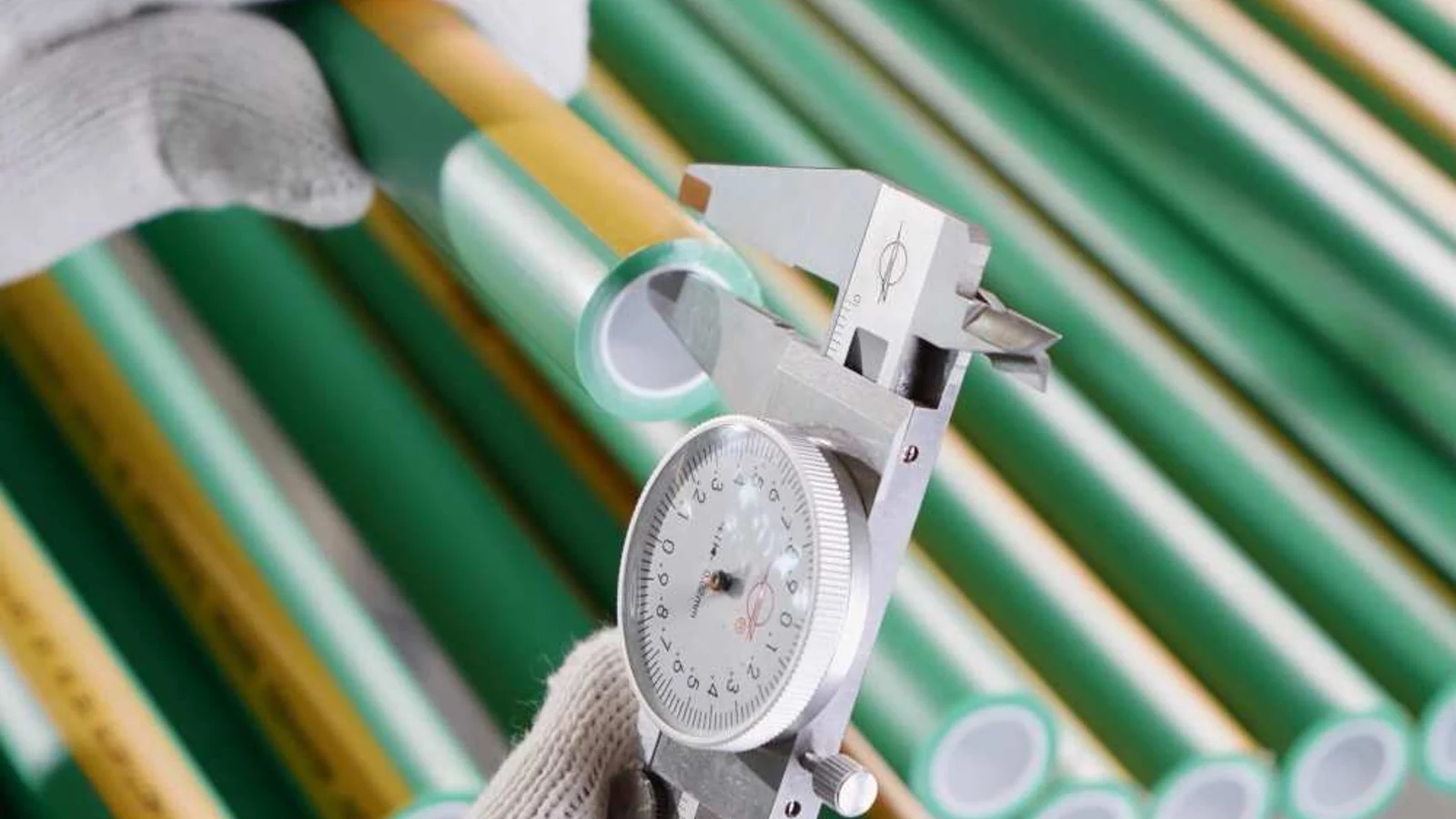
- Caliper the wall across pallets. Documented practice is to sample across multiple pallets rather than the top layer — the top layer is the one that gets loaded last and inspected first.
- Compare against a published figure. ISO 15874-2 Table 5 gives dimension class A, series S 2,5 as 8,3 mm at DN50 and 18,3 mm at DN110. Note that individual manufacturers publish their own schedules which may differ slightly from the ISO series figures — check yours against the schedule your contract actually names.
- Ask for the resin documentation. The producer’s technical datasheet for the named grade, plus batch or lot references tying that resin to your production run.
- Reconcile markings to certificates. The production period and site code on the pipe should agree with the certificate numbers you were issued.

Steps 1 to 4 need a caliper and ten minutes. Steps 5 and 6 need nothing but an email, and they are the two that most reliably reveal whether a supplier’s documentation is real: a factory that names its resin grade without hesitation is a factory that knows what it bought.
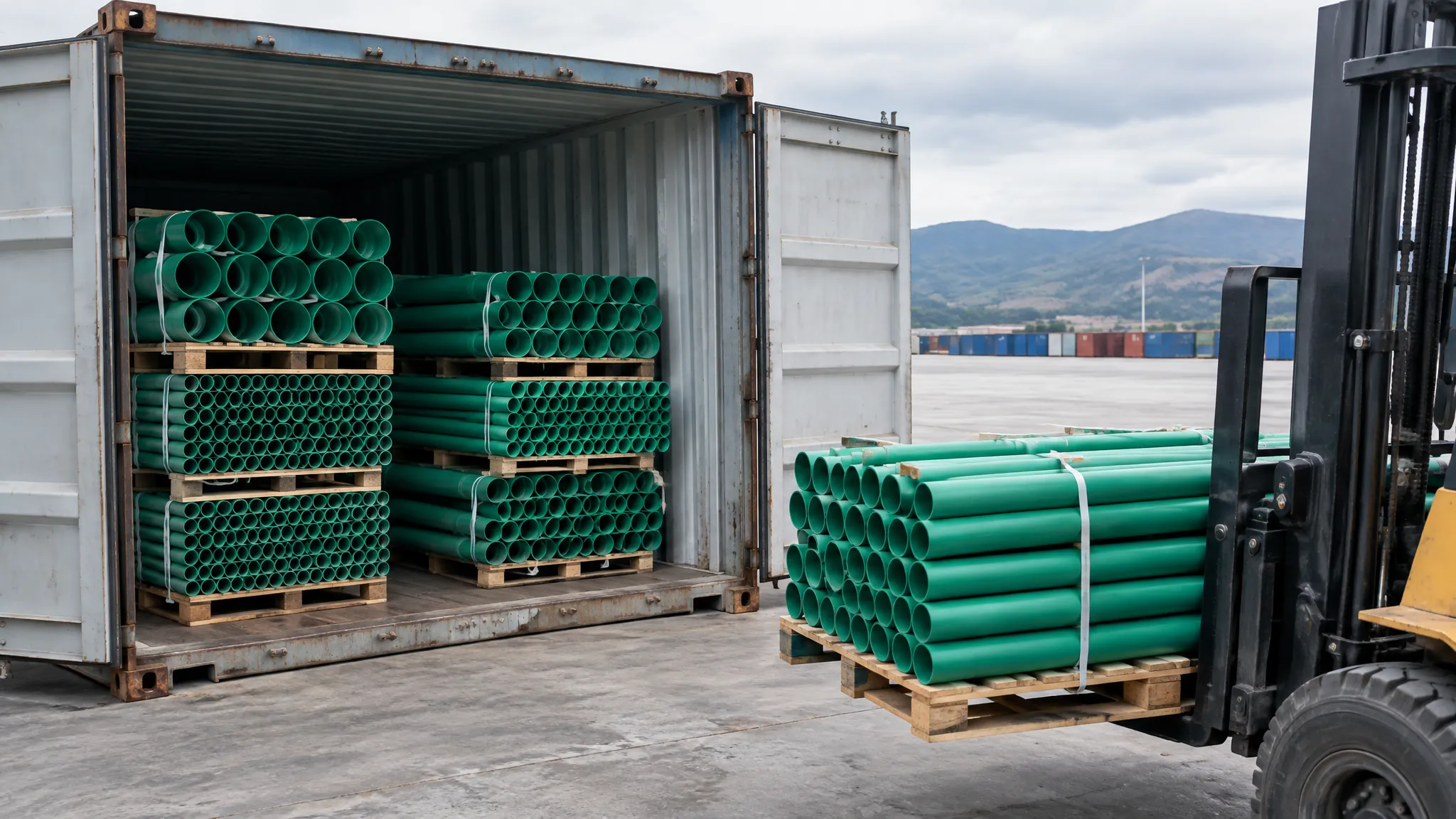
Two commercial facts decide whether the clause block above is even worth sending: order size, because most PP-R exporters quote by the container, and timing, because a grade clause has to be agreed before production starts — that is the window in which resin is bought. Ask both explicitly.
What we check, and where a supplier’s answer should match yours
Process descriptions are cheap — every manufacturer says it verifies resin and checks wall thickness, and none of that is checkable from where you sit. What is checkable is the number a supplier will commit to in writing before the container ships. So rather than describe our procedure, here is the schedule our own PN20 pipe is built and inspected to, size by size, in millimetres of wall:
| Nominal diameter | PN20 wall (mm) | Nominal diameter | PN20 wall (mm) |
|---|---|---|---|
| DN20 | 3.4 | DN63 | 10.5 |
| DN25 | 4.2 | DN75 | 12.5 |
| DN32 | 5.4 | DN90 | 15.0 |
| DN40 | 6.7 | DN110 | 18.4 |
| DN50 | 8.4 | DN160 | 26.6 |
That table is the useful thing to argue with: caliper a delivered DN50 and you should read 8.4 mm, a DN110 18.4 mm, across a range running DN20–DN160 in PN10 (SDR11), PN16 (SDR7.4), PN20 (SDR6) and PN25 (SDR5). The commercial terms are equally checkable — MOQ one FCL, LCL at a higher per-metre cost, 15–25 days production before ocean transit, 30% deposit against 70% before shipment — and on certification, ask for the certificate rather than the logo: ISO 9001, SAI Global, SKZ (Germany), HY and NSF each carry a number that either reconciles against the pipe marking or does not.
Apply that to any supplier, ours included — and in the interest of not overclaiming, we do not publish the specific PP-R grade and producer behind our virgin PP-R resin, so hold us to the same rule this article recommends and ask for the grade name on the order confirmation.
What a third-party test can and cannot settle
If a dispute reaches the laboratory stage, be realistic about which questions a test answers. Dimensional checks and short-term pressure tests are quick and decisive. The long-duration requirements in ISO 15874-2 are not: the 95 °C / 1000 h pressure test in Table 10 takes roughly six weeks of continuous testing, and the thermal-stability test in Table 11 runs for 8760 hours — a full year — at 110 °C.
That timing asymmetry is the practical argument for putting the material designation, the resin grade and the marking requirement in the contract at the start. A specification you can verify against the printed line on the pipe, on the day the container is opened, is worth considerably more than one you could theoretically prove a year later.
For context on how pressure classes map onto these ISO application classes, our guide to PN10, PN16, PN20 and PN25 pressure classes covers the relationship in detail, and the dimensions and tolerance chart gives the size-by-size figures to check a delivery against.
Frequently Asked Questions
What does PPR stand for in plumbing?
PPR stands for polypropylene random copolymer, a thermoplastic used for hot and cold water pipe. ISO 15874-2:2013 designates the material PP-R with a hyphen. “PPR” without the hyphen is a trade term rather than a controlled designation.
Is PPR the same as PP-R?
In practice they refer to the same material, but only PP-R is the designation ISO 15874-2 controls. Because “PPR” is not a controlled term, a document carrying it does not by itself commit a supplier to random copolymer rather than another polypropylene.
What is the difference between PP-R and PP-B?
They are separate materials in ISO 15874-2 with different requirements. At 95 °C for 1000 hours, PP-R must withstand 3,5 MPa hoop stress and PP-B only 2,6 MPa. PP-B is also held to a lower maximum pipe series, meaning a thicker wall for the same duty.
What should be printed on a PPR pipe?
ISO 15874-2 Table 12 requires eight aspects: the standard number, manufacturer’s name or mark, nominal diameter and wall thickness, dimension class, material, application class with operating pressure, opacity if declared, and traceability information — at least once per metre.
How do I specify PPR pipe on a purchase order?
Replace the word with fields: material designation (PP-R per ISO 15874-2), the standard and dimension class, the pipe series, the resin grade and producer, the melt flow rate with test conditions, and a requirement to carry the full Table 12 marking.
Why does the resin grade matter if the pipe passes a pressure test?
Short-term pressure tests are quick, but ISO’s long-duration requirements are not — the 95 °C/1000 h test runs about six weeks and the thermal stability test 8760 hours. Naming the grade up front is verifiable on delivery day; the long tests are not.



 English
 Español
 Français
 Português do Brasil