

Most PPR specification sheets you will be sent are written in a language the governing standard does not speak. They lead with PN20, DN25 and SDR6, and stop there. Open ISO 15874-2:2013 and the letters “PN” do not appear once. What the standard actually asks for is a service class, a design pressure in bar, and a pipe series S — and those three things, not a PN number, are what decide whether the wall in your hands is legal for the job.
That gap is where specification arguments start. A distributor sells PN20 into an underfloor heating job because PN20 sounds like more pipe than PN16. A consultant rejects a delivery that was correctly manufactured. A customs file gets held because the print on the pipe says one thing and the certificate says another. All three are the same mistake: treating a marketing shorthand as a specification.
This page is the specification picture in full — the material designation, the application classes, how a wall thickness is actually chosen under the standard, which tests a mill has to pass, and what has to be printed on the pipe. The dimension-by-dimension numbers and the tolerance table live on a separate page, linked below, so nothing here is repeated from it.
Key takeaways
- PN is not an ISO term. ISO 15874-2:2013 specifies wall thickness by service class, design pressure and pipe series S. PN is the DIN-era market shorthand that got printed on the catalogue.
- The controlling rule is clause 6.2.2. Pick emin so the resulting S-series value is equal to or less than the Scalc,max in Table 3 for your class and pressure. That single sentence is the whole selection logic.
- “PP-R type 3” is a retired designation. DIN 8078 dropped type numbering in its 2008-09 edition. Current material designations are PP-H, PP-B, PP-R and PP-RCT.
- There is no OIT requirement in ISO 15874-2. The standard’s thermal-stability route for PP-R is 8 760 hours at 110 °C under 1,9 MPa hoop stress — a full year of testing, not a 20-minute oven scan.
- Marking is a specified list, not branding. Table 12 sets eight items, and clause 10.1 requires them at least once per metre.
- Class 5 is the expensive one. At 10 bar it allows Scalc,max 1,9 for PP-R against 3,0 for Class 1, which on DN63 means buying S2 at 12,7 mm instead of S3,2 at 8,6 mm — 48 % more wall at the same diameter and pressure.
Reading order
- Which standards actually govern PPR, and what each one owns
- The material line: PP-R, PP-RCT, and the “type 3” that no longer exists
- Service classes are the specification; PN is the shorthand
- How a wall thickness is actually chosen under ISO 15874-2
- The tests a mill has to pass — and what OIT is not
- Marking and certification: what must be on the pipe
- Writing the specification into a purchase order
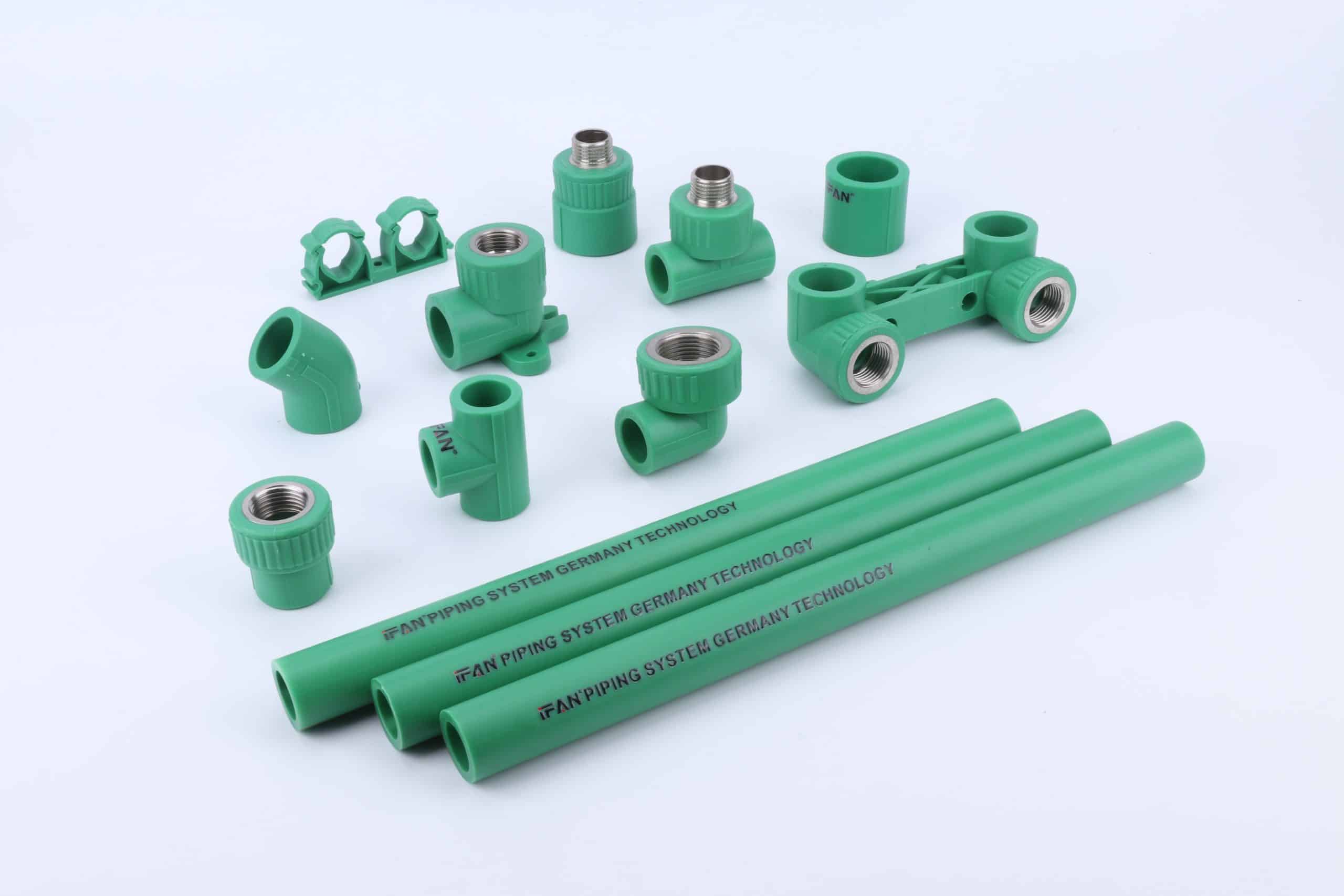

Which standards actually govern PPR, and what each one owns
Four documents get quoted on PPR datasheets, and buyers routinely treat them as interchangeable. They are not. Each owns a different part of the specification, and knowing which owns what is the difference between a defensible rejection and an argument you will lose.
ISO 15874 is a series, not a single standard, and the split matters commercially. Part 1 is General and carries the classification of service conditions in its clause 4. Part 2 is Pipes and carries everything you would inspect on a delivery. Part 3 is Fittings.
Part 5 is Fitness for purpose of the system — and this is the one buyers forget: ISO 15874-2 clause 9 states that when pipes are jointed to each other or to Part 3 fittings, “the pipes and the joints shall conform to ISO 15874-5.” A compliant pipe and a compliant fitting do not automatically make a compliant system. The joint is separately governed.
| Document | What it owns | What you cite it for |
|---|---|---|
| ISO 15874-1:2013 | General; clause 4 classification of service conditions; clause 5 material, including 5.3 reprocessable material | The application class the project runs at |
| ISO 15874-2:2013 | Pipes: clause 4 material, 6 geometry, 7 mechanical, 8 physical/chemical, 10 marking | Nearly every inspectable requirement |
| ISO 15874-5:2013 | Fitness for purpose of the assembled system | Joint performance, invoked by Part 2 clause 9 |
| DIN 8077:2008-09 | “Polypropylene (PP) pipes — PP-H, PP-B, PP-R, PP-RCT — Dimensions”, 34 pages | The German dimensional route, still specified across the Gulf |
| DIN 8078:2008-09 | “…General quality requirements and testing”, 17 pages | The quality/testing half of the DIN pair |
The authoritative records are worth bookmarking rather than trusting a reseller’s summary: ISO 15874-2:2013 and ISO 15874-1:2013 at ISO, and the classification document behind the service classes, ISO 10508:2006.
DIN 8077 and DIN 8078 are a matched pair and a tender that names only one of them has specified half a system. The pattern to watch for is a supplier quoting DIN 8077 alone: that is the dimensions document, and it says nothing about whether the pipe survives a pressure test. Note also what is deliberately absent from this page — clause numbers for either DIN standard. Their bibliographic records are public; their clause-numbered body text is behind a paywall. A fabricated DIN clause number is worse than no clause number, and buyers do get caught quoting one back to a lab that then cannot find it.
The version trap on ISO 15874-2
ISO 15874-2:2013 has been amended twice, and the second amendment is recent enough that most supplier datasheets have not caught up. Amendment 2:2022 added a new subclause 7.2, Impact resistance, with its own test table and a new normative reference to ISO 3127. A datasheet dated before 2022 that claims “conforms to ISO 15874-2” is not lying, but it is describing a shorter list of requirements than the standard now carries. If your market enforces the amended text, ask which edition the mill’s type-test report was issued against.
The material line: PP-R, PP-RCT, and the “type 3” that no longer exists
“PP-R type 3” appears on a large share of PPR marketing, including tender documents written this decade. It is a real designation with a real history — and it is retired. The 1996 edition of DIN 8078 was titled “Types 1, 2 and 3 polypropylene (PP) pipes”, where type 1 was PP-H (homopolymer), type 2 was PP-B (block copolymer) and type 3 was PP-R (random copolymer). The 2008-09 edition dropped the numbering entirely, and its title now names the four materials directly: PP-H, PP-B, PP-R, PP-RCT.
This is not pedantry when a certificate is being checked at a border. A buyer who writes “PP-R type 3” into a specification is quoting a standard edition that was superseded in 2008, and an inspector who wants to reject the shipment has an easy opening. Write PP-R. The standard’s own marking table gives “PP-R” as the example material string.
The fourth material, PP-RCT, is the one that changes commercial decisions. It was added to the ISO series in the 2013 revision — the foreword to ISO 15874-1:2013 records that “In 5.1, the material PP-RCT has been included”, and ISO 15874-2:2013 added it to clause 6, 6.2.2 and Table 5 at the same time. Its practical consequence sits in a footnote most people skim past: the Table 5 column headers read S8a, S6,3a, S5, S4a, S3,2, S2,5, S2, and footnote a says “Only valid for PP-RCT”. Three series carry that marker, not two.
S8 and S6,3 are the obvious featherweights. But S4 is restricted just as firmly, and S4 is not an exotic wall — at DN63 it is 7,1 mm, a thickness that turns up on ordinary commercial offers without anyone blinking. Ordinary PP-R is entitled to none of the three, and the same footnote is repeated verbatim on Table 6, the copper-equivalent class B1 sizes, so switching dimension class does not get around it.
Where this bites a distributor. A thinner wall at the same outside diameter means more bore, more flow and less resin per metre. So if a competitor quotes a suspiciously light DN63 at S6,3 or at S4, the question is not “is it thin” but “is it PP-RCT, and does the certificate say so?” S4 is the one that slips through: 7,1 mm looks unremarkable next to S6,3’s 4,7 mm, so nothing reads as a red flag until you check the material. A PP-R pipe made to an S-series only PP-RCT is entitled to is non-conforming, and it looks like a bargain right up until the pressure test.
Material quality below the designation is not something the pipe print will tell you. ISO 15874-2 clause 4.2 routes it through long-term hydrostatic strength: the pipe material “shall be evaluated in accordance with ISO 9080” to find its σLPL values, which must be at least as high as the reference curves in the standard’s Figures 1 to 4.
That evaluation is done on the compound, by the resin producer, over years. It is why the resin source is a legitimate purchasing question rather than a marketing one — the PPR Global Series range states Borealis and Hyosung as its raw-material sources, and a supplier who cannot name a resin producer at all is a supplier who cannot show you a σLPL curve.
Service classes are the specification; PN is the shorthand
Here is the single most useful thing on this page. When ISO 15874-2 says “class of application”, it means one of five numbered service conditions, each defined as a temperature-time profile over a 50-year design period. Not a pressure. A profile.
The classification table below is ISO 10508:2006 Table 1, the classification document the hot-and-cold-water plastics standards work from. Read a row as a life story for the pipe: TD is the ordinary running temperature and how many years of the 50 it occupies, Tmax is a higher temperature the system reaches for short periods, and Tmal is the malfunction temperature reached when controls fail — allowed for a total of 100 hours across the whole 50 years.
| Class | TD / years | Tmax / years | Tmal / hours | Typical field of application |
|---|---|---|---|---|
| 1 | 60 °C / 49 | 80 °C / 1 | 95 °C / 100 | Hot water supply (60 °C) |
| 2 | 70 °C / 49 | 80 °C / 1 | 95 °C / 100 | Hot water supply (70 °C) |
| 4 | 20 °C / 2,5 + 40 °C / 20 + 60 °C / 25 | 70 °C / 2,5 | 100 °C / 100 | Under-floor heating and low-temperature radiators |
| 5 | 20 °C / 14 + 60 °C / 25 + 80 °C / 10 | 90 °C / 1 | 100 °C / 100 | High temperature radiators |
Class 3 exists — low-temperature underfloor heating — but the standard restricts it, and the restriction is instructive. Its footnote reads “Only allowed when the malfunction temperature cannot rise above 65 °C.” In most buildings nobody can guarantee that, which is why class 3 is rare on real tenders and class 4 does the underfloor work instead.
Three consequences buyers miss
First, the classes are guidance. ISO 10508 clause 4 says plainly that the applications “are given as guidance and are not requirements. In countries with extreme weather conditions other classes may be preferred.” A Gulf project specifying a higher class than the table suggests is not over-engineering; it is doing what the standard invites.
Second, every class carries cold water for free. The same clause requires that any system meeting one of the five classes “shall also be suitable for the transportation of cold water for a period of 50 years at a temperature of 20 °C and a design pressure of 10 bar.” So a class 5 pipe is automatically qualified for the cold line. You never need to buy a separate cold-water specification.
Third, a shorter design life scales the profile — with one exception. If the specified service life is under 50 years, “all the times given in Table 1 shall be reduced by a proportionate amount, except for the time for malfunction, which shall remain at 100 h.” The malfunction allowance is absolute. A 25-year system still has to survive the same 100 hours at 100 °C, because a failed thermostat does not care how long the building was designed to last.
How a wall thickness is actually chosen under ISO 15874-2
This is the mechanism the SERP does not explain, and it is one sentence. ISO 15874-2:2013 clause 6.2.2: “For any particular class of service conditions, design pressure and nominal size, the minimum wall thickness, emin, shall be chosen in such a way that the corresponding S series or Scalc-value is equal to or less than the values of Scalc,max given in Table 1, 2, 3 or 4.”
Table 3 is the PP-R one. It is small, it is the entire selection logic for the material you are buying, and virtually no supplier datasheet reproduces it.
| Design pressure pD | Class 1 | Class 2 | Class 4 | Class 5 |
|---|---|---|---|---|
| 4 bar | 6,9 | 5,3 | 6,9 | 4,7 |
| 6 bar | 5,0 | 3,5 | 5,5 | 3,2 |
| 8 bar | 3,8 | 2,6 | 4,1 | 2,4 |
| 10 bar | 3,0 | 2,1 | 3,3 | 1,9 |
Two features of this table repay a slow read. Class 4 is less demanding than class 2 at every pressure — 3,3 against 2,1 at 10 bar — because class 4 spends most of its 50 years at 20 °C and 40 °C, while class 2 sits at 70 °C for 49 of them. Underfloor heating is thermally gentler than a hot-water riser, and the standard prices it accordingly.
And class 5 at 10 bar demands Scalc,max 1,9, against 3,0 for class 1. Wall thickness relates to the series as e = dn/(2S+1), so a lower ceiling forces a thicker wall — but you do not buy the formula’s answer, you buy the next catalog series that satisfies it. On DN63 that means class 5 lands on S2 at 12,7 mm while class 1 clears at S3,2 and 8,6 mm: 48 % more wall at the same diameter and the same 10 bar. High-temperature radiators are an expensive thing to discover late in a tender.
A worked example you can reuse
Take a real question: DN32 PP-R on a 10-bar hot-water riser, class 2. Table 3 gives Scalc,max = 2,1. So the S-series must be 2,1 or lower — S2,5 is too high and fails, and you drop to S2. In ISO 15874-2 Table 5, dimension class A, DN32 at S2 is emin 6,5 mm.
Now run the same DN32 at 10 bar as class 1 hot water supply. Scalc,max = 3,0, so S2,5 (5,4 mm) is admissible. That is the whole difference between a 5,4 mm wall and a 6,5 mm wall — one line in the service-class column. In resin terms the wall cross-section goes from 451 mm² to 521 mm², so class 2 costs about 15 % more material per metre at the same diameter and the same 10 bar.
That is the arithmetic deciding whether a rival quote is cheap or non-conforming, and it is why “PN20” on its own answers nothing: PN20 corresponds to S2,5, which is correct at class 1 and wrong at class 2.
Two more clauses complete the geometry. Clause 6.2.2 also sets an absolute floor that overrides the arithmetic: “pipes intended to be joined together by fusion shall have a minimum wall thickness of 2,0 mm.” Since virtually all PPR is socket-fused, that rule quietly deletes the thinnest options at small diameters regardless of what the pressure calculation allows. And clause 6.1 requires that dimensions “shall be measured in accordance with ISO 3126” — so an incoming-inspection dispute over how the caliper was used has a named referee.
The dimension class nobody asks about. ISO 15874-2 carries four dimension classes, and they are not interchangeable. Table 5 is class A, “sizes in accordance with ISO 4065:1996”, which is the DN20/25/32 range the global PPR trade runs on. Tables 6 and 7 are classes B1 and B2, “sizes based on copper pipe sizes” — 10, 12, 15, 18, 22, 28, 35 mm — used where PPR replaces copper. Table 8 is class C, “non-preferred pipe sizes used for example for heating systems”.
If a European enquiry asks for 22 mm PPR and your catalogue only runs class A, you are not looking at the same product family, and the marking table requires the class to be printed on the pipe precisely so this cannot be fudged.
The tests a mill has to pass — and what OIT is not
Specification arguments usually end at dimensions, because dimensions are what a buyer can measure on a pallet. The requirements that actually determine whether the pipe lasts 50 years are in clauses 7 and 8, and they are type tests — done once on a material and production route, not on your container.

Clause 7 covers resistance to internal pressure. For PP-R, ISO 15874-2 Table 10 sets four separate hydrostatic tests, all requiring no failure during the test period, on three test pieces each, water-in-water with a Type A end cap:
| Hoop stress | Temperature | Period | What it proves |
|---|---|---|---|
| 16,0 MPa | 20 °C | 1 h | Short-term burst strength |
| 4,3 MPa | 95 °C | 22 h | Hot short-term behaviour |
| 3,8 MPa | 95 °C | 165 h | Onset of the ductile-brittle transition |
| 3,5 MPa | 95 °C | 1 000 h | The long-term anchor point |
The 1 000-hour test at 95 °C is the one to ask for by name. It takes six weeks of continuous testing and it is the point on the curve where a badly stabilised compound gives itself away. A mill that can hand you a current type-test report against that line has spent real money; a mill that offers only a 20 °C burst figure has tested the easy one.
Why there is no OIT number on this page
Oxidation induction time gets quoted constantly in PPR sales conversations, usually as “our OIT is over 20 minutes”. It is a legitimate laboratory measurement of how long a sample resists oxidation at a fixed temperature under oxygen, and it is a genuine proxy for antioxidant package quality. But ISO 15874-2:2013 does not require it. Clause 8 and its Table 11 specify exactly four physical and chemical characteristics — longitudinal reversion, thermal stability by hydrostatic pressure testing, impact resistance and melt flow rate. Oxidation induction time is not among them.
What the standard uses instead is heavier. Thermal stability for PP-R is proved by hydrostatic pressure testing at 1,9 MPa hoop stress, 110 °C, water-in-air, for a test period of 8 760 hours — one full year of continuous testing on a single test piece, with the requirement being no bursting during the period.
That is the standard’s answer to “will the stabiliser package survive”. An OIT figure quoted at you is not a conformity claim under ISO 15874-2; it is supplementary evidence. Treat a supplier who leads with OIT and cannot produce the 8 760-hour result accordingly.
The rest of Table 11 is straightforwardly checkable and worth putting on an inspection scope:
- Longitudinal reversion ≤ 2 %, by Method B of ISO 2505 (oven test). The PP-R test temperature is 135 °C — note that PP-H and PP-B are tested at 150 °C, so a report at 150 °C is not a PP-R report. Exposure runs 1 h for en ≤ 8 mm, 2 h for 8 mm < en ≤ 16 mm, and 4 h above that, on 3 test pieces.
- Melt flow rate of the compound ≤ 0,5 g/10 min at 230 °C / 2,16 kg to ISO 1133-1. This is the sharpest single screen for recycled or degraded feedstock.
- Melt flow rate of the pipe: 30 % maximum difference compared with compound from the same batch. This is the clause that catches over-processing — the resin can be fine and the extrusion still cooked it.
- Impact resistance ≤ 10 %, tested at 0 °C for PP-R on 10 test pieces to ISO 9854-1 and ISO 9854-2.
That last line is where Amendment 2:2022 changed things. The amendment adds a dedicated subclause 7.2 and splits impact testing by size: the Charpy method (ISO 9854-1 / ISO 9854-2) for DN ≤ 25 mm, and the round-the-clock method to ISO 3127 with a true impact rate TIR ≤ 10 % for DN ≥ 32 mm, both at 0 °C.
If you import into a cold market, this is the requirement that matters on arrival, and it is new enough that asking which method was used is a fair test of whether a supplier reads the standards they print on the pipe.
IFANULTRA’s own documented incoming and outgoing check sequence tracks this list rather than replacing it: resin grade verified by source and grade, a caliper wall check sampled across multiple pallets rather than the top layer only, OD and wall checked to ISO 15874 and DIN 8077, pressure and thermal testing to the rated class, and printed markings reconciled against certificate numbers.
The sampling detail is the one worth copying into your own inspection brief — top-layer-only sampling is how a mixed pallet passes, and the mechanics of running that check on an arriving container are covered in PPR pipe batch consistency and incoming inspection.
Marking and certification: what must be on the pipe
Marking is the cheapest conformity check in existence and the one most often skipped. ISO 15874-2 clause 10.2 and its Table 12 set a minimum required marking list of eight items. Everything else on the pipe is the manufacturer’s choice; these are not.
| Required aspect | Marking or symbol |
|---|---|
| Number of the International Standard | ISO 15874 |
| Manufacturer’s name and/or trade mark | Name or code |
| Nominal outside diameter and nominal wall thickness | e.g. 16 × 2,2 |
| Pipe dimension class | e.g. A |
| Material | e.g. PP-R |
| Application class combined with operating pressure | e.g. Class 1/10 bar |
| Opacity (if declared by the manufacturer) | e.g. opaque |
| Manufacturer’s information (traceability) | Production period — year and month, in figures or code; plus a name or code for the production site if the manufacturer produces at different sites |
Look at the sixth row again. “Application class combined with operating pressure — e.g. Class 1/10 bar.” The standard’s own example of how a PPR pipe should be marked contains no PN number at all. If a pipe is printed “PN20” and nothing else, it is not carrying the marking ISO 15874-2 requires. That does not make it bad pipe, but it does mean the print cannot be reconciled to a service class, which is precisely the reconciliation an inspector performs.
What to check, in order, on a delivery
- Read one metre of print, in full. Clause 10.1 requires marking “not less than once per metre”, so any random metre must carry the complete set. If you have to hunt for a legible block, that is itself a finding.
- Reconcile the class-and-pressure string to your order. “Class 1/10 bar” on pipe ordered for a class 2 riser is a rejection, not a discussion.
- Check the dimension class letter against the size. Class A with a 22 mm outside diameter is internally inconsistent — 22 mm is a class B size.
- Confirm the traceability block resolves. Year, month and, where the manufacturer runs multiple plants, a site code. This is the string a certificate has to match.
- Check print quality against clause 10.1. The colouring of printed information “shall differ from the basic colouring of the pipe” and the marking must be legible without magnification. Green-on-green print that you need a torch to read fails a requirement that is actually written down.
On certification, hedge carefully and check the destination market rather than the marketing page. A certificate is issued by a body against a scheme, for a scope, with an expiry — and “our products are certified” is not a specification. IFANULTRA publishes ISO 9001, SAI Global, SKZ, HY and NSF on its certification page, and its PPR Global Series page separately states DVGW and NSF certification for the PP-R range.
Those are marks, not scopes: the questions that decide whether a certificate helps you at a border are which product family it covers, whether pipe and fittings are covered by the same certificate or separate ones, and when it expires. Ask for the certificate document, not the logo, and check the scope line yourself.
Writing the specification into a purchase order
Everything above collapses into a small number of strings that belong on the PO. A specification that names only “PPR PN20 DN20-DN110” leaves the mill free to make choices you did not intend, and leaves you without grounds to reject the result.
Name six things: the material designation (PP-R, or PP-RCT if you are buying the thin-wall series), the standard and its edition including whether Amendment 2:2022 applies, the application class and design pressure in the standard’s own “Class n/x bar” form, the dimension class letter, the size-and-series list, and the marking requirement itself. That last one is unusual on a PO and it is the one that gives you leverage: writing “marking to ISO 15874-2:2013 Table 12, complete, at least once per metre” converts a print inspection from an argument into a contract term.
Best for / not ideal for
This specification route is best for distributors carrying a range across several markets, where one wrong class assumption multiplies across a container; project buyers whose consultant has written a class into the tender; and anyone whose certificate has to survive a customs check, where the print-to-certificate reconciliation is the check that gets run.
It is not the right frame for a single small residential job — at that scale the local convention, usually PN20 for hot and PN10 or PN16 for cold, is a reasonable shortcut and the class arithmetic will not change your order. It is also not sufficient on its own for underfloor heating design, where oxygen diffusion and barrier layers enter the specification and ISO 15874-5 governs the assembled system rather than the pipe.
What a first enquiry should contain
Buyers routinely send “please quote PPR pipe” and then spend three emails converging on what they meant. A first enquiry that gets a usable quote back names the class and pressure, the dimension class, and the size-and-series list, and asks three questions: which edition of ISO 15874-2 the type-test reports were issued against, whether the 1 000-hour 95 °C result is available, and whether pipe and fittings sit on the same certificate.
On the commercial side, IFANULTRA’s published terms are a minimum of one full container load, with LCL possible at a higher per-metre cost; 15 to 25 days of production for a container before ocean transit; and 30 % deposit against 70 % before shipment. Its standard range runs DN20 to DN160 across PN10 (SDR11), PN16 (SDR7.4), PN20 (SDR6) and PN25 (SDR5), and the two lines are the PPR Global Series at 67 SKUs and the PPR Quality Series at 28 SKUs.
Pricing is not published as a list because resin cost dominates it and moves; the honest answer is that it is quoted against a specific size mix and class, so send the mix rather than asking for a rate. If you are at the stage of turning a specification into an actual first order, PPR pipe MOQ and the first container plan works through how the size mix and packing unit set the real minimum.
One thing this page deliberately does not give you is a number for how tightly any individual mill runs its own wall-thickness check against the ISO 15874-2 Table 9 minimum. An internal band tighter than the standard is a real differentiator when a manufacturer publishes it, and IFANULTRA’s documented protocol describes the method — multi-pallet caliper sampling — without publishing the reject threshold. Ask for it in writing and treat a supplier who cannot state one as a supplier who does not have one.
For the dimension-by-dimension numbers behind all of this — the full DN20 to DN160 chart, the ISO 11922-1 tolerance grades, ovality, and how to check a delivered pipe against them — the companion page is the PPR pipe dimensions and tolerance chart. For the market-facing PN view of the same physics, see PPR pressure classes PN10 to PN25. And for what the certificates themselves prove, PPR pipe certification covers the schemes and scopes.
Conclusion
The specification that protects you is not the one on the catalogue cover. It is the string ISO 15874-2 asks to be printed on the pipe itself — material, dimension class, application class and pressure, size and wall — because that string is the one an inspector, a certificate and a type-test report can all be reconciled against. PN20 cannot be reconciled against anything; it is a number that means S2,5, which is correct for class 1 and wrong for class 2.
If you take one habit from this page, make it the clause 6.2.2 check: before accepting any quoted wall, look up the Scalc,max for your class and pressure in Table 3 and confirm the offered series sits at or below it. It takes a minute, it is the calculation the standard actually mandates, and it is the one most suppliers have never been asked to show.
Frequently Asked Questions
What are the specifications of PPR pipe?
Under ISO 15874-2:2013: material designation (PP-R or PP-RCT), application class and design pressure, dimension class A to C, diameter with pipe series S, and the Table 12 marking set. PN is market shorthand, not a standard term.
Is PPR pipe ISO 15874 or DIN 8077?
Both, covering different ground. ISO 15874 is the international series: Part 1 general, Part 2 pipes, Part 3 fittings, Part 5 system fitness. DIN 8077:2008-09 covers dimensions; DIN 8078:2008-09 covers quality requirements and testing. Naming DIN 8077 alone specifies only half.
What is the difference between PN and service class?
PN is a market-convention pressure label. A service class is a 50-year temperature-time profile from ISO 10508 Table 1 — class 1 is 60 °C hot water, class 5 high-temperature radiators. ISO 15874-2 asks for both together, as Class 1/10 bar.
What does PP-R type 3 mean?
It is the retired DIN 8078:1996 designation, where type 1 was PP-H, type 2 PP-B and type 3 PP-R. The 2008-09 edition dropped type numbering and names PP-H, PP-B, PP-R and PP-RCT directly. Specify PP-R, the wording the ISO marking table uses.
What is the OIT requirement for PPR pipe?
ISO 15874-2:2013 sets none. Table 11 requires longitudinal reversion, thermal stability, impact resistance and melt flow rate. Thermal stability for PP-R is 8 760 hours at 110 °C under 1,9 MPa. An OIT figure is supplementary evidence, not a conformity claim.
How do I choose PPR pipe wall thickness?
By ISO 15874-2 clause 6.2.2: pick a wall whose S-series value is at or below the Scalc,max in Table 3 for your class and pressure. DN32 at 10 bar class 2 gives 2,1, so S2 at 6,5 mm.
What must be marked on a PPR pipe?
Table 12 requires eight items: ISO 15874, manufacturer name or code, diameter and wall thickness, dimension class, material, application class with operating pressure, opacity if declared, and a traceability block giving production year, month and site code — once per metre.
Did ISO 15874-2 change recently?
Yes. Amendment 2:2022 added subclause 7.2 Impact resistance and ISO 3127 as a normative reference, splitting impact testing between the Charpy method for DN up to 25 mm and the round-the-clock method above it. Ask which edition a mill’s type-test report cites.









 English
 Español
 Français
 Português do Brasil