

ISO 15874 specifies a polypropylene piping system; DIN 8077 specifies pipe dimensions, and DIN 8078 covers quality requirements and testing. A purchase order needs the applicable part and edition, the application class, design pressure and pipe series. The family number alone leaves those decisions open.
Use this guide to check the reference, reconcile the wall schedule and separate a product test report from destination-market drinking-water approval. ISO 15874-2:2013 remains published with its amendments; the replacement is a committee draft, not a published third edition.
What ISO 15874 actually is, and the two part numbers that do not exist
Key takeaways
- ISO 15874 has five published parts — 1, 2, 3, 5 and 7. There is no Part 4 and no Part 6. A PO citing “ISO 15874-4” cites a document that was never published.
- DIN 8077 and DIN 8078 are both still current. The publisher stamps both 2008-09 editions [CURRENT] as of 2026. 8077 is dimensions; 8078 is quality and testing. They are two documents, not one hyphenated number.
- “ISO 15874-2:2013” is an incomplete reference in 2026. It carries Amendment 1:2018 and Amendment 2:2022, and a third edition is in development.
- A 50-year design basis is conditional. Material-strength evaluation and the stated service profile support it; a test interval above 8 760 hours has no one-year upper limit.
- An ISO 15874 report is not a drinking-water approval. The standard says so itself, in its own Introduction.
On this page
- What ISO 15874 actually is, and the two part numbers that do not exist
- The edition on your purchase order is probably out of date
- DIN 8077 and DIN 8078: still current, and not the same document
- From S-series to wall thickness: the arithmetic behind the number on the pipe
- Application classes: the part of the standard buyers skip
- Where the 50-year number really comes from
- What an ISO 15874 certificate does not give you
- How to verify a standards claim before the container ships

The original video owner disabled embedding. Its source page requires sign-in for bot verification in this check; playback was not observed. The written checks remain available while a replacement is reviewed.
ISO 15874 covers polypropylene hot/cold-water and heating systems within buildings, including water intended or not intended for human consumption. It does not establish suitability for buried mains, compressed air or industrial chemical service. The parts map separates pipe dimensions from fittings and assembled-joint tests; citing the family number leaves the required document undefined.
ISO/TS 15874-7:2018 provides requirements and guidance for conformity assessment, manufacturer quality plans and certification procedures. Its Technical Specification status does not remove those requirements. The foreword identifies CEN/TC 155 working with ISO/TC 138/SC 2 under the Vienna Agreement.
| Part | Title | What you go there for |
|---|---|---|
| Part 1 | General | Definitions, symbols, the classification of service conditions, material rules |
| Part 2 | Pipes | Pipe dimensions, mechanical and physical characteristics, marking |
| Part 3 | Fittings | Everything the pipe connects to |
| Part 4 | does not exist | — |
| Part 5 | Fitness for purpose of the system | Joint tests — how the assembled system is proven, not the components |
| Part 6 | does not exist | — |
| Part 7 | Guidance for the assessment of conformity | Requirements and guidance for conformity assessment; manufacturer quality plans and certification procedures |
The edition on your purchase order is probably out of date
ISO 15874-2:2013 remains published with Amendment 1:2018 and Amendment 2:2022; Amendment 2’s title identifies the impact test. The complete amendment texts were not inspected here, so obtain them before defining acceptance. As checked 5 October 2026, ISO/CD 15874-2 is under development at stage 30.60, not a published replacement.
The 2013 foreword records PP-RCT added to Table 5 and Annex A Table A.6 extended to 160 mm. This establishes neither a universal manufacturing maximum nor why a supplier stops at DN160. Freeze the published edition and amendments in the order; require written agreement for later changes.
- Amendment 1:2018 — ISO 15874-2:2013/Amd 1:2018
- Amendment 2:2022 — ISO 15874-2:2013/Amd 2:2022, published under the title Amendment 2: Impact test
- A third edition is in development as ISO/CD 15874-2. The official catalogue lists committee stage 30.60, close of comment period, checked 5 October 2026. It has not replaced the published 2013 edition.
DIN 8077 and DIN 8078: still current, and not the same document
DIN Media lists both corrected 2008-09 editions as current on 5 October 2026. They originated in 2007-05 and cover PP-H, PP-B, PP-R and PP-RCT. Dimensions alone do not establish long-term material strength: request the applicable quality/testing evidence as well as the dimensional reference.
German-language PDFs cost EUR 112.80 for DIN 8077 and EUR 82.60 for DIN 8078, VAT included, at that observation date: EUR 195.40 together. English PDF prices differ. Buy the language and licence needed for the technical annexe rather than relying on a supplier’s abbreviated standards list.
| Document | Scope | Edition & status | Extent |
|---|---|---|---|
| DIN 8077 | Dimensions only | 2008-09 · [CURRENT] | 33 pages · ICS 23.040.20 |
| DIN 8078 | General quality requirements and testing | 2008-09 · [CURRENT] | 17 pages · ICS 23.040.20 |
From S-series to wall thickness: the arithmetic behind the number on the pipe
S and SDR describe geometry: S = (SDR − 1)/2; SDR = 2S + 1. PN is a pressure designation dependent on material and reference conditions. IFAN ULTRA’s PN20/SDR 6 association is product-specific. ISO 15874-2:2013 cites ISO 4065:1996; the 2018 definitions explain geometry without replacing that dated reference.
The table’s dn/6 values are preliminary, not conformity verdicts. ISO 4065:2018 uses calculated preferred-number S values: nominal S 2.5 corresponds to 2.5119. At 160 mm, 160/(2×2.5119+1) =26.5613 mm, rounding upward to 26.6 mm. Its difference from 160/6 is not an anomaly or certification.
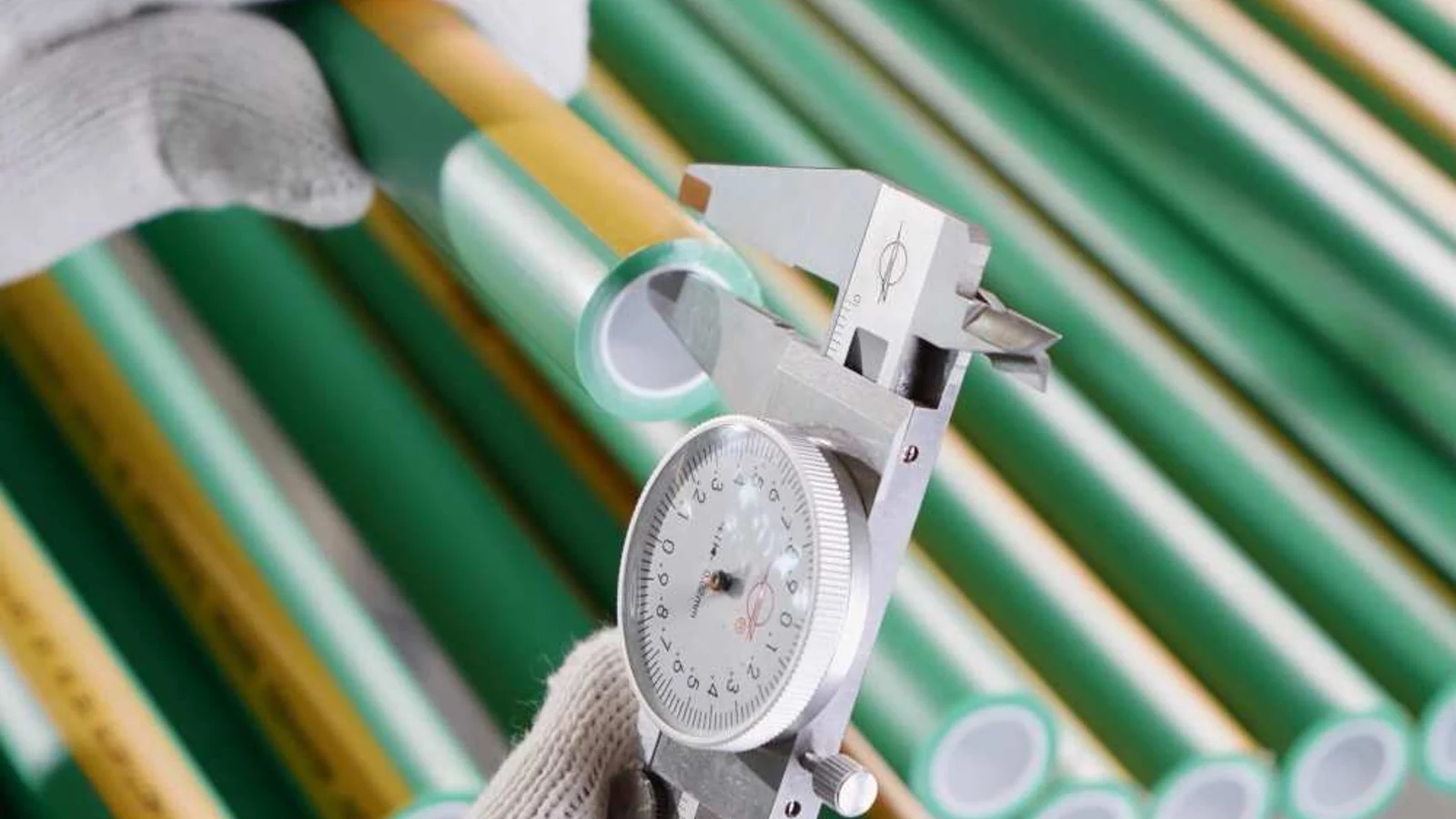
Nominal wall en is the minimum permissible thickness at any point, not an average; measurement rounds to the next higher 0.1 mm. Scalc=(dn−en)/(2en) is dimensionless. Use the agreed tables and dimensional reference for acceptance.

| Outside diameter (mm) | dn/6 approximate (mm) | Published wall (mm) | Verdict |
|---|---|---|---|
| 20 | 3,333 | 3,4 | Check agreed table |
| 32 | 5,333 | 5,4 | Check agreed table |
| 50 | 8,333 | 8,4 | Check agreed table |
| 75 | 12,5 | 12,5 | Check agreed table |
| 110 | 18,333 | 18,4 | Check agreed table |
| 160 | 26,667 | 26,6 | Check agreed table |
Application classes: the part of the standard buyers skip
Application class describes a service profile over time, not an unrestricted operating temperature. A quotation stating only “ISO 15874, PN20” therefore leaves the application and design pressure unresolved. Specify these alongside material and pipe series before comparing reports; a matching nominal pressure label cannot fill in missing service conditions.
The inspected Part 5 Table 2 example below is PP-H, polypropylene homopolymer. Its class labels and temperatures are not PP-R acceptance values. Obtain the applicable PP-R table and agreed service profile. The public Part 1 preview does not expose its full profile table; this is not a verified transcription of that unavailable table.
| Application class | Max. design temperature Tmax (°C) | PP-R acceptance |
|---|---|---|
| Class 1 | 80 °C | Use applicable PP-R table |
| Class 2 | 80 °C | Use applicable PP-R table |
| Class 3 | not in this example | — |
| Class 4 | 70 °C | Use applicable PP-R table |
| Class 5 | 90 °C | Use applicable PP-R table |
Where the 50-year number really comes from
A 50-year design basis requires temperature profile, design pressure and material evidence; it is not a fifty-year observation test. Part 2 clause 4.2 evaluates material under ISO 9080, using ISO 1167-1/-2 pressure testing to establish σLPL against reference curves. The prescribed temperatures, intervals and recommended result proportion are retained below.
Above 8760 hours is a lower interval boundary, not a test-duration ceiling. Statistical extrapolation supports long-term material-strength evaluation, not an unconditional installation guarantee. Part 5 Table 1 applies internal-pressure and thermal-cycling tests to socket-welded joints; bending, pull-out, pressure-cycling and vacuum tests apply to mechanical joints. Assembled-specimen reports do not certify every site joint’s workmanship.
- Test temperatures of 20 °C, 60 to 70 °C, and 95 °C
- At each temperature, at least three failure times in each of four intervals: 10 h to 100 h, 100 h to 1 000 h, 1 000 h to 8 760 h, and above 8 760 h
- Results plotted individually, with the standard stating that at least 97,5 % should lie on or above the reference line

What an ISO 15874 certificate does not give you
ISO 15874-1’s introduction does not establish unrestricted drinking-water use; national requirements remain applicable. A type-test report is evidence about tested specimens under its scope, not a replacement for destination-market potable-water approval. Verify the separate approval’s issuing body, product scope and validity rather than inferring it from an ISO number.
Type testing also does not verify the batch in your container. Match design evidence with batch records and incoming inspection. The destination-market standards guide covers the separate market-regime decision. Keep both questions in the purchase file; neither document substitutes for the other.
How to verify a standards claim before the container ships
The documented five-check protocol below connects resin, dimensions, tests and markings to shipment review. Preserve the certificate’s material, product scope and applicable edition alongside the measured batch records; arithmetic is a preliminary reconciliation, not the acceptance method.
Published IFAN ULTRA series pages claim DVGW/NSF, while the certification page lists ISO9001, SAI Global, SKZ and NSF without DVGW. Request the certificate number and scope; this discrepancy does not establish DVGW entitlement. Series pages name Borealis and Hyosung; verify resin grade documentation for the PPR Global Series, rather than treating producer names as conformity evidence.
- Verify resin source and grade against material documentation.
- Measure wall across multiple pallets; nominal wall is a minimum, not an average.
- Compare OD and wall with agreed standard tables and tolerances; use arithmetic only preliminarily.
- Check applicable internal-pressure and thermal-cycling reports for socket-welded systems.
- Reconcile product markings, certificate identifiers and delivered batch.

Where to go from here
Use the checklist to connect the order, report and delivered product. A correct standard number is only the start: material, service profile and acceptance evidence must identify the same product. Record unresolved discrepancies and their owner before authorizing shipment, rather than leaving an inspector to infer which edition or batch the paperwork describes.
Ask for production lead time after document review, sampling and approval are scheduled. A production estimate cannot resolve missing certificate scope or changed criteria. Retain the agreed acceptance basis and obtain written approval for changes; a supplier’s later catalogue revision should not silently redefine the order.
- The part, published edition and amendments are identified.
- The material, pipe series, application class and design pressure agree.
- The batch dimensions reconcile to the scheduled geometry.
- The joint-test scope matches the supplied system.
- The destination-market drinking-water evidence is separate and applicable.
Frequently asked questions
What is the main standard for PPR pipe?
ISO 15874 covers polypropylene piping systems for building hot and cold water and heating. Part 2 covers pipes, Part 3 fittings, and Part 5 fitness for purpose of the assembled system.
Is there an ISO 15874 Part 4 or Part 6?
The published family lists Parts 1, 2, 3, 5 and 7. Check a purchase order that cites Part 4 or Part 6 against the official catalogue.
Are DIN 8077 and DIN 8078 still valid in 2026?
DIN Media lists DIN 8077:2008-09 and DIN 8078:2008-09 as current. DIN 8077 covers dimensions; DIN 8078 covers general quality requirements and testing.
What is the difference between S, SDR and PN?
S and SDR describe geometry: S = (SDR − 1)/2. PN is a nominal-pressure designation, whose association with SDR depends on the material and reference conditions.
Has PPR pipe really been tested for 50 years?
A 50-year design basis is not proof of a fifty-year observation test. The stated service conditions and long-term material-strength evaluation must support the claim; above 8 760 hours is a lower test-interval boundary, not a maximum.
Does an ISO 15874 certificate approve the pipe for drinking water?
ISO 15874 does not replace national requirements for drinking-water suitability. Verify the applicable destination-market approval and its product scope separately.
Is ISO 15874-2:2013 still the published reference?
ISO lists ISO 15874-2:2013 as published with Amendment 1:2018 and Amendment 2:2022. ISO/CD 15874-2 is under development at committee stage 30.60, checked 5 October 2026.
Why does so much PPR pipe stop at DN160?
The 2013 revision extended Annex A Table A.6 to 160 mm. This table does not establish a universal manufacturing limit; verify the actual supplier range and applicable standard.



 English
 Español
 Français
 Português do Brasil