
The honest answer to “what is the right PPR pipe price” is that there is no single number — a PPR pipe price is set almost entirely by how much resin sits in the pipe wall and what grade of resin it is. Resin is the dominant line item in a finished PPR pipe, often cited as roughly 70–85% of the manufacturing cost, so a quote is really a quote on material, not on plastic tubing in the abstract. Change the wall thickness, the PN class, or swap virgin polypropylene for recycled regrind, and the price moves — even though the label on the box still says “PPR.”
This guide is written for importers and distributors who need to compare supplier quotes without getting burned. It walks through what a quote must specify, what actually drives cost, why two “PPR” prices can differ by 30% for the wrong reasons, and how to normalize per-meter against per-ton so you compare apples to apples. If you want the full technical background on the material first, start with our PPR pipe guide on properties, installation and selection, then come back here to turn that knowledge into a scoring sheet for quotes.
Key Takeaways
- Resin is roughly 70–85% of a PPR pipe’s cost, so price tracks the weight of material in the wall, not the “PPR” label.
- A PN20 pipe carries a thicker wall than PN10 at the same diameter (DN25 = 4.2 mm vs 2.3 mm), so it uses more resin and costs more per meter.
- Two PPR quotes can differ by around 30% mainly because one has a thinner wall or recycled/filled resin — that is a cheaper product, not a better deal.
- Convert every per-meter quote to price per kilogram of resin to expose an underweight pipe instantly.
- Fix resin grade, PN class, wall thickness, diameter and certification before you compare price — otherwise you are comparing different products.
- A quote far below market almost always means a cut corner; ask for caliper photos of the wall and resin batch proof.
What a PPR quote should actually specify
A vague PPR quote is the first red flag. “PPR pipe, DN25, $X per meter” tells you almost nothing, because the price depends on details the seller left out. A quote you can actually trust names the resin grade, the pressure class, the exact wall thickness, the diameter, the stick length, and the certifications — in writing, per SKU. If any of those are missing, the seller has room to ship a lighter, cheaper pipe than you thought you bought.
Before you even look at the number, make sure the quote pins down these fields:
- Resin grade: 100% virgin PP-R (polypropylene random copolymer) versus recycled or mineral-filled resin. This single line explains most price gaps.
- PN class: PN10, PN16, PN20 or PN25. The class sets the wall thickness, and with it the amount of material used.
- Wall thickness in mm: stated per size, not implied. A compliant PN20 DN25 pipe has a ~4.2 mm wall; a “PN20” pipe with a 3.5 mm wall is not the same product.
- Diameter (DN): the outside diameter in mm, fixed across compliant factories. Only the wall and bore change with PN.
- Length per stick and per bundle: so per-meter math is honest.
- Certifications and standard: ISO 15874, DIN 8077/8078, and any market-specific mark such as NSF for US potable water — with the certificate reference, not just a claim.
If a supplier will not put these in writing, treat the quote as indicative only. You cannot compare it to anything, and you cannot hold anyone to it at customs. Confirm current certification requirements for your destination market with a customs broker or the relevant authority, because a certificate that satisfies one country may not clear another.
What actually drives the PPR pipe price
Five things move a PPR pipe price, and four of them come back to how much material is in the pipe. Understanding the PPR price factors lets you predict roughly where an honest quote should land and spot the ones that cannot be real.
1. Resin grade — virgin versus recycled or filled
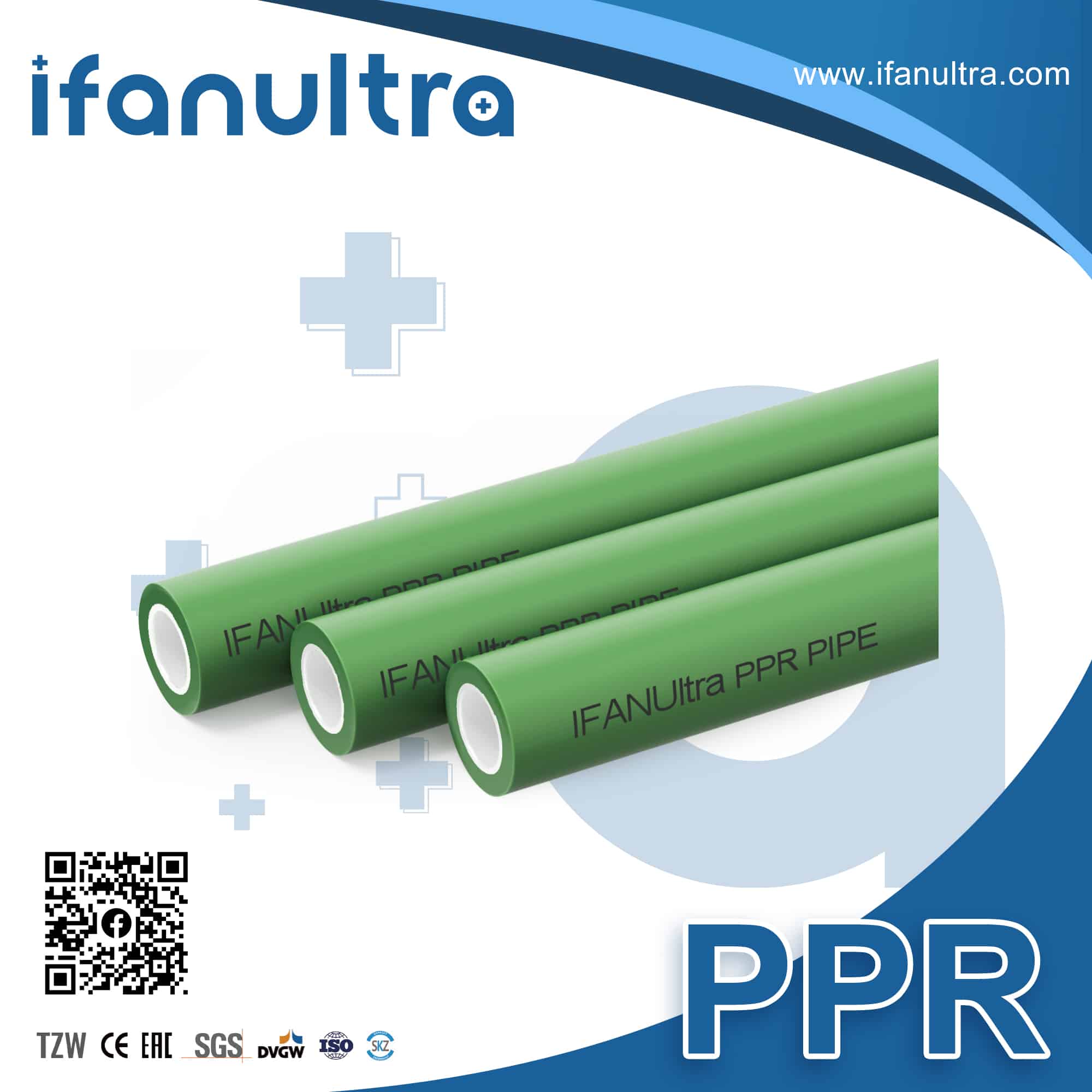
Virgin polypropylene random copolymer is a globally traded commodity with a fairly visible baseline price. Recycled regrind and mineral-filled compounds are cheaper per kilogram, so a factory that blends 20–40% recycled material into “PPR” can undercut a virgin-resin factory and still make margin. The catch is that filled or recycled PP-R loses the impact strength, creep resistance and long-term pressure rating that make PPR worth 50 years of service. IFANULTRA runs virgin Nordic polypropylene, not recycled or filled resin, because a hot-water pressure pipe is the wrong place to save on material.
2. PN class and wall thickness — more material, higher cost
The pressure class sets the wall, and the wall sets the resin weight. At DN25, a PN10 pipe carries roughly a 2.3 mm wall, PN16 about 3.4 mm, PN20 about 4.2 mm, and PN25 about 5.0 mm. That is why a PN20 pipe costs meaningfully more per meter than a PN10 pipe of the same diameter — it is not a different grade of tubing, it is more plastic. Buyers who quietly compare a PN10 quote against a PN20 quote and pick the cheaper one are usually buying a lower pressure rating by accident.
3. Diameter
Larger DN sizes consume far more resin per meter, and the wall has to grow to hold the same pressure. Moving from DN20 up through DN63, DN110 and DN160 is where per-meter prices climb steeply. A PN20 DN160 pipe has a wall near 26.6 mm versus 3.4 mm at DN20 — an order-of-magnitude difference in material.
4. Additives — UV stabilizer and fiber composite
UV-resistant and fiber-composite variants cost more because the compound itself costs more and the extrusion is more complex. Fiber-composite PPR earns its premium: it cuts linear thermal expansion by around 75%, from roughly 0.15 mm/(m·°C) for plain PPR to about 0.03–0.05, which matters on long hot-water runs. That is a real feature you are paying for, not a corner being cut.
5. Certification and quality control
Certificates (ISO 9001, SKZ, NSF and market-specific marks) and the batch testing behind them cost money to maintain. A factory that skips independent testing, batch documentation and tolerance control can quote lower — right up until a batch fails at customs or in the field. See the ISO 15874 standard y NSF for the reference frameworks buyers should be asking about.
Why two “PPR” quotes can differ by 30%
Here is the insider warning that saves importers the most money: when two quotes for the “same” PPR pipe come in 30% apart, the gap is almost never a smarter factory finding efficiencies. It is a thinner wall, a lower PN class quietly substituted, or recycled/filled resin standing in for virgin. Resin is 70–85% of the cost, and resin cost is roughly proportional to wall weight, so there is simply no honest way to cut 30% off a virgin-resin, full-wall pipe.
The common tricks behind a “cheaper” PPR quote:
- Thin wall: a pipe labeled PN20 but extruded closer to PN16 wall thickness. Same outside diameter, less resin, looks identical on a spec sheet that omits the wall in mm.
- Recycled or filled resin: regrind or mineral filler blended in to drop the raw-material bill, at the cost of brittleness and a shorter real service life.
- Short-measured length: sticks that run under the nominal length, so the per-meter price only looks low.
- Missing certs: no NSF or ISO paperwork behind the claim, which becomes your problem at the border.
So why is one PPR pipe cheaper than another? Nearly always because it is a different, lesser product wearing the same three letters. Treat a large price gap as a question to investigate, not a discount to grab. The distributors who get hurt are the ones who forward the lowest number to their own customers, then field the warranty claims when thin-wall pipe cracks under hot water.
Per-meter vs per-ton: how factories quote and how to normalize
Factories quote PPR two ways, and each hides something. A per-meter price is convenient for your sell-through math but says nothing about how much resin is in each meter — a thin-wall pipe and a full-wall pipe can post the same per-meter number. A per-ton (or per-kilogram) resin price is honest about material but has to be converted back to your unit of sale. The fix is to convert everything to price per kilogram, because resin is the cost.
To normalize, ask the supplier for the weight per meter (grams per meter) of each SKU, which any real factory can provide from its extrusion data. Then:
- Divide the per-meter price by the weight per meter to get an effective price per kilogram of finished pipe.
- Compare that per-kg figure across suppliers for the same DN and PN. A pipe that looks cheap per meter but light per meter will show a suspiciously low weight — that is your underweight-pipe alarm.
- Sanity-check the weight per meter against the expected wall thickness for that PN and diameter. If the grams-per-meter is well below the compliant figure, the wall is thin regardless of the label.
One more layer for importers: fix the Incoterms before comparing. A factory FOB price and a delivered DDP price are not comparable until you add ocean freight, insurance, port and inland handling, and duties to the FOB number. PPR is light and bulky, so a container often fills by volume before it hits its weight limit, which makes freight per ton meaningful in your landed cost. Confirm duty and clearance details with a customs broker for your specific market.
How to compare PPR quotes apples-to-apples
The rule is simple: fix the product before you compare the price. Lock resin grade, PN class, wall thickness, diameter and certification to the same values for every supplier, then and only then let price decide. Use the checklist below as a scoring sheet — send it to each factory and refuse to compare any quote that leaves a cell blank.
| Field to fix | What to require | Why it changes price |
|---|---|---|
| Resin grade | 100% virgin PP-R, stated on the quote | Recycled/filled resin is cheaper but brittle; biggest single gap |
| PN class | Same class for all (e.g. PN20) | Higher PN = thicker wall = more resin |
| Wall thickness (mm) | Exact mm per size (PN20 DN25 ≈ 4.2 mm) | A thin wall on the same DN is the classic hidden cut |
| Diameter (DN) | Same DN, outside diameter in mm | Larger DN uses far more resin per meter |
| Weight per meter | Grams per meter for each SKU | Lets you convert to price per kg and expose light pipe |
| Certificación | ISO 15874, DIN 8077/8078, NSF where needed, with references | Testing and paperwork carry real cost; missing certs fail at customs |
| Length & Incoterms | Stick length + FOB/CIF/DDP defined | Normalizes per-meter math and landed cost |
Once every supplier is answering the same specification, price becomes a fair comparison and you can push on it. Vetting the factory behind the quote matters just as much as the numbers — our PPR manufacturer vetting checklist covers how to confirm the factory is real and consistent before a purchase order goes out.
Price red flags to check before you order
A quote well below market is not a win — it is a warning. Since resin is most of the cost and virgin PP-R has a visible baseline, a price that undercuts everyone else by a wide margin has to be paying for that gap somewhere you will not see until the pipe is in the ground. Before you commit, run these checks:
- Request caliper photos: ask for a caliper or micrometer photo showing the actual wall thickness against a ruler, per size. Compare it to the compliant mm figure for that PN.
- Ask for resin proof: the resin batch certificate or supplier name for the virgin PP-R. Vague answers usually mean regrind.
- Weigh a sample: a sample pipe’s grams-per-meter tells the truth even when the spec sheet does not.
- Check tolerance and documentation: a real factory holds wall tolerance tight and can show batch records. No documentation is itself a red flag.
- Verify certificate references: confirm the ISO/NSF numbers resolve to the actual product, not a shared or expired certificate. Confirm what your destination market accepts with a customs broker.
This is exactly the discipline behind what we check before a batch ships: virgin resin confirmed, wall thickness measured against the PN spec, and certificates matched to the product. It is slower than accepting the lowest number, and it is the difference between a container you can resell and one you have to argue about.
What moves PPR prices over time — and how buyers hedge
PPR prices are not fixed, and the main reason is the resin underneath them. Polypropylene random copolymer is a petrochemical commodity tied to propylene, naphtha and ultimately crude oil, so resin pricing shifts through the year with feedstock and energy costs. Because resin is the majority of a pipe’s cost, a move in polypropylene flows almost directly into the pipe quote. That is why a price quoted three months ago may not hold today — it is not a supplier being difficult, it is the raw material moving.
Importers who buy in volume can smooth this out rather than chase spot prices:
- Lock the price for a window: agree a fixed price for a defined period or order quantity, so a mid-cycle resin spike does not reset your cost.
- Place forward orders: commit to scheduled shipments across the year to secure capacity and a stable price, rather than reordering each time on the current market.
- Build a resin-index clause: tie any price adjustment to a published polypropylene index so changes are transparent and mutual, not a surprise.
- Hold safety stock through spikes: a buffer of your fastest-moving SKUs lets you ride out a short resin surge without repricing your own customers.
The buyers who suffer least from PPR price volatility are the ones who treat the resin market as the real variable and negotiate around it, instead of assuming a low quote from one quarter will still be available the next.
Conclusión
A PPR pipe price is a price on resin — on how much virgin PP-R sits in the wall and what certificates stand behind it. Fix the resin grade, PN class, wall thickness, diameter and certification across every supplier, convert per-meter quotes to price per kilogram, and a fair comparison falls out. Large gaps stop looking like discounts and start looking like the thinner wall or filled resin they usually are.
If you import or distribute and want a quote you can score against a real specification, the IFANULTRA team can send full specs, wall thickness per size, resin details and a catalog so you know exactly what you are pricing.
Frequently Asked Questions
How much does PPR pipe cost?
There is no single figure because resin is 70–85% of the cost. Price scales with diameter, PN class and wall thickness, so a larger or higher-pressure pipe costs more per meter. Fix the spec first, then compare quotes.
Why is one PPR pipe cheaper than another?
Usually because it is a lesser product with the same label — a thinner wall, a lower PN class, or recycled/filled resin instead of virgin PP-R. Since resin drives cost, there is no honest way to cut 30% off a full-wall virgin pipe.
How do I compare PPR price per meter fairly?
Ask each supplier for grams per meter, then divide the per-meter price by weight to get price per kilogram. A pipe that is cheap per meter but light per meter is underweight — the per-kg view exposes it instantly.
What are the main PPR price factors?
Resin grade (virgin vs recycled/filled), PN class and wall thickness, diameter, additives like UV stabilizer or fiber composite, and certification. Four of the five come back to how much resin is in the pipe wall.
Is a very low PPR quote a good deal?
Rarely. A price far below market almost always means a cut corner — thin wall, recycled resin, or missing certificates that fail at customs. Request caliper photos of the wall and resin batch proof before you order.
Written by the IFANULTRA team — a PPR pipe and fittings brand of IFAN Group, drawing on 30+ years of manufacturing experience, German automated production lines, and ISO 9001, SKZ and NSF certified PPR product lines.









 English
 Español
 Français
 Português do Brasil