
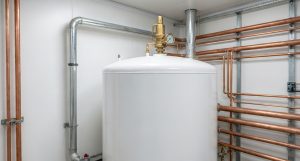
A burst overflow pipe on the 12th floor of a commercial office building does not stay a small problem for long. Water finds the elevator shaft, damages ceiling assemblies on multiple floors, and shuts down tenant operations while insurance adjusters and restoration crews take over. The repair bill for a single overflow failure in a mid-rise commercial property can reach five figures — and that figure does not include the tenant disruption costs or the code-compliance penalties that follow.
For facilities managers, the overflow pipe is one of those components that receives almost no attention until it fails. It sits above ceilings or in mechanical rooms, out of sight, carrying discharge water from pressure relief valves and expansion tanks. Yet this small-diameter pipe plays a critical safety role in every commercial hot water system.
This guide covers the decisions that matter when selecting, sizing, and installing overflow pipes for commercial hot water systems: material choice, diameter calculation, code compliance, and installation practices that prevent the failures that cost real money.
What Is a Hot Water Overflow Pipe and Why It Matters
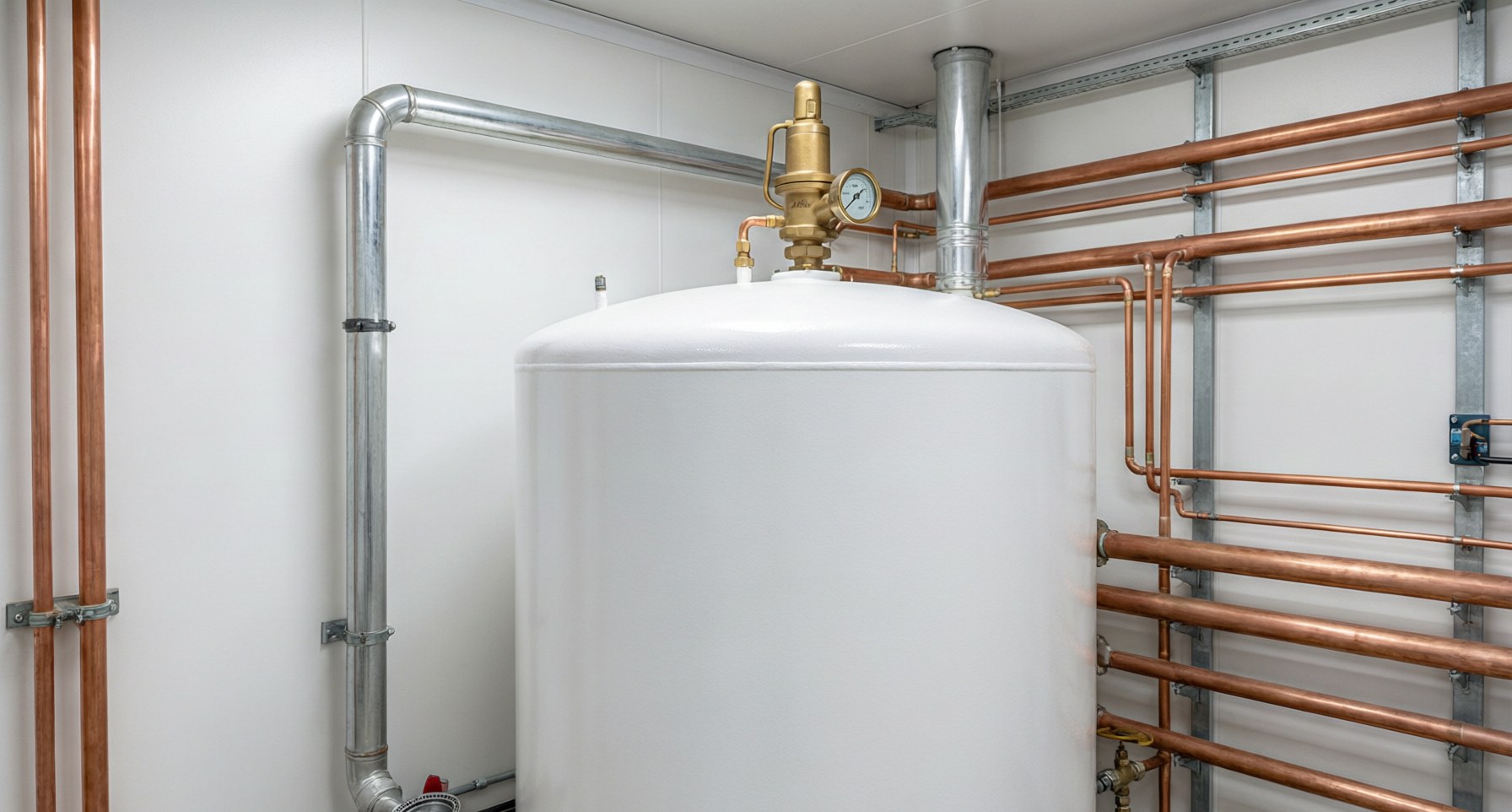
A hot water overflow pipe is a discharge conduit that carries water away from a hot water storage vessel when internal pressure or volume exceeds safe operating limits. It connects to the pressure and temperature relief valve (TPRV) on the storage tank and routes discharged water to a visible point or an approved drainage location.
The overflow pipe exists as a safety device. When a thermostat fails and the heater continues to raise water temperature, pressure builds inside the vessel. The TPRV opens to prevent catastrophic tank failure, and the overflow pipe carries that discharged water safely away. Without a properly sized and installed overflow pipe, that discharge water has nowhere controlled to go.
In commercial buildings, the stakes are higher than in residential settings. Hot water storage vessels in commercial properties typically hold 500 to 2,000 liters. The discharge volume during a relief event is proportionally larger. An overflow pipe that is undersized, poorly routed, or made from a material that degrades over time becomes a liability rather than a safety feature.
Consider the failure modes. A corroded pipe may burst during discharge, sending water into occupied spaces. An undersized pipe restricts flow, leaving the vessel over-pressurized even with the valve open. A poorly supported pipe sags over time, creating low points where mineral deposits accumulate and restrict flow.
Types of Overflow Pipes for Hot Water Systems
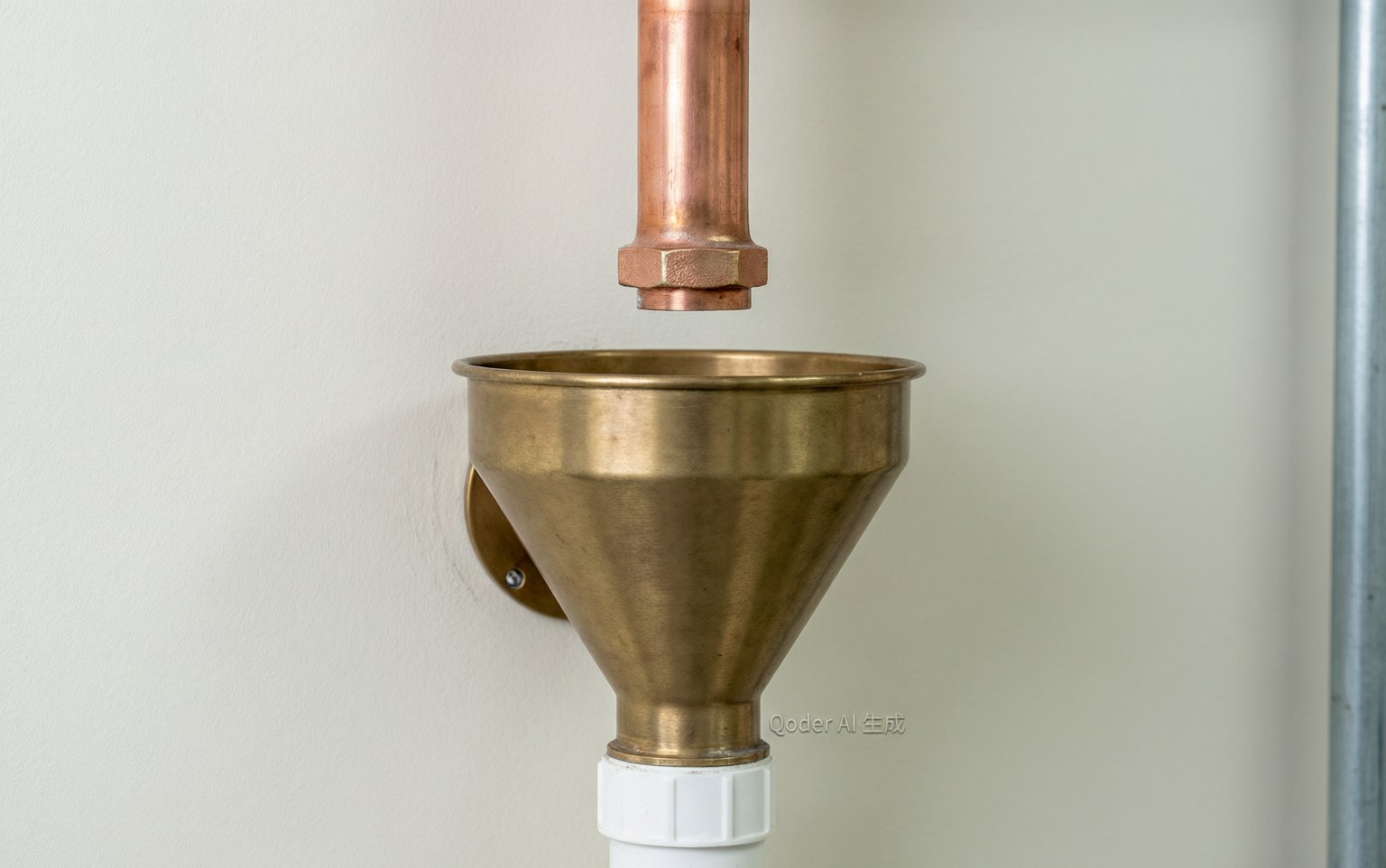
Overflow pipe configurations vary by storage vessel type, pressure relief system design, and local code. The most common commercial configuration uses a tundish overflow — a visible chamber installed between the TPRV outlet and the discharge pipe. It creates an air break to prevent backflow and serves as a visual indicator when the system discharges.
In a direct discharge configuration, the overflow pipe connects directly from the TPRV to the drainage point without an intermediate air break. This setup is simpler and less expensive to install, but it eliminates the visual discharge indicator. Direct discharge configurations are sometimes used in installations where the overflow pipe terminates at an exterior drainage point that is not regularly observed.
Overflow pipes also differ by the type of discharge they handle. Pressure relief overflow pipes carry discharge from TPRV activation events, which occur when system pressure exceeds the valve’s set point. Expansion overflow pipes handle the increased water volume that results from thermal expansion in closed systems. Some commercial installations require both, routed through separate or combined overflow paths.
The discharge path itself can be gravity-fed o pumped. Gravity-fed systems rely on a continuous downward slope and have no mechanical dependencies, making them the most reliable option. Gravity discharge is the code-preferred arrangement whenever the terminal drain point can be positioned below the relief valve outlet — a rooftop mechanical room draining down to ground level is exactly such a case. A pumped discharge is required only when the drain point cannot be located below the valve, for example where the discharge must rise to a sewer connection at a higher elevation. Pumped systems add a maintenance-dependent failure point and must follow the pump manufacturer’s instructions and local code.
Material Selection: PPR vs Copper vs Stainless Steel
Material selection has the longest-lasting impact on overflow pipe performance. The three materials most commonly specified — PPR, copper, and stainless steel — each have distinct characteristics and cost profiles. The right choice depends on water chemistry, installation environment, budget, and local code acceptance.
The table below compares these three materials across the factors that matter most for overflow pipe applications in commercial buildings.
| Factor | PPR | Copper | Stainless Steel |
|---|---|---|---|
| Material cost (relative) | Low (baseline) | 2–3× PPR | 3–5× PPR |
| Max continuous temperature | 70°C (95°C short-term) | 100°C+ | 100°C+ |
| Corrosion resistance | Excellent — inert to most water chemistries | Good in neutral pH; vulnerable in acidic or high-sulfate water | Excellent across wide pH range |
| Joint method | Socket fusion welding (monolithic) | Soldered or press-fit | Welded or threaded |
| Joint leak risk | Very low — joint strength equals or exceeds pipe body | Moderate — solder joints can develop pinhole leaks | Low with welded joints; moderate with threaded |
| Thermal expansion coefficient | High (~0.15 mm/m·°C) | Low (~0.017 mm/m·°C) | Low (~0.016 mm/m·°C) |
| UV resistance | Poor — requires protection from direct sunlight | Bien | Excelente |
| Expected service life | 50+ years at 70°C (per ISO 15874) | 50+ years in favorable water conditions | 50+ years across most conditions |
| Installation skill requirement | Fusion welding equipment and training | Soldering skill or press tool | Welding or threading skill |
PPR has gained significant adoption in commercial hot water systems, including overflow applications. Its primary advantages are corrosion resistance — PPR is chemically inert to the range of water chemistries typically found in commercial buildings — and joint integrity. Socket fusion welding creates a monolithic connection where the joint is as strong as the pipe body itself, which essentially eliminates the joint-leak failure mode that affects soldered copper systems.
PPR’s main limitation is its higher thermal expansion coefficient — roughly five to six times that of copper at the same temperature change. This is manageable with proper support spacing and expansion loops but requires attention during design. PPR also cannot be exposed to direct sunlight, so outdoor runs require UV protection. For available PPR piping specifications, see the Serie Global PPR.
Copper remains widely specified and is mandated by some local codes. Its advantages include high temperature tolerance, rigidity, and UV resistance. However, copper is vulnerable to pinhole corrosion in low-pH or high-sulfate water, and soldered joints represent potential leak points in systems with frequent thermal cycling.
Stainless steel offers the broadest corrosion resistance but at three to five times the material cost of PPR. It is typically reserved for healthcare facilities with aggressive water treatment protocols or installations where water chemistry exceeds the limits of PPR and copper.
Sizing and Standards for Commercial Overflow Pipes
Overflow pipe diameter is not a guess-and-check decision. It must be sized to handle the maximum discharge flow from the pressure relief valve without creating back-pressure that could impede the valve’s operation. An undersized overflow pipe can render even a correctly rated TPRV ineffective.
The fundamental sizing rule: the overflow pipe’s internal diameter must equal or exceed the TPRV outlet diameter. In practice, commercial installations often step up one size to account for friction losses over the pipe run length. A 20mm TPRV outlet typically calls for a 25mm overflow pipe if the run exceeds 3 meters; for runs under 3 meters with minimal fittings, 20mm may be acceptable.
The table below provides general sizing guidance for common commercial hot water system configurations — a planning aid, not a substitute for a hydraulic calculation. Verify against your specific TPRV specifications and the local plumbing code (for example ASME A112.4.1 in North America, EN 1490 or national equivalents in Europe), and never run the overflow pipe smaller than the relief valve outlet.
| Storage Volume | Typical TPRV Size | Recommended Overflow Pipe Diameter | Max Run Length (at this diameter) |
|---|---|---|---|
| 100–300 liters | 20mm | 20mm | Up to 3m (fewer than 3 fittings) |
| 300–500 liters | 20mm | 25mm | Up to 6m |
| 500–1,000 liters | 25mm | 25mm | Up to 5m |
| 1,000–2,000 liters | 25mm or 32mm | 32mm | Up to 8m |
| Over 2,000 liters | 32mm+ | 32mm or per engineer spec | Per hydraulic calculation |
Key standards governing overflow pipe design include ISO 15874 (plastics piping for hot and cold water), EN 806 (building water installations), and IPC Section 608 (relief valve discharge pipes in the US). Regardless of the applicable standard, overflow pipes must discharge to a visible point with an air gap — typically 25mm minimum between the pipe outlet and the flood level of the receiving drain.
Documenting the applicable code for each building and maintaining a reference table of TPRV sizes and overflow pipe diameters per vessel creates a useful resource for maintenance teams. Additional compliance documentation is available on our certifications page.
Buenas prácticas de instalación
Proper material selection and correct sizing mean nothing if the installation introduces failure points. The following practices apply specifically to overflow pipe installations in commercial hot water systems, with emphasis on PPR installations where fusion welding is the joint method.
Fusion welding quality. PPR joints are made by socket fusion welding — the pipe end and fitting are heated to approximately 260°C and joined under pressure. Allow the weld to cool undisturbed for the manufacturer-specified time. A proper fusion joint shows a small, uniform bead at the joint edge. An irregular or absent bead indicates a cold weld that must be cut out and remade.
Support spacing. PPR requires more frequent support than copper due to lower rigidity. For horizontal runs, spacing should not exceed 500mm for 20mm pipe, 650mm for 25mm, and 800mm for 32mm. Supports should allow axial movement for thermal expansion.
Expansion compensation. For straight runs longer than 6 meters, include an expansion loop or offset to absorb thermal movement. A simple U-shaped loop with arms at least 200mm long handles the expansion in most overflow pipe installations. Do not rigidly constrain the pipe at both ends of a long run without providing expansion compensation.
Slope for gravity discharge. The overflow pipe must maintain a continuous downward slope from the TPRV to the discharge point. A minimum slope of 1:100 (10mm per meter) is recommended. Avoid low points where water can pool — these become scale accumulation points and can restrict flow over time. If the routing requires the pipe to go up at any point, install a vacuum breaker at the high point to prevent siphoning.
Insulation in unconditioned spaces. If the overflow pipe runs through unconditioned spaces — rooftop mechanical rooms, exterior walls, unheated structures — insulate with closed-cell foam sleeves to prevent freezing. Insulation also prevents condensation on the pipe exterior during discharge events in humid environments.
Tundish installation. Mount the tundish vertically in an accessible location where maintenance staff can see it during routine rounds. Ensure the air gap inside the tundish matches the manufacturer’s specification — typically 20mm minimum.
1. Verify overflow pipe diameter matches or exceeds TPRV outlet size
2. Confirm continuous downward slope from vessel to discharge point
3. Install supports at specified spacing with allowance for thermal movement
4. Include expansion compensation for straight runs exceeding 6 meters
5. Make all PPR fusion joints per manufacturer temperature and time specifications
6. Inspect each fusion joint for uniform bead before concealing pipe
7. Install tundish in accessible, visible location if specified
8. Verify air gap at discharge point meets code minimum
9. Insulate pipe in unconditioned spaces
10. Label overflow pipe at both ends and at intervals not exceeding 3 meters
Troubleshooting Common Overflow Pipe Issues
Overflow pipes do not fail often, but when they do, the consequences justify a structured troubleshooting approach. The symptoms below cover the most common issues facilities managers encounter, with diagnostic steps and resolution guidance.
Continuous dripping or flow. Occasional short discharge during heating cycles is normal. Continuous flow signals a fault. Check the system pressure gauge first — if pressure exceeds the TPRV set point — commonly 150 psi / 1.03 MPa for North American combination temperature-and-pressure relief valves, and roughly 600-700 kPa (6-7 bar) in many European installations; always confirm the value stamped on the valve nameplate or required by the local code — the issue is likely a failed pressure-reducing valve. If pressure is normal but flow continues, the TPRV itself may need replacement.
Discharge with no apparent cause. If pressure and temperature readings are normal, check for a failed expansion vessel. A ruptured bladder cannot absorb thermal expansion, causing pressure to rise until the TPRV opens. Test by pressing the Schrader valve — water instead of air indicates bladder failure.
Scale buildup restricting flow. In hard water areas, mineral deposits reduce internal diameter over time. This is more common in metallic pipes. PPR’s smooth interior resists scale adhesion more effectively. If restriction is suspected, replace the affected section rather than attempting chemical descaling.
Visible corrosion or degradation. Copper overflow pipes in aggressive water may show green patina or blue-green staining at joints, indicating active corrosion. PPR does not corrode chemically but can show thermal stress discoloration if temperatures regularly exceed rated capacity. During quarterly inspections, check all visible supports and re-secure any that have loosened from thermal cycling.
When to repair versus replace. Isolated issues — a single failed support, a leaking joint at one location — can often be repaired in place. Widespread scale buildup, multiple corrosion points, or a pipe that has been in service for more than 25 years (for copper) warrants full replacement. When replacing, consider upgrading to PPR if the existing system uses copper and water chemistry has contributed to the degradation. Our Serie de calidad PPR offers options suited for retrofit applications.
If troubleshooting reveals issues beyond routine maintenance, contact our technical support team for guidance on material selection and specifications for your replacement system.
Choosing the Right Overflow Pipe for Your Facility
The overflow pipe selection process comes down to matching four facility-specific variables against the material and sizing options covered in this guide. Work through each variable systematically, and the right specification becomes clear.
Water chemistry. Obtain or reference your most recent water quality report. If pH is below 6.5 or sulfate levels are elevated, PPR’s corrosion resistance becomes a significant advantage over copper. If water chemistry is neutral and stable, copper and PPR both perform well.
Installation environment. Map the overflow pipe routing from TPRV to discharge point. If any section runs through exterior exposed areas with direct sunlight, that section requires UV-resistant material or protected PPR with insulation sleeving. Interior-only runs through conditioned spaces suit PPR without additional protection.
Budget and lifecycle cost. Compare total installed cost — materials, labor, maintenance, and replacement frequency. PPR typically offers the lowest total installed cost for interior commercial overflow installations. Stainless steel’s premium is justified only in environments demanding its specific corrosion resistance.
Local code requirements. Before finalizing your specification, confirm that the selected material and sizing comply with your local plumbing code. Some jurisdictions have specific requirements for overflow pipe materials, discharge configurations, or air gap dimensions. If your jurisdiction does not specifically address PPR for overflow applications, the ISO 15874 certification provides the standards basis for approval.
The decision framework below summarizes the selection logic for common commercial scenarios.
| Facility Condition | Recommended Material | Rationale |
|---|---|---|
| Interior run, neutral water, budget-sensitive | PPR | Lowest cost, excellent joint integrity, corrosion-proof |
| Interior run, aggressive water chemistry (low pH) | PPR or Stainless Steel | PPR resists chemical attack; SS for extreme conditions |
| Exterior exposed section, no UV protection available | Copper | UV resistant, rigid, code-accepted for exposed runs |
| Healthcare or pharmaceutical facility | Stainless Steel | Withstands aggressive sterilization and water treatment |
| Code mandates metallic pipe | Copper | Most widely accepted metallic option; lower cost than SS |
Overflow pipe selection is a small decision within a commercial plumbing system, but it is one where getting the specification right prevents expensive failures. The material performs its safety function reliably for decades when matched to the installation conditions and sized correctly.
For facilities managers ready to evaluate PPR piping systems for their overflow applications, the Serie Global PPR provides the full range of diameters, pressure ratings, and fittings needed for commercial hot water overflow installations. Browse the complete product series overview to compare options across application types.
Frequently Asked Questions
What size overflow pipe do I need for a commercial hot water system?
Commercial hot water overflow pipe diameter typically ranges from 20mm to 32mm, depending on the storage vessel capacity, heater output, and local plumbing code requirements. The overflow pipe diameter should generally match or exceed the pressure relief valve outlet size. For systems with storage volumes above 500 liters, 25mm or 32mm diameters are common.
Can PPR pipes be used for hot water overflow applications?
Yes. PPR pipes are suitable for hot water overflow applications. They handle continuous temperatures up to 70°C and short-term peaks up to 95°C, covering typical commercial hot water storage conditions. PPR is certified under ISO 15874 for hot and cold water installations, and fusion-welded joints provide leak-free connections.
How often should commercial overflow pipes be inspected?
Overflow pipes should be visually inspected at least quarterly. Check for scale buildup, corrosion signs, loose supports, and proper discharge flow path. Full flow testing should be conducted annually alongside pressure relief valve servicing. Facilities with hard water may need more frequent inspection due to mineral deposit accumulation.
Why is my overflow pipe continuously discharging water?
Continuous discharge typically indicates a system fault. Common causes include a faulty pressure relief valve, excessive system pressure from a failing pressure-reducing valve, malfunctioning temperature controls, or a failed expansion vessel. Occasional short discharge during heating cycles is normal. Continuous flow warrants immediate investigation.
Is PPR more cost-effective than copper for commercial overflow pipes?
In most commercial applications, PPR offers lower total installed cost. Material costs are typically 40–60% lower than copper, and fusion welding is faster than soldering. When you factor in corrosion resistance and reduced joint-related maintenance, the lifecycle cost advantage of PPR grows over a 25-year service period.









 English
 Español
 Français
 Português do Brasil