

I once visited a facility where they feared using plastic pipes for fuel transfer. Their worry was static electricity—a real and dangerous concern that stopped their project.
You prevent static buildup in plastic pipes for flammable fluids by using specially made static-dissipative pipes, installing a complete grounding and bonding system, and strictly following industry safety standards. This three-part approach safely guides static charges to the ground, eliminating the spark risk that could ignite vapors.
This is not just an add-on feature; it’s a basic safety requirement. Let me explain the key components that make a plastic piping system safe for handling solvents and fuels.
What are the Conductive or Carbon-Loaded Compounds Used in Static-Dissipative Pipes?
Ordinary plastic is an insulator. For safe fuel handling, we need to make it slightly conductive. This is where compound technology becomes critical.
Static-dissipative pipes use special compounds where conductive materials, like carbon black or carbon fibers, mix into the plastic resin (like HDPE or PP). This creates a permanent network inside the pipe wall that allows static charges to flow slowly to the ground instead of building up to a dangerous spark.

The Science Behind the Safety
Think of normal plastic like a rubber rug. Walking on it builds up static charge on your body. Static-dissipative plastic is like an antistatic mat—it lets the charge leak away safely. Manufacturers achieve this by adding conductive fillers during the pipe extrusion process.
The most common and cost-effective filler is carbon black. Engineers finely distribute it throughout the polymer matrix. When the carbon black particles touch each other, they form conductive pathways. The right amount and distribution are crucial. Too little carbon black, and the pipe remains insulating. Too much, and the pipe becomes overly conductive and loses its mechanical strength.
For more demanding applications, manufacturers use carbon fibers o metallic fibers. These fillers create even better and more reliable conductive networks at lower loading levels. This helps maintain the pipe’s original flexibility and pressure rating.
Choosing the Right Material for the Job
Not all conductive pipes are the same. Their performance is measured by surface resistivity o volume resistivity, usually expressed in ohms. A safe range for static dissipation is typically between 10^5 to 10^9 ohms. Pipes in this range drain charge effectively without being as conductive as metal.
Here is a comparison of common conductive compounds:
| Conductive Filler Type | How It Works | Best Use Case | Ventajas clave |
|---|---|---|---|
| Carbon Black | Particles form connected pathways in the plastic. | General fuel transfer, solvent lines. | Most cost-effective; good for standard applications. |
| Carbon Fiber | Long, thin fibers create a robust network. | High-purity systems, aggressive chemicals. | Better conductivity with less filler; maintains pipe properties. |
| Inherently Dissipative Polymer (IDP) | Special polymer blend is conductive by nature. | Sensitive environments (e.g., electronics). | Clean, no carbon dust; consistent performance. |
When you select a pipe, you must confirm its resistivity rating with the supplier. Always ask for a test report. The pipe must be homogenous—the conductive property should run through the entire pipe wall and every fitting. At IFAN, we ensure our conductive compounds have consistent dispersion, providing reliable and certified static dissipation throughout the system.
How is Proper Grounding and Bonding Achieved in a Non-Metallic Piping System?
A conductive pipe alone is not enough. It’s like having a wire without plugging it into the ground. The charge needs a dedicated path to leave the system safely.
Proper grounding is achieved by connecting all conductive pipe sections and components to a certified earth ground using copper wires, braids, or clamps. Bonding is done by ensuring electrical continuity across every joint—using conductive adhesives, gaskets, or clamps—so the entire network becomes one connected system for charge to flow through.

Step-by-Step: Building a Safe Path to Earth
Grounding a plastic system is different from grounding metal pipes. You must add the conductive path yourself. Here is the standard practice:
1. Install Grounding Clamps and Lugs: You attach special stainless steel or brass clamps to the pipe at designated points. These clamps have a terminal to connect a grounding wire. It is vital to clean the pipe surface at the clamp location to ensure good metal-to-pipe contact.
2. Use Conductive Bonding Across Joints: Every connection point is a potential break in the electrical path. For flanged connections, you use conductive gaskets. For threaded or fused joints, you must install a bonding wire o jumper cable that physically connects the two metal parts of the adjoining fittings. Some advanced electrofusion fittings have built-in conductive elements that make this connection automatically.
3. Run a Grounding Conductor to the Earth Ground: You connect all the clamps and bonding points with a heavy-gauge bare copper wire. This wire then connects to the facility’s main grounding electrode system. This final connection to the earth is what allows the static charge to dissipate safely.
Common Mistakes and How to Avoid Them
Many system failures happen during installation. Here are the most frequent errors:
- Using Insulating Gaskets: A standard rubber gasket in a flanged connection will block the electrical path. Always specify conductive gaskets.
- Forgetting Bonding Jumpers: If you have two metal valves installed in a plastic line, they are isolated by the plastic pipe. A bonding jumper between the valve bodies is essential.
- Poor Contact at Clamps: Paint, dirt, or a loose clamp will prevent good electrical contact. The clamp must bite into the pipe material slightly.
- No Final Earth Connection: The copper wire must connect to a verified, low-resistance earth ground. A wire that ends at a steel beam is not sufficient.
The table below outlines the key components of a static-safe piping network:
| System Component | Its Role in Static Safety | Material & Specification |
|---|---|---|
| Conductive Pipe & Fittings | Provides the main path for charge to flow. | Carbon-loaded HDPE/PP; Volume Resistivity < 10^9 Ω·cm. |
| Grounding Clamps | Attaches the wire to the pipe. | Stainless steel/Brass; must pierce pipe surface oxide. |
| Bonding Jumpers & Wires | Bridges across joints and components. | Bare tinned copper braid or cable; low resistance. |
| Earth Grounding Electrode | The final destination for the charge. | Facility’s grounding rod or grid; resistance < 25 ohms. |
A best practice is to measure the electrical continuity of the entire system after installation using a megohmmeter. This test confirms that every part of the pipe network is connected and the resistance to ground is within safe limits.
What Industry Standards Like API RP 2003 Define Safety Requirements?
You cannot rely on guesswork for safety. Industry standards provide the essential rulebook for designing and operating these systems.
Key industry standards like API RP 2003 (Protection Against Ignitions Arising from Static, Lightning, and Stray Currents) and NFPA 77 (Recommended Practice on Static Electricity) define the safety requirements. They specify maximum allowable flow velocities, material resistivity limits, and mandatory grounding practices to prevent static charge generation and accumulation in piping systems.

Understanding the Rulebook: API RP 2003 and NFPA 77
These documents are not just guidelines for experts; they are the consensus of best practices from the entire industry. They tell you exactly what to do and what to avoid.
API Recommended Practice 2003 is the primary standard for the petroleum and petrochemical industry. It is very practical. For example, it sets a critical safety rule: the maximum flow velocity for hydrocarbons in pipes. A very fast flow generates more static electricity. The standard often cites a limit of 7 meters per second as a safe velocity until you can prove the system is properly grounded. It also clearly states that non-metallic pipes must have a resistance to ground of less than 10^6 ohms (1 Megohm).
NFPA 77 provides a broader framework for all static electricity hazards. It explains the science and offers detailed recommendations on bonding and grounding techniques for different equipment. It emphasizes that you must bond all isolated conductors within the system, including filters, strainers, and tanks, to the same ground.
Other Relevant Standards and Certifications
Depending on your region and industry, other standards may apply:
- IEC 60079-32-1: An international standard for explosive atmospheres, covering electrostatic hazards.
- ATEX Directive (EU): Regulatory requirements for equipment used in explosive atmospheres.
- OSHA Regulations (US): The Occupational Safety and Health Administration has general rules about controlling ignition sources, which inherently apply to static electricity.
How Standards Translate to Your Project
When you work with a supplier like IFAN, these standards shape the entire process. They determine:
- Product Design: Our static-dissipative pipes are manufactured to meet the resistivity limits in these standards.
- System Engineering: We design the grounding scheme based on standard-prescribed methods.
- Documentation: We provide test certificates proving our materials comply with the relevant clauses of API RP 2003 or NFPA 77.
Always insist on documentation that shows compliance. It is your proof that the system was built with safety as the first priority.
Why is This a Fundamental Safety Requirement for Solvents and Fuels Handling?
Static electricity is an invisible, ever-present danger in fluid transfer. Ignoring it is an unacceptable risk.
This is a fundamental safety requirement because a single static spark can ignite flammable vapors from solvents or fuels, causing a fire or explosion. Plastic pipes inherently generate static charge when fluids flow through them. Without a safe way to drain this charge, it accumulates until it jumps as a spark—a direct ignition source in a potentially explosive atmosphere.
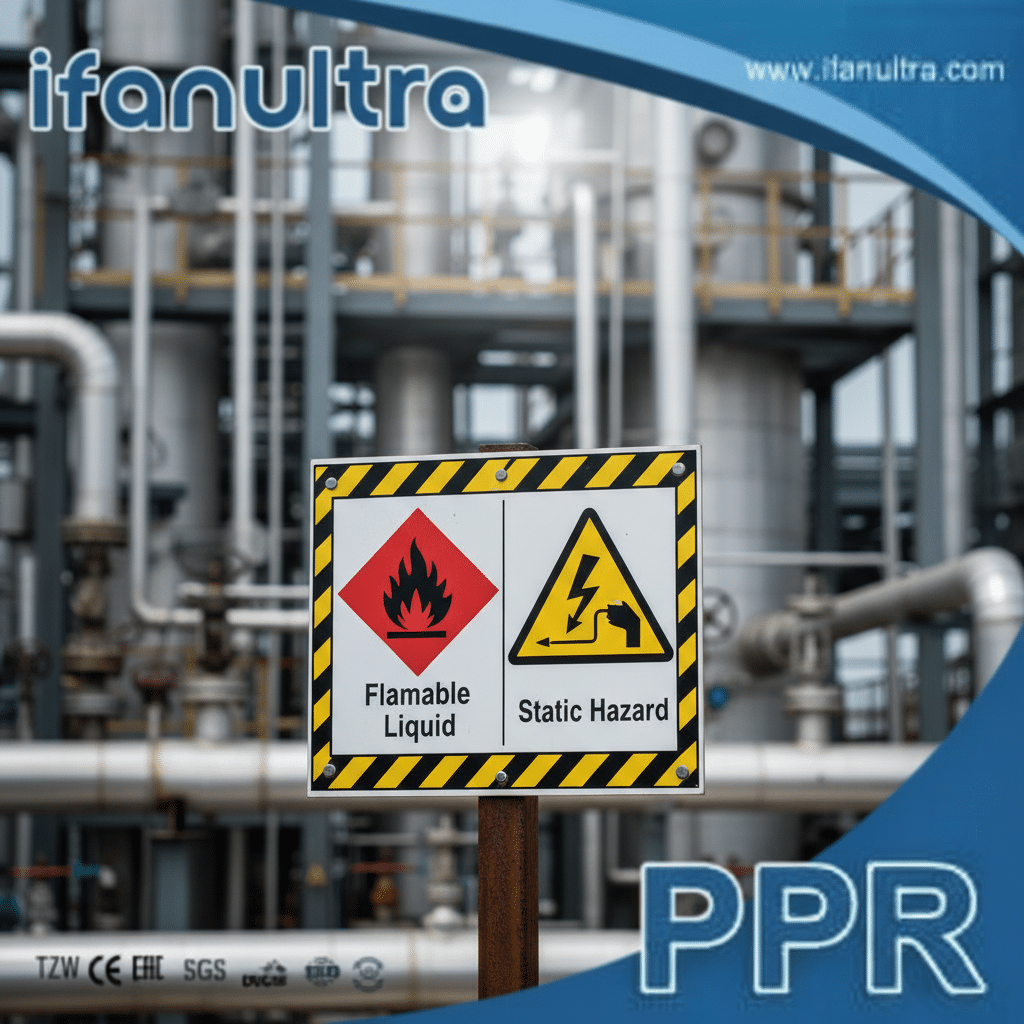
The Simple Physics of a Major Hazard
To understand the risk, you need to know three things: Generation, Accumulation, and Discharge.
1. Generation (Where the charge comes from): When a liquid like gasoline flows through a pipe, friction occurs. This friction strips electrons from the liquid molecules and deposits them on the pipe wall. This process, called the “flow electrification” or “streaming current,” continuously generates static electricity. The faster the flow and the lower the fluid conductivity, the more charge it generates.
2. Accumulation (Where the charge gets stuck): Ordinary plastic is an excellent insulator. The charge generated cannot move through it. So, the charge builds up on the inner surface of the pipe, creating a high voltage. Isolated metal components like valves or filters in the line can also become charged.
3. Discharge (The dangerous result): When the voltage gets high enough, it will find a way to equalize. It can jump as a spark to a nearby grounded object, or it can create a brush discharge inside the pipe. If the spark has enough energy and finds a mixture of fuel vapor and air within its flammable range, it will cause ignition.
Real-World Consequences and the Human Factor
The consequences are severe: fires, explosions, equipment damage, severe injuries, and loss of life. What makes static especially dangerous is its unpredictability. An operation might seem safe for years until one day, a slight change in humidity, flow rate, or fluid composition creates the perfect conditions for a disaster.
Furthermore, operators often cannot see or feel the hazard until it is too late. This is why a passive, built-in safety system is non-negotiable. Static-dissipative pipes with proper grounding work automatically, 24/7, without any need for human intervention. They remove the ignition source before it can ever become a threat.
Investing in this protection is not an extra cost; it is the foundation of responsible operations when handling flammable fluids with plastic piping.
Conclusión
Preventing static buildup requires the right conductive materials, flawless grounding, and adherence to strict standards. For a complete, certified safe system, partner with IFAN for your static-dissipative piping and bonding solutions.









 English
 Español
 Français
 Português do Brasil