
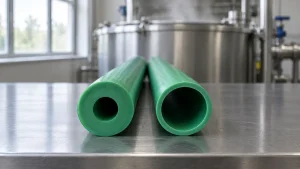
A container of DN63 pipe lands for a hotel’s 70 °C hot-water risers. The print line says PP-RCT. Every length measures to size and every joint fuses, and none of that tells you which resin you bought, because PP-R and PP-RCT share outside diameters and fuse to each other.
Here is the short answer. PP-RCT is polypropylene random copolymer with modified crystallinity and temperature resistance. ISO 15874-2:2013 asks it to carry more hoop stress than PP-R in long hot service, so one pressure class can run on a thinner wall. It is not stronger everywhere. At 20 °C for 1 hour the standard asks PP-RCT to survive 15.0 MPa and PP-R 16.0 MPa. That inversion is why an importer cannot confirm the grade with a quick test. The order needs three controls: a print line that names the grade, paperwork tied to the resin batch, and a 95 °C test that runs for days.
Key Takeaways
- ISO 15874-2:2013 asks PP-RCT to survive 15.0 MPa at 20 °C for 1 hour where PP-R must survive 16.0 MPa. A fast test favours the cheaper grade.
- The grades separate only in long hot tests: at 95 °C for 1,000 hours, PP-RCT must hold 3.8 MPa against 3.5 MPa for PP-R.
- In dimension class A, the S8, S6.3 and S4 series are valid only for PP-RCT. A pipe printed PP-R on one of those walls is off-standard.
- At Class 2 and 10 bar, PP-RCT at S3.2 gives 47-49% more flow area and 26-27% less resin per metre than PP-R at S2.
- A PP-R pipe delivered on that S3.2 wall runs at 3.2 MPa against a 2.12 MPa design stress, 51% over.
On this page
The Plastics Pipe Institute trains installers on PP-R and PP-RCT in a single socket-fusion film. From 6:28 it runs the fusion itself, and nothing in that sequence would tell you which grade went into the joint.

PP-RCT vs PP-R at a Glance: What ISO 15874-2 Actually Separates
Both grades live in the same standard. The foreword to ISO 15874-1:2013 records that the material PP-RCT was included in clause 5.1, and Part 2 added it to its wall-thickness table in the same edition. The pipe part in force is ISO 15874-2:2013 with Amd 1:2018 and Amd 2:2022. A replacement draft, ISO/CD 15874-2, closed its comment period on 20 May 2026, so cite the dated edition on your order.
Read the table below row by row. Two rows favour PP-R, and those are the rows a hurried inspector reaches first.
| Requisito | PP-R value (MPa or status) | PP-RCT value (MPa or status) | Verdict for the order |
|---|---|---|---|
| Hoop stress, 20 °C, 1 h (MPa) | 16.0 | 15.0 | PP-R higher; useless for grade proof |
| Hoop stress, 95 °C, 22 h (MPa) | 4.3 | 4.2 | PP-R higher; useless for grade proof |
| Hoop stress, 95 °C, 165 h (MPa) | 3.8 | 4.0 | First point that separates the grades |
| Hoop stress, 95 °C, 1,000 h (MPa) | 3.5 | 3.8 | Separates the grades; 41.7 days |
| Thermal stability, 110 °C, 8,760 h (MPa) | 1.9 | 2.6 | Separates the grades; a full year |
| Design stress, Class 2 (MPa) | 2.12 | 3.40 | PP-RCT allows a thinner wall |
| Thin series S8, S6.3, S4 | Not permitted | Permitted | Check the printed wall against the grade |
| Fusion to the other grade | Yes | Yes | No site check reveals a swap |
Why a Room-Temperature Pressure Test Picks the Wrong Grade
Table 10 of ISO 15874-2:2013 sets four hydrostatic points for each grade, three test pieces each, water inside and outside the specimen, methods ISO 1167-1 and ISO 1167-2. At 20 °C for 1 hour, PP-R must survive 16.0 MPa and PP-RCT 15.0 MPa. At 95 °C for 22 hours, the figures are 4.3 and 4.2 MPa. On both short points the standard expects PP-R to do slightly better.
That matters on the dock. A burst rig or a one-hour hold is the test a buyer can buy quickly, and it is the test where a PP-R substitute looks at least as good as the grade you paid for. A pass proves the pipe is polypropylene pipe of sound manufacture. It says nothing about which reference curve the resin was qualified against.
The cheaper checks do not help either. Longitudinal reversion runs at 135 °C for both grades with the same ≤2% limit. Melt flow rate carries one compound limit, ≤0.5 g/10 min at 230 °C and 2.16 kg, for every material in the table. The grades part company only at 95 °C for 165 hours (3.8 against 4.0 MPa) and 1,000 hours (3.5 against 3.8 MPa), and in the 110 °C thermal stability test at 2.6 MPa for PP-RCT against 1.9 MPa for PP-R. Those tests take 6.9 days, 41.7 days and 365 days.
| Test duration at 95 °C (hours) | PP-R (MPa) | PP-RCT (MPa) |
|---|---|---|
| 22 | 4.3 | 4.2 |
| 165 | 3.8 | 4.0 |
| 1,000 | 3.5 | 3.8 |
Which Grade Should You Order? Where PP-RCT Pays for Its Premium
Order PP-RCT when the application class and design pressure would otherwise push PP-R onto a heavy wall. The clean case is Class 2, 70 °C hot-water supply, at 10 bar. ISO 15874-2 caps the pipe series for PP-R at S2.1 there, which in catalogue terms means the S2 wall. For PP-RCT the cap is S3.4, so the S3.2 wall qualifies. Our hot-water class guide carries the full design-stress and series tables for every class; this section only prices the one case.
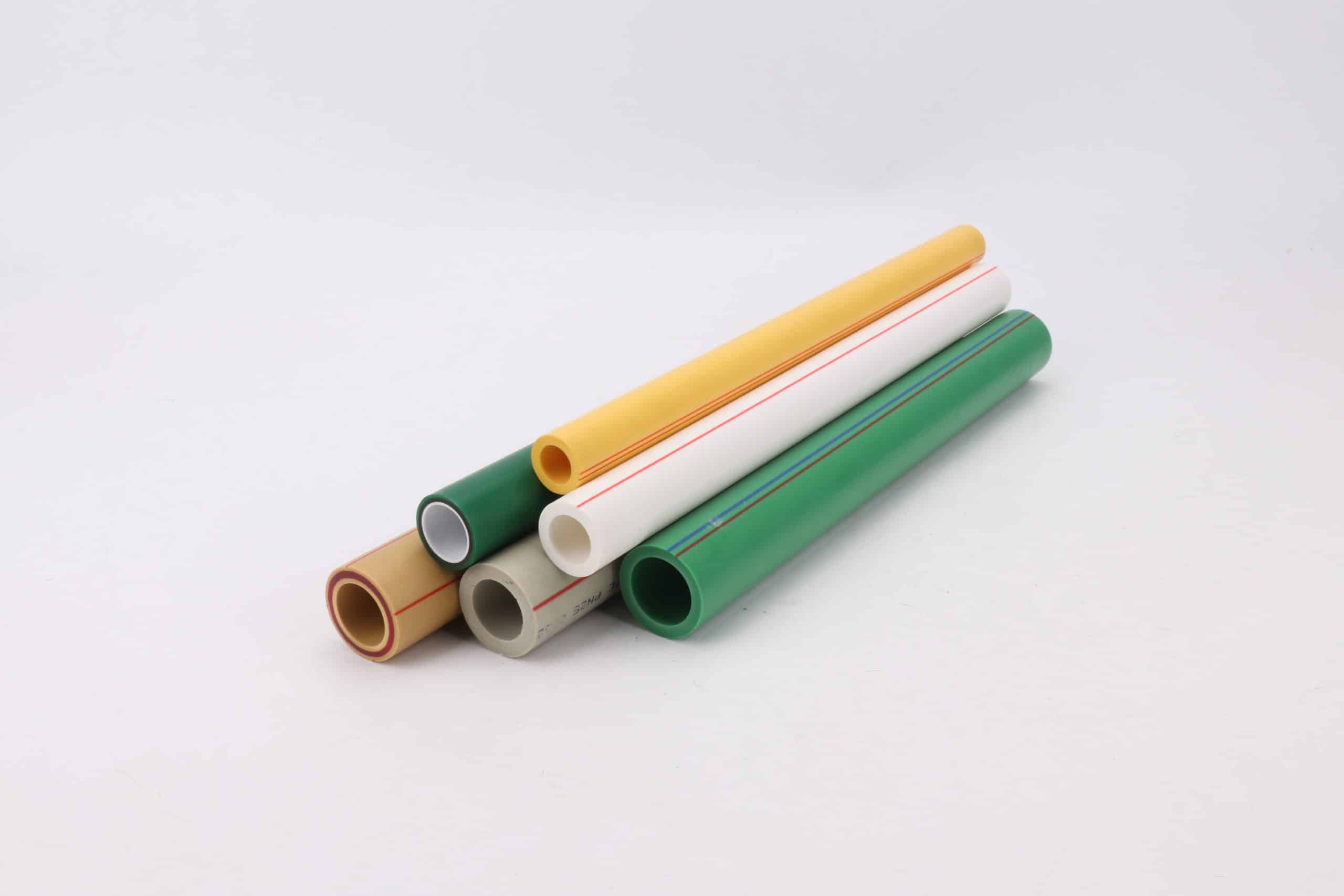
| DN (outside diameter, mm) | PP-R S2 wall / bore (mm) | PP-RCT S3.2 wall / bore (mm) | Flow area gain (%) | Resin per metre (%) |
|---|---|---|---|---|
| 20 | 4.1 / 11.8 | 2.8 / 14.4 | +49 | -26 |
| 25 | 5.1 / 14.8 | 3.5 / 18.0 | +48 | -26 |
| 32 | 6.5 / 19.0 | 4.4 / 23.2 | +49 | -27 |
| 40 | 8.1 / 23.8 | 5.5 / 29.0 | +48 | -27 |
| 63 | 12.7 / 37.6 | 8.6 / 45.8 | +48 | -27 |
| 75 | 15.1 / 44.8 | 10.3 / 54.4 | +47 | -26 |
| 90 | 18.1 / 53.8 | 12.3 / 65.4 | +48 | -27 |
Across the range, the thinner PP-RCT wall buys 47-49% more flow area and uses 26-27% less resin per metre. At 8 bar the gap narrows but stays useful: a DN63 PP-R pipe needs the S2.5 wall and a 42.0 mm bore, while PP-RCT may run on S4 with a 48.8 mm bore.
The resin arithmetic sets your price ceiling. At equal resin prices the PP-RCT metre carries about a quarter less polymer, so a PP-RCT resin priced more than about 36% above PP-R resin erases that saving on the resin line. Ask the supplier to quote both builds per metre and compare them against that line.
| Buyer situation | Order this | Why | Verdict |
|---|---|---|---|
| Cold water or Class 1 at 6 bar | PP-R, standard wall | PP-R already qualifies on common walls | PP-R |
| Class 2 at 8 bar, stock-driven | PP-R S2.5 (PN20) | S2.5 is inside the PP-R cap of 2.6 | PP-R, unless bore matters |
| Class 2 at 10 bar, risers or plant rooms | PP-RCT S3.2 | PP-R would need S2 | PP-RCT |
| Distributor stocking one hot-water line | PP-R PN20 plus a class chart | One SKU family, clear class limits | PP-R, sold by class |
Our published PP-R range runs DN20-DN160 across PN10 to PN25, and the Serie Global PPR page is where those product families sit.
How the Swap Happens, and What It Does to a 70 °C Line
Take the Class 2 riser from the table above, ordered as PP-RCT on the S3.2 wall. Suppose the extruder ran PP-R resin that day, or the stock was relabelled at a trading yard. Every dimension still matches the order, because S3.2 is a legal PP-R series too. The installer fuses it without a second thought, since the two grades fuse to each other.
The standard’s own formula shows the cost. Hoop design stress equals design pressure times pipe series: 1.0 MPa × 3.2 = 3.2 MPa. PP-R’s design stress at Class 2 is 2.12 MPa, so the pipe runs 51% over the stress its 50-year rating was calculated on. The same wall in genuine PP-RCT sits under its 3.40 MPa.
Nothing fails on commissioning day. An ambient-temperature pressure test at handover will not flag it, for the reason covered above. Any shortfall surfaces later, in years of hot service, where the design margin was meant to be. That is why the controls sit on the order, before the deposit, and not on the building site.
Control One: Make the Print Line Carry the Grade
ISO 15874-2 lists a minimum marking set, printed at least once per metre and legible without magnification. It covers the standard number, maker’s name or code, outside diameter by wall, dimension class, the material, the application class with operating pressure, and traceability: production year and month, plus a site code where the maker runs several plants. The 2013 text calls this Table 12. Amendment 2:2022 renumbers it Table 14, so quote the amended table number on a 2026 order.
Write the exact string you expect onto the purchase order, for example material PP-RCT, dimension class A, Class 2/10 bar. Then use the thin series as a tripwire. In Table 5, the S8, S6.3 and S4 columns carry the footnote Only valid for PP-RCT. A DN63 pipe with a 7.1 mm wall printed PP-R is off-standard whatever else it says. Our specification guide walks through the rest of Table 5.
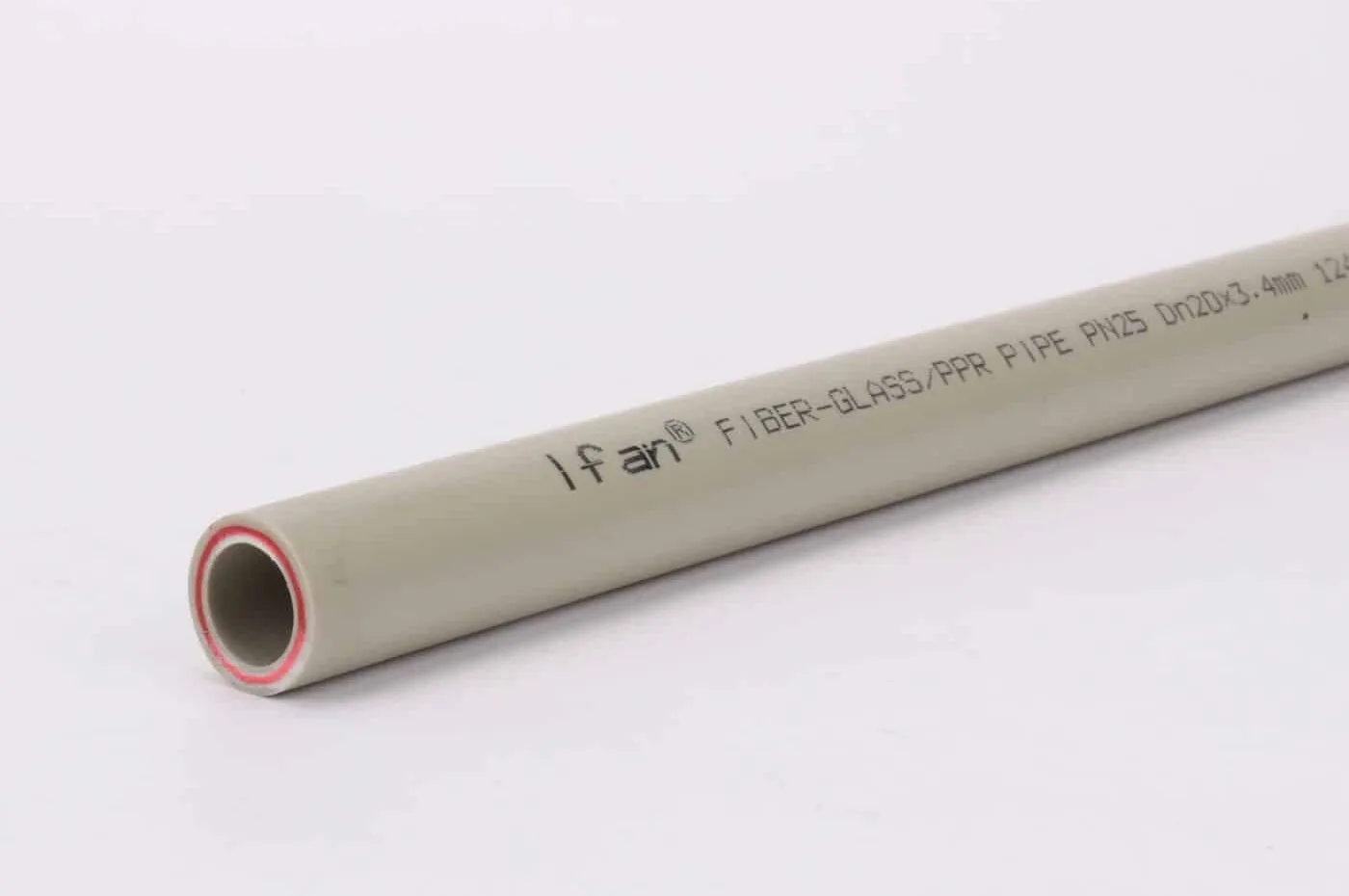
A print line is a claim, and it costs a supplier nothing to type. Its value is that it creates a production period you can hold paperwork against.
Control Two: Reconcile the Certificates to the Resin Lot
Two kinds of evidence get stapled to a shipment. ISO/TS 15874-7:2018 defines a type test as proof that a compound or product is capable of conforming, valid until the compound or product changes. A batch release test is run on a batch and must pass before that batch can be released. A PP-RCT order needs both, and they answer different questions.
- Resin qualification: the compound’s evaluation to ISO 9080:2012, showing it meets the PP-RCT reference curve in ISO 15874-2 Figure 4, not the PP-R curve.
- Compound batch: the resin producer’s certificate naming the grade and batch, with its melt flow rate.
- Pipe batch: a report on the pipe lot whose production period matches the print line, including pipe melt flow rate. ISO 15874-2 allows the pipe to differ by at most 30% from the compound from the same batch, which ties the pipe to a named compound batch.
- Third-party scope: any certificate you rely on should name PP-RCT in its scope, not just PP-R pipe.
Our own QC protocol reconciles printed markings to certificate numbers on PP-R, and the same logic transfers directly. For how certificates are checked at the border, see the customs certificate guide.
Control Three: Test the Property You Paid For
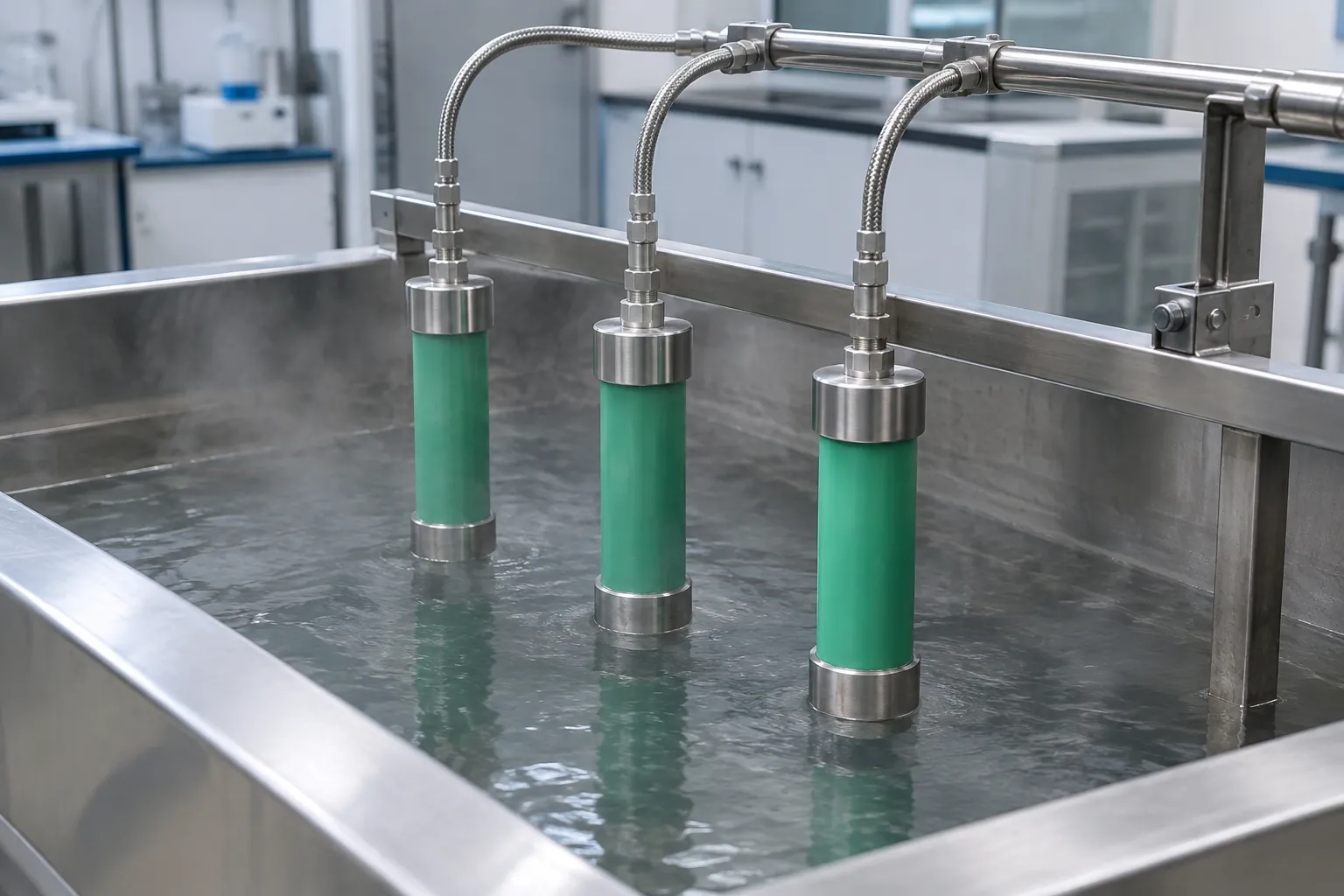
Paper can be wrong, so keep retained samples from each production period and test the property that actually separates the grades. The practical choice is the 95 °C hydrostatic test at 4.0 MPa for 165 hours, three pieces, which takes 6.9 days and exceeds the 3.8 MPa PP-R requirement at the same point. The 1,000-hour point at 3.8 MPa is stronger evidence and takes 41.7 days, which usually means it runs pre-shipment or on a first lot only. A pass does not name the resin. It proves the pipe holds the PP-RCT requirement, which is the property you paid for.
One shortcut needs a warning. A DSC scan is sometimes proposed as a quick grade check, by looking for beta-phase crystals. The Plastics Pipe Institute notes that commercial PP-RCT resins may be alpha-phase or a combination of alpha and beta, so a missing beta peak does not prove PP-R. Treat DSC as a fingerprint against an approved sample, never as a pass/fail grade test.
| Control | Put on the order | What it catches | What it misses |
|---|---|---|---|
| Print line | Exact material, class and period string | Wrong grade printed; PP-R on S4, S6.3, S8 | PP-R resin printed as PP-RCT |
| Paper chain | Type test, compound batch, pipe batch report | Reports for another grade or period | A report written for the wrong lot |
| Hot test | 95 °C, 4.0 MPa, 165 h on retained pieces | Resin that cannot hold PP-RCT stress | Nothing faster than 6.9 days |
Sampling, notice periods and the referee lab belong in the acceptance clause itself; our purchase order clause guide y incoming inspection guide cover that machinery for PP-R, and it applies unchanged here.
What We Check Before a Hot-Water Order Ships
Our published QC protocol for PP-R has five steps, and each maps onto one of the controls above. Resin is verified by source and grade. The wall is calipered on samples drawn across several pallets, not only the top layer. Outside diameter and wall are checked against ISO 15874 and DIN 8077, across our DN20-DN160 range and PN10 (SDR11) to PN25 (SDR5) classes. Pressure and thermal tests run to the rated class. Printed markings are reconciled to certificate numbers.
The fifth step matters most for a grade question, because it puts the print line and the paperwork on one desk. If a supplier cannot show you that reconciliation for a PP-R lot, do not expect it on a PP-RCT lot. If a PP-RCT enquiry comes in, the same five steps would apply, with two changes. The resin check names the PP-RCT compound and its batch. The pressure test runs at the PP-RCT points in Table 10: 4.0 MPa at 95 °C for 165 hours rather than 3.8 MPa, and 3.8 MPa for 1,000 hours rather than 3.5 MPa.
MOQ, Lead Time and Price Structure for a PP-RCT Order
Start from a known baseline. For our published PP-R lines the MOQ is 1 FCL, with LCL possible at a higher per-metre cost, and production takes 15-25 days for one container before ocean transit, on 30% deposit and 70% before shipment. Our first-container plan breaks that down. We do not publish a PP-RCT MOQ or lead time, so ask any supplier, us included, these four questions.
- Is the PP-RCT compound in stock, or bought against your order? Bought-in resin adds the resin lead time in front of the 15-25 day run.
- Is PP-RCT a dedicated extrusion campaign? If it is, ask for the minimum run length, because that becomes your real MOQ.
- Which hot test is held before release? A 165-hour hold adds 6.9 days; a 1,000-hour hold adds 41.7 days.
- Is the quote per metre for both builds, PP-R S2 and PP-RCT S3.2, at your class and pressure?
On price, resin is 70-85% of manufacturing cost, and PP-R resin runs US$780-1,150 per tonne. Those two facts make the break-even test above the useful one. Compare the per-metre quotes, not the per-tonne resin claims.
Conclusión
The trade-off is clear once the numbers sit side by side. PP-RCT buys 47-49% more flow area and a quarter less polymer at Class 2 and 10 bar. What it costs you is verification, because the only tests that separate the grades take 6.9 days or longer, and a substitute passes every quick check.
If the class and pressure let a standard PP-R wall qualify, order PP-R and skip the control burden. If they do not, order PP-RCT with the print string, the paper chain and a retained-sample hot test written into the order.
Frequently Asked Questions
What is the difference between PP-R and PP-RCT pipe?
PP-RCT is a polypropylene random copolymer with modified crystallinity and temperature resistance. Under ISO 15874-2:2013 it must hold 3.8 MPa at 95 °C for 1,000 hours where PP-R must hold 3.5 MPa, so the same hot-water duty can run on a thinner wall. At 20 °C for 1 hour the requirement runs the other way: 15.0 MPa for PP-RCT against 16.0 MPa for PP-R.
Can PP-R and PP-RCT pipe be fused together?
Yes. The Plastics Pipe Institute states the two are completely compatible and that PP-R pipe can be fused to PP-RCT fittings and the reverse. That is also why a mixed or substituted delivery goes unnoticed on site: nothing in the joint behaves differently.
How can I tell if a delivered pipe is really PP-RCT?
Not by eye or with a short test. Check that the print line names PP-RCT with a class and pressure and a production period, reconcile that period to a report on the same compound batch, and hold retained samples for the 95 °C hydrostatic test at 4.0 MPa for 165 hours, which takes 6.9 days.
Is PP-RCT always worth the extra cost?
Only where the class and pressure force a heavy PP-R wall. At Class 2 and 10 bar, PP-R needs the S2 wall while PP-RCT clears S3.2, which gives 47-49% more flow area and 26-27% less resin per metre. On a cold or low-pressure line the PP-R wall already qualifies and the premium buys little.
Which standards name PP-RCT for pipe?
ISO 15874-2:2013 with Amd 1:2018 and Amd 2:2022 for hot and cold water pipe, DIN 8077:2008-09 for dimensions and DIN 8078:2008-09 for quality requirements and testing. In North America the reference is ASTM F2389, revised as F2389-24a in July 2024. A revision of ISO 15874-2 reached committee-draft stage in 2026.









 English
 Español
 Français
 Português do Brasil