

Every PPR joint starts with a cut, and the ppr pipe cutter in your crew’s bag decides how that joint will behave long before the welding machine heats up. Installers tend to buy a cutter once, run it for years, and blame the welder or the pipe when joints misbehave. The tool that fails quietly is the one nobody re-checks.
This comparison looks at the three tool families that actually cut PPR on site: ratchet scissor cutters, rotary wheel cutters, and fine-tooth saws with a guide. The judgment below rests on manufacturer capacity specs, blade geometry, and the fusion-prep practice behind socket welding. We did not run lab squareness measurements for it, and the article says so wherever it matters. The reference diameters are DN20, DN40 and DN63, because that spread covers a service line, the top of ratchet territory, and the point where thick wall starts punishing hand tools.
Key Takeaways
- Ratchet scissor cutters are typically rated to about 42 mm OD by their manufacturers, and they are the fastest clean option inside that range.
- DN63 sits beyond ratchet rated capacity. Rotary wheel cutters or a guided fine-tooth saw take over there.
- An out-of-square cut face fuses only part of the circumference, producing a partial joint that can pass its first pressure test.
- Rotary wheel cutters span small hand classes listed around 14-63 mm up to large-bore ND 160-315 mm units with hardened tool-steel blades.
- Retirement is a diameter rule, not a sharpness rule: past its rated OD, a ratchet cutter leaves service regardless of blade condition.
- Verdicts here come from manufacturer specs and cut mechanics, not laboratory measurements, and the comparison table flags that scope.
A Square Cut Decides The Joint
Socket fusion asks the pipe face and the fitting socket to meet with full contact all the way around, at roughly 260°C, for the heating time that diameter demands. The cut face is the first welding parameter, set before any dial is turned. A face that is not square to the pipe axis hands the welder a problem no temperature setting can fix. Process guidance for heated-element welding of PP pipe is set out in the German guideline DVS 2207-11, and every stage it describes starts from a properly prepared pipe end.
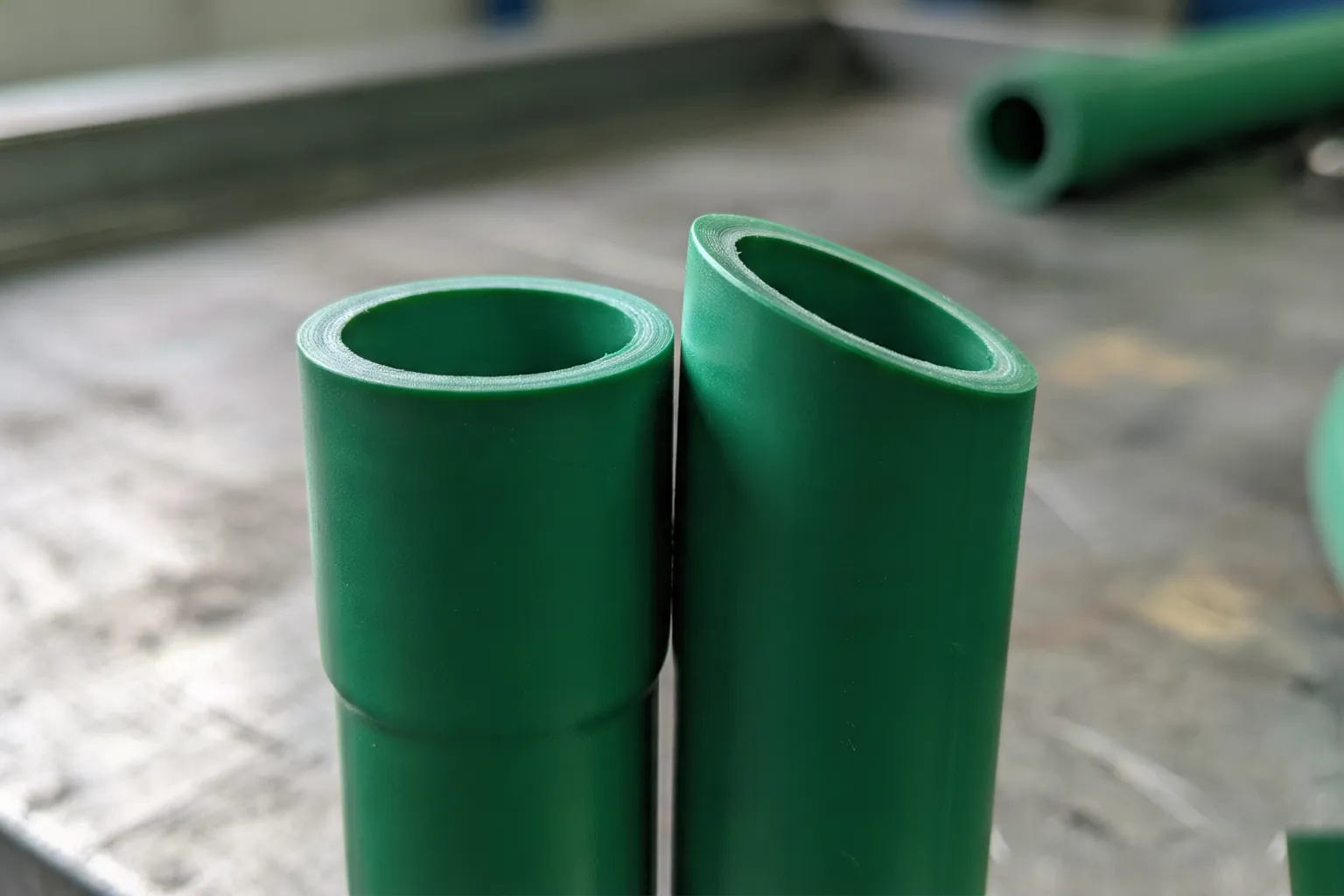
Picture a face tilted by even one degree. One edge of that face reaches the fitting socket first, heats first and melts first, while the opposite edge still sits short. The result is a joint fused on part of its circumference only. It can hold through the installation pressure test and leak months later, once thermal cycling starts working on the weak arc. Our step-by-step guide to PPR heat fusion walks through why contact quality governs every stage after the cut.
The consequence scales with diameter. A DN20 PN20 pipe carries 3.4 mm of wall, so a small face error still leaves most of the ring in contact. A DN63 PN20 pipe carries 10.5 mm of wall, and the same angular error drags a much larger wedge of material out of alignment. More stored stress, less forgiveness, and a bigger joint to cut out and redo when it fails. When those failures appear in service, the diagnosis path runs through the PPR leak causes and fixes guide.
Three Tools That Cut PPR Pipe
Three tool families do nearly all PPR cutting on real jobs. Each one removes material a different way, and the removal method is what decides the face the welder inherits. Capacity figures below are the classes manufacturers list for each family, not universal limits, so check the rating printed on any tool you buy.
Ratchet Scissor Cutters Own Small Diameters
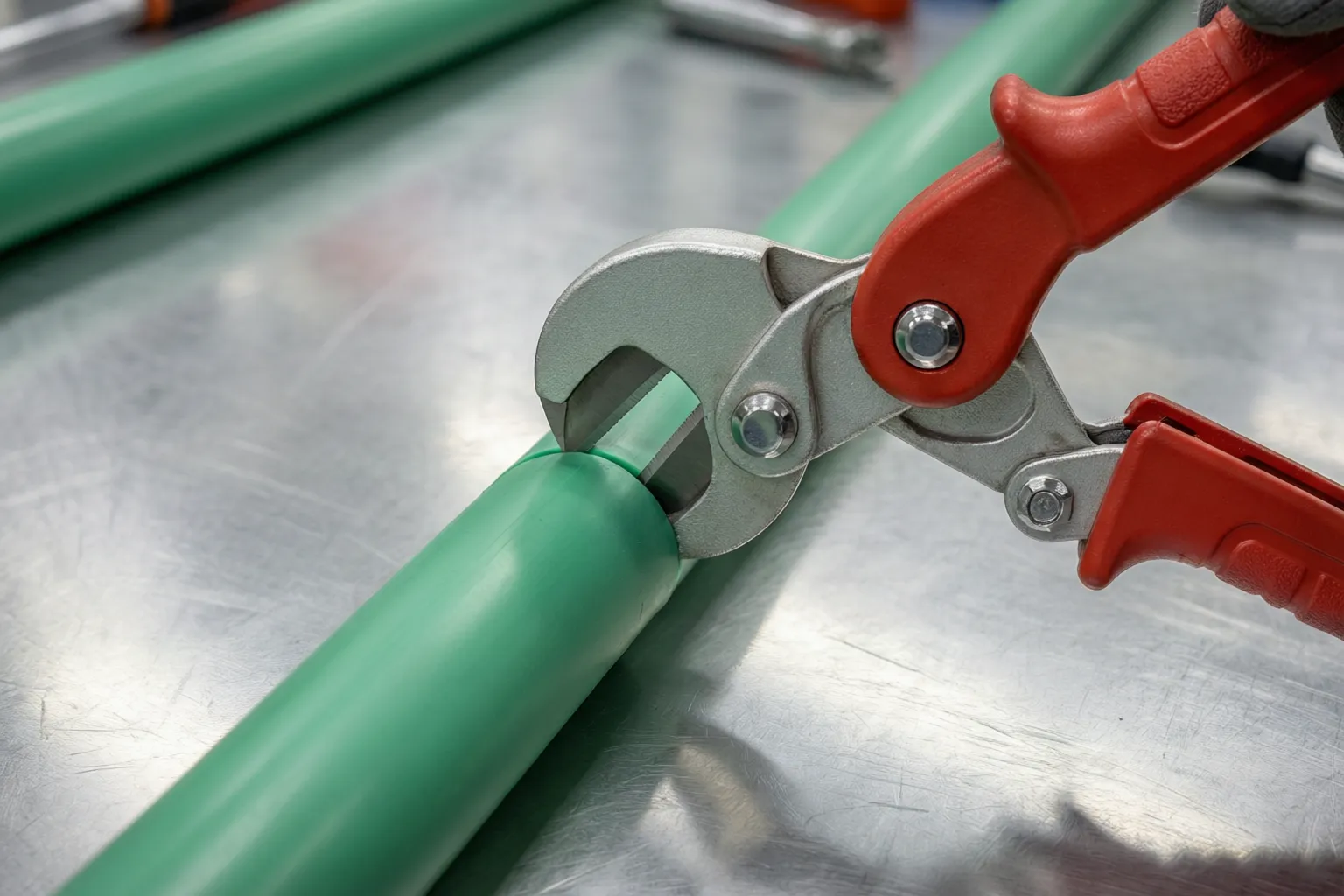
The ratchet cutter is a scissor with a V-blade and a self-advancing ratchet, so each squeeze bites a little deeper without springing back. Manufacturers typically rate this family to about 40-42 mm OD, which covers DN20 through DN32 with room and puts DN40 at the ceiling. Blades are usually heat-treated carbon or stainless steel. Inside its range the tool is fast, one-handed, and leaves a clean face, which is why it dominates service-line work.
Rotary Wheel Cutters Take The Big Work
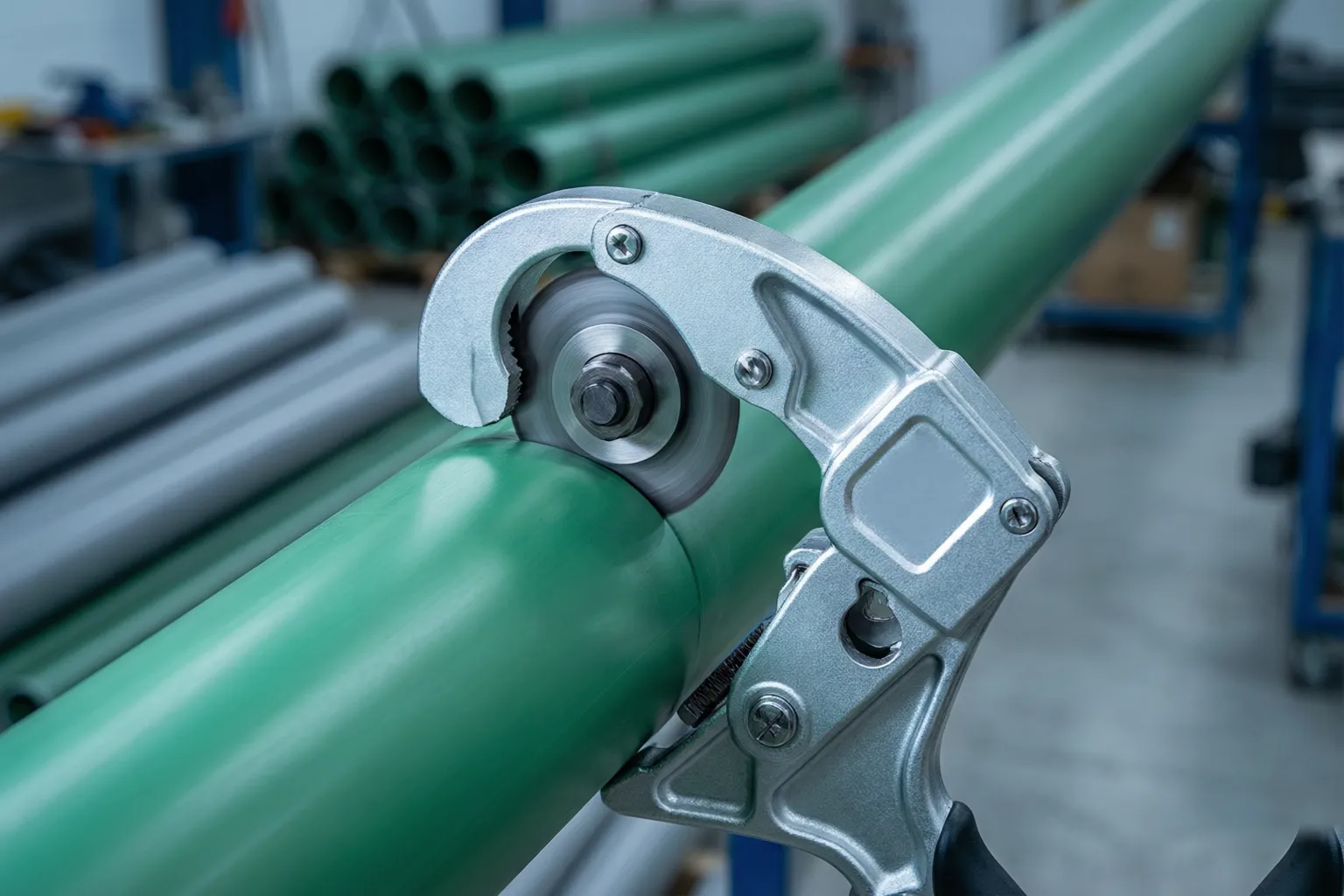
A rotary cutter rolls a hardened scoring wheel around the pipe OD, deepening a groove each pass until the pipe parts. Because the wheel tracks the pipe’s own circumference, the cut stays square to the axis by geometry rather than by hand steadiness. Supplier catalogs list small hand classes around 14-63 mm and large-bore units covering ND 160-315 mm with hardened tool-steel blades, the latter built for mains and tie-ins. Rotary cutting produces no dust and no swarf, though it leaves a groove ring that needs cleaning before fusion.
Saws Work Only With A Guide
A fine-tooth saw in a mitre guide is the fallback when a pipe is beyond the cutters on the truck or trapped where no cutter head fits. The guide is the whole point. Freehand sawing rarely produces a face square enough for socket fusion, and sawing loads plastic with burr and swarf that must come off before heating. Treat a saw as a planned method with a guide, not as a shortcut.
One obligation follows all three methods: deburr the inside edge and take a light chamfer so the pipe enters the molten socket without scraping material back off it. The cutting technique itself, step by step, is covered in the guide to cutting PPR pipe. This page is about which tool earns the cut.
Head To Head At Three Diameters
Scope note: the squareness ratings below are qualitative tiers built from manufacturer capacity specs and cut mechanics. No tool was bench-measured for this article, and no page in the current market publishes such measurements either. Read the tiers as risk ranking, not as angle data.
| Tool | DN20 (3.4 mm wall) | DN40 (6.7 mm wall) | DN63 (10.5 mm wall) |
|---|---|---|---|
| Ratchet scissor cutter | Low risk. Fast, clean, in its design range. | Medium risk. At the rated limit; crush and drift appear as blades wear. | High risk. Beyond rated capacity; jaws cannot hold alignment on 10.5 mm wall. |
| Rotary wheel cutter | Low risk, slower than a ratchet. Overkill for service lines. | Low risk. Square by geometry; clean groove ring. | Low risk. The intended tool; needs clearance to rotate. |
| Fine-tooth saw + guide | Workable but slow; burr and swarf must come off. | Square only with a guide; freehand faces wander. | Valid fallback in tight spots; guide and deburr are mandatory. |
At DN20 the decision is boring, which is exactly what you want: the ratchet wins on speed and face quality, and nothing else needs to be said. At DN40 the ratchet is working its last legal shift. A fresh blade from a quality maker can still produce a usable face, but wall is now 6.7 mm and every sign of wear shows up as crush or drift. Rotary takes this size without drama. At DN63 the ratchet is beyond its rated capacity, full stop. Ten and a half millimetres of PN20 wall defeats the scissor mechanism no matter how sharp the blade, because the jaws lose alignment across that OD. The pick at DN63 is a rotary cutter where the pipe has clearance, and a guided saw where it does not.
If one verdict has to cover a mixed job, it is this: buy the ratchet for the service-line half of the work, buy the rotary for everything from DN50 upward, and only let a saw touch a fusion face when a guide is clamped to the pipe.
Blade Geometry Decides The Face
Three Cut Mechanics, Three Faces
A scissor cutter shears: one blade drives through the wall against a fixed anvil face, and the cut stays square only while the blade tracks perfectly straight through both walls. A rotary cutter scores: the wheel follows the pipe’s own circumference, so squareness is built into the path. A saw removes material as chips, which frees it from any capacity limit but adds two surfaces that need finishing. Each mechanic fails in its own characteristic way.
The scissor failure mode is wander plus crush. As OD grows, the blade has more wall to travel through, and any play in the pivot or any dullness at the edge steers it off-plane. Before breakthrough, the jaws also compress the wall, and on thick pipe that compression survives as an ovalised, stressed edge. That is a mechanism argument, not a measured tolerance, and it explains why makers stop rating these tools around 42 mm. The wall numbers behind the argument sit in the PPR dimensions and tolerance chart: 3.4 mm at DN20, 6.7 mm at DN40, 10.5 mm at DN63 for PN20.
What A Good Face Looks Like
Whatever tool made it, the face that goes into the welder has four properties: square to the axis, free of burr, free of swarf or dust, and wiped clean and dry. Rotary cuts add one more chore, clearing the groove ring so nothing sits between the face and the fitting socket. A two-second look against any flat reference shows a tilted face. If the gap at the edge is visible, the joint already knows about it.
When A Cutter Needs Retirement
Wear Signs Worth Stopping For
- Rising effort: cuts that used to take two squeezes now take five, and the ratchet starts skipping.
- Crush instead of slice: the wall deforms ahead of the blade instead of parting cleanly.
- Angled faces: the cut comes off visibly out of square, or the pipe pinches the blade mid-cut.
- New burr: an edge that used to come off clean now carries a lip or a ragged ring.
Any one of these is enough to stop and check. The check itself takes seconds: cut a piece of scrap, stand it on a flat surface, and look at the gap between the face edge and the reference. Repeat with a fresh blade if the tool takes spares. A blade that wanders on scrap is already charging its cost against your joints, one partial-circumference weld at a time.
The Retirement Rule Is About Diameter
Here is the part that surprises people. A ratchet cutter can be perfectly sharp and still be the wrong tool, because the limit is the mechanism’s ability to hold alignment across a growing OD, not the blade’s edge. As a rule of thumb, once a job moves above a ratchet cutter’s rated OD, typically past the DN40 class, the tool leaves that job regardless of condition. Capacity classes are cheap to confirm: basic ratchet cutters list at very low prices at tool suppliers, with example retail listings in single-digit currency units, so replacing a worn or out-classed tool costs less than one reworked joint.
Building A Cutting Kit For Crews
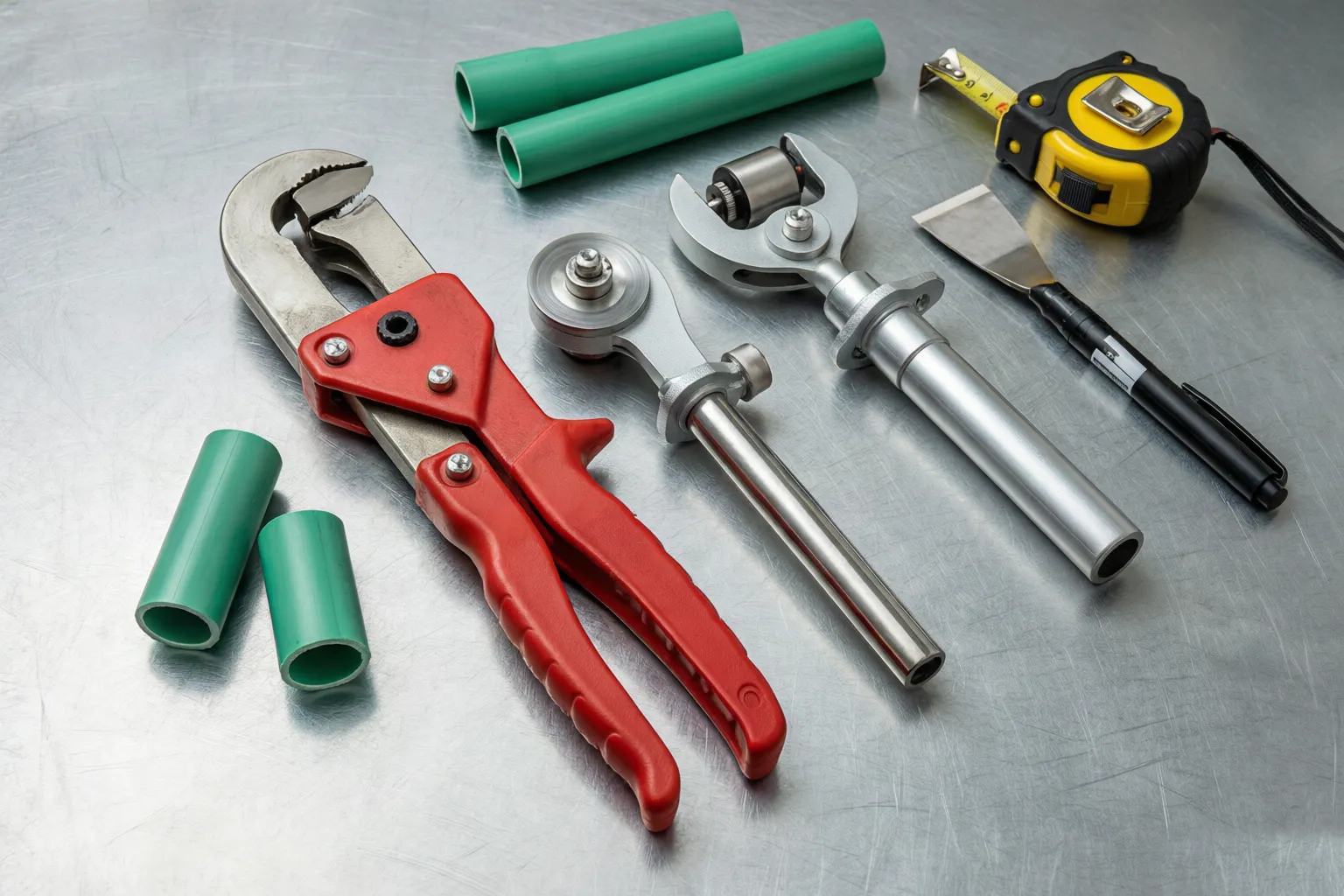
The kit follows the diameter mix, not the other way around. The table below maps a crew’s typical range to the tools that keep every face square. Distributors equipping installation crews can use the same logic in reverse: stock the cutter classes your pipe programme actually sells.
| Your Diameter Mix | Carry This | Why |
|---|---|---|
| Service lines, DN20-DN40 | Ratchet cutter, spare blades, deburr/chamfer tool | Fastest clean cut in range; blades are the consumable |
| Mixed mains, DN50-DN63 | Rotary wheel cutter in the 63 mm class, chamfer tool | Square by geometry past ratchet capacity |
| Large bore or tight spots | Large-bore rotary or fine-tooth saw with mitre guide | Covers DN75+ and no-clearance tie-ins |
Pair the cutter’s diameter coverage with the welding machine’s die coverage. A crew that welds DN20-DN63 on a handheld socket machine needs cutting tools that hold square faces across that exact spread, and a crew stepping up to DN75 and beyond needs both the bench machine and the large-bore cutting answer. The PPR welding machine buying guide matches machine classes to pipe ranges.
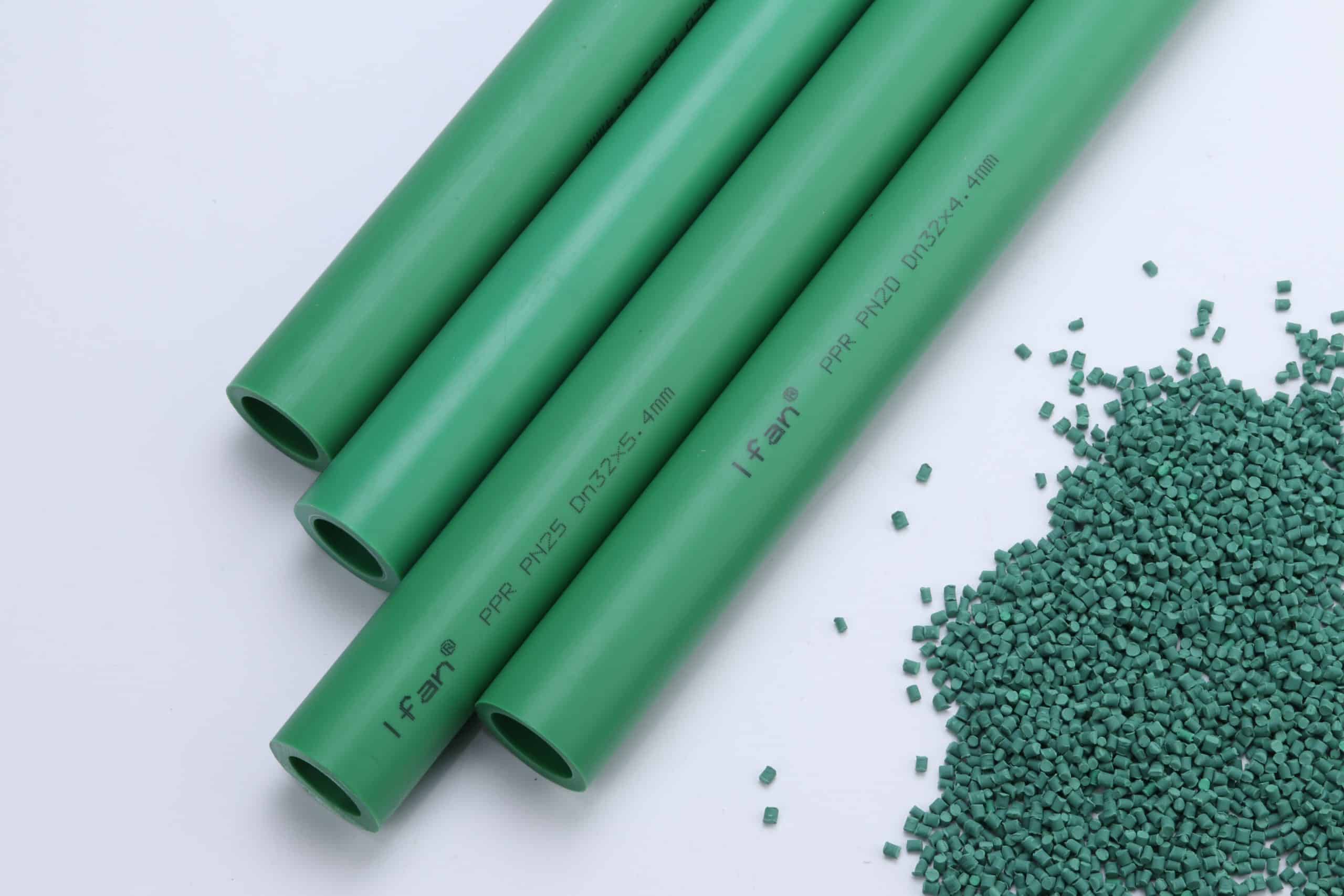
Last link in the chain is the pipe itself. A clean, square cut only pays off when the pipe’s OD and wall hold to spec, because cutter jaws and scoring wheels are sized to those same dimensions. IFANULTRA’s PPR range runs DN20-DN160 in PN10-PN25 with OD and wall verified to ISO 15874 and DIN 8077, which is the foundation the whole cutting and fusion sequence stands on. The full range sits under the PPR product series overview.
Frequently Asked Questions
Can I cut PPR pipe with a hacksaw?
Yes, if the saw has fine teeth and runs in a mitre guide, then the face is deburred and cleaned before fusion. Freehand sawing rarely produces the square face socket fusion needs, and swarf left on the face causes defects.
What size PPR pipe can a ratchet cutter handle?
Most ratchet scissor cutters are rated to about 42 mm OD by their manufacturers, which is DN40 class. Beyond the rated OD the jaws cannot hold alignment, so DN63 and up belongs to rotary cutters or a guided saw.
Does the cut angle really affect PPR welding?
Yes. Socket fusion relies on full contact between pipe face and fitting socket. An angled face leaves a wedge-shaped gap, heats unevenly and can produce a cold joint that passes the first pressure test but leaks later.
When should I replace a PPR pipe cutter?
Replace the blade or the tool when cuts need visibly more force, the wall crushes instead of slicing, the face comes off angled, or a burr appears that was not there before. A blade that wanders on scrap is already costing joints.
Do I need to deburr PPR pipe after cutting?
Yes. Remove the internal bead and any swarf, and lightly chamfer the edge so it does not scrape coating material off the fitting socket during insertion. Rotary cutters leave a groove that also needs cleaning.
Conclusion
The three tool families split cleanly along diameter lines. Ratchet cutters are the fast, cheap answer inside their rated range, typically to about 42 mm OD. Rotary wheel cutters hold square faces by geometry from the mid sizes into large bore, and saws stay useful only behind a guide. The trade-off is speed against capacity: the ratchet buys speed by giving up reach, and the moment a crew pushes it past its rating, the joints start paying for it.
Key Takeaways
- Ratchet cutter for DN20-DN40 class work; rotary wheel cutter from DN50 upward; guided saw only as fallback.
- Retire ratchet cutters above their rated OD regardless of blade sharpness, because the limit is alignment, not the edge.
- Judge every face against a flat reference on scrap before trusting a blade with the real run.
If your crew runs mixed diameters, take ten minutes to check the rating printed on each cutter against the pipe it actually meets this month, and set up the kit table above for whichever range comes next. When you next order pipe for that range, match the cut quality with material that holds OD and wall to ISO 15874 and DIN 8077 across DN20-DN160, supplied by the container with a one-container minimum and 15-25 days production, so every square face you produce fuses into a joint built to the same tolerance.









 English
 Español
 Français
 Português do Brasil