

A PPR pipe is a hot- and cold-water pressure pipe made from polypropylene random copolymer, joined not with glue or threads but by melting two parts into a single piece. That heat-fused joint is why a correctly installed line carries a 50-year design life and effectively never leaks at the connection. For a buyer, though, “PPR” on a label says almost nothing on its own — the pressure class, the wall thickness, the raw material, and the certification behind it decide whether the pipe lasts five decades or splits in its second winter.
This is the reference page for the whole PPR topic on this site. It covers what the material actually is, how the PN pressure classes and DN sizes work, how PPR compares to PVC, PEX and copper, how the pipe is installed, and what to check before you place a wholesale order. IFANULTRA manufactures its PPR lines on German automated extrusion equipment using virgin Nordic polypropylene, and the specifications below reflect the international standards those lines are built to — ISO 15874 and DIN 8077/8078.
Key Takeaways
- PPR (polypropylene random copolymer) handles roughly 70°C continuous and short peaks to 95°C, with a 50-year design life at its rated pressure and temperature.
- Pressure is graded by PN class: PN10, PN16, PN20 and PN25. PN20 (series S2.5 / SDR6) is the standard choice for hot-water plumbing.
- Sizes run from DN20 to DN160 by outside diameter; wall thickness rises with the PN class, so the same DN20 pipe is thicker in PN20 than in PN10.
- Joints are made by socket heat fusion at about 260°C, creating a single homogeneous part with no gasket, glue or thread to fail.
- PPR beats PVC on temperature and PEX on rigidity for fixed pressure lines; copper still wins on peak heat but corrodes and costs far more.
- The two things that separate good PPR from cheap PPR are virgin (not recycled) resin and a real, verifiable certificate such as ISO 9001, SKZ or NSF.
- For wholesale buyers, price per meter means little without confirmed wall thickness, resin type and batch consistency across a full container.

What Is PPR Pipe and What Is It Made Of?
PPR stands for polypropylene random copolymer, a thermoplastic in the polypropylene family engineered specifically for pressurized water. The “random” part refers to how the ethylene units are distributed through the polypropylene chain, which lowers the material’s stiffness point and lets it stay tough at the temperatures a hot-water line reaches. The result is a pipe that is chemically inert, does not rust, does not scale up on the inside, and adds nothing to the water passing through it.
Density sits near 0.905 g/cm³, so a PPR pipe is light enough that a DN110 length is comfortably handled by two people on site. Thermal conductivity is roughly 0.24 W/(m·K) — a fraction of copper’s — which means the pipe holds heat in a hot line and resists condensation on a cold one, often reducing the amount of separate insulation a project needs.
Not all PPR is the same grade, and this is where the quality gap opens. Pipe extruded from virgin polypropylene keeps a consistent molecular structure and hits the full pressure and lifespan ratings. Pipe cut with recycled or filled resin looks identical on the shelf but loses long-term pressure resistance and can turn brittle. IFANULTRA runs virgin Nordic polypropylene for exactly this reason: the raw material, not the shape, is what carries the 50-year rating.
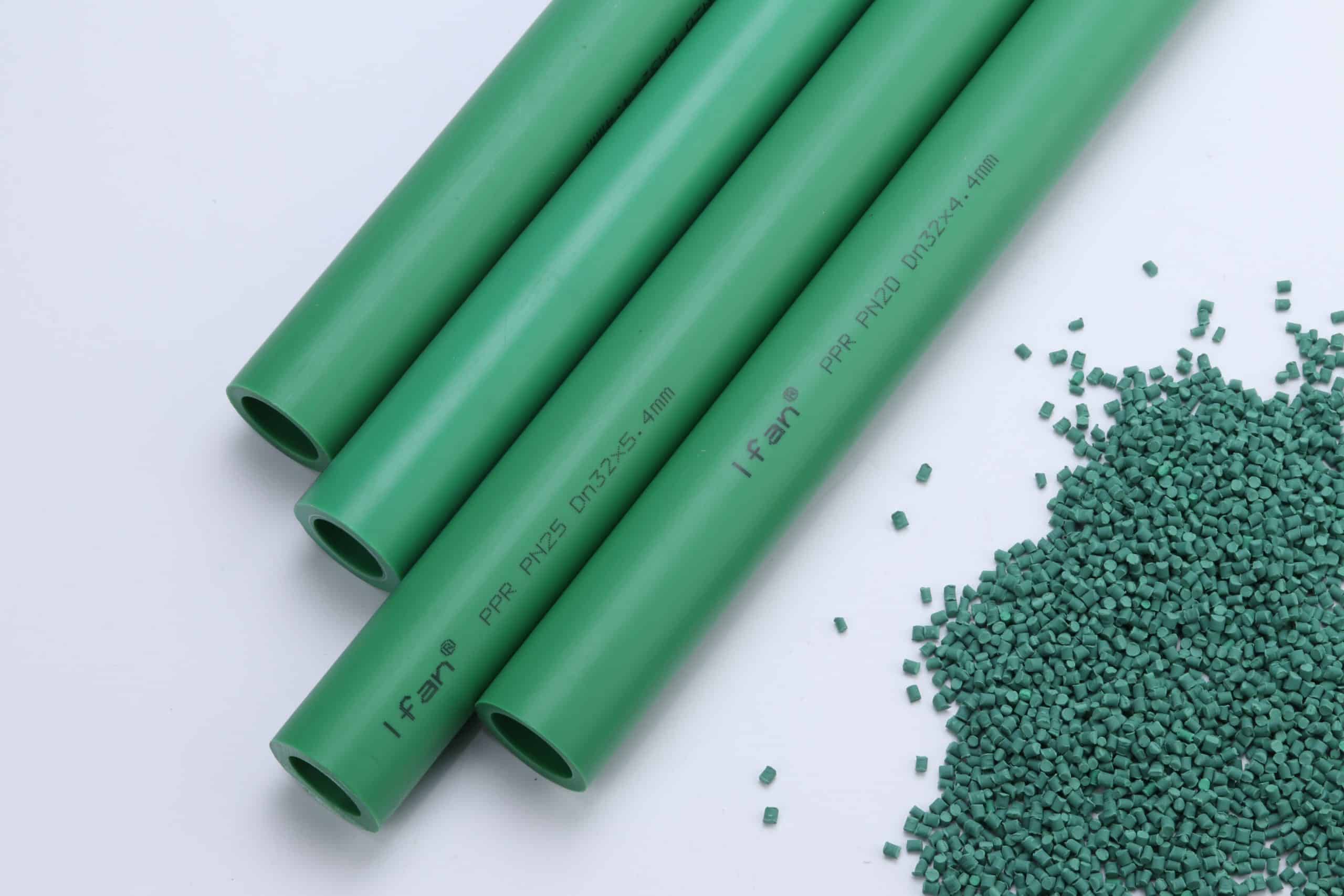
PPR Pipe Properties at a Glance
The numbers below are the ones that actually decide a specification. Temperature and pressure are linked — a PPR pipe can hold its rated pressure for 50 years at 20°C, but the safe working pressure drops as the water gets hotter, which is why hot lines use a higher PN class than cold ones at the same size.
| Property | Typical value | Why it matters |
|---|---|---|
| Material | PP-R (polypropylene random copolymer) | Inert, corrosion-proof, food-safe |
| Max continuous temperature | ~70°C | Suits domestic hot water without derating problems |
| Short-term peak temperature | ~95°C | Tolerates boiler spikes and fault conditions |
| Design life | 50 years at rated PN & temperature | Basis of the pressure classification |
| Linear thermal expansion | ~0.15 mm/(m·°C) | Long hot runs need expansion loops or fiber-composite pipe |
| Thermal conductivity | ~0.24 W/(m·K) | Low heat loss, resists condensation |
| Joining method | Socket heat fusion at ~260°C | One homogeneous joint, no gasket to age |
One property deserves a warning rather than a cell in a table. PPR expands about 0.15 mm for every meter of pipe per degree of temperature rise, which is far more than metal. Heat a straight 4-meter hot-water run by 50°C and it wants to grow roughly 30 mm. Ignore that on a long exposed line and the pipe bows between clips. This is the single most common design mistake with PPR, and the fix — expansion loops, correct clip spacing, or fiber-composite pipe — is covered in the installation section below.
PPR Pressure Classes: PN10, PN16, PN20 and PN25
The PN number is the one spec buyers most often get wrong. PN stands for nominal pressure — the pressure in bar the pipe holds for 50 years carrying 20°C water. It is not the pressure at hot temperatures, which is always lower. Each PN class corresponds to a wall-thickness series, written as an S value or an SDR (the ratio of outside diameter to wall thickness). A lower S or SDR means a thicker wall and a higher pressure rating.
| Class | Series / SDR | Wall at DN25 | Typical use |
|---|---|---|---|
| PN10 | S5 / SDR11 | ~2.3 mm | Cold water, low-pressure distribution |
| PN16 | S3.2 / SDR7.4 | ~3.4 mm | Higher-pressure cold or warm water |
| PN20 | S2.5 / SDR6 | ~4.2 mm | Standard hot-water plumbing (most common) |
| PN25 | S2 / SDR5 | ~5.0 mm | High-pressure hot lines; often fiber-composite |
In practice, most residential and commercial hot-water work is done in PN20, and cold-water branches in PN16 or PN10 to save cost. The trap for wholesale buyers is that a cheaper quote is often a lower PN class in disguise: a PN16 pipe sold as “PN20” has a thinner wall and fails early on a hot line. Because outside diameter is fixed by standard, the only honest way to confirm the class is to caliper the wall thickness against the table above.
PPR Pipe Sizes and Dimensions (DN20–DN160)
PPR is sized by DN, the nominal outside diameter in millimeters, and that outside diameter is fixed across every compliant factory. A DN25 pipe is 25 mm on the outside whether it comes from IFANULTRA or any ISO 15874 producer — what changes with the PN class is the wall thickness, and with it the bore the water flows through. The table shows the standard PN20 wall for the common range.
| DN (outside Ø) | PN20 wall | Common application |
|---|---|---|
| DN20 | 3.4 mm | Fixture branches, taps, single outlets |
| DN25 | 4.2 mm | Bathroom / kitchen risers |
| DN32 | 5.4 mm | Apartment main branches |
| DN40 | 6.7 mm | Floor / zone mains |
| DN50 | 8.4 mm | Building risers |
| DN63 | 10.5 mm | Main supply lines |
| DN75–DN110 | 12.5–18.4 mm | Commercial mains, plant rooms |
| DN160 | 26.6 mm | Industrial and large-diameter transfer |
Because dimensions are standardized, fittings from a compliant range fuse to any compliant pipe of the same DN — you are not locked to one brand’s tooling. The practical selection rule is to size by flow demand, then set the PN class by whether the line is hot or cold. A full size-by-size chart with cold-water walls lives in the dedicated PPR sizes guide linked at the end of this page.
Standards and Certifications That Actually Mean Something
Two pipes can both say “PPR” and be built to completely different rules. The dimensional and performance baseline most of the world uses is ISO 15874, mirrored in Europe as EN ISO 15874 and in the German system as DIN 8077 for dimensions and DIN 8078 for quality and testing. A pipe built to these will physically match fittings and hold its stated PN rating. Buyers selling into the United States should also look for a potable-water mark, since many jurisdictions there may require it depending on the application.
- ISO 9001: a quality-management-system certificate for the factory, not the pipe — it signals process control, not product performance on its own.
- SKZ (Germany): a plastics-industry testing body; an SKZ mark points to independent testing of the polymer and pipe.
- NSF: a US-focused mark tied to potable-water safety and standards compliance for that market.
- SAI Global: assurance and certification services covering quality and risk management.
IFANULTRA holds ISO 9001, SAI Global, SKZ, HY and NSF certification across its PPR lines. The buyer’s job is not to collect logos but to verify them: ask for the certificate number and the issuing body, then confirm it is current and names the actual manufacturer rather than a trading company. A PDF with no traceable number is worth nothing at a customs check. Requirements differ by market and product, so confirm the exact marks your destination country expects with a local compliance contact before you order.
PPR Pipe Types: Plain, Fiber-Composite and UV-Resistant
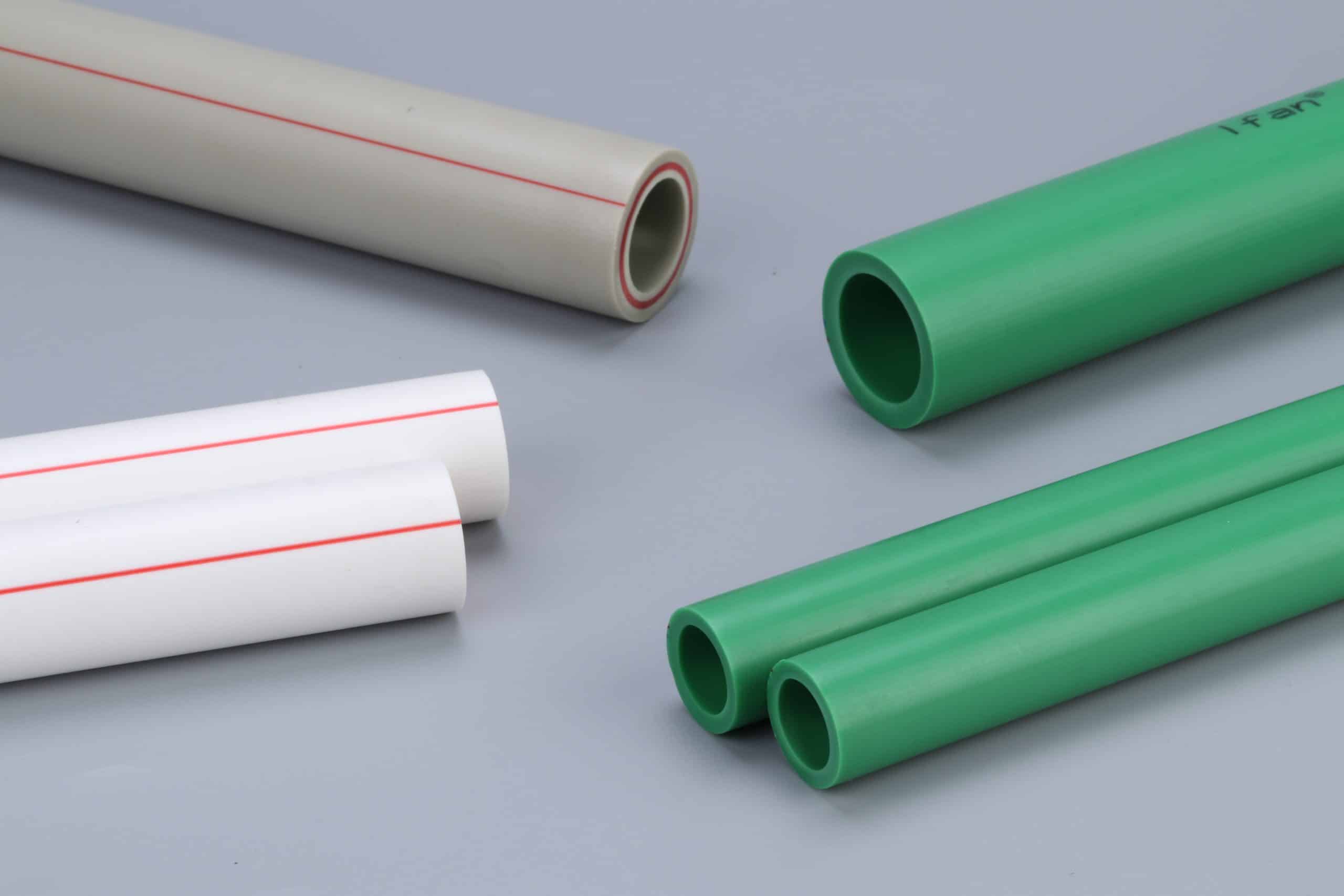
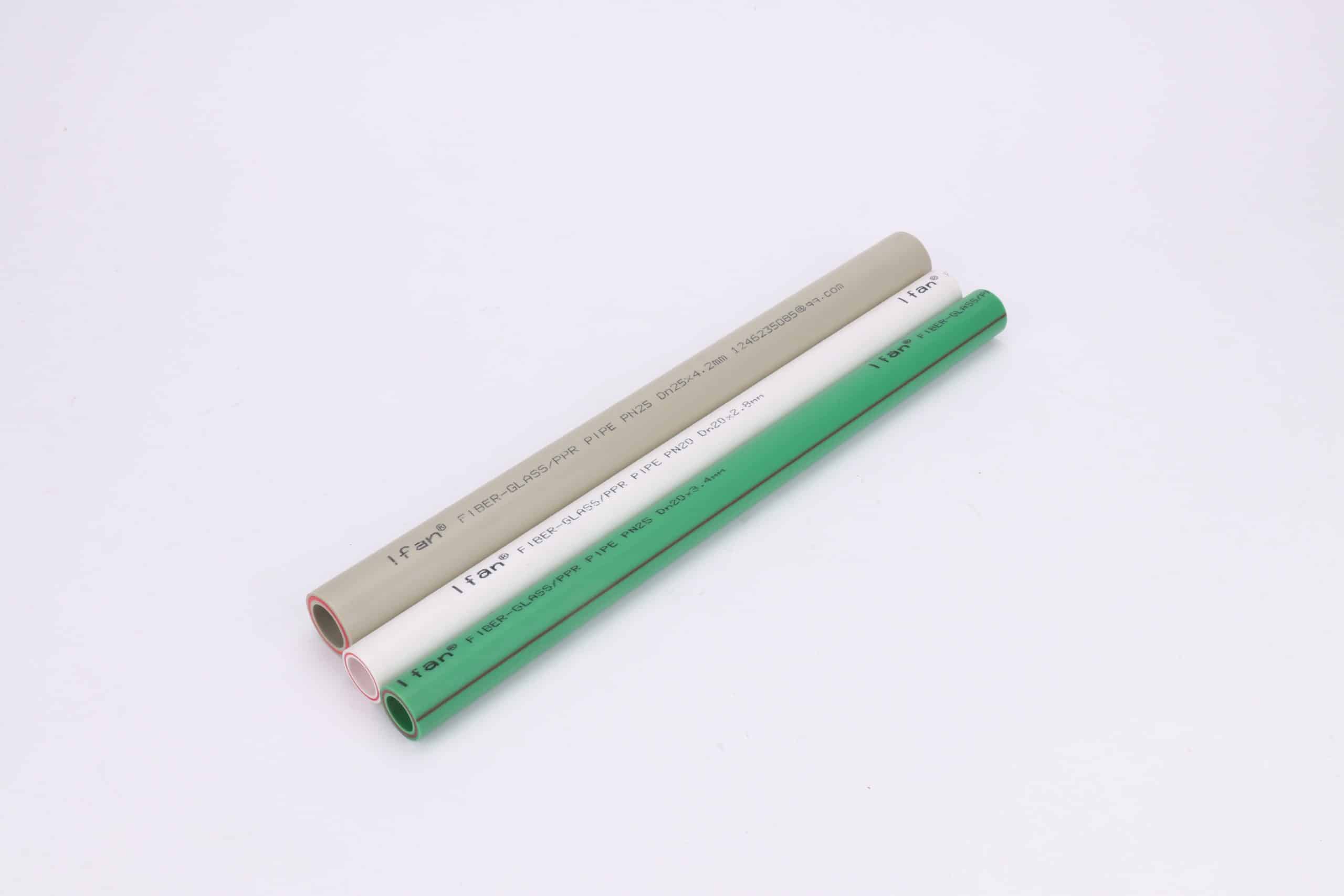
“PPR pipe” is a family, not one product. The plain green or white pipe most people picture is the base case, but two variants solve specific problems and are worth stocking for the right jobs.
- Plain PPR: single-layer pipe for standard hot and cold pressure lines. Simple, lowest cost, and the workhorse of the category.
- Fiber-composite PPR (glass-fiber core): a middle layer reinforced with glass fiber cuts thermal expansion by around three-quarters, from ~0.15 to roughly 0.03–0.05 mm/(m·°C). For long exposed hot runs this is the difference between a straight line and a sagging one.
- UV-resistant PPR: standard PPR degrades under direct sunlight, so an outdoor run needs a UV-stabilized grade or physical shielding. Getting this wrong is a common cause of premature outdoor failure.
IFANULTRA splits its catalog into the PPR Global Series and the PPR Quality Series across these variants, so a distributor can match plain pipe to interior plumbing and reserve fiber-composite for the hot mains where expansion actually bites. Choosing the variant by the job, rather than buying one type for everything, is what keeps warranty claims down.
PPR Fittings and Valves: The Full System
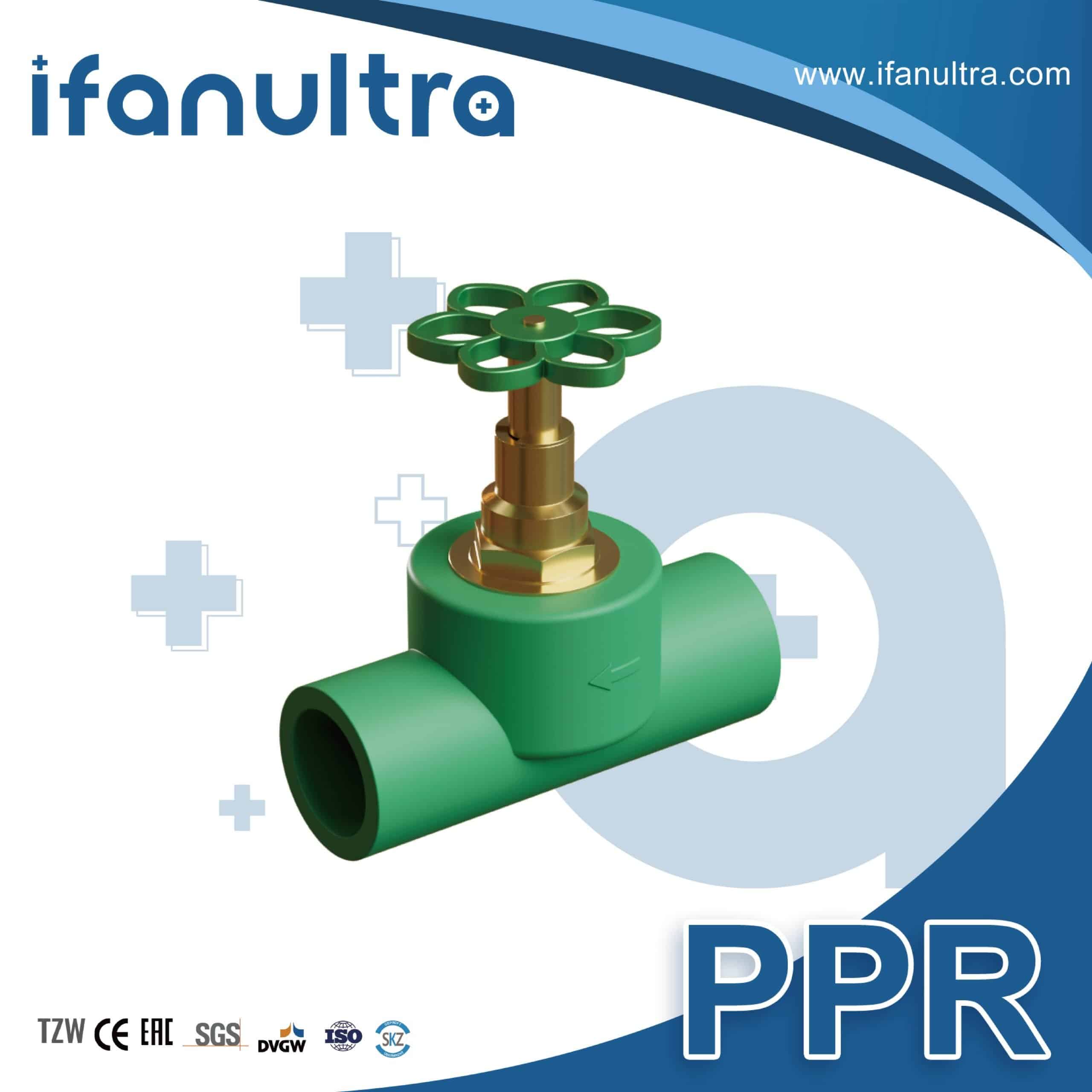
A pipe run is mostly fittings, and PPR fittings fuse to the pipe by the same heat process, so the whole network becomes one continuous material with no weak adhesive joints. Stocking the pipe without a matched fitting range leaves a distributor selling half a system.
- Sockets (couplers): join two straight lengths; the most-used part in any order.
- Elbows (45° / 90°): change direction; segmented elbows handle large diameters.
- Tees and reducers: branch a line or step between sizes.
- Transition fittings (male/female threaded, flange adapters): connect PPR to metal valves, meters and pumps — the bridge between plastic and the rest of the system.
- Valves: ball and stop valves built into the PPR system so isolation points fuse in rather than bolt on.
The transition fittings are where most system failures start, because they mate plastic to metal. A brass insert molded into a PPR body, rather than a thread cut straight into the plastic, is far more durable at these junctions — a detail worth confirming when comparing fitting suppliers.
PPR vs PVC, PEX and Copper: How to Choose
The honest positioning: PPR is the strongest all-round choice for fixed hot-and-cold pressure plumbing in the markets where fusion tooling is common. It is not automatically right everywhere, and pretending otherwise costs credibility. Here is where each material genuinely wins.
| Material | Max temp | Joining | Best for |
|---|---|---|---|
| PPR | ~70°C cont / 95°C peak | Heat fusion | Fixed hot & cold pressure plumbing |
| PVC | ~60°C (cold service) | Solvent cement | Cold water, drainage, low cost |
| CPVC | ~93°C | Solvent cement | Hot water where fusion tools are unavailable |
| PEX | ~95°C | Crimp / push-fit | Flexible runs, retrofit, freeze tolerance |
| Copper | Very high | Soldered | High-heat lines; premium jobs |
Against PVC, PPR wins the moment hot water is involved — PVC is a cold-service pipe and softens where PPR is comfortable. Against PEX, the trade-off is rigidity versus flexibility: PEX is faster for winding retrofit runs, but PPR’s fused joint has nothing to loosen over decades. Against copper, PPR gives up peak temperature but removes corrosion, scaling, theft risk and most of the cost. Each of these match-ups has its own detailed comparison linked in the cluster block below.
Is PPR Pipe Right for Your Project?
PPR is the right specification for most pressurized water systems, but not for every line in a building. Being honest about where it does not fit is what keeps a distributor’s reputation intact.
| Best for | Not ideal for |
|---|---|
| Domestic & commercial hot/cold water | Open drainage and soil stacks (use PVC) |
| Compressed air and many industrial fluids | Continuous service above ~70°C |
| Chemical transfer within compatibility limits | Direct sunlight without a UV-grade or shield |
| Projects wanting 50-year, leak-free joints | Jobs with no access to fusion welding tools |

How PPR Pipe Is Installed: Heat Fusion Basics
PPR is joined by socket fusion, and the process is simple enough that its reliability depends entirely on getting three variables right: temperature, heating time, and alignment. A fusion tool heats a socket and the pipe end to about 260°C, the two are pushed together, and as they cool they become one part. Done correctly, the joint is as strong as the pipe itself.
- Cut square and mark depth: a skewed cut or over-insertion narrows the bore and weakens the weld.
- Heat both parts together: timing scales with diameter — a DN20 needs only a few seconds of heating, a DN63 substantially more. Under-heating gives a cold joint; over-heating collapses the bore.
- Push straight, do not twist: rotating during insertion tears the melt and creates a leak path.
- Hold and let cool undisturbed: moving the joint before it sets is a leading cause of pinhole leaks.
Because PPR expands with heat, long hot runs also need expansion loops or correct clip spacing, as flagged earlier. The full diameter-by-diameter heating-time chart and the common installation mistakes both have dedicated guides in the cluster below — this section is the overview, not the workshop manual.
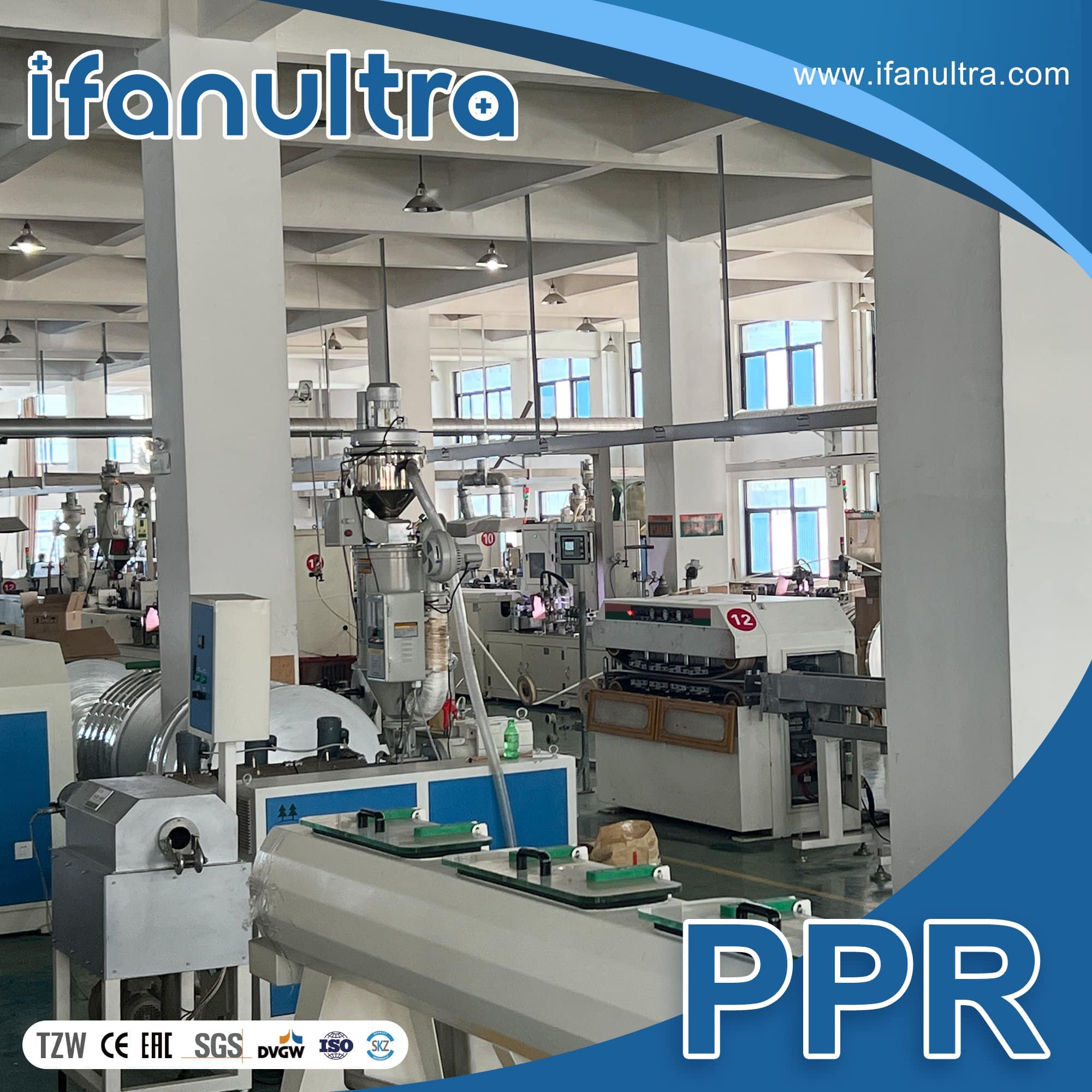
What We Check Before a Batch of PPR Ships
Consistency across a full container is where wholesale PPR is won or lost, so IFANULTRA runs each production batch through a fixed set of checks before it leaves the line. These are the same points a careful buyer should ask any supplier to evidence.
- Resin verification: confirm virgin Nordic polypropylene input, not recycled or filled resin, because raw material sets the lifespan.
- Wall thickness by caliper: measured against the PN-class table so a PN20 order is genuinely PN20 at every DN.
- Dimensional check to ISO 15874 / DIN 8077: outside diameter and ovality within tolerance so fittings fuse cleanly.
- Pressure and thermal testing: sample pipe held under pressure to confirm the batch meets its rating.
- Certificate and marking match: the print on the pipe, the batch paperwork and the certificate all name the same manufacturer and class.
A buyer cannot stand on the line, but can require the evidence: batch test reports, caliper photos, and certificate numbers before releasing balance payment. A supplier who hesitates at that request is telling you something.
Buying PPR Pipe Wholesale: Price, MOQ and Quality
For an importer or distributor, the risk with PPR is that it looks like a commodity and is quoted like one, when the real cost sits in what you cannot see on a photo. A price per meter is only comparable once three things are fixed: the resin grade, the exact PN wall thickness, and batch-to-batch consistency. Two quotes that differ by 30% are usually not the same pipe.
- Confirm the resin and class in writing: “PN20 virgin PP-R” on the proforma, not just “PPR pipe”.
- Match the SKU mix to your market: stock the fast-moving DN20–DN32 sizes deep and the large diameters shallow.
- Check certificate validity for your destination: the mark that clears customs in one country may not be the one another expects.
- Plan the container load: pipe is bulky and light, so freight per meter, not just factory price, decides landed cost.
A worked example: a distributor ordering a mixed 20-foot container of PPR for a Southeast Asian market might weight it toward PN20 DN20–DN32 for residential demand, add a smaller share of fiber-composite for hot mains, and confirm one certificate set covers the whole shipment. Getting the wall thickness verified before shipment, rather than after a customer complaint, is the entire difference between a repeat supplier and a warranty problem. The dedicated sourcing, price and certification guides in the cluster below go deeper on each step.

Common PPR Problems and How to Avoid Them
Most PPR failures trace back to a handful of avoidable causes, and none of them are the fault of the material when it is specified and installed correctly.
- Sagging on long hot runs: thermal expansion ignored — use fiber-composite pipe or add expansion loops and closer clips.
- Cold joints that weep: under-heated or twisted during fusion — follow the heating times and push straight.
- Outdoor brittleness: plain PPR left in sunlight — specify a UV-resistant grade or shield the run.
- Early pressure failure: a lower PN class or recycled resin sold as premium — caliper the wall and verify the resin.
Conclusion
PPR earns its place in plumbing because a correctly specified, correctly fused line simply lasts — 50 years of corrosion-free, leak-free service from a pipe that costs less than copper and outperforms PVC on heat. The specification discipline is what protects that outcome: the right PN class for the temperature, virgin resin, verified wall thickness, and a certificate you can actually trace.
If you are choosing PPR for a project or a product line, the next step is to match the class and size to your specific application, then confirm the supplier can evidence what they claim. The linked guides below break down sizing, pressure classes, material comparisons and sourcing in detail so you can decide with the numbers in front of you.
The Complete PPR Pipe Cluster
Frequently Asked Questions
What does PPR stand for in piping?
PPR stands for polypropylene random copolymer, a thermoplastic used for hot- and cold-water pressure pipes. It is corrosion-proof and joined by heat fusion rather than glue or threads.
What is the difference between PN16 and PN20 PPR pipe?
PN20 has a thicker wall than PN16 at the same diameter, so it holds higher pressure and suits hot water, while PN16 is common on cold or lower-pressure lines. The outside diameter is identical; only the wall and bore change.
How long does PPR pipe last?
PPR pipe carries a 50-year design life at its rated pressure and temperature. Reaching it depends on virgin resin, the correct PN class for the water temperature, and properly made fusion joints.
Can PPR pipe be used for hot water?
Yes. PPR handles about 70°C continuously and short peaks to 95°C, which covers domestic and commercial hot water. Use PN20 or fiber-composite pipe for hot lines rather than a cold-water class.
Is PPR better than PVC?
For hot water and pressurized supply lines, yes — PVC is a cold-service pipe that softens with heat, while PPR handles both hot and cold. For open drainage and the lowest cold-only cost, PVC still has a place.
Written by the IFANULTRA team — a PPR pipe and fittings brand of IFAN Group, drawing on 30+ years of manufacturing experience, German automated production lines, and ISO 9001, SKZ and NSF certified PPR product lines.









 English
 Español
 Français
 Português do Brasil