
A PP-R submittal comes back with one line circled: fire rating. The importer who quoted the job must now answer a question the pipe standard never asked and the certificate folder does not contain.
The short version is this. Polypropylene burns. Under EN 13501-1:2018 a pipe carries a reaction-to-fire class only where a specific product has a classification report behind it, and a product with no report sits in class F. The class B2 that suppliers quote comes from DIN 4102-1:1998-05, a German national standard, and it does not convert into a Euroclass. Neither number decides whether the pipe is allowed on the job. Two other things do: the sealed penetration where the pipe crosses a rated wall, and the system the pipe serves.
That second point is the boundary page one misses. PP-R carrying potable hot and cold water is plumbing with a firestopping detail. PP-R inside fire-fighting piping is settled by listing, not by fire class.
Key Takeaways
- Reaction to fire classifies the pipe (EN 13501-1:2018, classes A1 to F). Fire resistance classifies the sealed penetration (EN 13501-2:2023, EI plus minutes). A pipe never carries an EI rating.
- DIN 4102-1:1998-05 class B2 is a German national class. MPA NRW states that no direct link can be made between DIN 4102-1 classes and EN 13501-1 Euroclasses.
- Polypropylene: limiting oxygen index 19 %, self-ignition 360 °C to ASTM D 1929, UL 94 class HB, and it drips and keeps burning after the flame is removed.
- ISO 15874-2:2013 carries no reaction-to-fire requirement, so an ISO 15874 report is not a fire classification. IFAN ULTRA holds none today and says so.
- A collar’s dimensional limits live in its ETA and classification report, not its datasheet. Check them against the wall ordered: PN20 runs 3.4 mm at DN20 to 26.6 mm at DN160.
- Fire-fighting piping is a listing question. UL 1821 covers CPVC and PEX, not polypropylene, so no PP-R grade turns into sprinkler pipe.
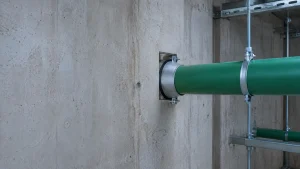
Watch the mechanism: an intumescent graphite collar closing around a plastic pipe under heat.

What Fire Class a PP-R Pipe Actually Carries
EN 13501-1:2018 classifies how a construction product reacts to fire. It runs A1, A2, B, C, D, E, F, with smoke classes s1 to s3 and droplet classes d0 to d2. Class E is reached on the small-flame ignitability test alone; B, C and D also demand the single burning item test. A product that fails the class E criteria is class F, where an untested product sits.
The class most PP-R suppliers quote is not a Euroclass at all. B2 belongs to DIN 4102-1:1998-05, still current in its May 1998 edition, whose classes run A1 and A2 for non-combustible, then B1, B2 and B3. B2 means normally flammable. Germany’s own materials testing institute, MPA NRW, puts the limit plainly: no direct link can be made between the European classifications and the DIN 4102-1 ones. B2 in a Euroclass box is a conversion nobody authorised.
The material behaves the same way under either system, and the GF Piping Systems pressure piping handbook records it. A limiting oxygen index of 19 %, against 21 % for ordinary air. Self-ignition at 360 °C to ASTM D 1929, and UL 94 class HB. Once lit, polypropylene drips and keeps burning after the flame is taken away. Buyers searching for the melting point are watching the wrong threshold.
| The question | Document and edition | What it classifies | What it cannot tell you |
|---|---|---|---|
| How easily does the pipe ignite? | EN 13501-1:2018 | Reaction to fire, classes A1 to F | Whether your pipe was ever tested |
| Same question, German route | DIN 4102-1:1998-05 | Building material classes A1 to B3 | A Euroclass; the two do not convert |
| How long does the wall hold? | EN 13501-2:2023 | Fire resistance of the element, in minutes | Anything at all about the pipe |
| Does the seal work on this pipe? | EN 1366-3:2021+A1:2024 | Test method for penetration seals | The rating itself, which Part 2 assigns |
| May it feed sprinklers? | UL 1821 listing | Thermoplastic sprinkler pipe for fire service | Anything about potable water pipe |
| EN 13501-1:2018 class | Tests required (methods) |
|---|---|
| B | 2 |
| C | 2 |
| D | 2 |
| E | 1 |
| F | 0 |
Why an ISO 15874 Certificate Says Nothing About Fire, and What We Check Instead
The document most suppliers send when a fire question arrives is an ISO 15874 test report. ISO 15874-2:2013 is the second edition, published February 2013, last reviewed and confirmed current in 2023. It sets application classes, design pressures and temperatures, dimensions, material and test requirements. It carries no reaction-to-fire requirement, and neither does Part 1. That family is unpacked in the ISO 15874 and DIN 8077 guide.
A reaction-to-fire class is not a property of polypropylene. It belongs to one product, tested in one form, written up in one classification report that names the laboratory, the report number, the product as tested and the class with its s and d suffixes. A report on a 3.4 mm wall is not a report on a 26.6 mm one. Anything short of that document is a claim, and review rejects claims.
The same test applies to us. Across DN20 to DN160, IFAN ULTRA verifies resin grade by source, calipers walls across multiple pallets rather than the top layer, checks diameter and wall against ISO 15874 and DIN 8077, pressure and thermal tests to the rated class, and reconciles markings to certificate numbers. None of that is a fire test, and no reaction-to-fire classification report sits in that file today. Ask every supplier for the report by laboratory and number, this one included. The certification page covers potable and dimensional ground, not fire.
At a Penetration, the Rated Element Is the Seal
A rated wall or floor holds for a period: EI 60, EI 120. When a combustible pipe crosses it, the rating belongs to the sealed opening, never to the pipe. The seal is tested to EN 1366-3:2021+A1:2024 and classified to EN 13501-2:2023, and the usual device is an intumescent collar that expands as the pipe softens and crushes the bore shut.
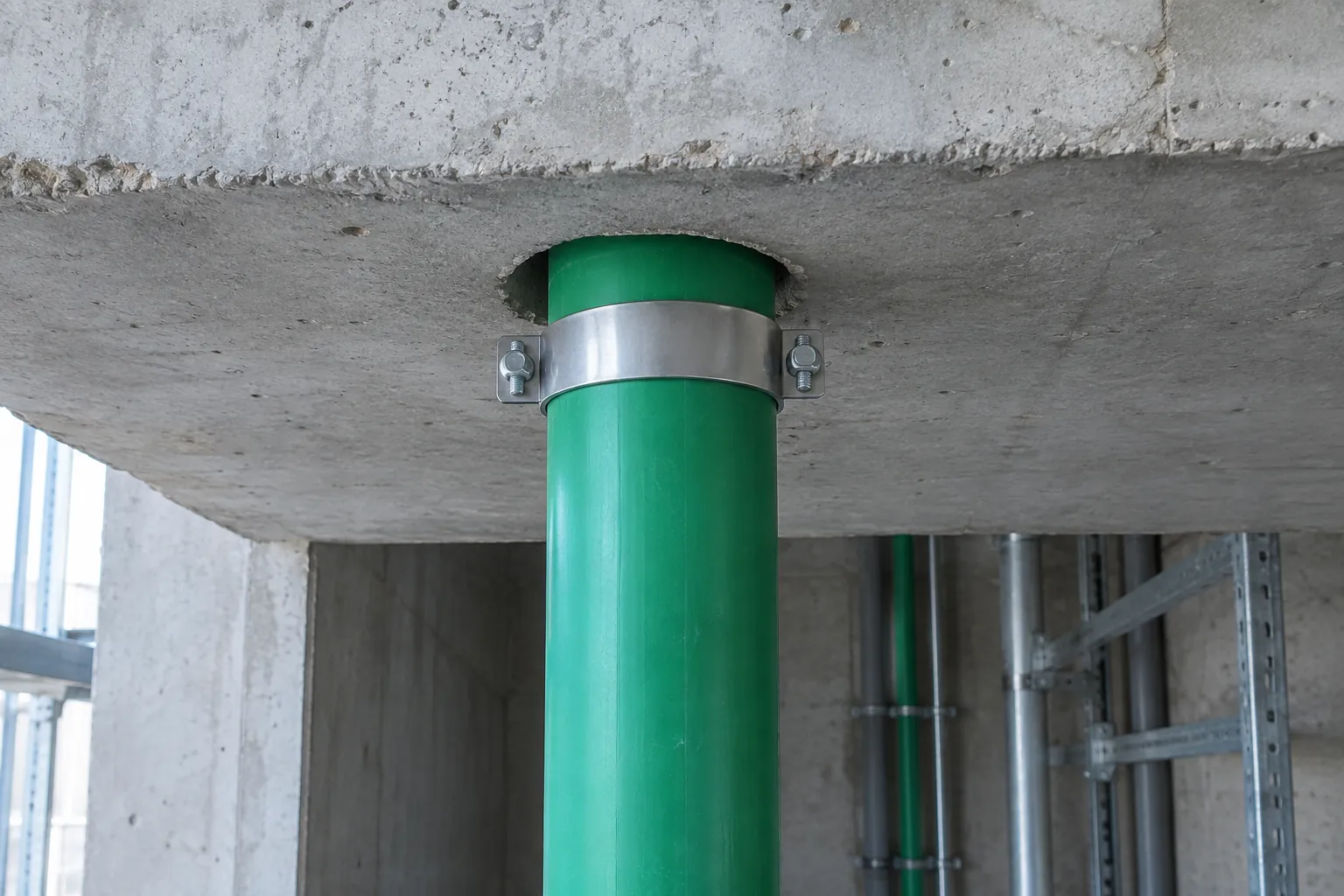
Read the approval, not the brochure. A collar datasheet current in August 2025 names the materials it suits, PVC, UPVC, polypropylene, PE and HDPE, and diameters to 250 mm outside diameter, and records a test to BS EN 1366-3:2009 under ETA 20/1125. Two things follow. The approval rests on the 2009 edition of a standard now at 2021 with a 2024 amendment, and the approval governs. And the datasheet carries no wall thickness range; those limits sit in the European Technical Assessment and the classification report.
This is where a pressure class breaks a detail. IFAN ULTRA PN20 is SDR 6, so the wall runs 3.4 mm at DN20, 8.4 mm at DN50, 18.4 mm at DN110 and 26.6 mm at DN160. PN16 and PN10 are thinner, as the pressure class guide sets out. A collar classified on a thin-wall PP pipe has not been classified on a 26.6 mm wall, and the inspector reading the report sees that before you do. Check the range against the series ordered from the PPR Global Series.
| Nominal diameter | PN20 wall (mm) |
|---|---|
| DN20 | 3.4 |
| DN25 | 4.2 |
| DN32 | 5.4 |
| DN40 | 6.7 |
| DN50 | 8.4 |
| DN63 | 10.5 |
| DN75 | 12.5 |
| DN90 | 15.0 |
| DN110 | 18.4 |
| DN160 | 26.6 |
| Check | Where the answer lives | IFAN ULTRA PN20 figure (mm) | It fails if |
|---|---|---|---|
| Pipe material | ETA and classification report | Not dimensional | Polypropylene is absent from the tested list |
| Outside diameter | ETA dimension table | 20 to 160 | Your diameter sits outside the tested range |
| Wall thickness | Classification report, not the datasheet | 3.4 to 26.6 | The SDR 6 wall exceeds the tested wall |
| Supporting construction | Classification report, tested substrate | Not dimensional | Your wall or slab was not the one tested |
| Period required | EN 13501-2:2023 classification, in minutes | Not dimensional | The EI period is under the wall’s rating |
Where GCC Codes Do and Do Not Allow PP-R
There is no single Gulf rule, and anyone who says there is has read one country’s document. The UAE, Saudi Arabia and Qatar each issue their own fire code, through their own authority. What they share is the boundary already drawn: a potable water pipe and a fire-fighting pipe answer different questions, even where both cross the same 120 minutes barrier.
In the UAE the governing document is the Fire and Life Safety Code of Practice, still the 2018 edition, published by the Ministry of Interior and enforced by each emirate. It moves. Abu Dhabi Civil Defence Authority released 54 amendments on 12 March 2026 covering compartmentation, passive fire protection, sprinkler systems and fire pumps. Jurisdiction matters as much as text. Civil defence approval governs fire-fighting systems, while potable water materials route through the emirate water authority, DEWA in Dubai, with conformity handled by MOIAT. The UAE sourcing guide works through that route.
Saudi Arabia works to SBC 801, the Saudi Fire Protection Code, and the edition has moved: the 2024 requirements were published on 24 December 2024 and took effect on 1 July 2025, replacing the 2018 code most consultants still quote. Qatar works through the Civil Defence Department under the Ministry of Interior, whose guideline circulates in a 2015 revision. That revision is in general use; we have not confirmed it as the latest issue, so ask the department, not a forum.
One thing holds across all three, and it has nothing to do with a fire class. Sprinkler and standpipe piping has to be listed for fire protection service, and for plastic the listing standard is UL 1821. The Plastics Pipe Institute names CPVC and PEX systems listed to it under NFPA 13, 13R and 13D, now in the NFPA 13 2025 edition. Polypropylene is not on that list, and a fire-retardant PP-R grade does not put it there.
| Jurisdiction | Governing document and edition | PP-R on potable hot and cold water | PP-R in fire-fighting piping | Verdict |
|---|---|---|---|---|
| United Arab Emirates | Fire and Life Safety Code of Practice, 2018 edition, amended March 2026 | Plumbing route via the water authority, DEWA in Dubai | No PP-R listing exists | Confirm the plumbing route and the firestop detail before the quotation goes out |
| Saudi Arabia | SBC 801, 2024 requirements in force since 1 July 2025, superseding 2018 | Plumbing route; confirm which edition is enforced | No PP-R listing exists | Confirm the enforced edition before the quotation goes out |
| Qatar | QCDD fire and life safety guideline, 2015 revision in circulation | Plumbing route; current issue unconfirmed here | No PP-R listing exists | Ask QCDD which issue applies before relying on the 2015 text |
| Sprinkler runs, all three | NFPA 13, 2025 edition, where adopted | Outside the scope of this system | Listed pipe only: CPVC or PEX to UL 1821 | PP-R is not a sprinkler material in any of them |
What to Put in the Submittal
Write the pipe line so every word behind it has a document. Name the product standard and edition, ISO 15874-2:2013, the pressure class and SDR, and the reaction-to-fire position as it is: report held, with laboratory and number, or no report held. An honest blank survives review.
Write the penetration line separately; it is a different product with a different approval. Name the period in minutes, the classification standard EN 13501-2:2023, the test standard edition the collar’s own approval used, the ETA number, and the material, diameter and wall thickness it covers. The installation method statement holds the sleeving detail.
Four questions before a container is booked. Do you hold a reaction-to-fire classification report for this exact product, and may I have the number? What wall thickness was tested? Which collars have been classified against this pipe? Can you confirm in writing that nothing in your range is offered for fire-fighting service? A first order here is 1 FCL with 15 to 25 days of production, which is time enough to get answers on paper.
Conclusion
Two moves close this out. Stop quoting a fire class you cannot attach a report to, and ask for the report number. Move the rating argument to the penetration, where EN 1366-3:2021+A1:2024 and EN 13501-2:2023 assign minutes, and check the collar approval against the wall you ordered.
Then split the job before you quote. Potable hot and cold water is plumbing; PP-R belongs there with its penetrations sealed. Fire-fighting piping is a listing question no grade of polypropylene answers. Confirm the edition your authority enforces before a metre is priced.
Frequently Asked Questions
Is PPR pipe fire resistant?
No. Polypropylene is combustible: limiting oxygen index 19 %, self-ignition 360 °C, and it drips and keeps burning once the flame is removed. Fire resistance in minutes belongs to the sealed penetration, not to the pipe.
What is the fire rating of PPR pipe?
It has one only where a specific product holds a classification report. Under EN 13501-1:2018 an untested product is class F. Ask for the report by laboratory and number; without it there is no rating to quote.
Can PPR pipe be used for fire sprinkler systems?
No. Sprinkler piping has to be listed for fire protection service, and the plastic listing standard UL 1821 covers CPVC and PEX. Polypropylene is not listed, so no PP-R grade qualifies whatever its reaction-to-fire class.
Does PPR pipe need a fire collar?
Wherever it crosses a fire-resistance-rated wall or floor, yes. The collar is tested to EN 1366-3:2021+A1:2024 and classified to EN 13501-2:2023, and its approval must cover your pipe material, diameter and wall thickness.
Is DIN 4102 B2 the same as Euroclass E?
No. MPA NRW states that no direct link can be made between DIN 4102-1 classes and EN 13501-1 Euroclasses. B2 evidences a German test to DIN 4102-1:1998-05; a Euroclass needs its own classification report.









 English
 Español
 Français
 Português do Brasil