
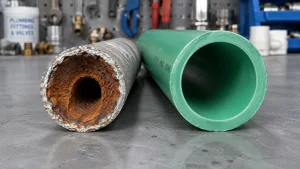
Consider a hot-water retrofit where inspection reveals a galvanised bore narrowed by corrosion product. The buying questions are the replacement duty, the required internal diameter and the installed quotation. This is an illustrative scenario, not an IFANULTRA field case.
PP-R can suit a corrosion-driven retrofit when its documented duty and installation requirements fit. Steel may remain preferable where impact, exposure or structural constraints govern. Compare the specific products and installation, rather than selecting from the material name alone.
The trap sits in the middle of the switch, and it is a sizing trap rather than a material one. Galvanised tube uses nominal-bore labels and PP-R uses outside diameter; in the DN20–DN50 examples below, replacing EN 10255 medium-series steel with the same-label PN20 PP-R retains about 59–64% of the nominal internal diameter.

PPR vs Galvanised Steel: The Head-to-Head
Most comparisons of these materials list adjectives. The rows that decide a specification are narrower: which document governs the pipe, how size is measured, how a joint is made, and what ends the line.
Two carry numbers worth memorising. A DN25 galvanised tube to EN 10255 medium series has a 27.3 mm bore; a DN25 PP-R pipe at PN20 has 16.6 mm. The published representative PP-R socket chart lists 260 °C and 7 s heating at DN25 under standard conditions; follow the approved system procedure. Steel is cut and threaded. The materials do not share a sizing basis, and that row causes the most expensive retrofit mistakes.
| Measure | Galvanised steel | PP-R | Verdict |
|---|---|---|---|
| Governing standard | EN 10255:2004+A1:2007 | ISO 15874-2:2013 + Amd 1:2018 + Amd 2:2022 | Tie. Cite edition and year on both |
| Sizing basis | Nominal bore; DN25 gives 27.3 mm bore | Outside diameter; DN25 PN20 gives 16.6 mm bore | Galvanised. Never swap by label |
| Joint method | Cut and threaded, sealed by compound | Socket fusion at 260 °C; 7 s on the die at DN25 | PP-R. Fused joint is homogeneous |
| Failure mode | Localised pitting through the wall; bore closes with tubercles | Cold joints and poor fusion discipline | Check fusion quality, duty and material evidence |
| Temperature ceiling | Verify the steel pipe, coating, joints and water chemistry against the specified temperature and pressure. | Check the offered product’s application class and pressure–temperature rating | Select the system whose documented rating and corrosion compatibility meet the duty. |
| Corrosion in hot water | Reviewed 65 °C study: about 0.05 mm/year; separate field report: zinc loss about one-third | Resists the steel rust mechanism; check chemical compatibility | PP-R where the documented duty fits |
Key Takeaways
- Replacing EN 10255 medium-series steel with same-label PN20 PP-R across DN20–DN50 retains 59–64% of the nominal internal diameter. An equal-head-loss, equal-roughness model gives 25–30 % of the flow; that is not actual system performance. Bore parity needs about two sizes up at PN20, one at PN10.
- A study reviewed by Chukhin et al. (2025) reported about 0.05 mm/year at 65 °C. Zinc-coating loss of about one-third in 12 months comes from a separate cited field report.
- Average corrosion rate misleads: uniform-rate arithmetic on a 3.2 mm DN25 wall predicts about 64 years, whereas the paper describes fistulas in inspected hot-water pipes after 3–5 years. The attack is localised.
- Cite standards in full: EN 10255:2004+A1:2007 for galvanised tube; ISO 15874-2:2013 with Amd 1:2018 and Amd 2:2022 for PP-R.
- PP-R’s 50-year design basis uses long-term strength extrapolation; it is not evidence of a 50-year field test or an unconditional service guarantee.
- No article can quote your installed cost. Drivers are public: zinc USD 3,539/t (June 2026), PP-R resin USD 780–1,150/t. Labour and delivered prices are local.

The Corrosion Clock: What Actually Ends a Galvanised Line
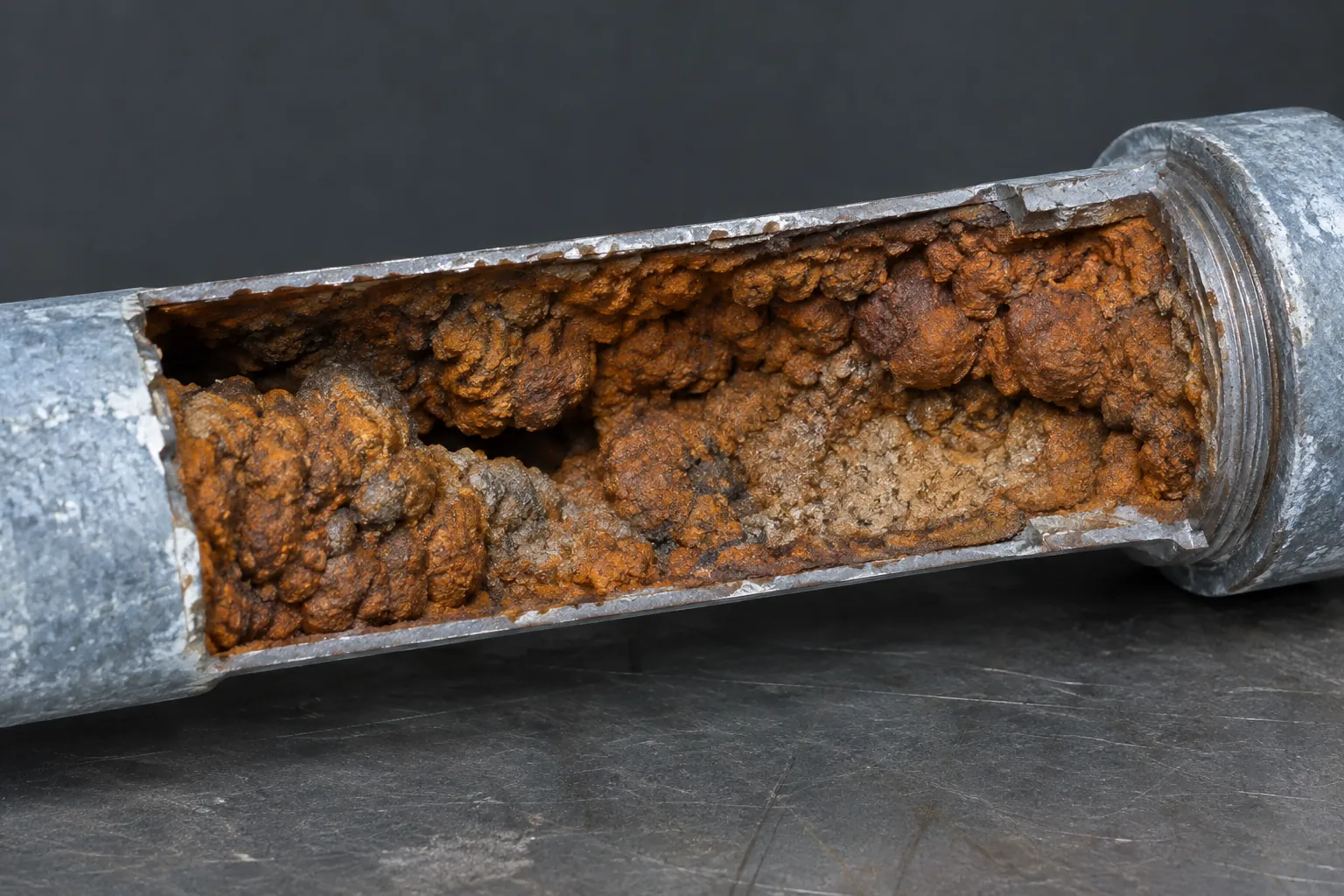
Almost every page comparing these materials asserts that galvanised pipe rusts. Very few put a measured rate against it. A 2025 paper on hot water supply systems by Chukhin, Makisha and Gulshin reviews an earlier experiment at 65 °C over 150 days: 1.1 g/m² per day, roughly 0.05 mm/year, rising to about 0.064 mm/year with copper ions. Separately, its introduction cites a Moscow hot-water field report: zinc-coating reductions of 17%, 9% and 6% in the first three months, then 1% over the next nine months. Summing those reported percentages gives 33%, a derived total, not a number printed directly in the paper. The paper’s 50 ± 2 °C bench images concern a different observation.
Those numbers describe hot water service with that network’s water chemistry, and they should not be read across to a cold-water line, whose chemistry and conditions may differ.
Now do the obvious arithmetic. A DN25 medium-series wall is 3.2 mm; at 0.05 mm per year, uniform corrosion takes about 64 years to eat through it. The 2025 paper describes inspected hot-water pipes removed after three to five years following fistulas. This is field evidence, not a matched lifetime experiment.
These separate observations illustrate why an average uniform-loss calculation cannot predict a particular riser’s life; the paper’s inspection and microscopy evidence identifies localised pitting. A replacement plan built on a smooth depreciation curve is planning for the wrong failure.
The Sizing Trap That Wrecks the Retrofit
Galvanised tube is sized on nominal bore. PP-R is sized on outside diameter, so its DN number is the outside of the pipe and the wall is subtracted from it. A contractor who orders “the same size in PP-R” gets something much smaller.
At DN25 the galvanised bore is 27.3 mm; PP-R PN20 at DN25 has a bore of 16.6 mm. Across DN20 to DN50 the label-for-label swap keeps 59–64 % of the bore. An equal-head-loss, equal-length, equal-Hazen–Williams-C model scales flow with diameter to the power 2.63 and gives 25–30 % retention. Different roughness, fittings and system conditions change the result; this isolates geometry, not measured service flow.
The correction depends on pressure class, which is why a single substitution rule is unsafe. At PN20 bore parity sits about two nominal sizes up: DN25 galvanised is matched to 97 % by PP-R DN40. At PN10 the wall is thinner and one step is close to enough, with DN32 reaching 96 % of the same bore.
Size from a flow calculation rather than a conversion table, pick the pressure class the duty needs, and check the wall schedule of the range you are buying. IFANULTRA’s hot-water guide publishes a PN20 wall schedule from DN20 to DN160; confirm the offered SKU dimensions in the quotation.
| Nominal size label (DN) | Galvanised steel bore, EN 10255 medium (mm) | PP-R PN10 bore, SDR 11 (mm) | PP-R PN20 bore, SDR 6 (mm) |
|---|---|---|---|
| 20 | 21.7 | 16.0 | 13.2 |
| 25 | 27.3 | 20.4 | 16.6 |
| 32 | 36.0 | 26.2 | 21.2 |
| 40 | 41.9 | 32.6 | 26.6 |
| 50 | 53.1 | 40.8 | 33.2 |
Read the chart as a warning about purchase orders, not hydraulics. The steel bore remains larger at every plotted label, and the gap generally widens across the range.
What the Cost Case Actually Looks Like
Public benchmarks and manufacturer estimates describe inputs; neither establishes an installed total. Zinc, which sets the galvanising cost of steel tube, averaged USD 3,539 per tonne in June 2026 on the World Bank Pink Sheet, with iron ore at USD 100.8 per dry tonne. IFANULTRA’s published cost discussion estimates PP-R resin at USD 780–1,150 per tonne and 70–85% of manufacturing cost; confirm the current grade-specific input and finished-product quotation. See the published cost discussion.
Both are input costs, not delivered pipe prices. A per-metre installed total built on them has estimated the three largest terms.
Two order inputs need separate pricing. Bore matching can require DN40 PP-R against DN25 galvanised; compare the selected sizes rather than assuming a material saving.
A 40-foot high-cube container has about 76 m³ of internal volume, but the limiting factor must be calculated from the packed SKU mix, gross weight and route-specific payload limits. See the carrier’s equipment example. Request packed volume and gross weight for each quotation before comparing freight.
| Cost element | Galvanised steel | PP-R | Who can price it |
|---|---|---|---|
| Raw material driver | Steel plus zinc coating; zinc USD 3,539/t (June 2026) | Manufacturer estimate: resin USD 780–1,150/t, 70–85% of works cost | World Bank benchmark; IFANULTRA estimate—confirm current inputs |
| Size bought for equal bore | DN25 carries 27.3 mm | DN40 at PN20, or DN32 at PN10 | Your flow calculation |
| Jointing on site | Cut, thread, seal; rework means recutting | Fusion at 260 °C, 7 s at DN25, 24 s at DN63 | Local contractor rate |
| Container economics | Calculate packed volume and gross weight for this order | Check packed volume against equipment and route-specific payload limits | Freight quote |
| First order terms | Varies by mill and stockist | MOQ 1 FCL; 15–25 days production; 30/70 payment | Supplier, in writing |
Make the quotations comparable
Send both suppliers the required flow, available pressure, run length, fittings schedule, water duty and existing measured dimensions. Ask each to return its selected size and rating, delivered pipe-and-fitting quantities, jointing scope, freight basis and dispatch date. Compare complete installed scope, not raw-material prices. Confirm the published 1 FCL MOQ and 15–25-day production basis against this order; transit, approval dependencies and site labour need separate dates and prices.
Where Galvanised Still Wins, and How to Tie the Two Together
PP-R has real limits, and a supplier who will not name them is worth less than one who will. The Plastics Pipe Institute’s North American overview describes PP-R ratings at 82 °C with pressure dependent on dimension ratio. That is not a universal ISO 15874 temperature ceiling. For galvanised steel, AGA guidance describes water-chemistry-dependent corrosion; verify the pipe, coating and joints against the duty. Select from the offered system’s application class, design pressure and temperature schedule, including the documented operating excursions.
Steel may suit impact-exposed runs, but support spacing must follow the applicable code and approved design. Both systems require supports appropriate to their material, loads and installation rules. Unprotected PP-R degrades under sustained UV, so outdoor runs need a UV-stabilised grade or covering. And the bore penalty is real, size for size.
One more limit costs importers the most. An ISO 15874 type-test report is not a drinking-water approval: the Introduction to ISO 15874-1 states that no information is provided on whether the product can be used without restriction, and that national regulations remain in force. Nor is the 50-year figure a 50-year test, as our own breakdown of ISO 15874 and DIN 8077 sets out.
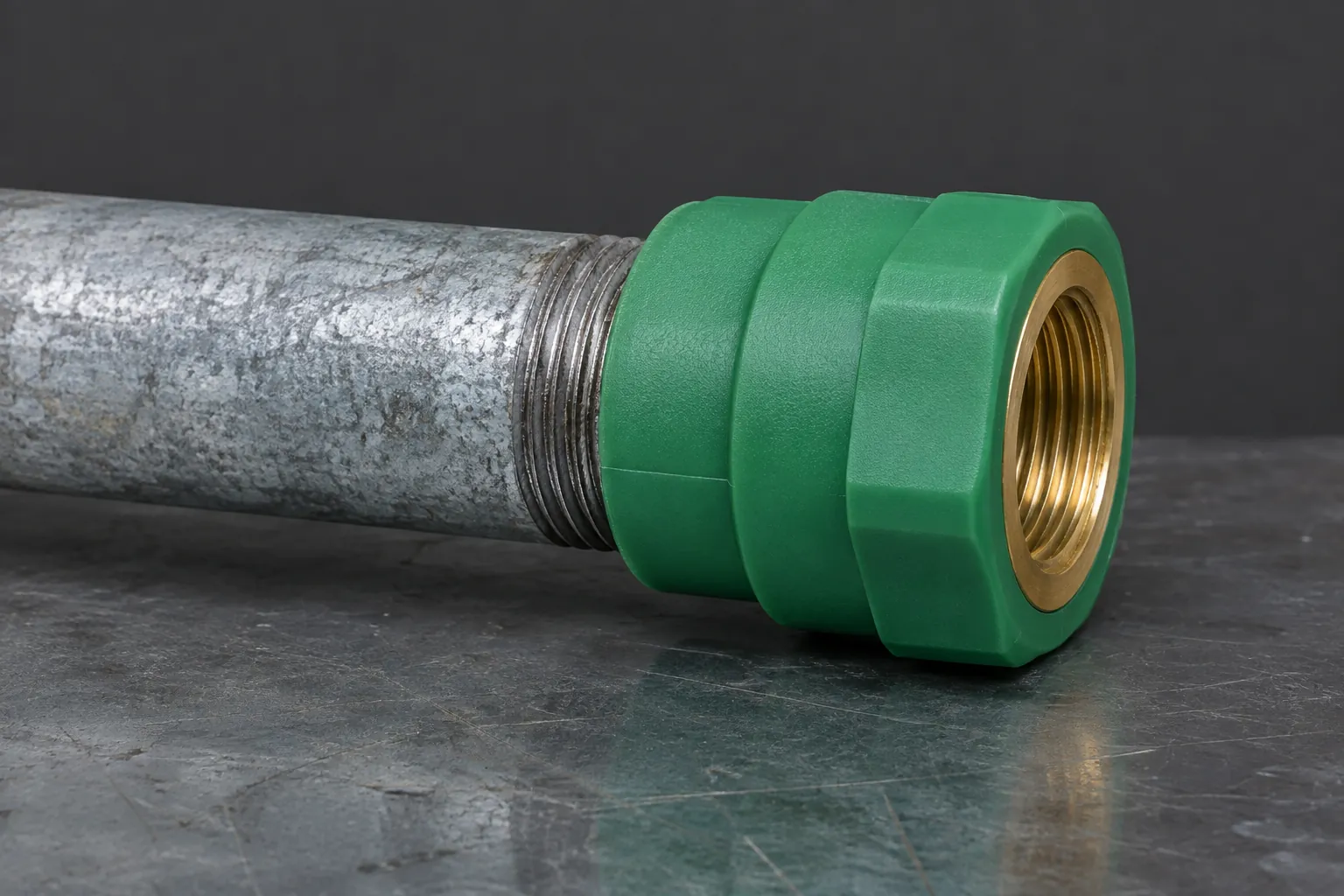
Where only part of a system is converted, the two materials meet at a threaded transition: a brass-insert fitting fused to the PP-R and threaded to the existing steel. Brass insert transitions are where mixed-material retrofits leak, so specify the insert rather than improvising.
What We Check Before a Bore-Matched Quote Goes Out
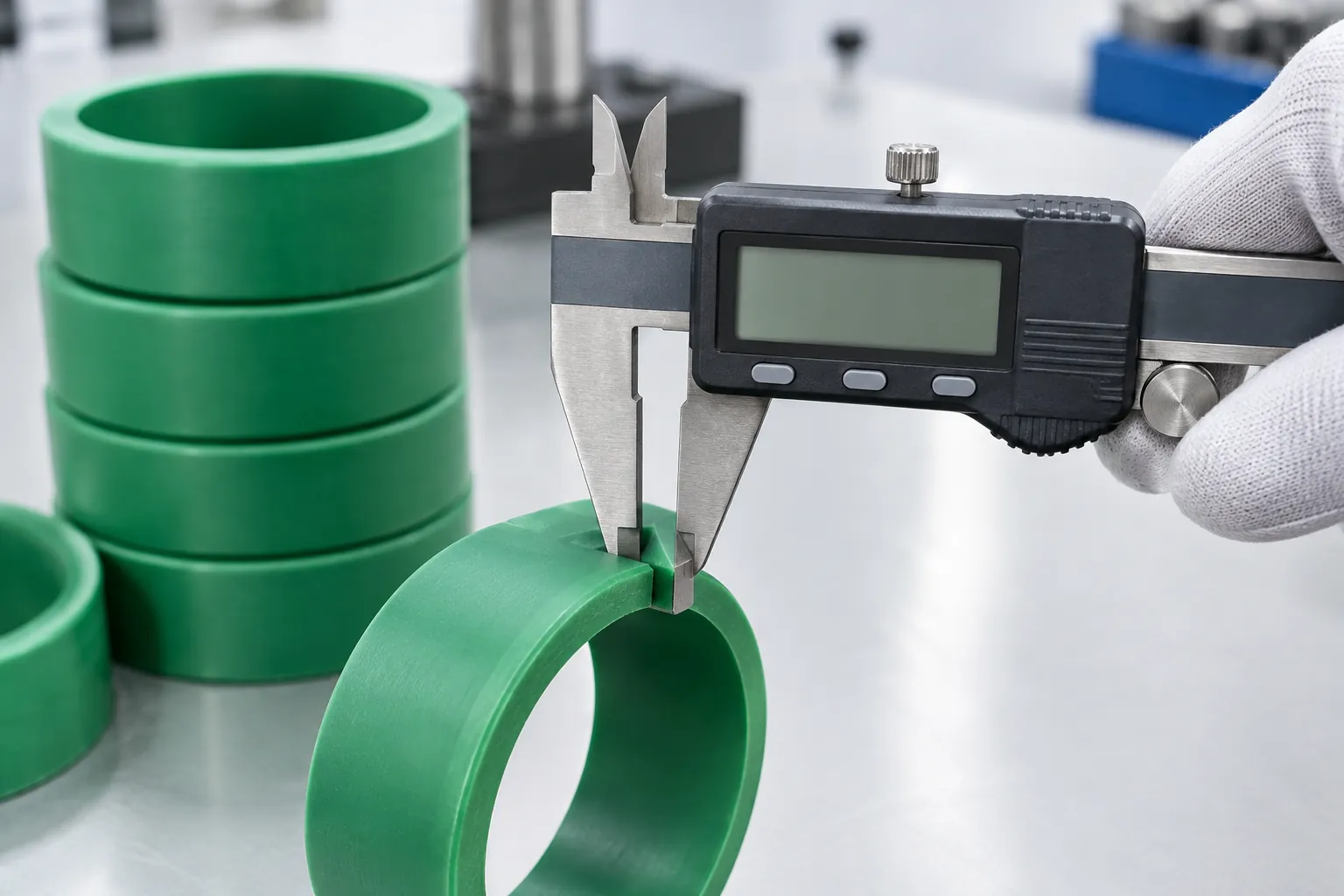
Our published QC process describes the checks supporting a bore-matched quotation; request the records for the offered batch. Resin grade is verified by source and grade. Wall thickness is checked with a caliper across multiple pallets rather than the top layer, because the top layer is the one that gets sampled.
Outside diameter and wall are measured against ISO 15874 and DIN 8077, pressure and thermal tests are run to the rated class, and printed markings are reconciled to the certificate numbers they claim. For DN40 PN20, 6.7 mm is the published nominal wall; acceptance must use the applicable tolerance and batch inspection criteria, rather than exact equality to one caliper reading.
Where that stops matters too. IFANULTRA’s public certification page lists ISO 9001, SAI Global, SKZ, HY and NSF; verify each current document and its product scope. ISO 9001 concerns quality management; a list of certificate names does not establish a particular product’s dimensions, pressure rating or local drinking-water acceptance. Request the current certificate or listing, covered SKU and scope, alongside the relevant product test evidence.
Which One Should You Specify?
The decision is keyed to duty, not to preference, and it splits cleanly enough to put in a table. A corrosion-driven replacement can favour PP-R where its documented rating and installation fit. Exposed, impact-loaded or hotter runs need a system selected for the actual loads, support arrangement and operating duty.
A buyer moving a first container needs five facts: the size range (DN20 to DN160), the pressure classes, the MOQ, the lead time, and what certification the supplier holds. Ours are ISO 9001, SAI Global, SKZ, HY and NSF. If copper is the other candidate rather than steel, that comparison runs differently and is covered in PPR vs copper.
| Situation | Best for | Why | Watch for |
|---|---|---|---|
| Concealed hot water riser | PP-R | Inspected hot-water pipes had fistulas after 3–5 years; no universal lifetime | Calculate flow and pressure drop; two PN20 size steps are only a comparison starting point. |
| Cold water, already corroding | PP-R | Existing deposits may restrict the bore; assess restriction and ongoing corrosion | Verify the actual pressure–temperature duty |
| Exposed or impact-loaded run | Galvanised steel | Steel may suit impact-exposed runs, but support spacing must follow applicable code and approved design. | Inspect threaded joints and pipe walls for corrosion. |
| Duty outside the offered PP-R rating | A separately qualified alternative system. | PP-R derates on pressure as temperature climbs | Check the class, not the material |
| Partial retrofit of a steel system | Both, joined properly | Brass-insert fittings carry the transition | The mixed joint is the leak risk |
Conclusion
PP-R can be a suitable corrosion-driven replacement when its documented rating and installation meet the duty. Keep steel where the approved design requires it for impact, span or operating conditions.
A preventable purchasing error is copying the old DN schedule onto a PP-R quotation without checking the bore and hydraulics. The same-label calculation shows a geometric risk, not a guaranteed loss of actual flow. Size from the bore, confirm the pressure class against the duty, and check the wall schedule before the container is booked, because that error is invisible on paper and expensive once the system is in the wall.
Frequently Asked Questions
What are the disadvantages of PPR pipe?
Four real ones: a smaller bore at the same DN label, a duty-specific pressure–temperature rating, degradation under sustained UV without a stabilised grade, and support requirements that must follow the manufacturer’s installation rules.
How do you connect PPR to GI pipe?
Use a compatible brass-insert transition: socket-fused under the approved system procedure on the PP-R side and threaded to steel. The published representative chart uses 260 °C under standard conditions. Specify the insert, thread compatibility and sealing method; do not assume every mixed-system connection uses an identical fitting.
Is GI pipe good for water?
Assess the actual duty and water chemistry. A study reviewed by Chukhin et al. reports about 0.05 mm/year at 65 °C; a separate cited field report concerns roughly one-third zinc-coating loss in 12 months. These are scoped observations, not a general life prediction.
Is PPR cheaper than GI pipe?
Raw-material benchmarks alone do not establish a pipe-price saving; compare delivered, bore-matched quantities and local installation costs. Delivered pipe prices and labour rates are local, so the honest answer is to price both locally against a bore-matched schedule.
Does PPR pipe really last 50 years?
The 50-year figure is an ISO 9080 extrapolation of the material strength curve, not a 50-year test; it is not an unconditional service-life guarantee. Material grade, duty, water chemistry and installation all require review.









 English
 Español
 Français
 Português do Brasil