
During a renovation project, a client mixed up pipe sizes and created a costly plumbing puzzle. That moment highlighted why understanding CTS is not just industry jargon—it’s essential for a smooth project.
CTS stands for “Copper Tube Size.” It is a standard sizing system where plastic pipes, like PEX or CPVC, are manufactured to match the outside diameter of traditional Type L copper tubing. This standardization allows for direct, easy connections between modern plastic systems and existing copper plumbing without requiring special adapters or complex calculations.
If you work with plumbing in older homes or commercial retrofits, you have likely encountered CTS. Therefore, let’s clarify exactly what it means and why this sizing system is so useful.
Does CTS Stand for Copper Tube Size or Copper Tubing Sizes in Piping?
This simple acronym can cause big confusion on a job site. Consequently, getting it right prevents ordering the wrong materials.
CTS universally stands for “Copper Tube Size” in North American piping standards. It refers specifically to a standardized set of outside diameters (OD) based on Type L copper tubing. While “Copper Tubing Sizes” is sometimes used conversationally, the official term and the one used in specifications and product catalogs is the singular “Copper Tube Size.”
Clarifying the Terminology
In plumbing and manufacturing, precise language matters. For example, “Copper Tube Size” (CTS) is the correct and formal designation. You will find this term in ASTM standards, building codes, and manufacturer literature.
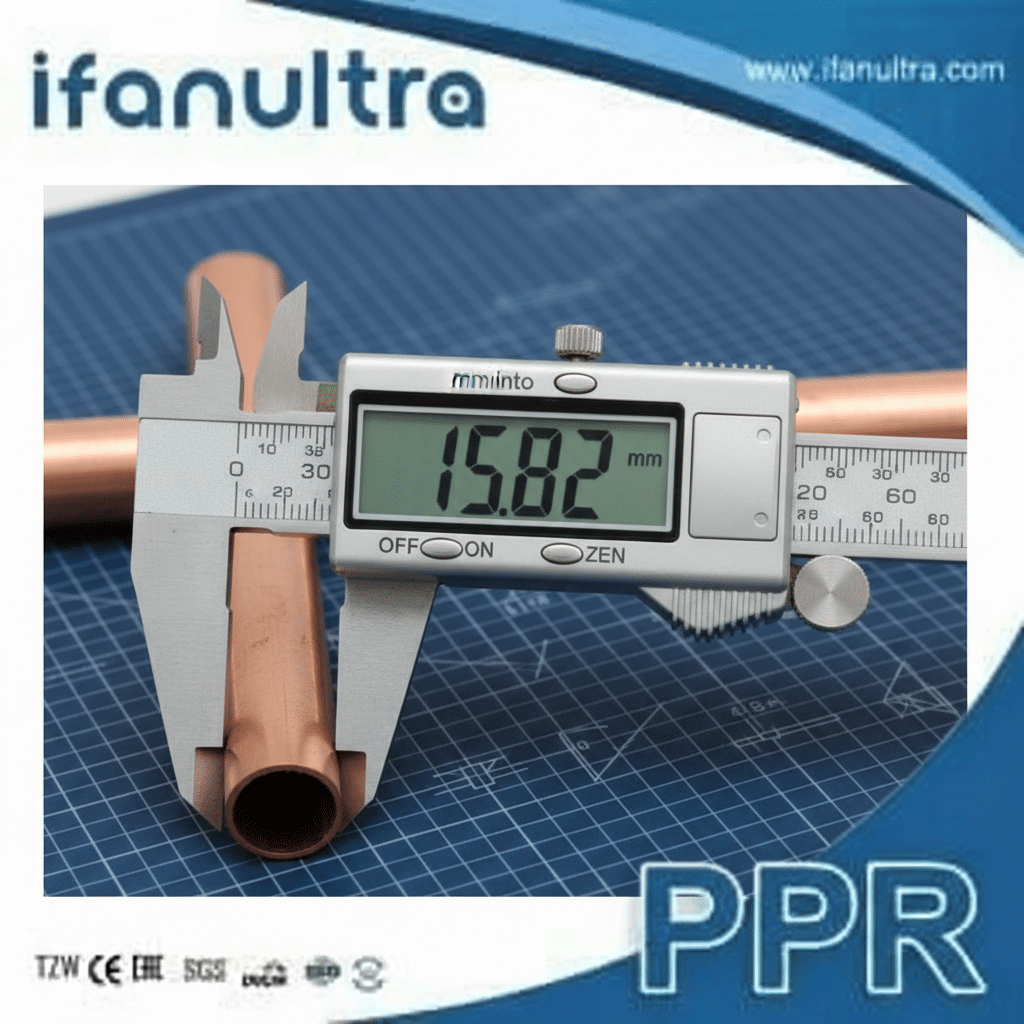
The reference to “Type L” copper is key. Specifically, copper tubing comes in three common wall thicknesses: Type K (thickest), Type L (standard), and Type M (thinnest). Crucially, all three types share the same outside diameter for a given nominal size. The difference is the inner diameter, due to wall thickness. Therefore, the CTS standard for plastic pipes copies the outside diameter of Type L copper.
Why the Singular Form “Size” is Used
The system is called “Copper Tube Size” because it denotes a specific sizing standard, not just a collection of dimensions. In other words, it is one complete system of measurement.
Think of it like clothing sizes. We refer to “men’s shoe size” as a system, not “men’s shoe sizes,” when talking about the scale itself. Similarly, CTS is the name of the scaling system.
Here is a quick reference for common CTS dimensions:
| Nominal Size | CTS Outside Diameter (OD) | Common Applications |
|---|---|---|
| 1/2 inch | 0.625 inches (15.875 mm) | Branch lines to faucets and fixtures. |
| 3/4 inch | 0.875 inches (22.225 mm) | Main water supply lines, water heaters. |
| 1 inch | 1.125 inches (28.575 mm) | Primary building supply, main distribution. |
So, when you see “CTS” on a pipe or fitting, it tells you, “This product is designed to connect seamlessly with the outside diameter of standard copper tubing.”
Why Are Some Plastic Pipes Sized to Match the Outside Diameter of Copper Tubing?
This wasn’t an accident; it was a brilliant solution to a major industry challenge. In fact, plastic pipes didn’t invent a new size—they adopted the one already on the walls of millions of buildings.
Plastic pipes are sized to match copper’s outside diameter to enable simple, direct replacement and integration in retrofit projects. When copper was the dominant material for decades, its dimensions became the default “language” of plumbing. Consequently, making new plastic pipes speak this same language allowed plumbers to upgrade systems without changing the fundamental layout or connection points.
The Historical Context: Copper’s Legacy
For much of the 20th century, copper tubing was the gold standard for potable water systems. As a result, entire generations of plumbers were trained on it. Millions of homes, offices, and factories were built with copper plumbing. This situation created a massive installed base.
When durable, corrosion-resistant plastics like CPVC and later PEX entered the market, they faced an adoption hurdle. Specifically, if they used a completely new sizing system, plumbers would need a whole new set of tools, knowledge, and adapters to use them alongside or as a replacement for copper. This friction would slow down sales and installation.
The Strategic Decision for Compatibility
Plastic pipe manufacturers made a strategic choice: compatibility equals adoption. By manufacturing to CTS, they achieved two major wins:
- Tool Compatibility: The same tube cutters and calibration tools used for copper could also work on CTS plastic pipe (especially CPVC). This lowered the barrier for plumbers to switch materials.
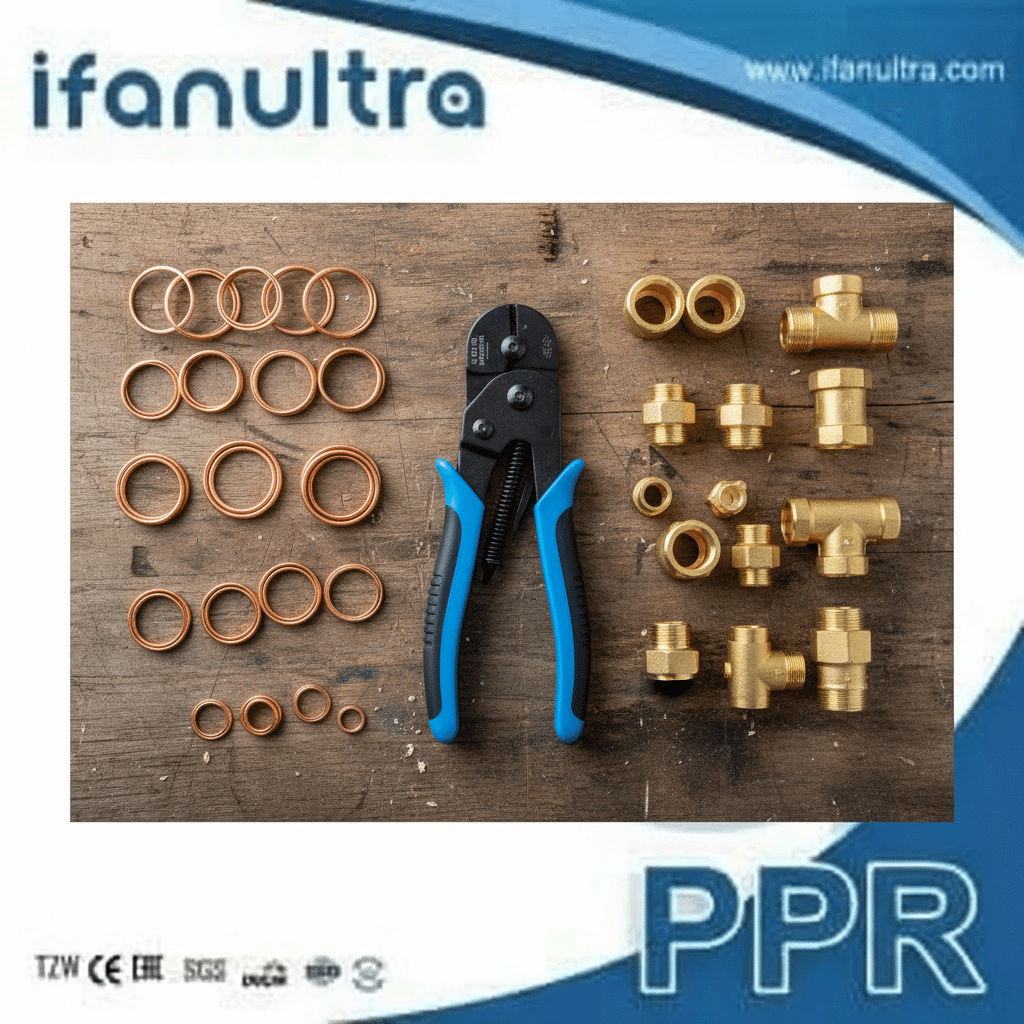
- Fitting and Connection Compatibility: The most important reason. Since the outside diameter matches, standard compression fittings and push-to-connect fittings designed for copper could also fit CTS plastic pipe. This meant a plumber could cut out a section of leaking copper and solder or press in a new section of CPVC or PEX using the same standard fittings.
This decision transformed the industry. Ultimately, it meant that the advantages of plastic—resistance to corrosion and scale, flexibility (for PEX), and often lower cost—could be easily brought into existing buildings. As a result, the plumbing world did not need to undergo a painful, expensive transition with two incompatible sizing systems running in parallel.
How Does CTS Sizing Simplify Retrofits and Connections to Existing Copper Systems?
This is where the theoretical benefit becomes a practical, time-saving reality on the job site. In short, CTS turns a complex retrofit into a straightforward repair.
CTS sizing simplifies retrofits by allowing plastic pipes to use the same fittings, hangers, and hole-penetrations as the copper being replaced. As a result, a plumber can directly connect new CTS plastic to old copper using standard solder, compression, or press fittings without reducing adapters. This process minimizes labor, material cost, and potential leak points.

A Step-by-Step Retrofit Scenario
Imagine you need to repair a leaking 3/4-inch copper line inside a wall.
Without CTS Compatibility:
- First, cut out the bad section of copper.
- Then, measure and install a new section of plastic pipe with a different outside diameter.
- Because the sizes differ, you must install a reducing adapter on each end of the new plastic pipe.
- Next, connect the adapters to the existing copper using a separate fitting.
- Finally, you now have four new connection points (copper-to-adapter and adapter-to-plastic on each side) instead of two. Unfortunately, each one is a potential future leak.
With CTS Compatibility:
- First, cut out the bad section of copper.
- Then, measure and cut a new section of 3/4-inch CTS PEX or CPVC.
- Next, slide standard copper-compatible press fittings or sweat couplings onto the ends of the existing copper.
- After that, insert the new CTS plastic pipe into the fittings and press or solder.
- As a result, you have only two connection points, and they are direct, standard joints.
The difference is clear: fewer parts, fewer steps, less room for error, and a more reliable final installation.
Benefits Beyond the Simple Connection
The simplification extends further:
- Hangers and Supports: Standard pipe hangers and straps designed for 1/2-inch or 3/4-inch copper will fit the same nominal size CTS plastic pipe perfectly. Therefore, you don’t need to buy new hardware.
- Wall Penetrations: The holes drilled through studs and plates for the original copper pipe are the correct size for the new CTS plastic pipe. Consequently, you don’t need to enlarge or patch holes.
- Design Consistency: For architects and engineers, using CTS means the spacing and layout designed for copper remain valid. As a result, they can specify a material change without redrawing the entire plumbing riser diagram.
Is CTS the Same as IPS or Schedule Sizes Used in Other Plastic Pipes?
This is a critical distinction that causes more mix-ups than almost any other in piping. In fact, the answer is a definitive no.
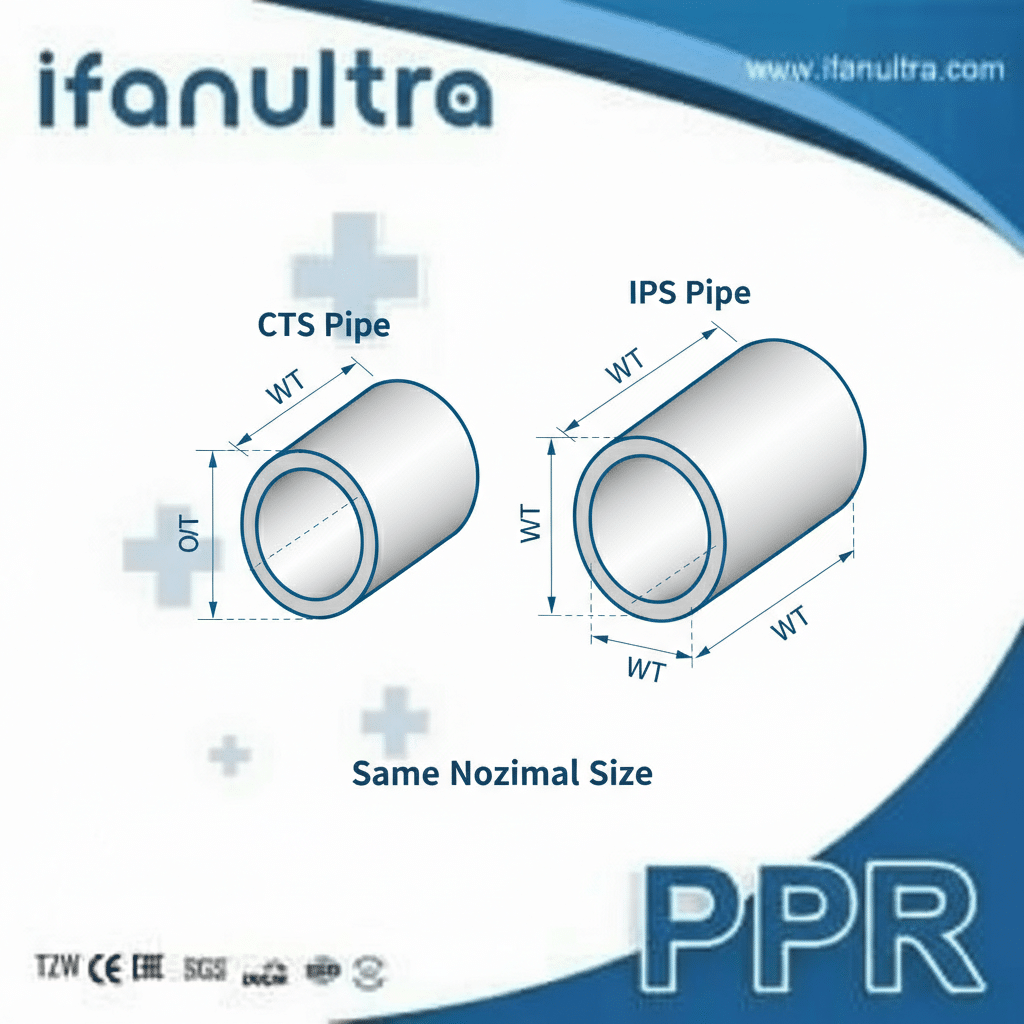
No, CTS is not the same as IPS or Schedule sizes. They are completely different sizing systems. Specifically, CTS is based on the outside diameter of copper tubing. In contrast, IPS (Iron Pipe Size) is based on the nominal size of old iron pipe, where the actual outside diameter is larger. Meanwhile, Schedule (e.g., Schedule 40) refers to wall thickness and pressure rating, not a fixed diameter.
Breaking Down the Different Systems
Mixing up these systems will result in pipes and fittings that do not connect. Therefore, let’s define each one:
1. CTS (Copper Tube Size):
- Basis: Outside Diameter (OD) of Type L copper.
- Key Trait: The OD is controlled and consistent for each nominal size.
- Example: A 1/2″ CTS pipe has an OD of 0.625 inches.
2. IPS (Iron Pipe Size):
- Basis: Historical inside diameter (ID) of old iron pipe.
- Key Trait: The outside diameter is larger and increases with “schedule” wall thickness. However, the nominal size is an approximation, not a physical measurement.
- Example: A 1/2″ IPS pipe (Schedule 40) has an OD of 0.840 inches—much larger than 1/2″ CTS.
3. Schedule (Sch 40, 80, etc.):
- Basis: Wall thickness and pressure rating standard.
- Key Trait: A “Schedule” number can apply to both IPS and CTS pipes, but it means different wall thicknesses for each system. Importantly, it does not define the diameter.
- Example: 1/2″ CTS Schedule 80 and 1/2″ IPS Schedule 80 are two different pipes with different ODs and pressure capabilities.
Comparison Table: CTS vs. IPS
This table shows why you cannot interchange fittings between these systems:
| Characteristic | CTS (e.g., for PEX, CPVC) | IPS (e.g., for PVC, some HDPE) |
|---|---|---|
| Standard Based On | Copper Tubing OD | Historic Iron Pipe ID |
| Outside Diameter (for 1/2″) | 0.625 in (15.875 mm) | 0.840 in (21.34 mm) |
| Primary Use | Potable water distribution (inside buildings) | Drain/waste/vent (DWV), irrigation, some main water lines |
| Common Connection Methods | Crimp, clamp, press, solder (with metal fittings) | Solvent cement (for PVC), threaded, flanged |
| Visual Difference | Smaller, thinner-looking for the same nominal size | Larger, heavier-looking for the same nominal size |
The Practical Rule: Always check the marking on the pipe. It will say “CTS” or “IPS/Schedule [number].” Never assume a 1/2-inch fitting will fit all 1/2-inch pipes. Instead, you must match the sizing system first.
Conclusion
Understanding CTS—Copper Tube Size—is key to efficient plumbing upgrades and repairs. For reliable, fully certified CTS PEX and CPVC piping systems that connect seamlessly to existing copper, choose IFAN.









 English
 Español
 Français
 Português do Brasil