
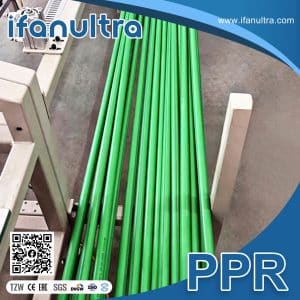
PPR pipe sizes run from DN20 up to DN160, and the number is the outside diameter in millimeters — DN20 is 20 mm across the outside, DN110 is 110 mm, and so on. That outside diameter is fixed across every compliant factory, so a fitting sized for DN25 mates with any brand’s DN25 pipe. What changes between one DN25 pipe and another is the wall thickness, which is set by the pressure class (PN), not by the diameter marking. Get those two numbers right — the DN for the bore you need, the PN for the pressure and heat you’ll run — and the pipe is specified.
This guide gives you the full size chart, the mm-to-inch rough equivalents plumbers still ask for, how wall thickness shifts with the PN class, and a method for choosing a diameter by flow rather than by habit. If you want the wider picture on the material, joining and selection, the PPR pipe guide covers properties and installation in depth; here we stay tight on sizes and dimensions.
Key Takeaways
- For PPR, DN is the outside diameter in millimeters and is fixed across compliant factories — DN25 is always 25 mm on the outside.
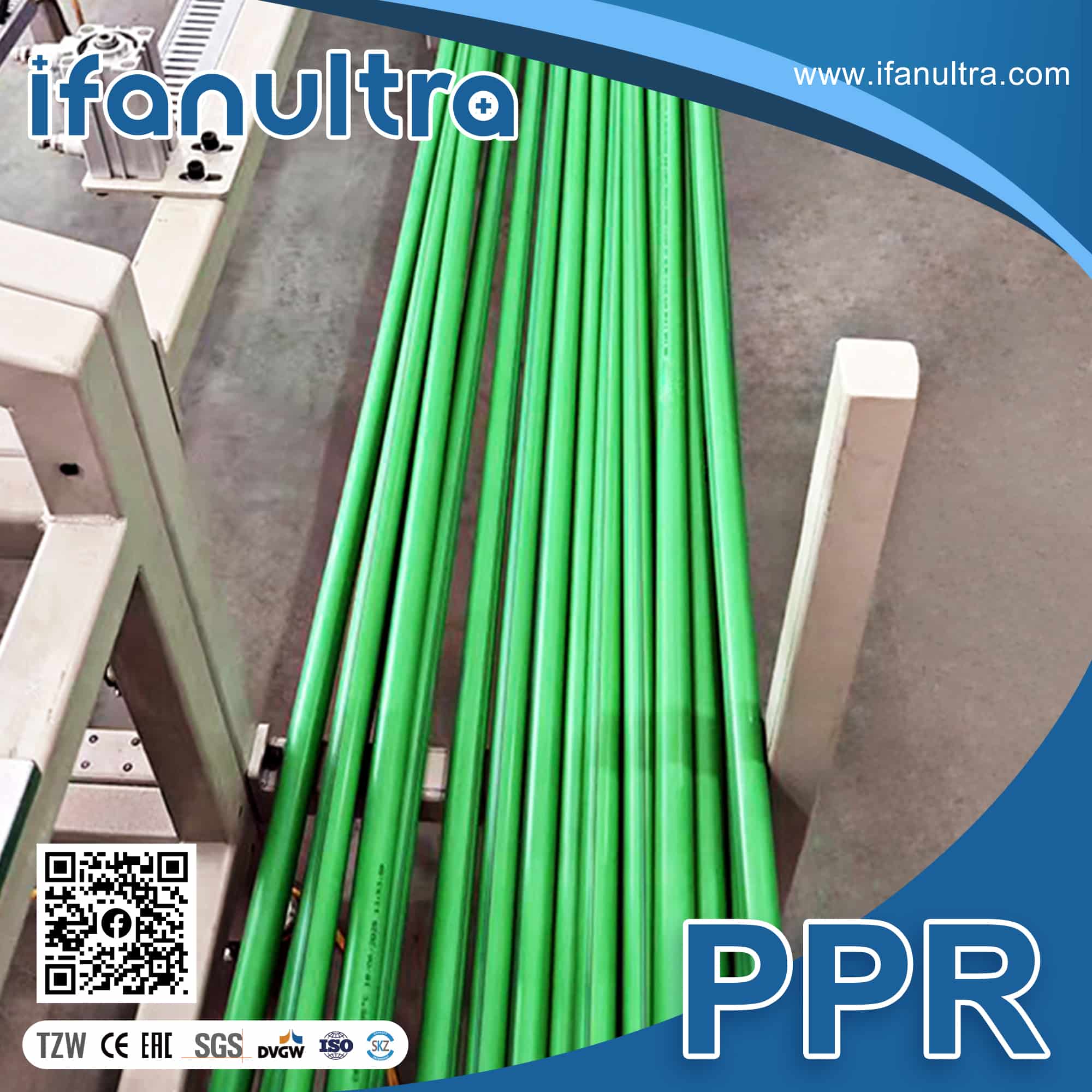
- Common sizes run DN20, 25, 32, 40, 50, 63, 75, 90, 110 up to DN160; the PN20 wall at DN25 is 4.2 mm and at DN110 is 18.4 mm.
- Wall thickness rises with the pressure class: a DN25 pipe is roughly 2.3 mm at PN10, 4.2 mm at PN20 and 5.0 mm at PN25.
- A thicker wall eats into the bore, so two pipes marked DN25 can carry different flow if their PN classes differ.
- Size by flow demand first, then set the PN by whether the line runs hot or cold — PN20 is the standard for hot water.
- DN20 (≈1/2″), DN25 (≈3/4″) and DN32 (≈1″) are the fast-moving sizes distributors should stock deep.
What “DN” actually means on a PPR pipe
DN stands for diamètre nominal — nominal diameter. On PPR pipe, and on plastic pressure pipe generally under ISO 15874 and DIN 8077, the DN number is the pipe’s outside diameter in millimeters. A DN25 pipe measures 25 mm across the outside. A DN63 pipe measures 63 mm. This is the single most useful fact for anyone specifying PPR: the outside diameter is fixed, so every compliant factory builds DN25 to the same 25 mm, and fittings, welding sockets and clamps designed for that size fit regardless of brand.
This trips people up because DN behaves differently in other pipe systems. In steel and many threaded systems, DN (or its cousin NPS) is a nominal label that tracks the approximate bore, not the outside. So the same “DN25” label means 25 mm outside on PPR but points at a roughly 1-inch thread on a steel line. That mismatch matters at the transition — a PPR-to-metal adapter is sized by the metal thread it screws into, not by the PPR DN alone.
DN vs inch: the rough equivalents
PPR is a metric system, so DN sizes never map cleanly onto inches. The equivalents below are the practical conversions plumbers use when they cross a PPR line into legacy imperial pipework — treat them as trade-fit references, not exact math. A DN20 PPR pipe pairs with a 1/2-inch thread, DN25 with 3/4 inch, DN32 with 1 inch, and so on up the chart. The inch figure describes the connecting thread size, while the DN is still the millimeter outside diameter of the plastic pipe itself.
Full PPR pipe size chart, DN20 to DN160
Here is the working size chart for PN20 pipe — the standard class for hot-water plumbing and the most common stock. Outside diameter is the DN value; the wall thickness shown is the PN20 wall. The inch column is the trade-fit thread equivalent, and the application column is the typical use rather than a hard rule.
| DN (size) | Outside Ø (mm) | Inch (≈) | PN20 wall (mm) | Common application |
|---|---|---|---|---|
| DN20 | 20 | 1/2″ | 3.4 | Fixture drops — basins, taps, single appliances |
| DN25 | 25 | 3/4″ | 4.2 | Branch lines feeding two or three fixtures |
| DN32 | 32 | 1″ | 5.4 | Risers and apartment mains |
| DN40 | 40 | 1 1/4″ | 6.7 | Building sub-mains |
| DN50 | 50 | 1 1/2″ | 8.4 | Main distribution, small plant rooms |
| DN63 | 63 | 2″ | 10.5 | Riser mains, commercial trunk lines |
| DN75 | 75 | 2 1/2″ | 12.5 | Large building mains |
| DN90 | 90 | 3″ | 15.0 | Plant rooms, industrial supply |
| DN110 | 110 | 4″ | 18.4 | Building mains, industrial process water |
| DN160 | 160 | 6″ | 26.6 | Large industrial and district supply |
Read the wall column carefully when you compare quotes. A DN25 PN20 pipe carries a 4.2 mm wall; a supplier shipping DN25 at 3.4 mm has quietly given you a PN16 pipe under a PN20 label. That is the most common way thin-wall pipe reaches a distributor’s shelf. What we check before a batch ships is that the wall at each DN matches the class printed on the pipe, because the wall is where the pressure rating lives.
How wall thickness changes with the PN class
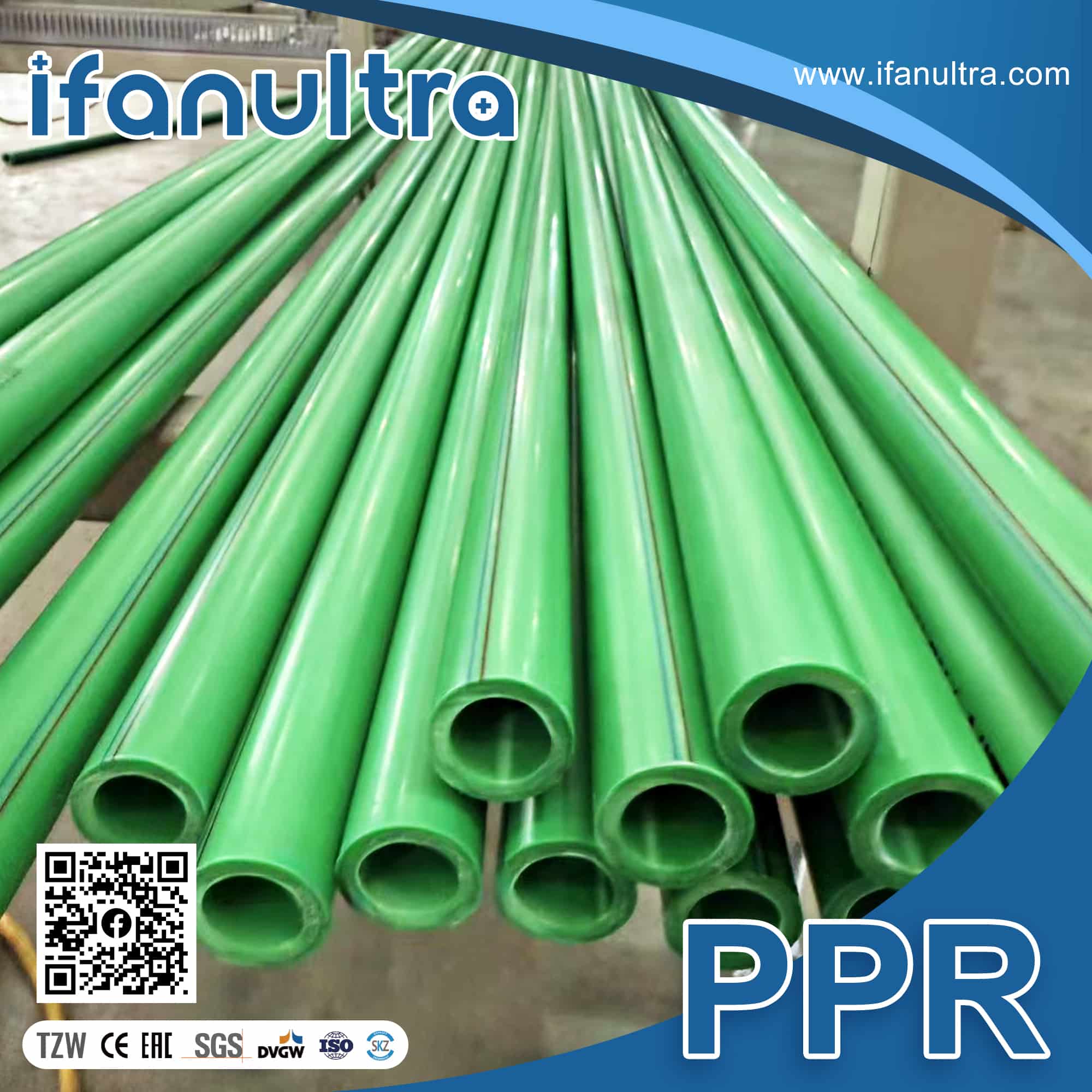
The PN number is the pressure the pipe holds for its 50-year design life at 20°C cold water. PN10 holds 10 bar, PN20 holds 20 bar, and the wall gets thicker as the class rises so the material can carry the extra hoop stress. The design tool behind this is the SDR — the standard dimension ratio, outside diameter divided by wall thickness. A lower SDR means a thicker wall relative to the diameter, which means a higher pressure rating. PN20 pipe runs SDR6; PN25 runs SDR5.
The table below holds the diameter constant at DN25 and shows how the same 25 mm outside pipe thickens as the class climbs. The outside diameter never moves — only the wall, and with it the bore.
| Pressure class | Series / SDR | DN25 wall (mm) | Typical use |
|---|---|---|---|
| PN10 | S5 / SDR11 | ≈ 2.3 | Cold water supply only |
| PN16 | S3.2 / SDR7.4 | ≈ 3.4 | Higher-pressure cold, warm water |
| PN20 | S2.5 / SDR6 | ≈ 4.2 | Standard hot water — the common stock |
| PN25 | S2 / SDR5 | ≈ 5.0 | High-pressure and fiber-composite lines |
The practical takeaway: the class you buy sets the wall, and the wall sets both the pressure the line survives and the temperature it tolerates over decades. PPR runs about 70°C continuously with a short-term peak near 95°C, but that rating assumes the correct class. Push a PN10 cold-water pipe onto a hot line and you spend the design life at higher stress than the wall was built for.
Inside diameter, bore and flow
The bore is what actually carries water, and the bore is what you never see printed on the pipe. Calculate it simply: inside diameter equals the outside diameter minus twice the wall thickness. A DN25 PN20 pipe with a 4.2 mm wall has a bore of 25 − (2 × 4.2) = 16.6 mm. A DN25 PN10 pipe with a 2.3 mm wall has a bore of 25 − (2 × 2.3) = 20.4 mm. Same DN, same 25 mm outside — but nearly 4 mm difference in bore.
That is why two pipes both marked DN25 can move different amounts of water. Flow area scales with the square of the bore, so a 20.4 mm bore carries roughly 50 percent more cross-sectional area than a 16.6 mm bore. The higher pressure class trades bore for wall. When you spec a hot line at PN20 for safety, you accept a smaller bore than the cold PN10 pipe of the same DN — and if flow matters on that run, you may need to step up a DN size to win the bore back. This is the detail that separates a designer who sizes by the printed DN from one who sizes by the number that carries water.

How to choose the right size for a line
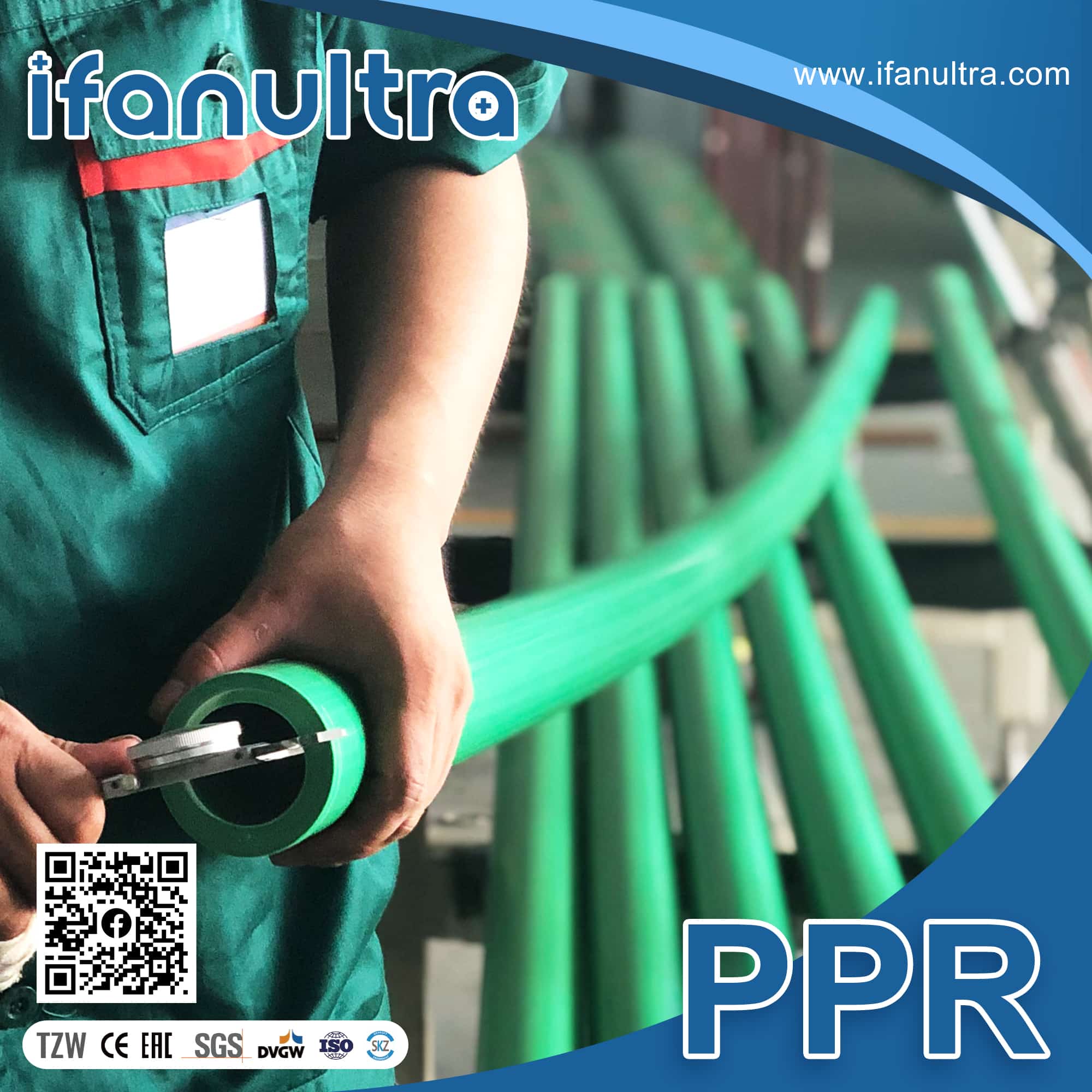
Choose the diameter and the class as two separate decisions, in this order. First, size the DN by flow demand — how much water the line has to deliver, and how fast, without dropping pressure or hissing at the tap. Then set the PN by service: cold water can run PN10 or PN16, hot water runs PN20 as the standard, and high-pressure or pumped systems move to PN25 or fiber-composite. The material meets ISO 15874, so the sizing logic holds across compliant brands.
Size by flow, not by the pipe already on the wall
Velocity is the practical limit. Keep flow velocity under roughly 2 m/s on hot lines to hold noise and erosion down, and use the bore — not the DN — in the velocity math. A single basin or tap is comfortable on DN20. Two or three fixtures on a branch want DN25. A riser feeding an apartment stack usually needs DN32, and building mains climb to DN50 and beyond. Undersize and you get weak showers and water hammer; oversize and you waste material and slow the hot water reaching the tap.
A short worked example
Say you are running a hot-water branch to a shower plus a basin. That is a hot line, so PN20 is the class — no debate. For flow, two fixtures on one branch land at DN25, which at PN20 gives a 16.6 mm bore. Check the velocity at your expected demand against that 16.6 mm bore, not against the 25 mm outside diameter. If the number sits comfortably under 2 m/s, DN25 PN20 is your pipe. If the run is long or feeds a high-flow rain shower and the velocity creeps up, step to DN32 PN20 to open the bore rather than dropping the class. Class protects the pipe from heat and pressure; DN protects the flow.
Fast-moving sizes for distributors to stock
Demand across the PPR size range is heavily skewed, and stocking to that skew keeps capital off the shelf. The small diameters do almost all the volume. DN20, DN25 and DN32 are the workhorses of residential and light-commercial plumbing — the fixture drops, branches and risers that every job repeats — so stock those three deep, in PN20, with matching sockets, elbows and tees. Running out of DN25 elbows stalls a whole install in a way that running out of DN110 rarely does.
- Stock deep: DN20, DN25, DN32 pipe and their full fitting sets in PN20 — this is the bulk of turnover.
- Stock moderate: DN40 and DN50 for sub-mains and small commercial work.
- Stock shallow or to order: DN63 and up. Large diameters tie up cash, ship at lower volume and often serve project buyers who order ahead.
- Match fittings to pipe at every size — a pipe sale with no matching elbow or socket is a lost sale.
The commercial risk for an importer sits inside those fast movers, not the large bore. Thin-wall pipe sold as premium hides most easily in DN20 and DN25, where a fraction of a millimeter off the wall is hard to spot by eye but drops the real pressure class. Buying on verified wall thickness and virgin resin — not just on a printed PN label — is what keeps a batch consistent across a full container.
Conclusão
PPR sizing comes down to two numbers read the right way. DN is the outside diameter in millimeters, fixed across compliant factories, so it tells you which fittings mate and which trade thread it pairs to. PN sets the wall, and the wall sets the bore, the pressure and the heat the line survives for its design life. Size the DN by flow, set the PN by service, and always check the wall against the class printed on the pipe.
If you are specifying a container of PPR to resell, the wall thickness at each DN is the number worth verifying before you commit. The IFANULTRA team can share the full dimension chart and certificates whenever you want to check a spec against your market.
Frequently Asked Questions
What sizes does PPR pipe come in?
Common PPR sizes are DN20, 25, 32, 40, 50, 63, 75, 90 and 110, with large-diameter runs up to DN160. The DN number is the outside diameter in millimeters, fixed across compliant factories.
Is DN the inside or outside diameter on PPR pipe?
On PPR pipe, DN is the outside diameter in millimeters. DN25 is 25 mm on the outside. The inside diameter, or bore, changes with the wall thickness set by the pressure class.
What is the wall thickness of DN25 PPR pipe?
A DN25 PPR pipe is about 4.2 mm thick at PN20, 3.4 mm at PN16, 5.0 mm at PN25 and 2.3 mm at PN10. The wall rises with the pressure class while the 25 mm outside stays fixed.
How do I choose the right PPR pipe size?
Size the DN by flow demand first — DN20 for a single fixture, DN25 for a branch, DN32 for a riser — then set the PN class by service, using PN20 for hot water and PN10 or PN16 for cold.
What is DN20 and DN25 in inches?
As a trade-fit reference, DN20 pairs with a 1/2-inch thread, DN25 with 3/4 inch and DN32 with 1 inch. These are connection equivalents, since PPR is a metric system that does not map exactly onto inches.
Written by the IFANULTRA team — a PPR pipe and fittings brand of IFAN Group, drawing on 30+ years of manufacturing experience, German automated production lines, and ISO 9001, SKZ and NSF certified PPR product lines.









 English
 Español
 Français
 Português do Brasil