
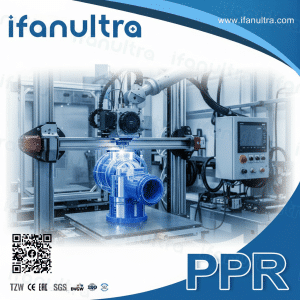
I remember waiting weeks for a custom metal fitting to arrive from overseas, only to find it didn’t fit. That costly delay made me realize the true potential of on-demand manufacturing.
3D printing is revolutionizing custom pipe fittings by enabling rapid production of complex geometries without expensive molds or tooling. It allows engineers to create lightweight, optimized designs, produce small batches economically, and even print replacement parts on-site, dramatically reducing lead times from weeks to hours.
However, this technology comes with its own set of considerations. Let’s explore how 3D printing is changing the game and where traditional methods still hold the advantage.
What Materials Are Available for 3D Printing Complex, Custom Fitting Geometries?
Choosing the right material is the first hurdle. I’ve seen projects fail because someone printed a water fitting with the wrong type of plastic.
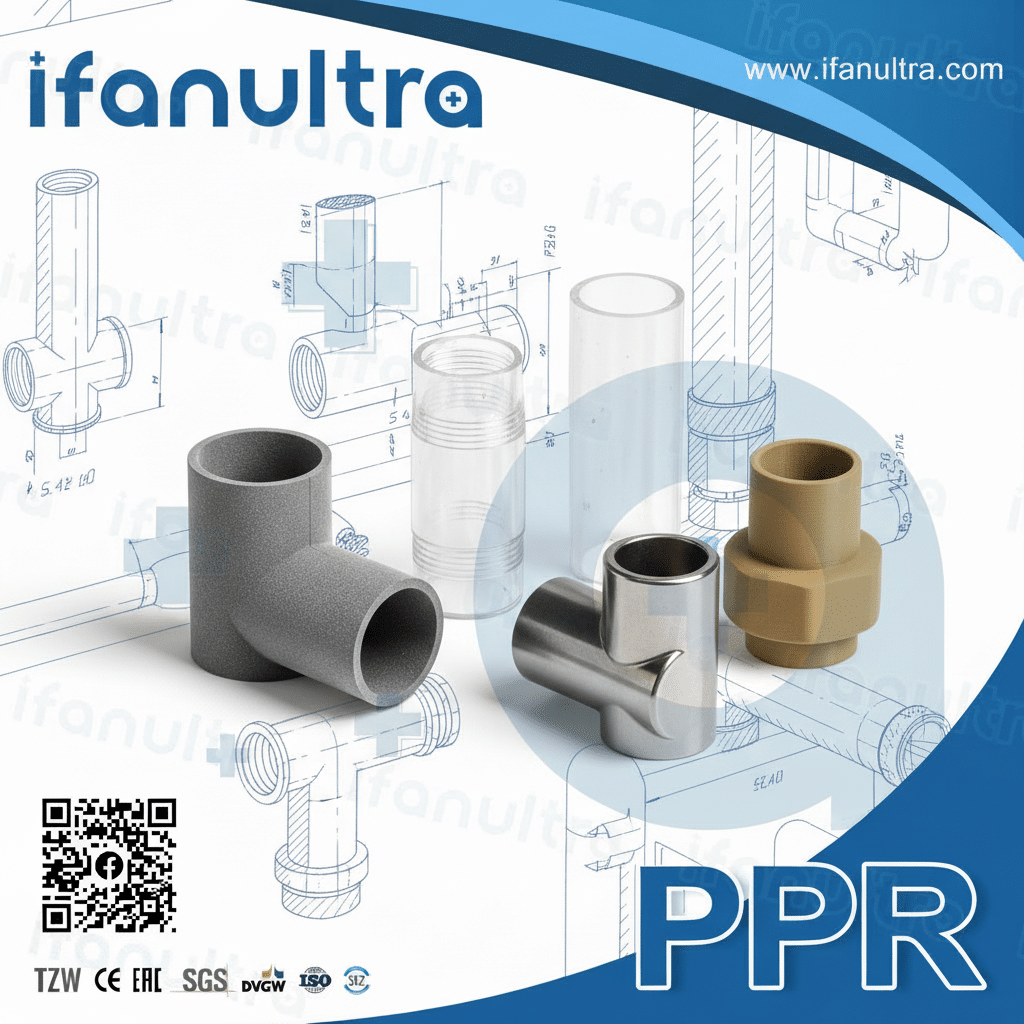
A wide range of materials is available for 3D printing pipe fittings, including engineering plastics like Nylon (PA), ABS, and PETG for general use; high-performance polymers like PEEK and PEI for chemical resistance and high temperatures; and even metals like stainless steel and titanium for extreme conditions. The choice depends entirely on the application’s pressure, temperature, and chemical exposure requirements.
Understanding Material Categories for Fittings
3D printing materials are not one-size-fits-all. Different printing technologies work with different material families, each offering unique properties.
1. FDM (Fused Deposition Modeling) Materials: This is the most common technology for plastic parts. It uses filament that melts and deposits layer by layer.
- PLA: Good for prototyping and non-pressure applications. It’s biodegradable but brittle and has low heat resistance. Not suitable for hot water.
- PETG: A great all-rounder. It offers good strength, chemical resistance, and can handle moderate temperatures. Many use it for functional prototypes and light-duty fittings.
- ABS/ASA: Strong and impact-resistant. ASA offers better UV resistance for outdoor use. Both can handle higher temperatures than PLA or PETG.
- Nylon (PA): Excellent strength, flexibility, and chemical resistance. Ideal for snap-fit connections and parts needing durability. It absorbs moisture, which requires consideration in design.
- Polycarbonate (PC): Very strong and heat-resistant. Can withstand high temperatures but requires a printer with an enclosed chamber.
2. SLA (Stereolithography) Resins: These use liquid resin cured by UV light. They produce very smooth, detailed parts.
- Standard Resins: Good for visual prototypes and form-fit testing, but generally brittle.
- Engineering Resins: These mimic the properties of ABS, Polypropylene, or even rubber. Some are tough and durable enough for functional testing, though long-term pressure performance is limited.
3. SLS (Selective Laser Sintering) Nylon: This technology uses a laser to fuse nylon powder. It produces strong, functional parts without needing supports.
- PA12 Nylon: The workhorse of industrial 3D printing. It offers excellent strength, chemical resistance, and durability. Great for complex, end-use parts in non-critical applications.
4. Metal 3D Printing (DMLS/SLM): For the most demanding applications.
- Stainless Steel: Excellent corrosion resistance and strength. Suitable for high-pressure, high-temperature, or sanitary applications.
- Titanium: Incredible strength-to-weight ratio and corrosion resistance. Used in aerospace, medical, and chemical processing.
- Aluminum: Lightweight and good thermal conductivity.
The table below summarizes material suitability for different fitting requirements:
| Material | Max Temp (°C) | Chemical Resistance | Pressure Suitability | Best Application |
|---|---|---|---|---|
| PLA | 50 | Poor | Very Low | Visual prototypes only |
| PETG | 70 | Good | Low-Moderate | Water prototypes, low-pressure air |
| ABS/ASA | 80 | Moderate | Moderate | Functional prototypes, outdoor enclosures |
| Nylon (PA12) | 120 | Good | Moderate-High | End-use parts, complex geometries |
| Stainless Steel | 400+ | Excellent | High | High-pressure, corrosive environments |
| PEEK | 250 | Excellent | High | High-temperature industrial applications |
When selecting a material, always consider the fluid type, operating temperature, and pressure. For potable water, ensure the material has appropriate certifications like NSF/ANSI 61.
How Does 3D Printing Enable Rapid Prototyping and Low-Volume Custom Production?
Speed matters in business. I’ve witnessed how a 3D-printed prototype can save months of development time compared to traditional methods.
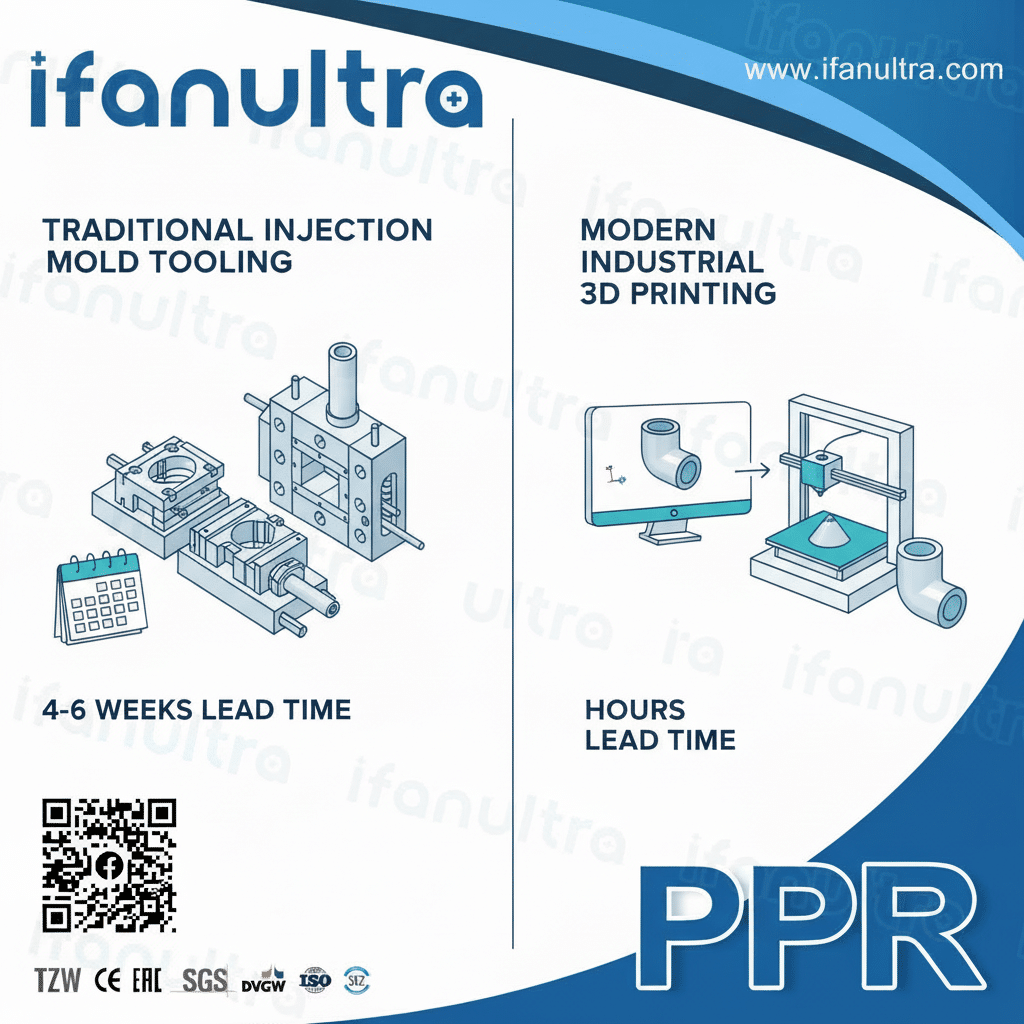
3D printing enables rapid prototyping by eliminating the need for costly, time-consuming molds. Design changes can be made in software and printed overnight, allowing engineers to test fit, form, and function within hours instead of weeks. For low-volume production, it makes small batches economical because there are no tooling costs to amortize, making each part cost the same whether you make one or one hundred.
The Traditional vs. Digital Workflow
To understand the impact, compare the traditional manufacturing process with 3D printing.
The Traditional Molded Fitting Process:
- Design: Engineer creates CAD model.
- Tooling Design: A mold designer creates the tool path.
- Mold Fabrication: A machinist cuts the steel or aluminum mold. This takes weeks and costs thousands to tens of thousands of dollars.
- Sample Run: The mold goes into an injection molding machine for the first samples.
- Testing: Parts are tested. If there’s an issue, you go back to step 2 or even step 1.
- Production: Once approved, you can finally make parts. Minimum order quantities often apply to make the mold cost worthwhile.
Total time for first part: 4-12 weeks. Cost for first part: High (due to mold).
The 3D Printing Process:
- Design: Engineer creates CAD model.
- Print: Send the file to a 3D printer. Print time ranges from 1-24 hours.
- Test: Remove the part and test it.
- Iterate: Find an issue? Modify the CAD file and re-print. Repeat until perfect.
- Production (Low-Volume): Print the final batch. Each part takes the same time and cost as the first.
Total time for first part: 1-2 days. Cost for first part: Low (no tooling).
When Does 3D Printing Make Sense for Production?
For low volumes, 3D printing is often the most cost-effective choice. The breakeven point depends on part complexity and material, but generally:
| Production Volume | 3D Printing Cost per Part | Injection Molding Cost per Part |
|---|---|---|
| 1-10 units | Low (no tooling cost) | Extremely High (tooling cost spread thin) |
| 10-100 units | Moderate | High |
| 100-1,000 units | High (per-part cost constant) | Moderate (tooling cost now spread) |
| 1,000+ units | Very High | Low (tooling cost fully amortized) |
For custom fittings needed in small quantities—like for specialized machinery, historical renovations, or experimental setups—3D printing is often the only practical solution.
Practical Applications in Custom Fittings
- Complex Internal Geometries: 3D printing can create fittings with internal channels or lattice structures that are impossible to mold.
- Consolidated Assemblies: Instead of multiple parts that need assembly, you can print a single, complex fitting that replaces several components.
- Ergonomic Customization: Handles or grips can be tailored to specific users.
What Are the Strength and Pressure Limitations of 3D-Printed Versus Molded Fittings?
This is the question that keeps engineers up at night. I’ve tested both, and the differences are real.
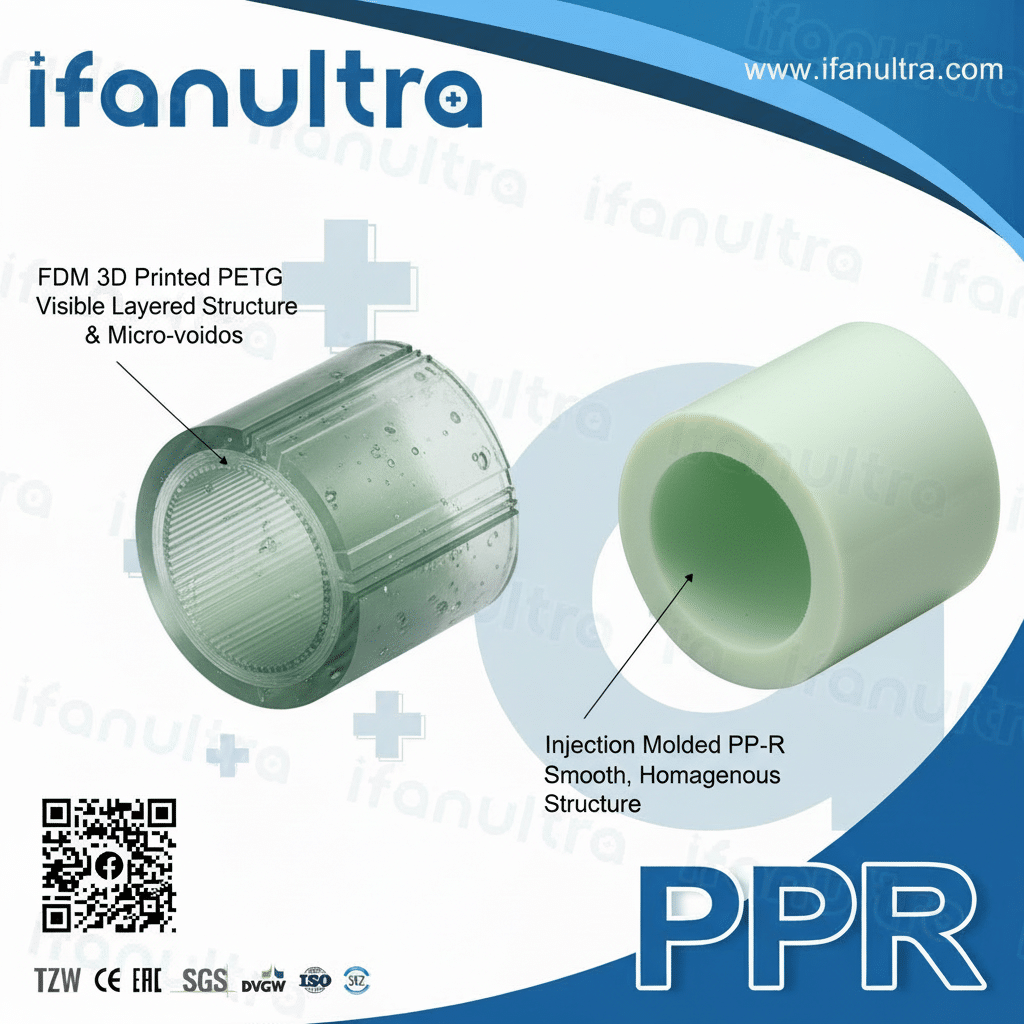
Molded fittings generally have higher and more predictable strength than 3D-printed ones because injection molding produces a homogeneous, void-free structure. 3D-printed fittings, especially in FDM, are inherently anisotropic—weaker between layers than within them. While advanced printing technologies like SLS and metal printing narrow this gap, molded parts remain the standard for high-pressure, safety-critical applications.
Understanding Anisotropy in 3D Printed Parts
The fundamental difference lies in how the material bonds.
Injection Molded Parts: Molten plastic is injected under high pressure into a steel cavity. The material cools uniformly, and polymer chains are randomly oriented but fully entangled. The result is a solid, isotropic (same properties in all directions) part with no weak points.
FDM 3D Printed Parts: Hot plastic extrudes through a nozzle and deposits in layers. Each layer bonds to the previous one through thermal fusion, but the bond is never as strong as the material itself. The part is strongest along the direction of the extrusion lines and weakest between layers. If you apply pressure that tries to pull layers apart, the part can fail at a much lower pressure than a molded equivalent.
SLS and MJF Nylon Parts: These powder-based technologies create more isotropic parts because the layers fuse more completely. The strength approaches that of molded parts, though some porosity may remain.
Pressure Rating Comparison
The table below provides general guidelines based on our testing and industry data:
| Manufacturing Method | Typical Max Pressure (Water at 23°C) | Consistency | Best Use Case |
|---|---|---|---|
| Injection Molded PP-R | 200+ PSI (depending on wall thickness) | Excellent, predictable | Permanent, high-pressure systems |
| SLS Nylon (PA12) | 100-150 PSI | Good | Functional prototypes, low-pressure systems |
| FDM PETG/ABS | 50-100 PSI | Variable, depends on layer adhesion | Non-critical prototypes, air lines |
| FDM PLA | 30-50 PSI | Poor | Visual models only |
| Metal 3D Printed | 300+ PSI (with proper post-processing) | Good (requires HIP treatment) | Specialized high-end applications |
Key Factors Affecting 3D Printed Fitting Strength
- Layer Orientation: Parts printed lying flat are stronger against internal pressure than parts printed standing up. Design with the load direction in mind.
- Infill Percentage and Pattern: 100% infill is essential for pressure applications. Lower infill creates voids that can fail under pressure.
- Print Temperature and Speed: Hotter, slower prints generally improve layer adhesion.
- Post-Processing: Annealing (heat treating) plastic parts can improve strength. Metal parts often require Hot Isostatic Pressing (HIP) to remove internal porosity.
Practical Advice
For non-critical applications like drainage, vent lines, or low-pressure irrigation, 3D-printed fittings can work well. For potable water under pressure, or any system where failure would cause damage, stick with certified, molded fittings from established manufacturers like IFAN. Use 3D printing for prototyping, custom one-offs, and creating masters for molding.
How Is On-Site, On-Demand Printing of Fittings Transforming Emergency Repairs?
I’ve been on job sites where a broken, obsolete fitting meant shutting down operations for days. On-demand printing changes everything.
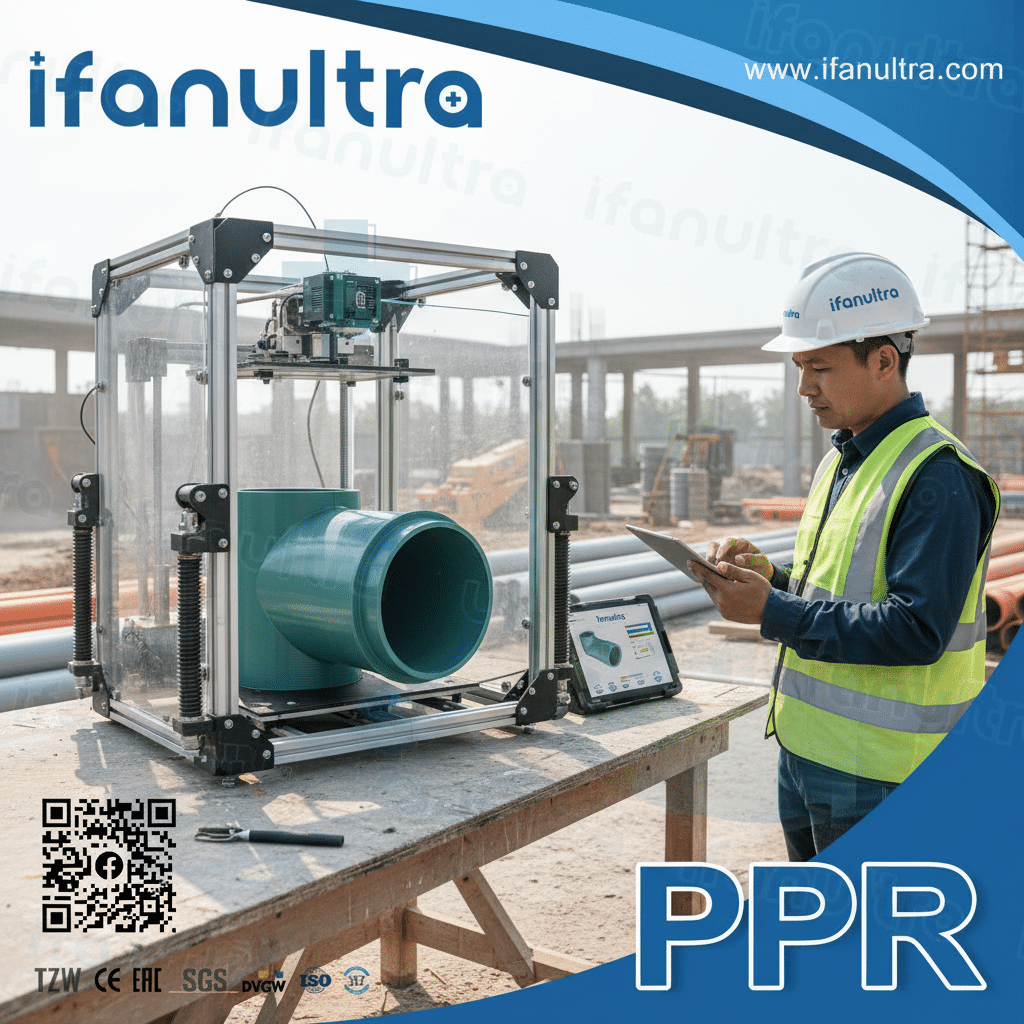
On-site, on-demand 3D printing transforms emergency repairs by eliminating wait times for spare parts. With a digital inventory of fitting designs, repair crews can print exact replacements on-site within hours using ruggedized mobile printers. This capability is particularly valuable for remote locations, aging infrastructure with obsolete parts, and situations where downtime costs are enormous.
The Digital Inventory Revolution
Traditional inventory management means warehousing thousands of physical parts. You either stock everything (expensive) or risk not having what you need when something breaks.
Digital inventory changes this model. Instead of storing physical parts, you store digital files. When a fitting breaks, you:
- Access the File: Retrieve the CAD file from your digital library. If it’s an obsolete part, you can reverse-engineer it with a 3D scanner.
- Print It: Send the file to a printer on the truck or at the nearest facility.
- Install It: The new part arrives in hours, not days.
This model is already transforming industries:
- Military and Naval: Ships carry 3D printers and filament to print replacement parts at sea, reducing dependency on supply chains.
- Remote Mining and Oil Operations: When a critical pipe fitting fails at a remote site, waiting days for a replacement can cost millions in lost production. On-site printing solves this.
- Municipal Water Utilities: Aging water systems often have parts that are no longer manufactured. Cities are beginning to scan and print these fittings on demand.
Real-World Applications in Emergency Repairs
Case Study: Obsolete Fitting in a Chemical Plant
A European chemical plant had a 30-year-old piping system. A custom elbow fitting cracked, and the original manufacturer no longer existed. Traditionally, they would have to replace an entire section of pipe, costing weeks and tens of thousands of euros. Instead, they:
- Scanned the broken fitting with a handheld 3D scanner.
- Cleaned up the digital model in CAD software.
- Printed the fitting in stainless steel using a metal 3D printing service.
- Installed the replacement within 72 hours.
Case Study: Disaster Relief
After natural disasters, damaged infrastructure needs rapid repair. Aid organizations are exploring containerized 3D printing labs that can deploy to disaster zones. They print essential pipe fittings for temporary water and sanitation systems on-site, using locally available materials when possible.
Practical Considerations for On-Site Printing
While promising, on-site printing isn’t a magic bullet. Consider these factors:
| Factor | Consideration |
|---|---|
| Printer Capability | Mobile printers are often smaller. Fittings must fit within the build volume. |
| Material Storage | Filament or powder must be kept dry and within temperature ranges. |
| Operator Skill | Someone on-site needs training to operate the printer and verify part quality. |
| Quality Assurance | How do you verify a printed part will hold pressure without testing? |
| Material Certification | Emergency-printed parts may not have the same certifications as manufactured ones. |
The Hybrid Future
The most practical approach combines both worlds. For immediate, temporary repairs, print a fitting to get the system running. Then, order a certified, molded replacement from a reliable supplier like IFAN for permanent installation. This way, you minimize downtime without compromising long-term safety and reliability.
Conclusion
3D printing offers incredible flexibility for prototyping, custom low-volume production, and emergency repairs. For critical, high-pressure systems requiring certified performance and guaranteed reliability, choose IFAN’s extensive range of molded PP-R fittings, engineered for decades of service.









 English
 Español
 Français
 Português do Brasil