

Most searches for PPR pipe suppliers in UAE end at a directory listing — twenty trading names in Al Quoz and Deira, a phone number each, and no way to tell which one is a stockist marking up an imported container and which one is the importer. That distinction is the whole decision. If you are buying a few hundred metres for one villa, the counter in Al Quoz is the right answer and this page will tell you so. If you are moving container volumes into a distribution business, you are paying someone else’s margin to hold inventory you could hold yourself.
The number that decides it is not the FOB price. A 40ft high-cube container holds about 76 m³ but will carry nearly 28,690 kg, and PPR pipe runs out of cubic metres long before it runs out of kilograms. Buy PPR the way you would buy fittings or valves — per tonne, in your head — and the freight arithmetic quietly works against you on every box you ship.

Key Takeaways
- UAE customs duty on imported plastic pipe is 5% of the CIF value under the GCC Common Customs Law, and VAT is 5%.
- A VAT-registered importer normally accounts for import VAT by reverse charge, declaring and recovering it on the same return — so for a reseller it is a cash-flow entry, not a 5% cost.
- MOIAT’s published conformity fees are AED 600 registration, AED 620 technical review and AED 500 issuance — an AED 1,720 ministry floor, before any testing or assessor days.
- The conformity certificate is held by a UAE-licensed entity, not by your overseas factory. If you import directly, that applicant is usually you.
- Civil Defence approval governs firefighting systems. PPR for potable hot and cold water routes through the water authority instead — a different queue entirely.
- PPR cubes out at roughly 76 m³ in a 40HQ well before the ~26 t practical weight ceiling, so per-tonne thinking loses money on freight.
- Direct import needs 1 FCL minimum and 15–25 days production before transit; below that volume a local stockist is genuinely cheaper.

The two supply routes into the UAE
Almost every business selling PPR in the Emirates sits in one of two positions, and the trade names give you no clue which. The first group manufactures locally or imports at scale and holds stock in a Dubai or Sharjah warehouse. The second group buys from the first group, breaks the pallets, and sells across a counter in bundles. Both will describe themselves as suppliers. Only one of them is carrying the inventory risk you would be taking over.
Local stockists earn their margin honestly. They hold every DN you might need, they release ten lengths at a time, they take a phone call at 7am when a site runs short, and they carry the cost of the slow-moving sizes so you do not have to. For a contractor working project to project, that service is worth real money — probably more than the margin being charged for it.
Direct import inverts every one of those terms. You commit to a full container, you wait 15–25 days for production before the box even sails, and you become the person holding DN90 that nobody asks for. What you buy in exchange is the margin, plus control of specification — which pressure class, which resin, which print legend, which certificate. That control matters more than the money once you start bidding work where the consultant names a standard.
The honest framing is that these are not competing answers to one question. They are answers to different questions about volume and cash. The rest of this guide gives you the arithmetic to find out which question you are actually asking, and it is deliberately built as a template you fill with your own quotes rather than a set of numbers to copy.
The volumetric trap that decides the economics
Here is the mistake that costs importers the most money, and it happens before anyone negotiates a price. PPR is quoted per tonne at the factory gate because resin is the cost driver — polypropylene runs US$780–1,150 per tonne and accounts for 70–85% of what it costs to make the pipe. So buyers reason in tonnes. Then they book a container and discover the box fills up with about a third of its weight allowance unused.
The numbers are unforgiving. A 40ft high-cube container gives you roughly 76 m³ of internal volume, and Maersk publishes a maximum payload near 28,690 kg for that equipment. In practice the ceiling that binds is nearer 26 tonnes once destination road limits are counted. But PPR pipe is a hollow tube. Load a 40HQ properly and you will hit the roof of the container long before you trouble either weight figure, which means every dollar of ocean freight is being spread across cubic metres, not kilograms.
The practical consequence is that freight per metre — not FOB per tonne — decides whether your landed cost beats the local counter price. Two factories quoting the same US$/tonne can land at materially different costs per metre depending on how well their production sizes nest and how tightly they bundle. A supplier who packs DN20 inside DN50 and bands the result is selling you a cheaper container than one who does not, at an identical quoted price.

So when you ask a factory for a container price, ask two more questions in the same message: how many metres of each DN actually go in a 40HQ on their loading plan, and whether small sizes are nested inside large ones. The achieved fill depends entirely on the SKU mix in your specific order, so nobody can give you a single honest percentage in advance — but they can give you the loading plan for your list. If a supplier cannot produce one, they have not loaded many containers of pipe.
The landed-cost stack, line by line
Landed cost is where the stockist-versus-import comparison is won or lost, and most importers build it wrong by leaving out the two lines at the bottom. Work through it in order. Every rate below is the published UAE figure; the freight line is the one you must fill in yourself, and the reason why is worth understanding.
| Cost line | Basis | What to watch |
|---|---|---|
| FOB goods | Resin at US$780–1,150/t, 70–85% of cost | Convert to cost per metre per DN before comparing |
| Ocean freight | Per container, quoted by your forwarder | Divide by achieved metres, not by tonnes |
| Insurance + inland | Included in the CIF base | It raises the duty base, so it is taxed twice over |
| Customs duty | 5% of CIF (GCC Common Customs Law) | Confirm the full tariff code with your broker |
| Import VAT | 5%, reverse charge if VAT-registered | Cash-flow entry for a reseller, not a margin cost |
| Conformity | AED 1,720 ministry floor + testing | Amortise across the SKUs it covers, not per container |
Two lines deserve explanation because they are where the arithmetic usually goes wrong. Duty is charged on CIF, meaning the customs base includes your freight and insurance — so a freight spike raises your duty bill as well as your shipping bill. The UAE government sets that rate at 5% of the value of goods plus cost, freight and insurance, and plastic pipes and fittings sit under HS heading 3917. The GCC now runs a 12-digit tariff structure, so confirm your exact commodity code through Dubai Customs rather than assuming the four-digit heading is enough.
VAT is the line most spreadsheets get wrong in the other direction. The UAE introduced VAT at 5% on 1 January 2018. A VAT-registered importer typically accounts for import VAT under the reverse-charge mechanism — declaring it as output tax and recovering it as input tax on the same VAT return, where the goods are used for taxable supplies. The net cash effect for a reseller is usually nil. Treating that 5% as a permanent cost can make a perfectly good import case look marginal, so confirm your own position with a tax adviser before you model it either way.
The freight line is deliberately blank, and honestly so. Drewry’s World Container Index sat at US$4,374 per 40ft on 23 July 2026, which tells you the direction of the market — but that composite covers eight East-West lanes and does not include a Gulf leg at all. Published rates for China to Jebel Ali come almost entirely from forwarder marketing pages, and in the same month they disagreed by a factor of two. A landed-cost model built on a number like that is worse than one with a blank in it. Get a written quote valid for two to three weeks and put that figure in the row.
Which UAE approval actually applies to your pipe
This section corrects an assumption that costs importers weeks. Buyers routinely arrive believing they need Civil Defence approval for their PPR, because Civil Defence is the name everyone in UAE construction knows. For potable hot and cold water pipe, that is generally the wrong queue.
Civil Defence approval governs fire and life-safety systems — firefighting pipework, where the specified materials are typically FM-approved HDPE, CPVC or steel, and where the approval attaches to the fire system as a whole. Domestic water supply materials follow a different route: the water and utility authority for the emirate. In Dubai that means DEWA’s approved-vendor and supplier registration process; Abu Dhabi runs its own equivalent. If your PPR is going into hot and cold water distribution inside buildings, the utility route and the consultant’s specification are what actually gate you, not the fire authority.
Separately, and this trips people up, there is the federal product-conformity layer. ESMA’s functions now sit with the Ministry of Industry and Advanced Technology, so certificates that older documents call ESMA certificates are issued under MOIAT. Construction and building materials fall within the regulated-product scope, which is why a conformity certificate is a normal part of an import file even when no fire authority is involved.
Underneath all of it sits the technical standard, and this is where you should be precise. ISO 15874-2:2013 is the current international standard for polypropylene pipes in hot and cold water installations — it was reviewed and confirmed in 2023 and carries two amendments, the second adding an impact test in 2022. Note what that is: a specification your pipe is tested against, not a certificate your supplier holds. A supplier who quotes a standard number as though it were their certificate number is telling you something about how carefully they read their own paperwork. Requirements vary by emirate, application and the consultant’s specification, so confirm your specific route with MOIAT, the relevant utility, or an accredited conformity body before you commit to a shipment.
Who actually holds the certificate
Ask a Chinese or Turkish factory whether they have UAE conformity certification and many will say yes. The answer is usually incomplete rather than dishonest, and the gap it hides is the single most expensive surprise in a first import.
The applicant of record for a UAE conformity certificate is a locally licensed entity. An overseas manufacturer generally cannot hold one on its own — it appoints a UAE-registered local representative holding a trade licence, and in practice the importer very often is that representative. So if you switch factories next year, the certificate does not necessarily travel with the factory; and if you buy from a local stockist, the certificate sitting behind that stock belongs to them, not to you. Import directly and the compliance obligation becomes yours, along with the renewal.
That reframes the cost. Here is what the ministry publishes, and it is worth seeing the lines separately rather than as one blended figure.
| MOIAT published fee | Amount | When it applies |
|---|---|---|
| Product/service registration request | AED 600 | Per submission |
| Technical review of documents | AED 620 | Per conformity certificate |
| Certificate issuance | AED 500 | Per certificate |
| Technical assessor | AED 2,500 | Per assessor per working day, if assessed |
Add the three fixed lines and the ministry’s own charge for one certificate is AED 1,720. Read that as a floor, not a budget. It excludes the conformity body’s testing fees, which are the largest and most variable part and are quoted per product family, and it excludes your local representative’s handling charge. MOIAT states a service duration of one and a half working days, but that is the ministry’s processing time once a complete file is in front of them — it is not the end-to-end timeline, because the testing that produces the file takes considerably longer. Plan the certificate before you plan the sailing.
One more thing worth knowing: an ECAS certificate of conformity is typically valid for a year and needs renewal before it lapses. Amortised across a product family and a year of containers, AED 1,720 plus testing is a rounding error on a distribution business. Amortised across one trial container it is not, which is a genuine argument for buying your first order from a local stockist while you prove the demand.
Local stockist or direct import: which one fits your business
Now the decision. The threshold is not a revenue figure, it is whether you can absorb a container of one specification and turn it inside a working capital cycle you can survive. A full container with 30% paid on order and the balance before shipment is a real cash commitment sitting in a warehouse for weeks before it earns anything.
| Facteur | UAE local stockist | Direct import |
|---|---|---|
| Minimum order | A bundle, or ten lengths | 1 FCL; LCL costs more per metre |
| Time to goods | Same day off the shelf | 15–25 days production, then transit |
| Cash exposure | Low; buy as you sell | 30% deposit, 70% before shipment |
| Spec control | Whatever they stock | Your DN/PN, resin and print legend |
| Certificate | Theirs, and it stays theirs | Yours to obtain and renew |
| Dead stock risk | Carried by the stockist | Yours, on the slow DNs |
Buy local if you are a contractor pulling material against live projects, if your monthly PPR usage would not clear a container in a quarter, or if you need mixed brands and mixed materials from one counter. The stockist’s margin is buying you flexibility and a same-day answer, and that is a fair trade — do not import out of pride.
Import directly if you are reselling rather than installing, if you can clear a container within roughly a quarter, and if you intend to build a brand position rather than compete on someone else’s stock list. The moment a consultant specification names a standard and a pressure class, holding your own certificate and your own print legend stops being a cost and starts being the reason you win the bid.
How to tell a stockist from an importer before you buy
Both sides of that table are legitimate businesses. The problem is that a trade name, a showroom and a website look identical whichever one you are standing in front of. So here is what actually separates them, in the order you can find it out — most of it on the first phone call, before anyone sends you a price.
Start with the certificate, because it is the one question a reseller cannot talk around. You already know the applicant of record for a UAE conformity certificate is a locally licensed entity. So ask directly: whose name is on the conformity certificate for this pipe, and can you send the certificate itself rather than a photo of the cover?
An importer answers with their own company name and sends the document. A counter trader answers with the name of whoever supplies them — which is a perfectly honest answer, and it tells you exactly where you are in the chain. What you are listening for is not a good answer or a bad one. It is whether the name they give you is theirs.
Then read the certificate instead of filing it. Check that the entity named matches the company on the proforma and the bank account, that the scope covers the DN and pressure class you are buying, and that the expiry has not passed. Match the print legend on the pipe itself against it. A legend that names a standard the certificate does not cover is the mismatch that holds consignments at the border.
The licence is the second check and it is public information the company will hand over. The UAE issues six licence types — industrial, commercial, crafts, tourism, agricultural and professional — and one licence can list several activities. Anyone extruding pipe in the Emirates holds an industrial licence. A pure trader holds a commercial one.
That distinction does not settle it on its own, because an importer who buys from an overseas factory also trades on a commercial licence. Read it alongside the certificate answer. Own certificate plus commercial licence means they import. Someone else’s certificate plus commercial licence means they buy locally and resell. Industrial licence means they make it here, which is a third answer worth knowing.
The third question is operational and it is the hardest to fake. Ask for a loading plan for your own DN and quantity list — how many metres of each size go into a 40HQ, and whether the small diameters nest inside the large ones. Only a business that ships containers has this. A stockist who buys off a local warehouse has never needed to produce one.
Stock breadth reads the same way once you know what to look for. Ask what they hold across the range, not what they hold in DN25. A house carrying DN20 through DN160 across several pressure classes is financing slow sizes nobody asks for weekly, and that is an importer’s balance sheet. Depth in three popular sizes and nothing above DN63 is a counter operation, which for a villa job is the right one.
Geography narrows it before you dial. Al Quoz is zoned industrial and mixes warehousing, light manufacturing and building-material trade, so both types sit there side by side. Deira is older trading premises and showrooms, weighted toward counter sales. The Sharjah industrial areas run to larger, cheaper warehousing, which is where volume stock tends to sit. Treat these as priors, not verdicts.
Two last things worth asking whichever route you take. Ask which approval they hold for your application, since Civil Defence governs firefighting and potable hot and cold water routes through the water authority — a supplier who conflates the two has not done the paperwork. And ask their lead time. Fifteen to twenty-five days plus transit is a factory answer. Same day off the shelf is a stockist answer, and neither is wrong.
- Whose name is on the conformity certificate? Theirs means they import; someone else’s means they resell.
- Can I see the certificate and its scope? Check entity, DN and pressure class covered, and expiry date.
- Does the print legend reconcile to it? A standard on the pipe that the certificate does not cover is a border hold waiting to happen.
- Which licence activities do you hold? Industrial means local manufacture; commercial covers both importers and traders, so read it with the certificate answer.
- Can you produce a loading plan for my list? Metres per DN in a 40HQ, with nesting — container loaders have this and counter traders do not.
- What do you hold across DN20 to DN160? Full-range stock is an importer’s cash tied up; three sizes deep is a counter.
How IFANULTRA fits a UAE import programme
If the arithmetic above points you toward direct import, here is what this factory brings to it — stated plainly, including where it does not fit.
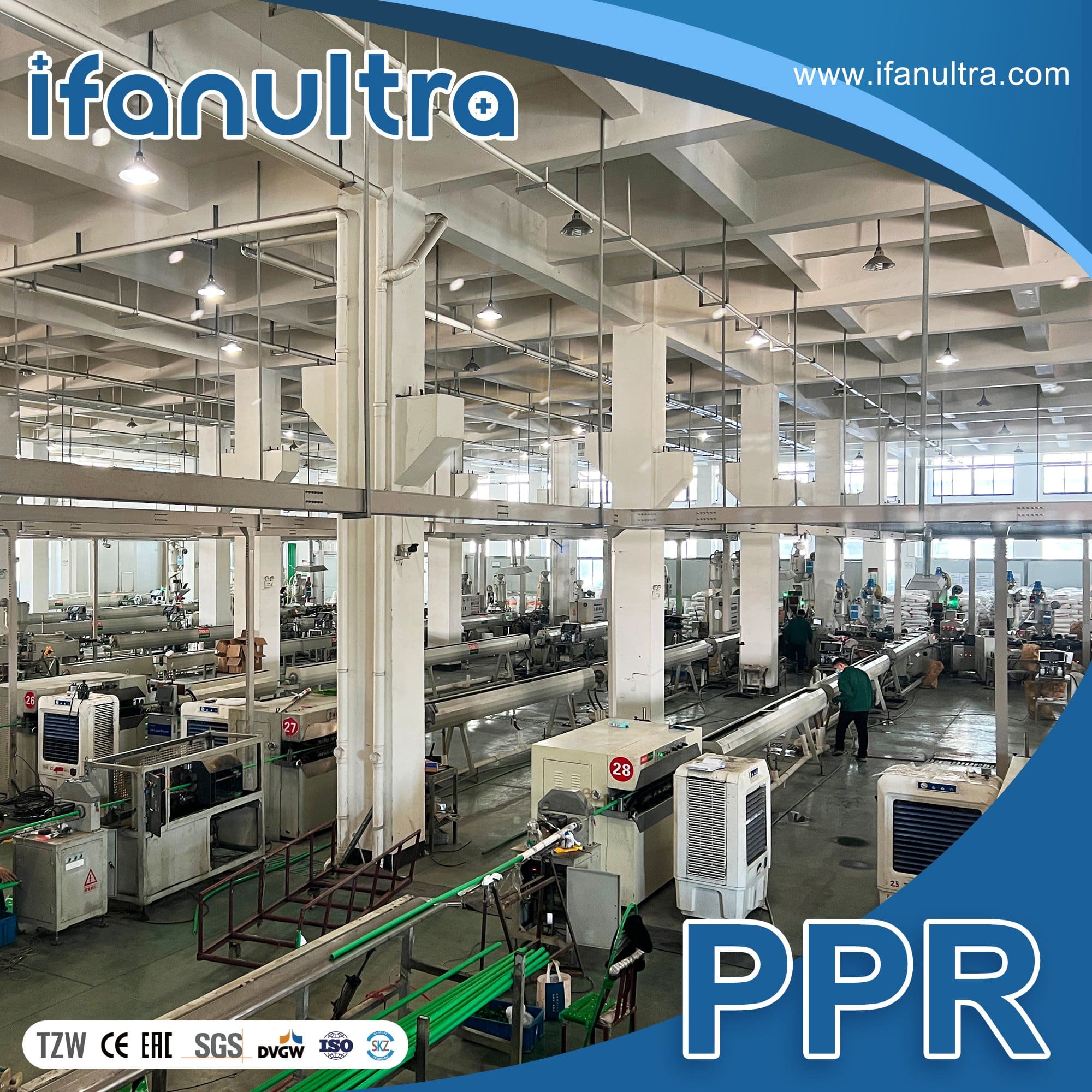
The range runs DN20 to DN160 across PN10 (SDR11), PN16 (SDR7.4), PN20 (SDR6) and PN25 (SDR5), split into a 67-SKU Série mondiale PPR and a 28-SKU PPR Quality Series. That breadth matters for a UAE stock list specifically, because Gulf cold-water lines sit hot enough in summer that specifying a single pressure class across a building is a decision, not a default. Pipe is produced on German automated lines from Nordic virgin PP-R rather than recycled filler — which is the variable that separates a pipe meeting its 50-year design curve from one that does not, and it is the first thing worth verifying in any quote you compare.
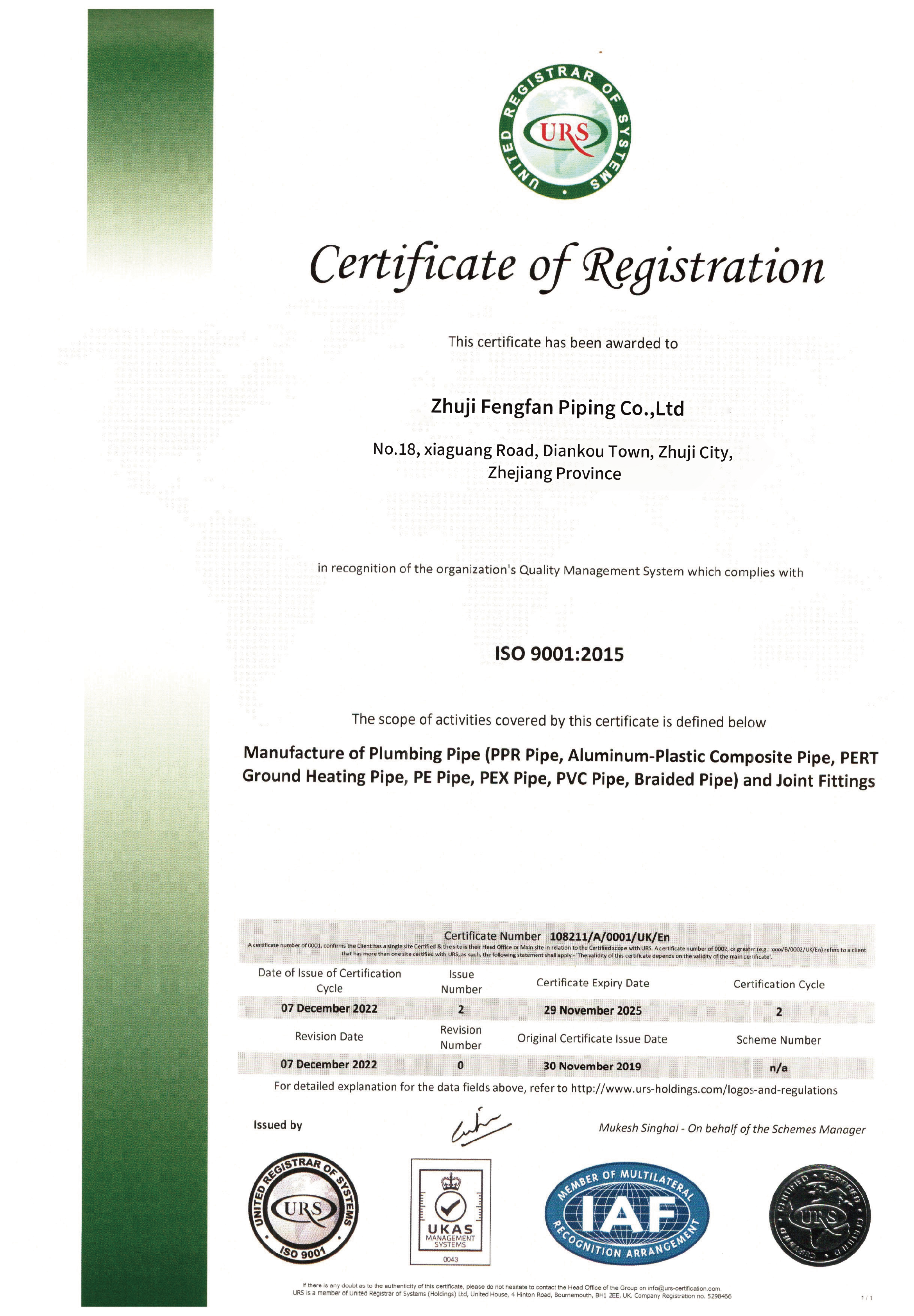
On paperwork, the certifications held are ISO 9001, SAI Global, SKZ, HY and NSF. What matters for a UAE file is not the list of names but the scope pages behind them — which product families each covers, and whether the SKUs on your proforma actually sit inside that scope. Ask for the scope documents and read them against your order before you rely on them for a conformity submission. Any supplier who sends a certificate image without the scope page has answered a different question than the one you asked.
Where this does not fit: the minimum is one full container, with LCL possible at a higher cost per metre. If you need ten lengths tomorrow, buy from a stockist in Al Quoz — that is genuinely the better answer, and it will stay the better answer until your volume clears a container in a quarter.
What to check before you pay the deposit
These are the five checks run on every batch before it ships, and they double as the inspection list to run on arrival at your own warehouse. A buyer who mirrors the factory’s QC is a buyer who does not discover a problem after the pipe is in a wall.
- Resin verified by source and grade: the material certificate should name the producer and grade, not just say “virgin PP-R”.
- Caliper wall checks across multiple pallets: sampled through the load, not from the top layer where the good pipe always sits.
- OD and wall to ISO 15874 and DIN 8077: measured against the standard’s tolerance, with several readings per length.
- Pressure and thermal testing to the rated class: a PN20 print legend means nothing without a test to PN20.
- Printed markings reconciled to certificate numbers: the legend on the pipe must tie back to the test report covering that batch.

That last check is the one that catches customs problems before they happen. The most common hold on a plastic pipe consignment is not a missing certificate — it is a certificate whose scope names a product family that does not quite include the SKU in the box, or a batch number on the pipe that cannot be reconciled to the test report. Both are visible on a desk in ten minutes if you ask for the documents before the balance payment rather than after the vessel sails.
Run the same reconciliation on the commercial paperwork. The company name on the proforma should match the name on the bank account you are asked to pay, and both should match the entity named on the certificates. A mismatch there is worth a phone call before it is worth a deposit.
Conclusion
Choosing between a UAE stockist and a direct container is a working-capital decision wearing a procurement costume. The duty and VAT rates are fixed and public, the conformity fees are published, and the only genuinely uncertain line is freight — which is exactly why the volumetric question matters more than the per-tonne price everyone negotiates over. Get the certificate holder question straight before the first shipment, because that one determines whether you are building an asset or renting someone else’s.
If you are weighing this up, start by pricing one real DN and PN you already sell — landed, with your own freight quote in the row — against what the counter charges you today. That single comparison usually answers the question faster than any spreadsheet.
Frequently Asked Questions
What customs duty applies to PPR pipe imported into the UAE?
Customs duty is 5% of the CIF value under the GCC Common Customs Law, and plastic pipes sit under HS heading 3917. Confirm the full 12-digit GCC code with your broker, since the statistical suffix depends on the specific article.
Do I need Civil Defence approval for PPR water pipe?
Generally no. Civil Defence approval governs firefighting systems, while potable hot and cold water materials route through the emirate’s water authority, such as DEWA in Dubai. Confirm your application with the relevant authority.
Is ESMA still the certifying body in the UAE?
ESMA’s functions now sit with the Ministry of Industry and Advanced Technology, so what older paperwork calls an ESMA certificate is issued under MOIAT. The scheme name ECAS is still in common use.
How many metres of PPR fit in a 40HQ container?
It depends entirely on your DN mix, because the box fills by volume rather than weight. A 40HQ offers roughly 76 m³, and nesting small diameters inside large ones changes the total significantly — ask your supplier for the loading plan for your specific list.
Can my overseas factory hold the UAE conformity certificate for me?
Usually not on its own. The applicant of record is a UAE-licensed entity, so a foreign manufacturer appoints a local representative — often the importer. Check whose licence sits behind any certificate you are shown.
What is the minimum order for importing PPR directly?
One full container is the practical minimum, with LCL possible at a higher cost per metre. Production runs 15–25 days before ocean transit, so plan roughly two months from order to warehouse.









 English
 Español
 Français
 Português do Brasil