
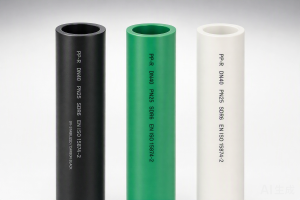
A distributor in Riyadh orders 20 containers of green PP-R pipe for a housing project. Sixteen go up fine. The four stored on the unshaded lot for ninety days arrive with surface micro-cracks the installer catches only when the welder chases the pipe for a bead. The pipe met ISO 15874. It just was not built for sun. Black polypropylene pipe exists for exactly that gap — and most buyers confuse it with black PE, black PVC, or black-dyed PP-R without understanding what the color actually does.
This page separates what black polypropylene pipe is, why carbon black matters more than the color, and where it outperforms the green and white PPR pipe you already stock. Every temperature, pressure, and standard figure is verified against a named source. If you are new to the terminology, see our Tube PPR pleine forme guide for the base definitions.
Key takeaways
- Black PP pipe is not one material. The pigment can sit on PP-H, PP-B, or PP-R — the grade determines temperature, pressure, and application.
- Carbon black at 2.0–2.5% loading delivers UV resistance. Lower loading gives color without protection.
- Carbon black works two ways: it absorbs UV and converts it to heat, and it scavenges free radicals that would break polymer chains.
- PP-R in black is still PP-R. A black PP-R PN20 pipe carries the same envelope as its green or white counterpart — the black adds UV survivability, not pressure capacity.
- PP-H handles higher heat (up to 95°C) but is brittle below ~5°C. If your climate drops near freezing, PP-H is the wrong pick.
- ISO 15874 governs PP-R; DIN 8077/8078 govern PP pipe dimensions and testing. ASTM F2389 covers the US market. ISO 15493 and EN 1452 are PVC/ABS standards.
On this page
- What is black polypropylene pipe?
- The three PP grades underneath the black
- Why black? Carbon black as UV stabilizer
- Black PP vs PPR: where they actually differ
- Temperature and pressure ratings
- Standards that apply (and two that don’t)
- Where to use black polypropylene pipe
- Black vs green vs white: market and regional preferences
- What to specify on a purchase order for black PP pipe
- Frequently asked questions
Video: IFANultra factory and product introduction — the manufacturer behind the black PP-R pipe discussed in this article.
What is black polypropylene pipe?
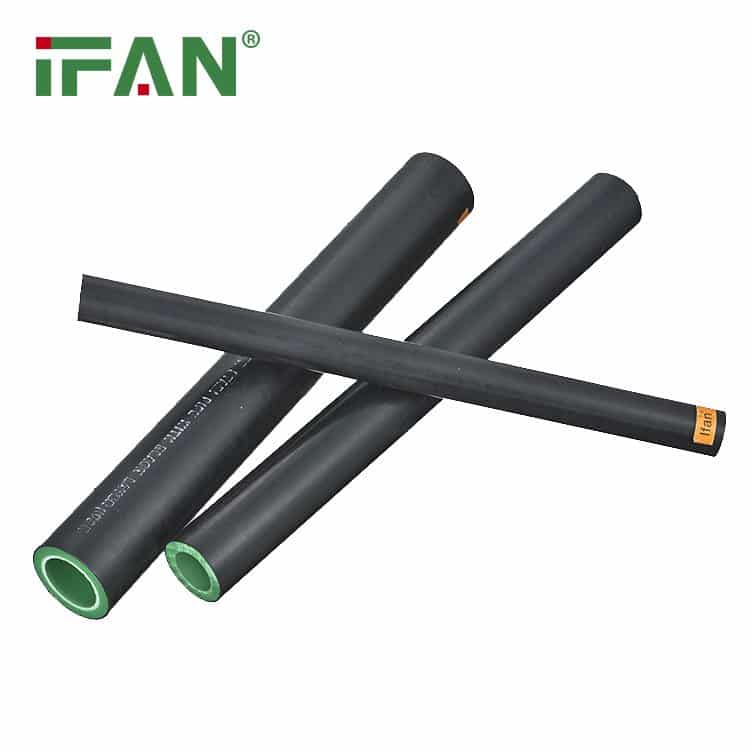
Black PP pipe is thermoplastic pipe extruded from one of three PP grades — PP-H, PP-B, or PP-R — with carbon black masterbatch blended into the resin during extrusion. The base polymer determines mechanical and thermal performance. The carbon black determines whether the pipe survives sustained UV exposure. For detailed specifications including wall thickness and tolerance data, see our PPR pipe specifications reference.
Polypropylene has a density of approximately 0.90–0.91 g/cm³. Its melting point ranges from 130°C to 171°C depending on grade — PP-H sits at the high end because its higher crystallinity (60–70%) produces a more ordered crystal structure, as documented by Resin Plastics. The internal bore has a surface roughness of roughly 0.007 mm, preventing scale buildup and keeping flow rates high. These properties belong to the polymer, not the pigment.
What the black adds is UV survivability. Without carbon black, polypropylene degrades through photo-oxidation: UV energy breaks polymer chains, generates free radicals, and the material becomes brittle and cracks. A pipe stored outdoors in a sunbelt climate without UV stabilization can show surface degradation in weeks. With the correct carbon black loading, that same pipe can sit on an unshaded lot for months and still pass hydrostatic pressure testing.
The three PP grades underneath the black
Before you discuss color, you need to know which PP grade is in the pipe. The three grades differ in ethylene content, molecular architecture, and performance — and a black pigment does nothing to change those differences.
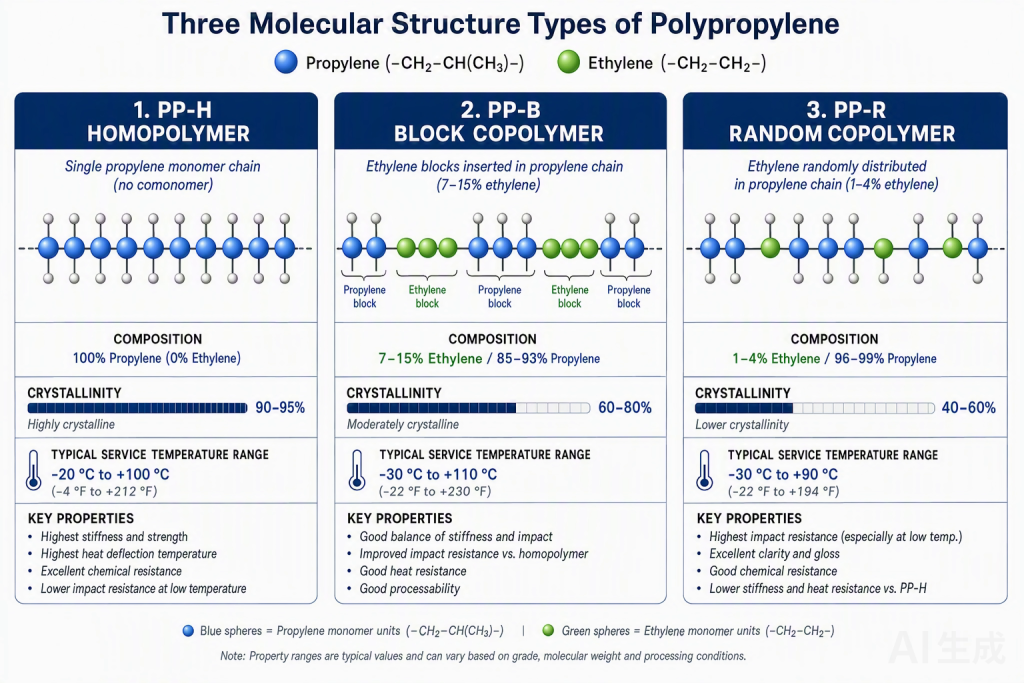
PP-H (Homopolymer) is produced from a single propylene monomer. It has the highest crystallinity at 60–70%, giving it the highest tensile strength, flexural modulus, and stiffness. PP-H withstands temperatures up to 95°C and has a heat deflection temperature of 100–120°C at 0.455 MPa — making it the standard for industrial chemical pipelines, fertilizer conveyance, and acidic wastewater. The trade-off: PP-H becomes brittle below approximately 5°C, and its compressive strength generally stays below PN16. No amount of carbon black changes that.
PP-B (Block Copolymer) incorporates ethylene in blocks at 7–15% content. That structure absorbs impact energy far better — PP-B maintains good impact toughness down to -40°C, which is why it is specified for underground water mains and sewer infrastructure in cold-climate markets. Its temperature tolerance tops out at approximately 80°C.
PP-R (Random Copolymer) contains 1–4% ethylene randomly distributed throughout the chain. That random distribution disrupts the crystal structure, lowering crystallinity and melting point compared to PP-H — but it gives PP-R greater elasticity, superior pressure resistance, and a smaller coefficient of thermal expansion. PP-R is rated for continuous service up to 70°C (95°C short-term peak per ISO 15874 application classes), and a PN20 PP-R pipe carries 10 bar at 70°C and 20 bar in cold water. PP-R can reach PN25 or PN32, well beyond PP-H’s sub-PN16 ceiling.
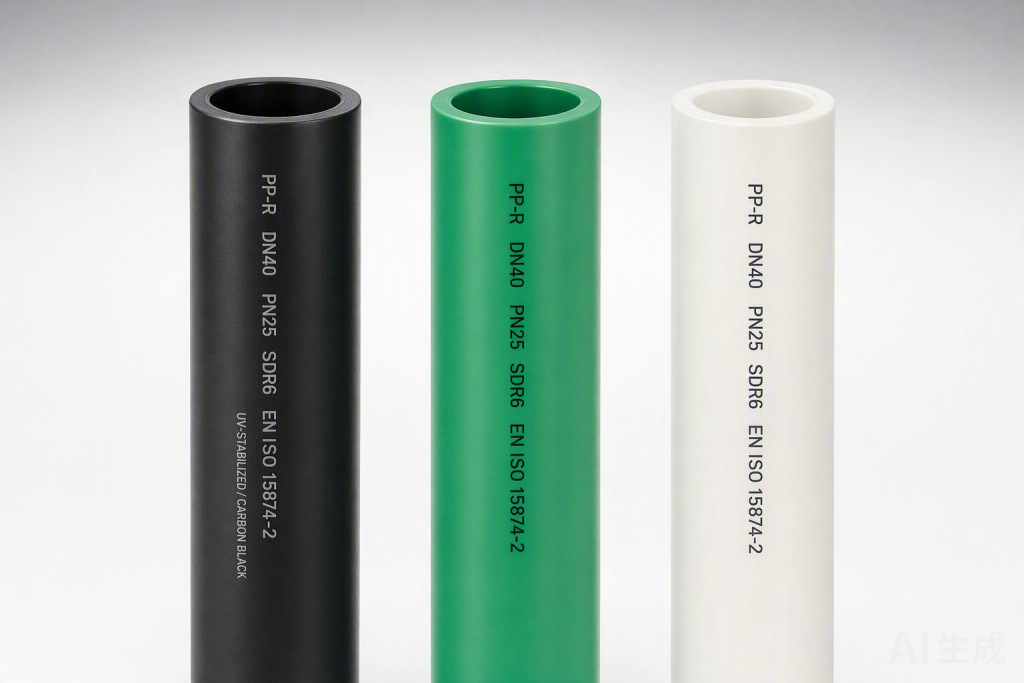
This is the grade most wholesalers already stock in green or white. When you see “black PPR pipe” on a quotation, it is PP-R with carbon black masterbatch — the same pressure-temperature envelope, the same fusion welding, and the same ISO 15874 standard, just with UV protection built in. Explore the full PPR global series for product details.
| Property | PP-H | PP-B | PP-R |
|---|---|---|---|
| Ethylene content | 0% | 7–15% (block) | 1–4% (random) |
| Max continuous temp | 95°C | 80°C | 70°C (95°C short-term peak, ISO 15874) |
| Low-temp limit | Brittle below ~5°C | Good to -40°C | Moderate above ~0°C |
| Pressure rating | Below PN16 | Moyen | Up to PN25–PN32 |
| Primary use | Chemical, industrial, wastewater | Underground, cold-climate | Hot/cold potable water, heating |
Why black? Carbon black as UV stabilizer
The black in black polypropylene pipe is not paint. It is carbon black — finely divided elemental carbon dispersed through the polymer matrix during extrusion. The loading that matters is 2.0–2.5% carbon black content in the finished pipe wall. IS 4984 mandates 2 to 2.25% for PE pipe, and PP pipe follows the same engineering logic, as detailed by Perfect Colourants. Below that loading, you get a dark color but minimal UV protection.
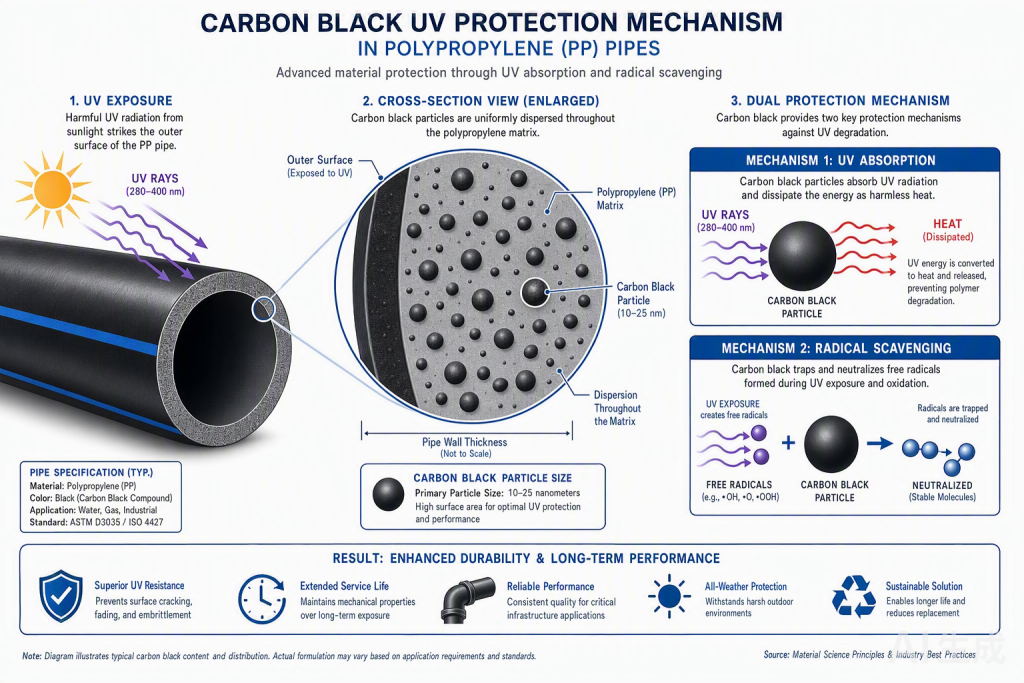
Carbon black protects the polymer through two mechanisms. First, it absorbs UV radiation across the full spectrum and converts that energy into heat that dissipates through the pipe wall instead of breaking polymer bonds. The optimal primary particle size is 10–25 nm for furnace carbon black, with a dispersion rating of 3 or better required for uniform protection. Second, carbon black acts as a radical scavenger — when UV triggers photo-oxidation and generates free radicals that would propagate chain scission, carbon black neutralizes them, capping the damage before it spreads.
Expert warning: A supplier offering “black” PP pipe at a price noticeably below the market may be using a general-purpose color masterbatch at 0.5–1% loading rather than a UV-grade carbon black at 2.0–2.5%. The pipe looks identical. The difference shows up after 3–6 months of sun exposure, when the low-loaded pipe chalks and cracks while the correctly loaded pipe remains sound. Ask for the carbon black content test report — not the color swatch. For related quality concerns, see our guide on PPR raw material: virgin vs recycled.
Black PP vs PPR: where they actually differ
The most common confusion is treating “black polypropylene pipe” and “PPR pipe” as two different materials. They are not. PPR is a grade of polypropylene. Black is a color. A black PP-R pipe is a PPR pipe with carbon black for UV resistance — the pressure-temperature envelope, fusion welding, and standard (ISO 15874) are identical to green or white PP-R of the same SDR and PN rating. If you need to compare PP with PVC alternatives, see our PPR vs PVC analysis.
What differs is which grade sits under the black pigment:
- Black PP-R vs standard PP-R: Same grade, same ratings (PN20 = 10 bar at 70°C, 20 bar cold), same welding. The black version is specified for sun-exposed runs — rooftop solar lines, exterior wall penetrations, irrigation mainlines.
- Black PP-H vs PP-R: Different grade. PP-H handles higher heat (up to 95°C vs PP-R’s 70°C) and has better chemical resistance. But PP-H is brittle below ~5°C, carries lower pressure (below PN16 vs PP-R’s PN25+), and has a larger coefficient of thermal expansion. For hot chemical transport in an indoor plant, PP-H black is right. For potable hot water, PP-R black is right.
- Black PP-B: The cold-climate specialist. For underground water mains in markets that freeze, PP-B’s impact toughness down to -40°C is the property that matters.
When a buyer asks for “black PP pipe,” which grade do they need? In potable water and HVAC, almost always PP-R. In chemical and industrial process piping, usually PP-H. In cold-climate underground infrastructure, possibly PP-B. A supplier quoting “black PP pipe” without specifying the grade is not giving you enough information.
Temperature and pressure ratings
Temperature and pressure ratings for PP pipe are paired values that move inversely. As service temperature rises, the pressure the pipe can sustain drops. A PN20 PP-R pipe rated at 20 bar in cold water carries 10 bar at 70°C. That relationship is defined by ISO 15874 stress regression curves and is the same regardless of pipe color. For exact dimensional data, refer to our PPR pipe dimensions and tolerance chart.
General PP pipe temperature resistance spans 0°C to 95°C, with the ceiling depending on grade. Metric pressure ratings range from 6 bar to 15 bar depending on SDR — common values are SDR 6, SDR 7.4, SDR 11, and SDR 17.6. A lower SDR means a thicker wall and higher pressure capacity.
For a wholesaler: a buyer requesting black pipe for a rooftop solar heating line in a GCC market needs PP-R black rated for 70°C continuous — the UV protection addresses sun, the pressure-temperature envelope addresses the operating condition. A buyer requesting black pipe for a chemical plant running 80°C acid needs PP-H black, because PP-R’s 70°C continuous ceiling is too close to the operating temperature. Getting these backwards is an engineering failure that shows up as a leak or rupture under load.
Standards that apply (and two that don’t)
Five standards govern polypropylene pipe in international trade. Two more are commonly cited in error.
ISO 15874 is the primary system standard for PP piping systems for hot and cold water. Published in parts — Part 1 (general), Part 2 (pipes), Part 3 (fittings), Part 5 (fitness for purpose) — all 2013 editions. EN ISO 15874 is the European adoption. The full standard is available from the ISO standards catalogue. A certificate citing only Part 2 covers the pipe and says nothing about the fittings.
DIN 8077 and DIN 8078 are the German standards, both 2008-09 editions. DIN 8077 covers PP pipe dimensions; DIN 8078 covers quality requirements and testing. Both cover PP-H, PP-B, PP-R, and PP-RCT. Because DIN splits dimensions from testing, a supplier quoting only “DIN 8077” has told you about wall thickness and nothing about whether the pipe passed a pressure test.
ASTM F2389 covers PP piping system components in both metric and IPS schedule 80 sizes for the US market. Nothing in ISO 15874 or DIN 8077 is dimensioned in IPS — the systems are not interchangeable.
ISO 15493 is frequently cited on spec sheets for industrial plastic pipe, but it covers ABS, PVC-U, and PVC-C — not polypropylene. The standard itself is available at ISO 15493. EN 1452 covers PVC-U pressure water pipes — also not polypropylene. Both appear on comparison tables in tender documents but have no bearing on PP pipe specification.
Real scenario: A distributor receives a datasheet for black PP-R pipe listing “ISO 15874, DIN 8077, EN 1452.” The first two are correct. The third is a PVC standard that has nothing to do with the product. If the datasheet carries an error that basic, the carbon black content figure on the same sheet deserves the same scrutiny.
Where to use black polypropylene pipe
Black PP pipe earns its place where UV exposure is a genuine operational factor — not just a storage inconvenience. The carbon black loading is permanent in the pipe wall, so UV protection does not wear off.
Industrial fluid and chemical transport. Black PP-H is standard for industrial chemical pipelines handling acids, alkalis, and aggressive wastewater. PP-H resists a broad range of acids, alkalis, and agricultural chemicals but is unsuitable for hydrocarbons like gasoline or kerosene. The UV protection matters because chemical process piping often runs outdoors along pipe racks between buildings.
Agricultural irrigation and fertilizer transport. Agricultural mainlines run above ground across fields, fully exposed for their entire service life. Black PP pipe — typically PP-B or PP-R depending on whether the priority is freeze resistance or pressure — is used for fertilizer transport and irrigation networks where UV degradation would otherwise limit the pipe to a few seasons.
Compressed air and HVAC. PP pipe appears in compressed air distribution and HVAC cooling/heating loops where piping runs through plant environments with UV exposure from skylights or open structures. The chemical inertness means no corrosion from condensate, and the smooth internal bore (0.007 mm roughness) keeps pressure drops low.
Outdoor potable water distribution. In markets where potable water supply lines run above ground — common in GCC, African, and South Asian markets — black PP-R provides UV resistance that green or white PP-R cannot. The pipe meets the same potable water certification (WRAS, NSF) as its colored counterparts; the carbon black is food-grade and does not leach. Browse our série de produits for the full range.
Black vs green vs white: market and regional preferences
Color in PP pipe signals UV protection, and in some markets it signals application. PP-R is typically green or white. PP-H is typically white or gray. Black PP can be any grade, and the color signals UV resistance regardless of what is underneath.
European markets historically prefer green PP-R for potable water — the color is associated with water supply and is referenced by some national plumbing codes. White PP-R is common in cost-sensitive markets where the pipe will be concealed behind walls. Black PP-R is the specification of choice in sunbelt markets — the GCC, North Africa, South Asia, and Latin America — where above-ground runs or extended outdoor storage are standard and UV degradation is a real operational risk.
For a wholesaler: if your destination is Germany or Poland, green PP-R is what buyers expect. If your destination is Saudi Arabia or the UAE, black PP-R addresses a real installation condition. Carrying the wrong color means the pipe sits in your warehouse while a competitor fills the order.
A black PP-R and a green PP-R from the same manufacturer, same SDR, same PN rating, and same standard perform identically in pressure and temperature. The difference is purely UV protection. The price difference, if any, reflects the cost of the carbon black masterbatch — typically a small percentage, not a premium tier.
What to specify on a purchase order for black PP pipe
If you are importing black polypropylene pipe, the PO needs to name five things — and color is the least important. The grade, the standard, the SDR/PN rating, the carbon black content, and the certification determine whether the pipe performs in the field.
- PP grade: Specify PP-H, PP-B, or PP-R explicitly. “Black PP pipe” is a color description, not a specification. The grade determines temperature ceiling, pressure capacity, and cold-weather performance.
- Standard: Name the standard by part number. For PP-R potable water: ISO 15874. For PP pipe dimensions and testing: DIN 8077 and DIN 8078. For US market: ASTM F2389. Do not accept a datasheet listing EN 1452 or ISO 15493 — those are PVC/ABS standards.
- SDR and PN rating: PN20 PP-R means 20 bar at 20°C and 10 bar at 70°C. If your buyer needs a specific pressure at a specific temperature, write both numbers on the PO. Cross-reference with our PPR pipe specifications page.
- Carbon black content: Require 2.0–2.5% carbon black in the finished pipe wall, and ask for the test report. This is the most commonly faked specification in black PP pipe — a low-loading color masterbatch costs less and looks identical until the pipe sits in the sun.
- Potable water certification: If the pipe is for drinking water, require WRAS, NSF, or the national equivalent. The certification proves the total formulation meets extractive limits.
The cost of getting these specifications right is zero. The cost of getting them wrong is a container that fails in the field or fails at customs. The specification is the only thing that protects you — it has to be on paper before the order is placed.
Frequently asked questions
Is black polypropylene pipe the same as black PPR pipe?
Not necessarily. “Black polypropylene pipe” covers any PP grade with carbon black. “Black PPR pipe” specifically means PP-R with carbon black. For potable water, “black PPR” is the correct term. For industrial chemical applications, the pipe may be black PP-H — a different grade.
Does the black color affect pressure or temperature ratings?
No. The pressure-temperature envelope is determined by the PP grade, SDR, and PN rating — not color. A black PP-R PN20 pipe and a green PP-R PN20 pipe from the same line carry the same 20 bar cold / 10 bar at 70°C rating. Carbon black affects UV resistance only. See our pipe dimensions and tolerance chart for exact SDR values.
How much carbon black should be in black PP pipe?
2.0–2.5% carbon black in the finished pipe wall. IS 4984 mandates 2 to 2.25% for PE pipe, and PP follows the same basis. Below that, the pipe is dark but UV protection is minimal. Ask for the carbon black content test report.
Which standard applies to black polypropylene pipe?
ISO 15874 (or EN ISO 15874) for PP-R systems. DIN 8077 and DIN 8078 for PP pipe dimensions and testing. ASTM F2389 for the US market. ISO 15493 and EN 1452 are PVC/ABS standards and do not apply to polypropylene.









 English
 Español
 Français
 Português do Brasil