
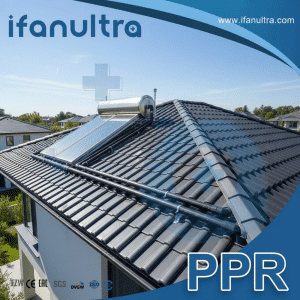
I recently inspected a failed outdoor pipe that wasn’t UV-stabilized. The damage from sun and heat was severe, a costly lesson on why material specification matters.
Yes, UV-resistant PPR is specifically formulated to be safe and durable for exposed outdoor hot water lines. It contains special additives that protect the polymer from the sun’s degrading rays while maintaining its strength and pressure rating under continuous heat, making it a reliable choice for outdoor applications.
However, simply using “UV-resistant” pipe isn’t enough. You must understand its limits and the correct installation methods to ensure a truly long-lasting system. Let’s examine the key factors.
How Does It Handle the Combined Stress of UV Radiation and High Temperature?
Sunlight and hot water together create a harsh environment. Standard PPR would quickly become brittle and fail under these conditions.
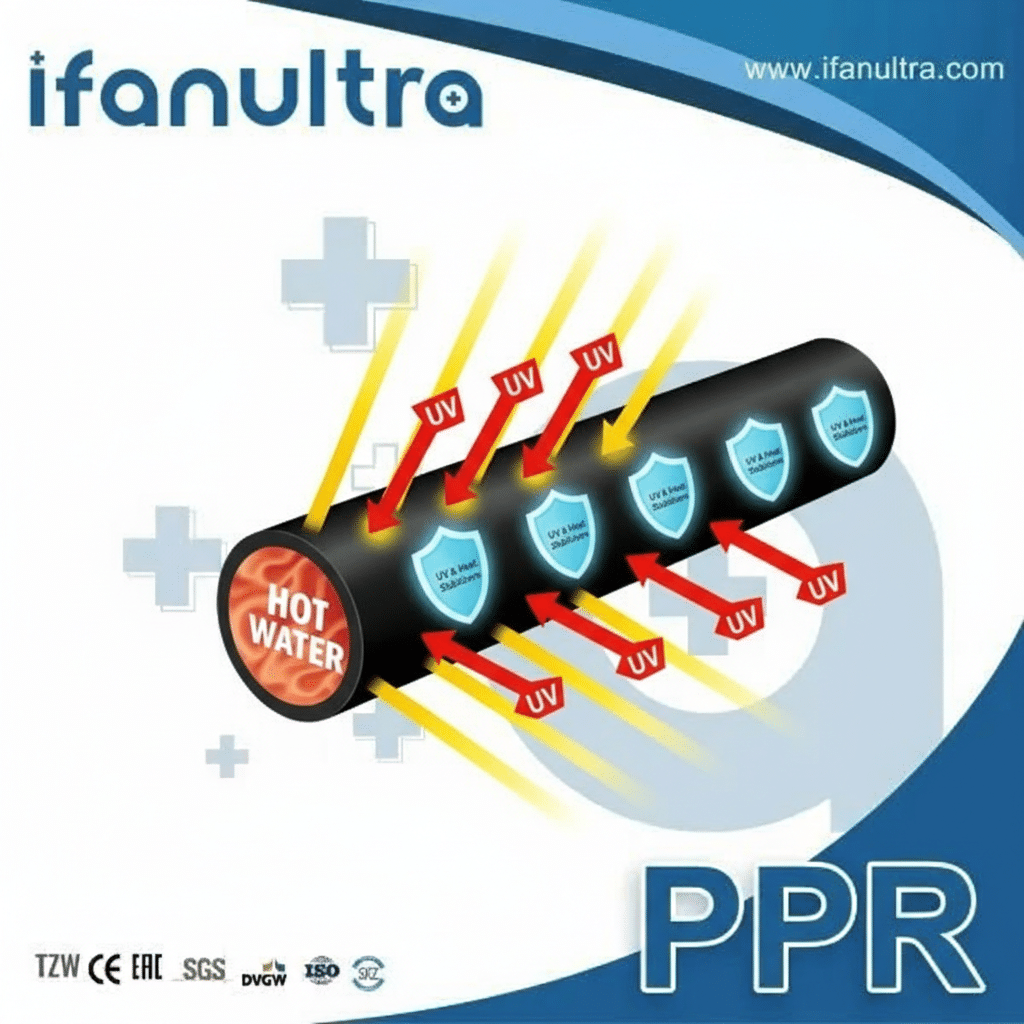
UV-resistant PPR handles the combined stress through a synergistic stabilization system. UV inhibitors absorb and scatter solar radiation, preventing polymer chain breakdown, while heat stabilizers work continuously to maintain molecular integrity against thermal degradation from hot water flowing inside.
The Dual-Attack Problem and Material Defense
Outdoor hot water lines face a double threat. Ultraviolet (UV) radiation attacks the pipe from the outside, and hot water stresses it from the inside. These forces work together to accelerate aging.
UV radiation causes photo-oxidation. It breaks the long polymer chains in standard PPR, making the material brittle, discolored, and weak. You’ll see cracking and a significant loss of impact strength. Meanwhile, high temperature internally accelerates oxidative degradation, reducing the material’s long-term pressure resistance.
The Stabilization Package: A Formulated Shield
Manufacturers combat this by compounding specific additives into the base PPR material during production. This isn’t just a surface coating; it’s a homogeneous mix throughout the pipe wall.
- UV Stabilizers (e.g., HALS, Carbon Black, TiO2): These act as shields. They either absorb the harmful UV energy and convert it to a small amount of harmless heat, or they physically block the rays from penetrating the polymer. Carbon black is a very effective and common stabilizer, which is why many outdoor-rated pipes are black.
- Heat Stabilizers: These are different additives that protect the polymer from the continuous thermal stress of hot water. They prevent the molecular chains from breaking down under heat over time, which preserves the pipe’s pressure rating and mechanical strength.
The key is that these stabilizers are designed to work together for the projected lifespan of the pipe (often 50+ years for cold water, with adjusted ratings for hot). A pipe only rated for UV resistance but not for continuous hot water service will still fail.
Real-World Performance Considerations
Even with stabilizers, some gradual surface weathering may occur. The pipe might develop a slight chalky appearance. However, the critical mechanical properties—burst strength, pressure rating, and leak-free joints—must remain intact. Properly formulated UV-resistant PPR is engineered to ensure this core performance is protected throughout its service life.
What Is the Maximum Continuous Temperature for UV-Stabilized PPR Pipes?
Temperature is the most critical limit for any plastic pipe. Exceeding it drastically shortens the pipe’s life.
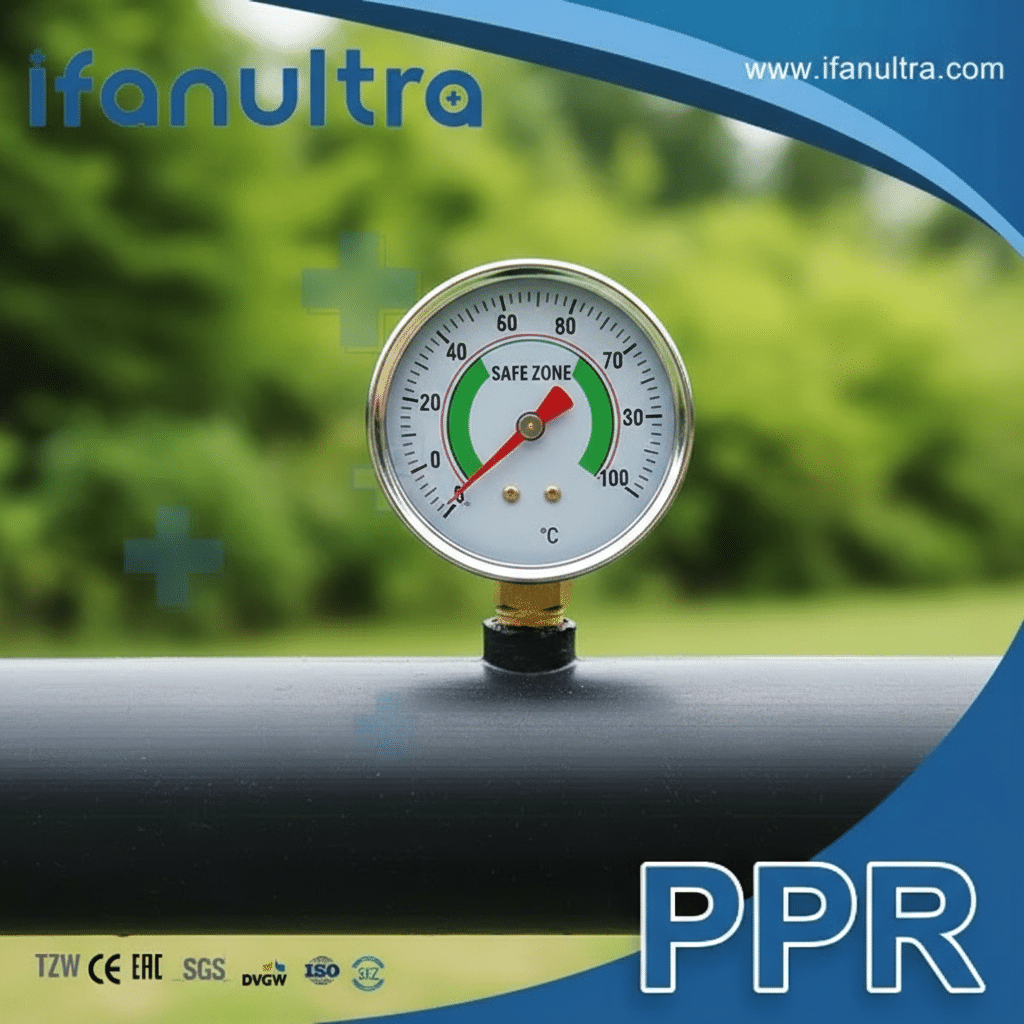
The maximum continuous operating temperature for standard, pressure-rated UV-stabilized PPR is typically 70°C (158°F) at correspondingly reduced pressure ratings. For short-term peaks, it can often handle up to 95°C (203°F) for a limited time, but the long-term strength and lifespan are designed around the lower continuous temperature.
Understanding Temperature Ratings and Pipe Life
The relationship between temperature and service life for PPR is inverse. The hotter the water, the faster the material ages, and the lower its maximum allowable operating pressure becomes. This is a fundamental principle of thermoplastic piping.
Manufacturers base their 50-year lifespan projections on a specific temperature-pressure profile. For standard PPR Type 3 (random copolymer), the classic benchmark is:
- 20°C (68°F): Full pressure rating (e.g., PN20, PN25).
- 70°C (158°F): The standard maximum continuous design temperature. At this temperature, the long-term hydrostatic strength is lower, so the system’s operating pressure must be derated.
The Critical Impact of Sun Exposure
For outdoor lines, you must consider ambient heat plus water temperature. A black pipe in direct summer sun can have a surface temperature 20-30°C (36-54°F) above the air temperature. If the air is 35°C (95°F), the pipe wall could be 60°C (140°F) before any hot water even flows inside.
This absorbed heat from the sun effectively pre-heats the pipe material, reducing its remaining capacity to handle the heat from the water. Therefore, for critical outdoor hot water lines, it is wise to design conservatively.
Guideline Table for Temperature and Pressure
| Application Scenario | Recommended Max Continuous Water Temp | Key Consideration |
|---|---|---|
| Outdoor Domestic Hot Water (With Sun Exposure) | 60°C – 65°C (140°F – 149°F) | Provides a safety margin for solar heating of the pipe wall. |
| Indoor Domestic Hot Water | Up to 70°C (158°F) | Standard rating applies when pipe is at room temperature. |
| Solar Thermal Pre-Heat Line (Low-Pressure) | Consult specific pipe rating; may be up to 90°C for specialized types. | Requires pipe specifically rated for high-temp solar applications. |
| Heating System Discharge / Condensate Lines | Must exceed boiler outlet temp; often requires PP-RCT or specialized material. | Standard PPR may not be sufficient. |
Always check the manufacturer’s specific technical data sheet for the exact temperature-pressure curve of the product you are using. Do not assume all UV-resistant PPR has the same rating.
Are There Specific Formulations for Solar Hot Water or Heating Discharge Lines?
Yes, standard UV-resistant PPR is often not sufficient for these high-demand applications. They require enhanced materials.
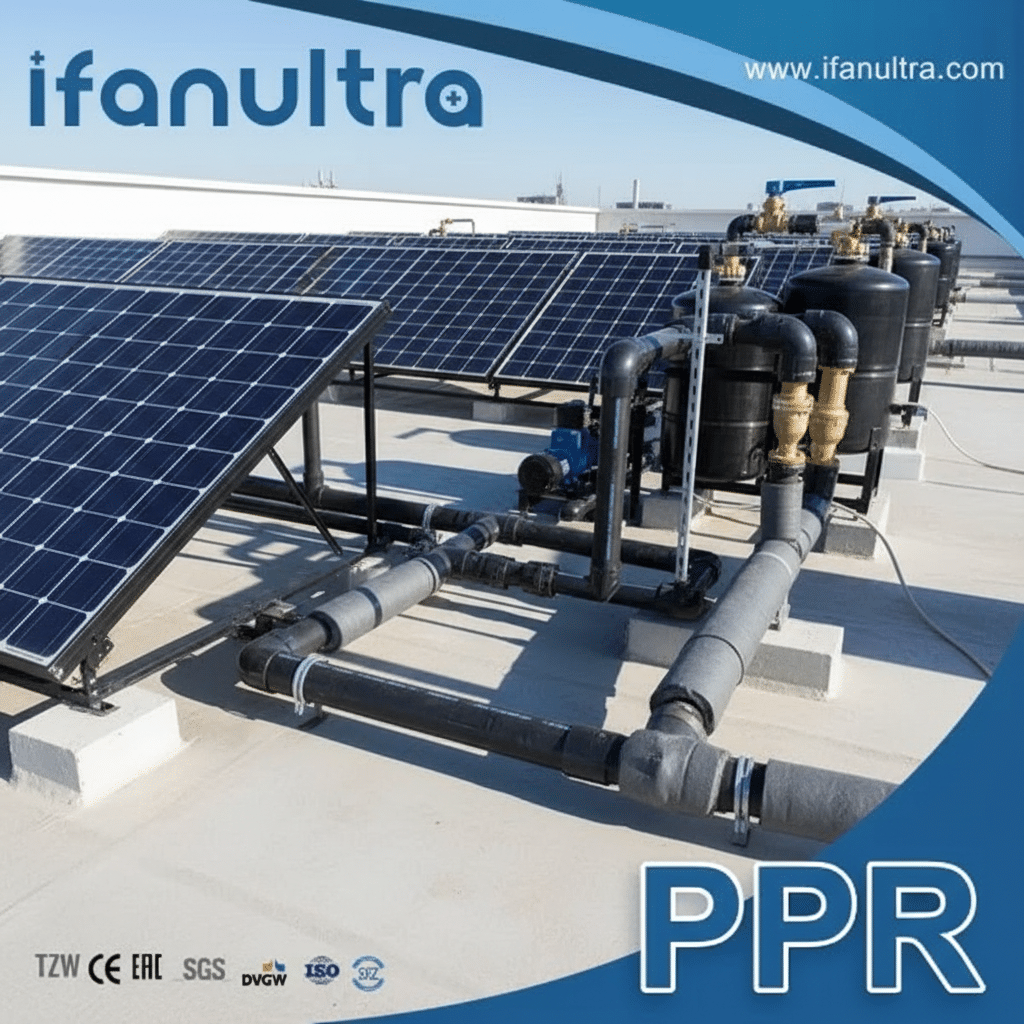
For solar hot water primary circuits and heating system discharge lines, specific high-temperature PPR formulations are essential. These are often PP-RCT (Polypropylene Random Copolymer with Crystallinity) or compounds with higher heat stabilizer loads. They are designed to withstand continuous temperatures often up to 90°C or higher while maintaining necessary pressure ratings and UV resistance.
Why Standard PPR Falls Short in High-Heat Roles
Standard PPR has a glass transition temperature and long-term strength limit that makes it risky for high-performance thermal applications. Stagnant, super-heated water in a solar loop or a boiler discharge can easily exceed 80-90°C, pushing standard PPR beyond its safe operating window. This leads to rapid loss of strength, excessive thermal expansion, and potential system failure.
High-Performance Material Options
The industry has developed advanced materials to fill this gap:
1. PP-RCT (Type 4): This is a significant upgrade. The “CT” stands for Crystallinity. The manufacturing process creates a different molecular structure with higher crystallinity, which gives the material:
- Higher long-term hydrostatic strength at high temperatures.
- Better resistance to slow crack growth.
- A higher maximum continuous operating temperature (often 80-90°C range).
PP-RCT is the go-to material for demanding hot water and low-pressure heating applications, including outdoor exposed lines when combined with UV stabilizers.
2. Specialty Stabilized Blends: Some manufacturers offer PPR compounds heavily fortified with advanced heat and UV stabilizers specifically branded for solar thermal applications. These are tested and certified for the unique temperature cycles (high stagnation temps) seen in solar systems.
Selection Guidelines for Different Hot Water Lines
Use this table to match the pipe type to the application:
| Application | Recommended Pipe Type | Key Reason |
|---|---|---|
| Exposed Outdoor DHW (to tap) | UV-Resistant Standard PPR (Type 3) | Handles typical 60-70°C water with sun exposure. |
| Solar Thermal Collector Loop (Pressurized) | UV-Resistant PP-RCT or Solar-Rated PPR | Must withstand stagnation temperatures >90°C and UV exposure. |
| Heat Pump Discharge / Low-Temp Heating Lines | PP-RCT | Optimized for continuous warm water (e.g., 40-60°C) circulation. |
| Boiler High-Temp Discharge / Condensate | Material per boiler OEM spec; often metal or CPVC. | Temperatures can exceed safe limits for even PP-RCT. |
Crucial Advice: Never use a pipe for a solar thermal primary circuit unless its data sheet explicitly states it is rated for the maximum expected stagnation temperature of your solar system. This is a safety-critical specification.
How Does Thermal Expansion Under the Sun Affect Long-Term Joint Integrity?
This is a silent system killer. Poor planning for expansion and contraction leads to stressed joints and leaks.
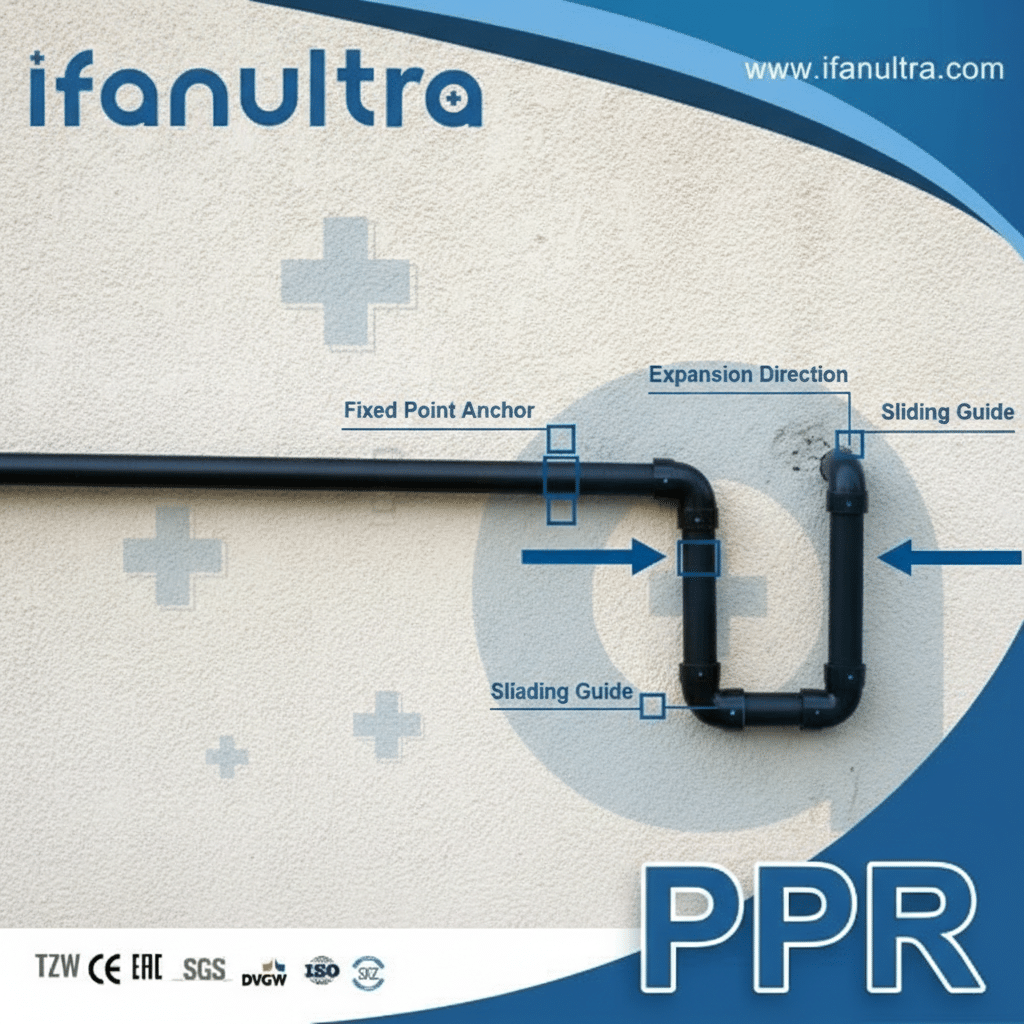
Thermal expansion under the sun directly stresses fixed joints and can cause them to pull apart or fail over time. PPR expands significantly with heat, so an exposed pipe run that heats up in the sun will lengthen. If the installation does not allow for this movement—using expansion loops, offsets, or sliding brackets—the force will transfer to the fittings, potentially compromising the fused joint.
The Physics of the Problem
PPR has a relatively high linear thermal expansion coefficient (about 0.15 mm/m·°C). This means a 10-meter pipe will expand 15 millimeters for every 20°C temperature increase. An outdoor pipe can easily experience a 40°C temperature swing between night and a hot, sunny day, leading to 30 mm of movement in that 10-meter section.
If both ends of this pipe are rigidly fixed, it has nowhere to go. The material will try to expand, creating immense compressive stress. This stress can cause the pipe to buckle or, more commonly, it transmits force axially back to the elbows, tees, and valves. Since the fused joints are strong but not designed to be structural anchors, this constant push-pull cycle can lead to fatigue.
Strategies to Manage Expansion in Outdoor Runs
You must design the pipeline to safely absorb this movement. Here are the primary methods:
1. Expansion Loops: A deliberate “U” or “Ω” shape in the pipe run. When the pipe expands, the loop opens or closes slightly, absorbing the length change without stressing the ends. This is the most effective method for long, straight runs.
2. Expansion Offsets: A “Z” shaped configuration. Similar to a loop, it uses the flexibility of the pipe to accommodate movement.
3. Proper Clamping: Use sliding guides and loose clamps instead of rigid grip-style clamps. The pipe must be able to slide through its supports as it expands and contracts. Fix anchors only at key points like branches or fittings.
4. Compensating Fittings: In some systems, specialized expansion compensation sleeves or bellows can be installed.
Installation Checklist for Outdoor PPR
To ensure joint integrity, follow these practical steps during installation:
- Calculate the Movement: Estimate the total expansion for each pipe run based on its length and expected temperature range.
- Plan Anchor Points: Decide where the pipeline will be firmly anchored (e.g., at a building entry point, before a valve).
- Design Loops/Offsets: Incorporate loops or offsets near the middle of long runs between anchors.
- Use Correct Supports: Install sliding pipe guides along the run. Leave a gap between the pipe and rigid surfaces.
- Allow Curing Time: After fusion welding, let the joint cool completely without any stress or movement on it.
Ignoring thermal expansion is the most common mistake in outdoor PPR installations. A perfectly fused joint can still fail if the system design traps it in a rigid frame that fights natural movement.
Conclusion
UV-resistant PPR is safe for outdoor hot water lines when you select the correct temperature grade and plan for thermal movement. For reliable performance, choose engineered solutions like IFAN’s UV-stabilized PPR and high-temperature PP-RCT pipes.









 English
 Español
 Français
 Português do Brasil