

The April 2026 KAN-therm catalogue lists ordinary PP-R PN20 at 20 × 3.4 mm as 0.172 kg/m and stabiGLASS at the same nominal dimensions as 0.218 kg/m. A heavier row can describe a different construction.
Use a PPR pipe weight per metre chart only after matching the manufacturer, product series, construction and dimension series. For an IFANULTRA order, ask for the current declared mass of the actual quoted SKU. The examples below are named public catalogue references, not IFANULTRA measurements or a shipment specification.
A declared weight reference, with its limits
Reference excerpt: KAN-therm PP, April 2026, printed page 6, ordinary PP-R PN16/S3.2/SDR7.4 and PN20/S2.5/SDR6. More sizes are in the source.
| Outside diameter (mm) | PN16 declared kg/m | PN20 declared kg/m |
|---|---|---|
| 20 | 0.148 | 0.172 |
| 32 | 0.370 | 0.434 |
| 63 | 1.410 | 1.650 |
| 110 | 4.300 | 5.040 |
The table is a manufacturer-specific excerpt. A missing diameter here does not mean the manufacturer cannot supply it. It means this page has not reproduced that row. Follow the source for the full series, then ask your own supplier for the current equivalent before applying a figure to an order.
Keep the source name beside any value copied into a spreadsheet. A column headed only “PPR kg/m” loses the qualification that made the number useful. When a colleague reuses the sheet later, they need to know whether it came from the offered product, a comparison catalogue, or a calculation.
The same nominal dimensions can hide a different row
The stabiGLASS comparison is from printed page 7. It is a separate construction. Do not combine its row with the ordinary PP-R table.
This matters when two quotations show different weights. The useful question is not which number is bigger. It is whether both suppliers are describing the same product. Ask each to name the construction and the declared weight basis. If they differ, resolve the specification before comparing price or treating a sample as underweight.
| Record in the quote | Why it changes the decision |
|---|---|
| Manufacturer, product series and catalogue revision | Identifies whose declaration you are using and whether it still covers the offered product. |
| Construction plus OD and SDR/pipe series | Keeps a reinforced product from being compared with a single-layer reference. |
| Declared kg/m and its basis | Separates a supplier declaration from a nominal calculation or an observed sample weight. |
| Order length and separate packing figures | Makes the arithmetic auditable without calling pipe mass gross shipment mass. |
Weight is one descriptor of the product, not a certificate. A mass comparison alone cannot establish material identity, pressure duty or compliance. Use the datasheet checks for the specification and the dimensions and tolerance guide for dimensional questions. Neither a heavy pipe nor a plausible chart row replaces those checks.
Use the lookup in this order
- Identify the manufacturer and exact product series on the quotation.
- Match construction, outside diameter and SDR or pipe series to the declared row.
- Check whether a declared kg/m figure is available. If it is missing or the row does not match, ask the supplier and stop the estimate.
- Confirm the number of metres, then calculate net pipe mass from the matching declared value.
- Keep packaging and gross shipment mass separate; request their own figures.
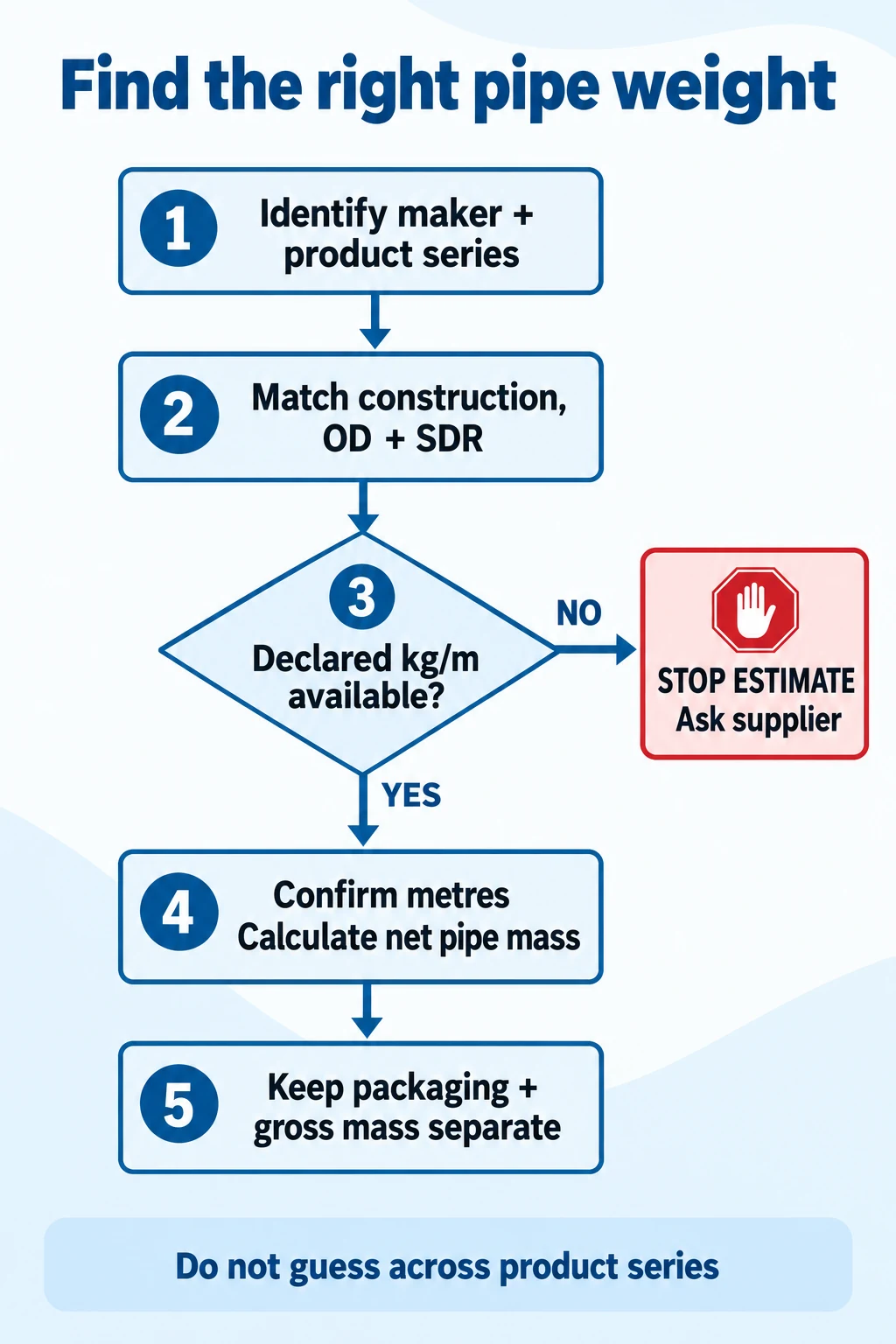
The stop in step three is part of the method. A nearby size, a reinforced row or another brand can be a research reference, but it cannot quietly become the missing supplier declaration. Leave the order’s weight cell unresolved until the supplier supplies the applicable value.
Convert metres without inventing a shipment weight
Illustrative conversion: 1,000 m × 0.172 kg/m = 172 kg, using the ordinary KAN-therm 20 mm PN20 declaration. The length is chosen for this example; the result is calculated net pipe mass, not a weighing or packing record.
Attach the length to the same line as the product specification. If an order contains more than one size or construction, calculate each line using its own matching declared value and add the line totals. A single average weight hides which row was used. That makes it harder to correct the estimate when a supplier changes a line item.
Packaging, fittings and other cargo need their own records. This calculation does not tell you what a loaded container weighs, how many bundles fit, or what a carrier will accept. Those are separate questions; the first-container planning guide covers the planning context.

Put the missing declaration in the RFQ
For an IFANULTRA quotation, send the product construction, outside diameter, SDR or pipe series, and required metres. Ask for the current SKU identifier, declared kg/m, catalogue revision and the basis of that mass figure. If the supplier offers a calculated value, have it labelled calculated with its inputs. If a sample is weighed, retain the sample identity, measured length and weighing record separately.
A copyable request: “Please identify the exact quoted pipe series and SKU, state its construction and dimension series, and supply the current declared mass per metre with its source and revision. Please list packaging and gross shipment mass separately from net pipe mass.” This is an editorial RFQ template, not a statement that those IFANULTRA figures have already been verified.
There is a tradeoff: a short reference chart is convenient, but a current product declaration is what makes an order estimate defensible. Use this page to locate the right question. Use the supplier’s matching, current row to answer it.
Use the PPR Global Series product range to identify the series for your enquiry. Request its current, matching weight declaration with the quotation.
Source and scope
Source: KAN-therm PP catalogue, effective 1 April 2026, printed pages 6–7; checked 8 October 2026.
Frequently asked questions
Is this chart an IFANULTRA weight declaration?
No. The excerpt is from the named KAN-therm catalogue. Request the current declared mass for the exact IFANULTRA series and SKU before using a value for an order.
Does kg/m multiplied by metres give gross shipment weight?
No. It gives an estimate of net pipe mass for the matching declared row. Packaging, fittings and other cargo require separate records.









 English
 Español
 Français
 Português do Brasil