

ISO 12162:2009, which turns long-term test data into pipe-resin grade numbers, says its classification “does not qualify a material for a specific application.” Keep that sentence in mind when a supplier sends a PP-R resin datasheet (TDS) as proof of what went into your pipe.
Here is the short answer. The MFR line identifies the flow grade, and for pipe it only counts at 230 °C and 2.16 kg, where ISO 15874-2:2013 caps the compound at 0.5 g/10 min. The MRS line, the “80” in PP-R 80, is the 97.5 % lower confidence limit of strength at 20 °C over 50 years, rounded down. The other lines are typical values for the grade. None of them proves hot-water performance, or that your lot was made from that grade. The lot certificate and the pipe test report do that.
Key Takeaways
- For pipe, an MFR figure is only comparable at 230 °C and 2.16 kg; ISO 15874-2:2013 caps the PP-R compound at 0.5 g/10 min.
- The “80” in PP-R 80 means MRS 8 MPa: sigma-LPL at 20 °C and 50 years of at least 8 and below 10 MPa, rounded down.
- ISO 12162:2009 says its classification does not qualify a material for a specific application, and its CRS values are not for hot and cold water temperature profiles.
- The proof chain runs from the lot certificate MFR to a pipe MFR within 30 % of it, to a print line that matches the pipe report.
On this page
Watch an ISO 1133 melt-flow run:

The Lines on a PP-R Resin Datasheet, and Which Ones Bind
ISO 19069-1:2015 builds the designation of any polypropylene moulding or extrusion grade on three designatory properties: tensile modulus, notched Charpy impact strength and MFR. Code letter R marks a random copolymer, and E marks a grade intended for extrusion of pipes, profiles and sheets. Specimen preparation and test conditions come from ISO 19069-2:2024. A pipe-grade TDS adds a long-term strength line and the pipe standards the grade targets.
The same standard warns that one designation does not guarantee one performance, so read each line for what it commits to.
| TDS line | What it states | Method or basis | Verdict: what it commits to |
|---|---|---|---|
| MFR | g/10 min at a stated temperature and load | ISO 1133-1:2022 | Flow grade only; compare at 230 °C / 2.16 kg |
| Tensile modulus | Stiffness of moulded specimens | ISO 19069-2:2024 | Grade-typical value, not your lot |
| Notched Charpy impact | Toughness at a stated temperature | ISO 19069-2:2024 | Grade-typical; check the test temperature |
| MRS or class number | sigma-LPL at 20 °C, 50 years, rounded down | ISO 9080:2012 and ISO 12162:2009 | Cold-water class; ask who evaluated it |
| “For ISO 15874 pipe” | Intended use | Producer statement | Nothing until a pipe is certified |
Those lines end up in pipe such as our DN20-DN160, PN10 to PN25 PPR Global Series range, and the questions below apply to any quote for it.
MFR: A Number That Means Nothing Without 230 °C and 2.16 kg
MFR is the mass of melt, in grams, pushed through a standard die in 10 minutes at a set temperature and load. The method is ISO 1133-1:2022, and it notes that its shear rates are much smaller than those in real processing. The figure ranks grades; it does not predict line behaviour.
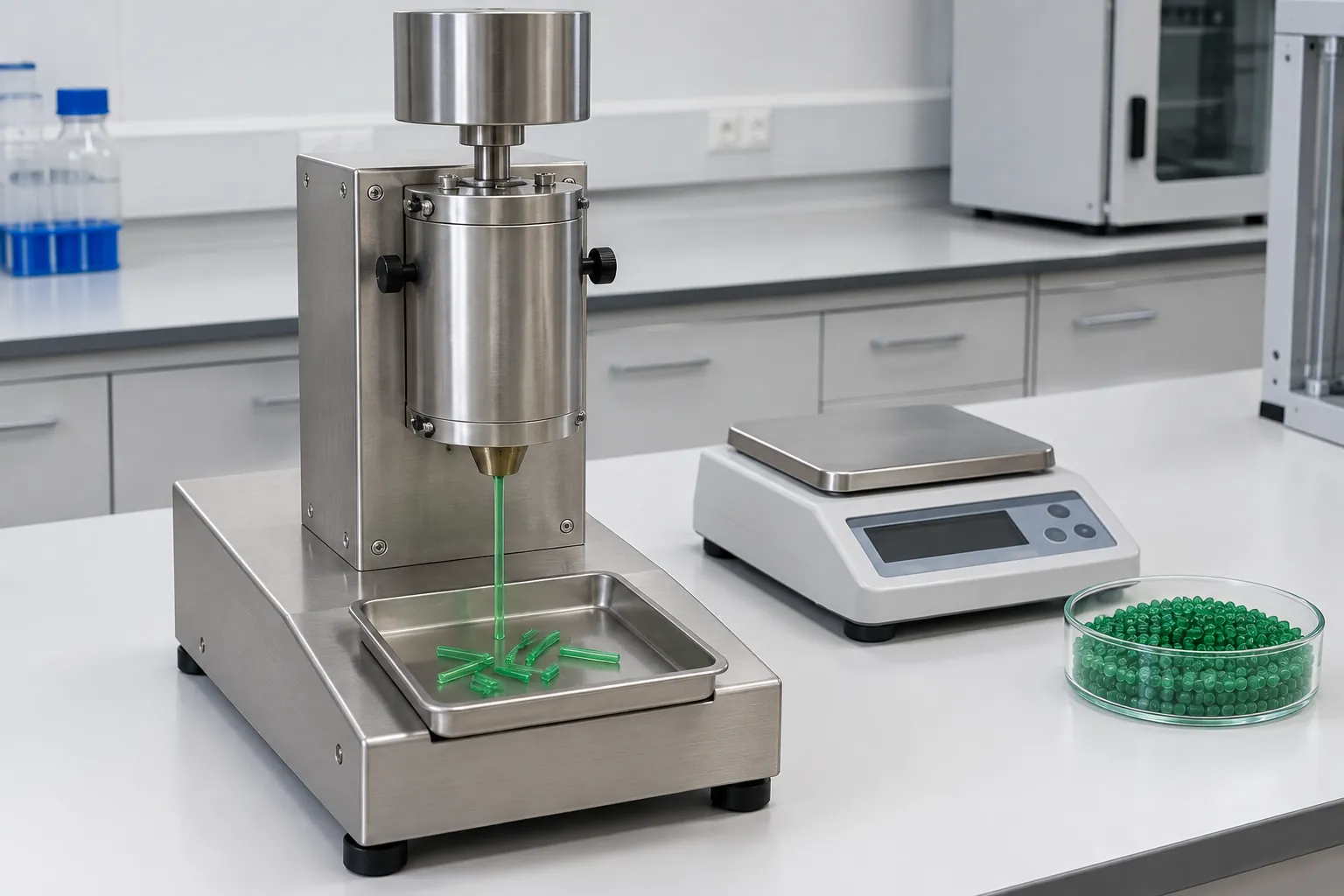
For pipe, the condition is fixed. ISO 15874-2:2013 Table 11 requires the PP-R compound to show no more than 0.5 g/10 min at 230 °C and 2.16 kg. A TDS figure quoted at another load, or with no condition printed, cannot be checked against that ceiling. Send it back and ask for the 230 °C / 2.16 kg value.
The same table holds the check that ties resin to pipe: pipe MFR may differ from the compound of the same batch by at most 30 %. ASTM F2389 clause 8.2 sets the same 30 % limit. A pipe report that shows pipe MFR with no compound MFR beside it has skipped the comparison. Our manufacturing audit guide shows how to run that ratio.
MRS and Sigma-LPL: What 80, 100 and 112 Encode
Long-term strength comes from pressure tests on pipe specimens, extrapolated with ISO 9080:2012 (reviewed and confirmed in 2023). ISO 12162:2009 then defines the terms. Sigma-LPL is the 97.5 % lower confidence limit of the predicted hydrostatic strength. MRS is sigma-LPL at 20 °C and 50 years, rounded down to the next R10 value below 10 MPa, or the next R20 value at 10 MPa and above. The classification number is 10 times the MRS, which is where the “80” in PP-R 80 comes from.
| Sigma-LPL at 20 °C, 50 years (MPa) | MRS (MPa) | Class number (MRS in MPa × 10) | Band width (MPa) |
|---|---|---|---|
| 6.3 to below 8 | 6.3 | 63 | 1.7 |
| 8 to below 10 | 8 | 80 | 2.0 |
| 10 to below 11.2 | 10 | 100 | 1.2 |
| 11.2 to below 12.5 | 11.2 | 112 | 1.3 |
| 12.5 to below 14 | 12.5 | 125 | 1.5 |
Rounding down hides a spread. A resin at 8.0 MPa and one at 9.9 MPa both classify as 80, a 1.9 MPa gap, about 24 % of 8.0, under one code. ISO 12162 also lets a producer designate a material to the next lower classification number, so a label may understate strength but should never overstate it. The Plastics Pipe Institute calls PP-R 80 and PP-R 100 the earlier PP-R resins, with PP-RCT the newer material that is stronger at elevated temperature. The naming history sits on our PPR full-form page.
| Class number (sigma-LPL band, MPa) | Band width (MPa) |
|---|---|
| 63 (6.3-8) | 1.7 |
| 80 (8-10) | 2.0 |
| 100 (10-11.2) | 1.2 |
| 112 (11.2-12.5) | 1.3 |
| 125 (12.5-14) | 1.5 |
What the Grade Code Does Not Promise
The usual failure is reading 80 as a hot-water rating. MRS is a 20 °C number. ISO 12162 states that its classification does not qualify a material for a specific application, and that its CRS values are not intended for temperature-profile service such as the hot and cold water installations of ISO 10508. A PP-R riser at 70 °C is exactly that service.
Hot-water pipe relies on the product standard instead. ISO 15874-2:2013 clause 4.2 requires the pipe material to be evaluated to ISO 9080 against the standard’s reference line, with at least 97.5 % of results on or above it. Ask for that evaluation report and the name of the body that witnessed it. PP-RCT has its own curve; see our PP-RCT order-control guide.
Ratings also expire. In PPI TR-4, the North American listing, an MRS or CRS belongs to a named company and a named material, with a grade letter (S for full data, E for experimental) and an expiration date. In the 2024 edition, the PP 112 table held three listings from one resin producer, and two carried an expiry of 31 December 2025. A datasheet copied from an old brochure can quote a rating whose listing has lapsed.
Datasheet, Lot Certificate, Pipe Report: The Chain That Should Agree
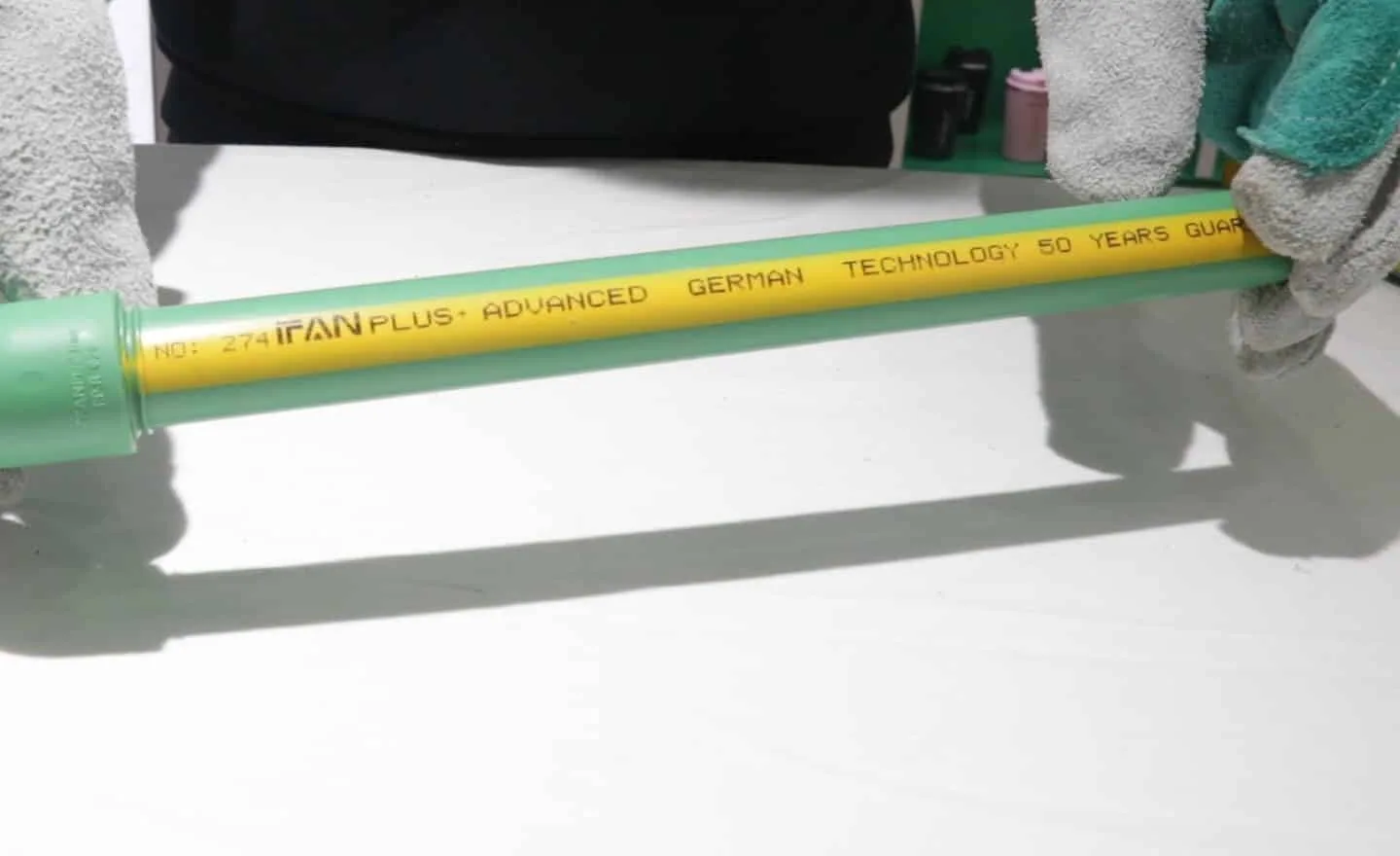
Three documents carry the resin into your container. A TDS describes the grade with typical values. The producer’s lot certificate gives measured values for the lot delivered, and the pipe test report gives pipe MFR and pressure results for one production period. The link between them is arithmetic: lot MFR under 0.5 g/10 min at 230 °C / 2.16 kg, pipe MFR within 30 % of it, and a print line whose material and period match the report. With the quote, ask for two items:
- The producer and grade name as printed on the lot certificate, not only on the TDS.
- The ISO 9080 evaluation or listing behind the MRS, with the evaluating body and date.
In North America, PPI model specification MS-08 requires PP-R and PP-RCT pipe to be made from compounds listed to NSF/ANSI 14 or PPI TR-4. Elsewhere, buyers rely on the body that certifies the pipe to ISO 15874-2:2013 with Amd 1:2018 and Amd 2:2022. Both ISO 15874-1 and ISO 15874-2 are now under revision, so put the dated editions on the order.
What We Check, and What Resin Does to Price, MOQ and Lead Time
What we check
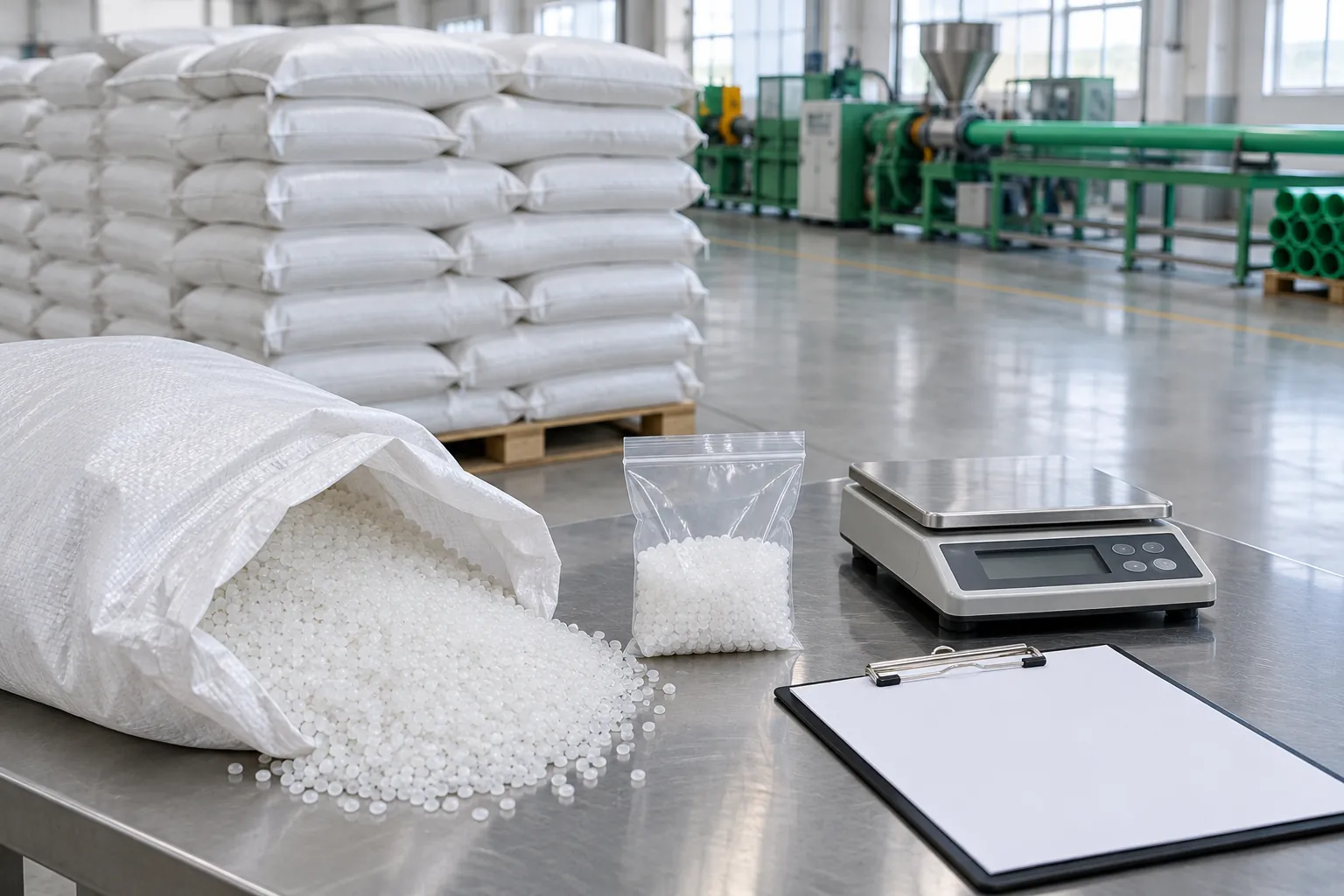
Our QC protocol opens with one step: resin grade verified by source and grade. We extrude virgin PP-R from Nordic raw material, not recycled filler, on German automated lines, and printed markings are reconciled to certificate numbers before shipment. The lot certificate, not a datasheet, is the document to ask any supplier for, us included. Filler checks are in our virgin vs recycled resin guide.
Resin is most of the price. It runs US$780-1,150 per ton and makes up 70-85 % of manufacturing cost, so a quote that names a premium grade but prices like a commodity grade gets the lot-certificate question first.
Our MOQ is 1 FCL, with LCL possible at a higher per-metre cost, and production for one container takes 15-25 days before ocean transit. Those figures assume the resin the line already runs. If your order names a specific producer grade, ask two questions before you accept a date. Is that grade in stock at the extruder? If it must be bought in, does the 15-25 day clock start at order or at resin arrival? That answer, not the TDS, sets your lead time.
Conclusion
The risk is accepting a TDS as proof. It carries a 20 °C grade code that can hide a 1.9 MPa spread, typical values for the grade, and a rating whose listing may have lapsed. Before you accept it, get the lot certificate, the ISO 9080 evaluation and the pipe report, and check the two MFR figures against each other.
Pricing pipe on a resin claim? Ask for the certificate chain with the quote, and use our guide to reading a PP-R pipe datasheet for the finished-pipe side.
Frequently Asked Questions
What does PP-R 80 mean on a resin datasheet?
It means the resin’s sigma-LPL at 20 °C and 50 years is at least 8 MPa and below 10 MPa, so its MRS is 8 MPa. Under ISO 12162:2009 the classification number is 10 times the MRS, which gives 80.
What MFR should a PP-R pipe resin have?
ISO 15874-2:2013 Table 11 caps the PP-R compound at 0.5 g/10 min, measured at 230 °C and 2.16 kg. The finished pipe may differ from the compound of the same batch by at most 30 %.
Are the values on a resin TDS guaranteed?
Treat them as typical grade values unless the sheet states otherwise. The resin lot certificate carries the measured values for the lot you received, and ISO 19069-1 warns that one designation does not guarantee one performance.
Does a higher MRS mean a resin is rated for hot water?
No. MRS is a 20 °C, 50-year value. ISO 12162:2009 says its classification does not qualify a material for a specific application; hot-water pipe relies on the ISO 9080 evaluation that ISO 15874-2:2013 clause 4.2 requires.









 English
 Español
 Français
 Português do Brasil