
Ask ten PP-R factories for a ppr pipe minimum order quantity and you will get ten different answers, most of them a single round number with no explanation attached. That is not evasion. It is because the minimum is not really one number: it is what falls out of how the pipe is packed, which wall class you chose, how many colours you want, and how much air is inside a shipping container once cylinders are stacked in it.
A buyer who asks “what is your MOQ” gets a number. A buyer who asks “what is your packing unit per diameter” gets the thing that actually governs the order.
Here is the figure that reframes a first order. A 20ft general purpose container carries 33.2 m³ and is rated to a 30,200 kg payload, according to Hapag-Lloyd’s published container specification. Fill that box with DN25 PP-R at 0.230 kg/m and it cubes out somewhere around 10,900 kg — roughly a third of the weight the container is legally allowed to carry.
PP-R is a volume cargo, not a weight cargo, and almost every costly mistake in a first container traces back to a buyer who planned it as though it were the other way round.
Key Takeaways
- MOQ for PP-R is usually structured per size and per colour, not as one order-wide number — the real quantum is the manufacturer’s packing unit for each diameter.
- Published packing units run 100 m for DN16–DN25, 40 m for DN32–DN40, 20 m for DN50–DN75, and 8 m for DN110, so small diameters commit you to more metres than large ones.
- A 20ft container offers 33.2 m³ and a 30,200 kg payload; loaded with PP-R it typically reaches its volume ceiling at roughly 30–36% of that weight limit.
- Wall class moves weight enormously: DN20 is 0.107 kg/m in SDR 11 and 0.172 kg/m in SDR 6 — a 61% difference on the same nominal size.
- The ICC states in the Incoterms 2020 introduction that a seller handing containerised goods to a carrier before vessel loading is well advised to sell FCA rather than FOB.
- Since 1 July 2016 SOLAS requires a Verified Gross Mass for every packed container, and Incoterms deliberately does not say who pays for it — so your contract must.
- Fittings, not pipe, decide whether a first container is sellable: pipe is the volume, fittings are the margin and the reorder trigger.

What a PP-R Pipe MOQ Actually Measures
A minimum order quantity is a supplier’s answer to a cost they cannot avoid. For PP-R that cost is almost never the raw material — polypropylene random copolymer is bought by the tonne and does not care whether your order is large or small. It is the changeover. An extrusion line running DN25 in green has to be stopped, the die and calibration sleeve swapped, the colour purged out of the barrel, and the first output scrapped until wall thickness and colour stabilise.
That block of lost time is identical whether the run that follows is 500 metres or 50,000. The MOQ exists to make the changeover worth performing.
This has a consequence buyers routinely miss: the minimum attaches to each size-and-colour combination separately, not to the order as a whole. A request for 5,000 m spread across nine diameters in two colours is not one order that clears a minimum. It is eighteen separate production decisions, most of which are individually below any sensible run length.
The same 5,000 m concentrated into three diameters in one colour is straightforward. When a quotation comes back much higher than expected, or with a lead time that seems out of proportion, fragmentation across the size list is usually the reason.
The four axes an MOQ is usually written against
- Per size: each nominal diameter is a separate die setup, so each carries its own floor.
- Per colour: green, white and grey are separate purges. A second colour can double the effective minimum of the whole list.
- Per wall class: SDR 6, SDR 7.4 and SDR 11 in the same diameter are different products with different tooling, not variants of one item.
- Per order or per container: a total-volume or total-value floor that sits on top of the per-item ones, usually set so the shipment fills a box economically.
Fittings behave differently again, because they are injection moulded rather than extruded. Each fitting is a dedicated mould, and a mould change is a heavier operation than a die swap. This is why a factory that will happily flex on pipe metres often will not flex on an obscure fitting: the request is not for more of something already running, it is to mount a specific tool for your order alone.
Asking which fittings are currently in production, rather than which exist in the catalogue, is one of the more useful questions a first-time buyer can ask.
A word on what this article deliberately does not do. It does not publish a single metre figure and call it the industry MOQ, because no such number survives contact with a real size list. Minimums are quoted per project against the mix you actually want, and any supplier quoting one before seeing your list is quoting a container, not a minimum.
What follows is the structure underneath the number, so that when you receive one you can tell whether it is reasonable.
The Packing Unit Is the Real Minimum
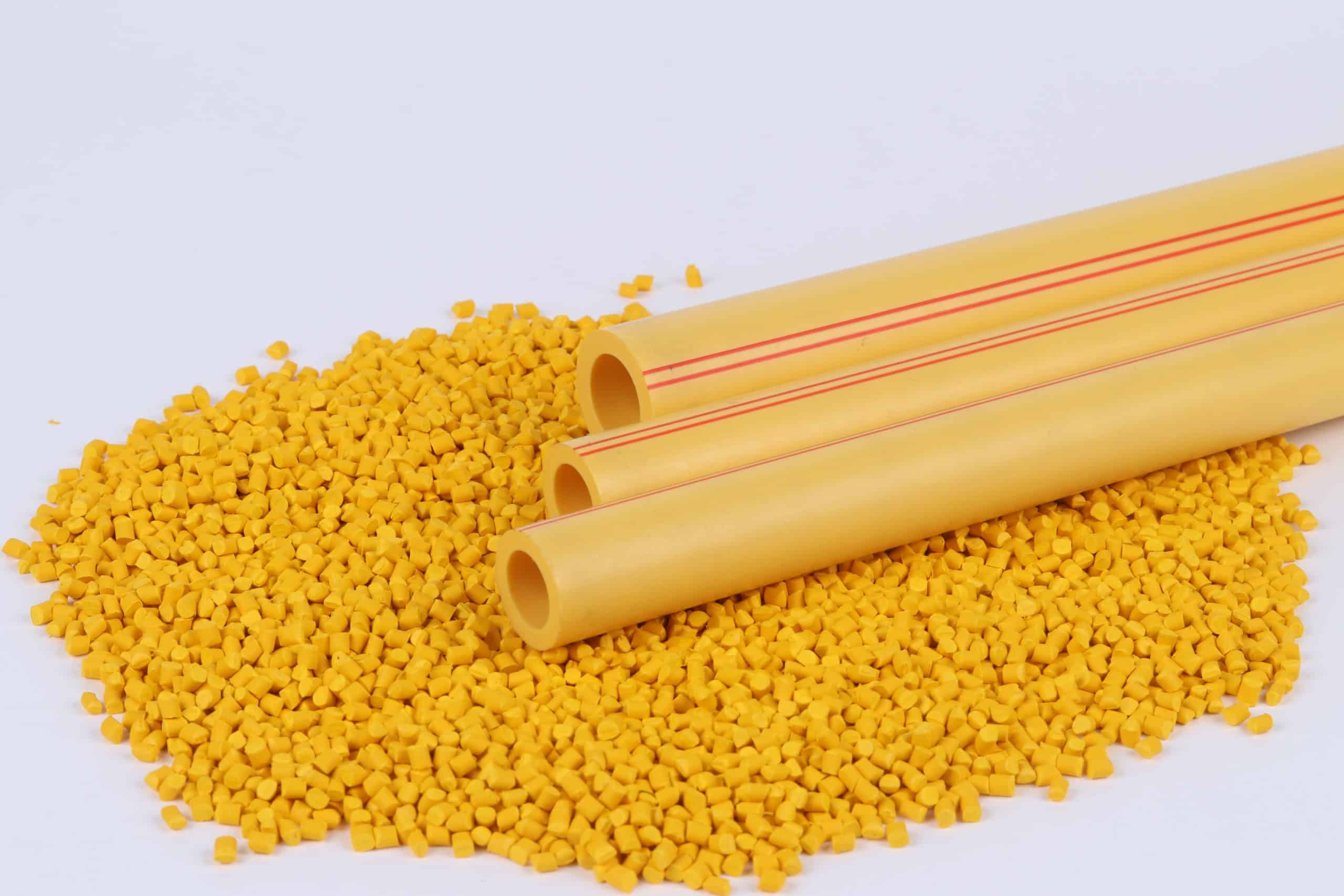
Every PP-R manufacturer publishes a packing unit alongside its dimensions, and it is the most under-read column on the datasheet. PP-R is supplied in 4 m straight lengths, and those lengths are bundled into a fixed quantity per diameter. You do not order metres. You order bundles, and the metres follow.
aquatherm’s published dimension sheet for its Fusiotherm PP-R range, declared to DIN 8077/78 and DIN EN ISO 15874, lists the packing unit for every size: 100 m for DN16 through DN25, 40 m for DN32 and DN40, 20 m for DN50 through DN75, 12 m for DN90, 8 m for DN110, and 4 m for DN125 and above.
Read that sequence again, because it inverts an assumption most buyers arrive with. Small pipe forces you to commit to more metres, not fewer. A single bundle of DN20 is 100 m; a single bundle of DN110 is 8 m. So a buyer who says “let us start small, just the little sizes” has unknowingly chosen the diameters with the largest minimum commitment per bundle.
And because the bundle is indivisible, asking for 60 m of DN20 does not produce a 60 m price — it produces a 100 m bundle, or a refusal, or a hand-packing surcharge that makes the saving pointless.
| Diameter | Packing unit | Wall, SDR 7.4 | Peso | Weight per bundle |
|---|---|---|---|---|
| DN20 | 100 m | 2.8 mm | 0.148 kg/m | 14.8 kg |
| DN25 | 100 m | 3.5 mm | 0.230 kg/m | 23.0 kg |
| DN32 | 40 m | 4.4 mm | 0.370 kg/m | 14.8 kg |
| DN50 | 20 m | 6.9 mm | 0.896 kg/m | 17.9 kg |
| DN75 | 20 m | 10.3 mm | 2.010 kg/m | 40.2 kg |
| DN110 | 8 m | 15.1 mm | 4.300 kg/m | 34.4 kg |
The right-hand column is the practical one. Notice how flat it is: a bundle weighs somewhere between about 15 kg and 40 kg across the entire range. That is not a coincidence — packing units are set so that one man can carry one bundle, which is why the metre count falls as the diameter rises.
Once you see the bundle rather than the metre as the unit of trade, quantities stop being arbitrary. Your order becomes a count of bundles per size, and both your quotation and your load plan become checkable arithmetic rather than a negotiation over round numbers.
One caution before you build a list on this table. These are one named manufacturer’s published figures, used here because they are verifiable and typical of European-standard PP-R. Packing units are not standardised across the industry the way dimensions are — a factory may bundle DN20 in 100 m, 200 m or by carton count, and Asian manufacturers frequently differ from European ones.
Ask for the supplier’s own packing list before you build quantities, and treat any table you found online, including this one, as a model of the structure rather than a statement of their numbers.
Why a Container of PP-R Runs Out of Space Before Weight
Hapag-Lloyd’s published container specification gives a 20ft general purpose box with wooden floor inside dimensions of 5,900 × 2,352 × 2,393 mm, a capacity of 33.2 m³, a tare of 2,300 kg and a maximum payload of 30,200 kg. Those are the carrier’s figures for its own units; equivalents vary slightly between boxes, and the same document lists a variant at 5,898 mm, 33.0 m³ and a 28,180 kg payload against the ISO 668 maximum gross mass of 30,480 kg.
For planning purposes the difference is immaterial. What matters is the ratio between the two limits.
Work it through with DN25 in SDR 7.4, at 0.230 kg/m. A metre of DN25 occupies a cylinder 25 mm across, so its gross cross-section is about 0.00049 m².
Cylinders cannot fill a rectangular box completely — bundled round pipe in practice occupies something in the region of 60–70% of the space it sits in, an estimate that varies with bundling and stacking discipline. At the optimistic end of that range, 33.2 m³ holds roughly 47,000 m of DN25, and 47,000 m at 0.230 kg/m is about 10,900 kg.
Against a 30,200 kg payload, that is roughly 36% of the weight the container is entitled to carry. At the more realistic 60% it is nearer 30%.
A PP-R container is a volume budget with a weight limit you will never reach. Plan in cubic metres; the kilogrammes take care of themselves.
Two practical consequences follow, and they point in opposite directions. The first is reassuring: you will not be caught by an overweight container on straight PP-R pipe, so the road-haulage weight limits that torment importers of tile or fasteners are not your problem. The second is expensive: you are paying for a full box of air-filled cylinders either way, so unused cubic metres are pure loss.
A container that leaves at 70% volume has not saved you 30% of the freight — it has spent the same freight moving less product, and the per-metre landed cost of everything inside it rises accordingly.
This is also the answer to a question buyers ask constantly, which is whether to ship 20ft or 40ft. A 40ft High Cube offers 76.3 m³ against a 28,650 kg payload — more than double the volume of the 20ft for a payload that is actually slightly lower.
For a low-density cargo like PP-R the high cube is dramatically more efficient per cubic metre, which is why established distributors move to 40HQ quickly. For a first order it is usually the wrong box, not because of freight, but because filling 76.3 m³ commits you to a quantity of unsold inventory you have no sales history to justify. Fill a 20ft properly first.

This is the decision that sets everything else, and it should be made before you build a size list rather than after. There are three realistic shapes for a first PP-R order, and the right one depends far more on whether you have committed demand than on how much cash you want to deploy.
Less than container load is the option most first-time buyers ask about and the one that punishes PP-R hardest. LCL freight is charged on chargeable weight, which for light cargo is calculated from volume rather than actual mass. PP-R is close to the worst possible cargo under that rule: it is almost all air by weight, so you pay the volumetric rate on every cubic metre while the goods themselves weigh very little.
Add the consolidation and deconsolidation handling at both ends, plus the destination charges that LCL shipments attract disproportionately, and the per-metre cost gap against a full container is wide.
It is wide enough that it frequently erases the margin on the goods entirely — which is the mechanism behind the common complaint that a small trial order “cost more than it was worth”. I cannot give you a defensible per-metre premium figure here, because LCL is quoted per shipment by lane and week and no published figure would be honest; get two forwarder quotes on your actual lane, one LCL and one FCL, before you decide.
A shared container — where your goods travel with another buyer’s under one bill of lading, usually arranged by the factory or a common agent — is the middle path, and it is the one most under-used. You get FCL economics on the ocean leg while committing to perhaps half a box.
The trade-offs are real and worth naming: your cargo leaves when the other party is ready, not when you are, so lead time becomes partly someone else’s decision; customs clearance is more complicated because one declaration covers two consignees; and if the other shipment has a documentation problem, your goods sit in the same container while it is resolved. Ask specifically who the consignee of record is and how the goods are separated and marked.
A full 20ft is the right first container for most buyers who already have a route to market — an existing plumbing or building-materials customer base, a project with a bill of quantities, or a retail counter that already sells competing pipe. The reason is not freight economics, though those favour it.
It is that a full container lets you order complete bundles across a coherent size range, which means you can actually serve a job when it comes, rather than discovering that you have DN25 but no DN32 and losing the customer to whoever has both.
| Option | Choose it when | The real cost |
|---|---|---|
| LCL | You are testing a market or a supplier and accept a poor unit cost to do it | Volumetric freight plus double handling; worst case for low-density cargo |
| Shared container | You want FCL rates but only need half a box of stock | Your sailing date and clearance depend on another consignee |
| Full 20ft | You have committed demand or an existing customer base | Working capital tied up in stock for one full sales cycle |
| Full 40ft HC | You have sold a prior container and know your size velocity | 76.3 m³ of inventory risk without sales history to price it |
If you take one thing from this section: the question is not “what is the smallest order I can place”, it is “what is the smallest order that lets me serve a complete job”. Those are different numbers, and the second one is usually a full 20ft.
Choosing the Wall Class and Series Before You Choose Quantities
Wall class is the decision that quietly rewrites your entire container. The same nominal DN20 pipe is 1.9 mm thick in SDR 11 and 3.4 mm thick in SDR 6, weighing 0.107 kg/m and 0.172 kg/m respectively — a 61% weight difference on a size a buyer thinks of as one product.
Thicker walls mean a smaller bore, more resin per metre, a higher price per metre and a higher pressure rating. Choose the wall class first, because ordering the wrong one is not a discount or a premium, it is a container of pipe that cannot legally be used for its intended service.
The selection rule is service temperature and pressure, not preference. Cold water distribution tolerates thinner walls; hot water and heating circuits need the thicker classes because PP-R’s pressure rating falls as temperature rises, which is the whole basis of the design curves in EN ISO 15874.
If your market runs mixed residential hot and cold, you will end up carrying two wall classes, and that doubles the number of size-and-class combinations your MOQ is calculated against. Many first containers are needlessly fragmented for exactly this reason. Our guide to PP-R pressure classes PN10 to PN25 walks through which class matches which service, and the PP-R dimensions and tolerance chart gives the wall thicknesses your incoming inspection should measure against.
Series choice is a market question, not a quality question
Manufacturers who export widely tend to publish more than one PP-R line, and the distinction is usually about which market a product is built to satisfy rather than which is better. IFANULTRA publishes two: the PP-R Global Series, presented as meeting the standards of multiple countries, and the PP-R Quality Series, presented as the heavier and thicker-walled line. Both are stated on those pages to be DVGW and NSF certified and to use Borealis and Hyosung raw material.
For a first container the choice usually resolves on what your buyers can verify: a market whose inspectors or tender documents name European standards points to the Global line, while a market that judges pipe by hand-feel and wall thickness at the counter points to the heavier one.
Whichever you choose, put the standard on the purchase order rather than the series name. A series name is a marketing designation that means nothing to a customs officer or a site engineer; DIN 8077 for dimensions and EN ISO 15874 for the piping system are checkable claims.
Certification marks in particular deserve care — a certificate covering pipe does not automatically cover fittings, and the two are frequently issued separately. If your market requires conformity evidence at import, our guide on verifying PP-R certificates at customs covers what to request before shipment rather than after arrival.

Building the Size Mix: a Worked First Container
The following is an illustrative plan, not a quotation and not a record of a particular shipment. It exists so you can copy the method: start from the volume of the box, allocate it across sizes in proportion to how a plumbing system actually consumes pipe, convert to whole bundles, and only then ask what it costs.
A residential PP-R installation uses a great deal of small-diameter branch pipe, a moderate amount of mid-range riser, and comparatively little large-diameter main — so a first container that mirrors that shape will sell down evenly instead of leaving you with unsellable ends.
| Size | Role in a system | Bundles | Metres |
|---|---|---|---|
| DN20 | Fixture branches — highest turnover | 120 | 12,000 |
| DN25 | Room and apartment feeds | 80 | 8,000 |
| DN32 | Floor risers and sub-mains | 75 | 3,000 |
| DN40 | Building risers | 30 | 1,200 |
| DN63 | Mains — low volume, hard to substitute | 20 | 400 |
That mix is 24,600 m of pipe. At the SDR 7.4 weights above it comes to roughly 5,700 kg — under a fifth of the 20ft payload, which is exactly the point made earlier, and it occupies something in the order of 20 m³ of gross cylinder volume before packing losses.
In other words the pipe alone does not fill the box, and this is precisely where a first container is won or lost. The remaining space is for fittings, and fittings are what turn a container of pipe into a business.
The ratio to plan against is roughly one elbow, socket or tee for every three to five metres of small-diameter branch pipe in a typical residential fit-out — the exact figure depends on how the market designs its systems, so treat it as a planning estimate to check against your own bill of quantities rather than a specification.
On 12,000 m of DN20 that is a large number of fittings, and it explains a pattern every established distributor knows: the pipe sells steadily, and then it stops selling because the DN20 elbows ran out. Carrying pipe without proportionate fittings means selling the easy half of the job and sending the customer elsewhere for the rest.
Two things to sanity-check before you send this list. First, deliberately narrow it: five diameters and one wall class in one colour is a coherent first order, while twelve diameters in two colours is four times the fragmentation and will come back with a worse price and a longer lead time.
Second, ask for a stowage plan showing how the bundles occupy the box before you confirm — if the factory cannot produce one, they are estimating your fill the same way you are. Our guide to which PP-R SKUs to stock first goes deeper into the fittings side of this decision.
The Incoterm and the Weighing Rule That Catch First-Time Buyers
Almost every sourcing article tells you to clarify whether you are buying EXW, FOB or CIF. Very few mention that the ICC — the body that writes Incoterms — has a published view on which of those is appropriate for goods in a container, and that its answer is not the one the industry defaults to. In the introduction to Incoterms 2020, at paragraph 66, the ICC asks whether it remains true that a seller handing containerised goods to a carrier before loading onto a ship is well advised to sell on FCA terms rather than FOB, and answers: “The answer to that question is Yes.”
The reasoning matters for a PP-R buyer specifically. Under FOB, delivery occurs and risk passes when the goods are on board the vessel. But a container of pipe is not handed over at the ship’s rail — it is handed to the carrier days earlier at a terminal or container yard.
That leaves a gap in which the seller has lost physical control of the goods but still bears the risk, and if something happens in that window the question of who insured it becomes genuinely contested.
FCA closes the gap by placing delivery where the handover actually happens. Incoterms 2020 also added an option in FCA A6/B6 for the buyer to instruct the carrier to issue a bill of lading with an on-board notation, which removes the historic reason many buyers insisted on FOB in the first place — the letter-of-credit requirement for an on-board bill.
In practice most Chinese PP-R factories quote FOB and are comfortable with it, and insisting on FCA for a first order is not usually worth the friction. What is worth doing is understanding what you are accepting, and confirming who is responsible for the goods during terminal handling.
If you do use FOB, note the buyer’s own duty under article B10 to notify the seller of the vessel and the point within the port in good time — a first-time buyer who leaves that to the freight forwarder without confirming it has been done is the most common cause of a container missing its booked sailing.
The VGM gap nobody allocates
Since 1 July 2016, Regulation 2 under the SOLAS Convention has required the shipper to declare a Verified Gross Mass for every packed container, either by weighing the packed container on calibrated and certified equipment or by weighing the contents and adding the tare.
The sanction is blunt: a container without a VGM “should not be loaded onto a ship”. Here is the part that matters commercially — the ICC’s drafting group considered allocating the VGM obligation and cost between seller and buyer in Incoterms 2020, and decided it was too specific and complex to include. So the rule creates a duty, and the Incoterm you choose deliberately does not say whose duty it is.
That silence is a contract gap you should close in one line on the purchase order: state that the seller obtains and submits the VGM. It is a small cost and a trivial task for a factory that ships containers weekly. It is a missed sailing for a first-time importer who assumed someone else was handling it.
This is also a hedged area worth confirming locally rather than assuming — requirements and enforcement vary by port and by market, and a freight forwarder on your lane will know how the local terminal actually applies the rule.
Is a Full Container of PP-R Right for Your Business?
A first container is a working-capital decision disguised as a purchasing one. The goods are cheap per metre and expensive in aggregate, they sell over months rather than weeks, and PP-R does not spoil — which sounds like an advantage until you realise it means a mistake stays on your shelf indefinitely rather than forcing a quick correction. It is worth being honest about who this suits.
| A full container fits you if | It does not fit you if |
|---|---|
| You already sell plumbing or building materials to a repeat customer base | You are still validating whether there is demand for the brand at all |
| You have a project or tender with a bill of quantities behind it | Your market requires certification you have not yet confirmed the pipe holds |
| You can carry the stock for a full sales cycle without straining cash | You need the goods within a few weeks — production plus sea freight will not do it |
| You can store bundles under cover, out of direct sunlight | Your only storage is an open yard in a high-UV market |
That last row is not filler. Unprotected PP-R degrades under prolonged ultraviolet exposure, which is why manufacturers publish UV-stabilised variants as separate products rather than treating it as a property of all PP-R — aquatherm’s dimension sheet, for instance, lists a UV version of its faser composite pipe with a black outer layer over the green core, as a distinct article range rather than an option.
A container of standard green pipe stored in an open yard through a Gulf or Southeast Asian summer is a container being slowly written off. If covered storage is genuinely unavailable, that is a reason to specify a UV-protected line at the order stage — not something to discover a season later.
The cash-cycle row deserves the same scrutiny, because it is the one buyers consistently answer optimistically. Work the timeline honestly: production against a confirmed order, then sea freight, then clearance, then the weeks or months over which five diameters actually sell down. Most of that period is capital sitting still.
The useful test is not whether you can afford the invoice — it is whether you can afford the invoice plus the next one, because the second container has to be ordered while the first is still selling if you intend to hold continuity of supply.
A distributor who buys one container, sells it out, and only then reorders will be out of stock for the entire production-plus-freight window, and in a market where a plumber can buy a competitor’s DN20 the same afternoon, that gap is where a newly built customer base quietly goes elsewhere.
If you fall on the wrong side of two or more rows above, the honest recommendation is a shared container or a sample order against a specific job, and a full container on the second purchase once you know your size velocity. There is no prize for importing early, and a first container bought on optimism rather than demand is the single most common way a new pipe distribution business ties up its capital in the wrong five diameters.
The Twelve Lines to Settle Before You Pay a Deposit
Every item below is something that is cheap to agree before a deposit and expensive to argue after one. Work down it in order; the first four determine what you are buying, the middle four determine whether it arrives correctly, and the last four determine what happens when something is wrong.
- Standard, not series name: DIN 8077 for dimensions, EN ISO 15874 for the system, written on the PO itself.
- Wall class per size: stated as SDR or PN for each diameter, since one order can legitimately carry two classes.
- Packing unit per size: the supplier’s own figures, in writing — your bundle count depends entirely on them.
- Fitting ratio: quantities per fitting family, checked against your metres rather than ordered as an afterthought.
- Print legend: exactly what is printed on the pipe — standard, class, size, batch, date — since this is what an inspector reads.
- Certificates covering both: confirm in writing whether pipe and fittings are covered by the same certificate or separate ones.
- Stowage plan: a bundle-by-bundle load plan before confirmation, so the fill is arithmetic rather than hope.
- VGM responsibility: one line naming who obtains and submits it, because the Incoterm will not.
- Incoterm and named place: FOB or FCA plus the actual port or terminal, not just the city.
- Inspection point: when and where wall thickness and dimensions are measured, and by whom.
- Tolerance for shortfall: what happens if a bundle count arrives short or a size is substituted.
- Payment against documents: which documents release the balance, listed by name.
The inspection line deserves particular emphasis because it is where a cheap quotation reveals itself. Wall thickness is the variable a supplier can shave without any visible change to the pipe — a DN25 in SDR 7.4 should measure 3.5 mm, and a batch running consistently under that is a batch delivering less pressure capacity than the marking claims, at a lower resin cost per metre.
Measuring wall thickness with a calliper at several points along several random lengths, before the balance is paid, is the single highest-value check available to an importer. Our batch consistency and incoming inspection guide sets out how to sample it, and the manufacturer vetting checklist covers what to establish about the supplier before you get that far.
If your destination market applies conformity or duty rules at import — as most do for water-contact products — settle the documentary requirements before production starts, not while the container is on the water. Requirements vary by market and by the importer’s role, so confirm the current position with a customs broker on your lane.
Conclusão
A PP-R minimum order quantity is not a number a supplier chooses arbitrarily; it is what emerges once packing units, wall classes, colours and the cubic capacity of a container are all applied to the size list you actually want. Buyers who plan in bundles rather than metres, who fix the wall class before the quantities, and who close the VGM and inspection gaps on the purchase order tend to get a better price and a shorter lead time than buyers who open with a request for the lowest possible minimum.
If you are planning a first container, the most productive next step is to write down five diameters, one wall class and one colour, then ask a supplier for the packing unit against each. You will learn more about whether you can work with that factory from how precisely they answer than from any figure they quote.
Frequently Asked Questions
Is the MOQ for PP-R pipe set per size or per order?
Usually both. Each diameter, colour and wall class carries its own floor because each is a separate production setup, and a total order or container minimum often sits on top. Concentrating your list into fewer sizes is the fastest way to clear it.
How many metres of PP-R pipe fit in a 20ft container?
It depends entirely on the size mix, because volume rather than weight is the constraint. A 20ft box offers 33.2 m³, which for a single small diameter is tens of thousands of metres but for a mixed load is best answered by asking the factory for a stowage plan.
Can I order below a factory’s stated minimum?
Sometimes, if you accept a surcharge or take stock already in production. Ask which sizes are currently running rather than asking for a general exception — buying from a live run costs the factory nothing extra.
Should I buy PP-R on FOB or FCA terms?
The ICC advises FCA for containerised goods handed to a carrier before vessel loading, since FOB leaves a risk gap at the terminal. Most factories quote FOB and it is workable, provided you know where risk actually passes.
Why is LCL so expensive for PP-R pipe?
Because LCL is charged on volumetric rather than actual weight, and PP-R is mostly air by weight. You pay the volume rate on every cubic metre plus consolidation handling at both ends, which is the worst case for a low-density cargo.
Do I need to arrange the Verified Gross Mass myself?
Incoterms deliberately does not allocate it, so whoever your contract names is responsible. Put one line on the purchase order making the seller responsible; a factory shipping weekly handles it routinely.
How many fittings should I order with a container of pipe?
Plan roughly one fitting per three to five metres of small-diameter branch pipe as a starting estimate, then check it against a real bill of quantities from your market. Running out of DN20 elbows stops pipe sales dead.









 English
 Español
 Français
 Português do Brasil