

PP-R is a candidate for a specified building-side district-cooling circuit, not an automatic substitute for the utility network or ETS piping. First identify whether the connection is direct or separated by a heat exchanger, then apply the utility’s material requirements and the building circuit’s pressure, temperature, hydraulic and insulation duties. Some manufacturers offer pre-insulated PP-R for buried district-cooling applications, so neither “all PP-R is approved” nor “PP-R can never be buried” is a sound rule.
- Locate the exact proposed segment on the direct or indirect ETS drawing before selecting PP-R.
- An indirect heat exchanger separates water circuits; it does not prove lower building pressure or remove project review.
- Utility connection requirements govern their stated scope. A pipe-product standard does not approve a material substitution.
- The published South Energy specification names carbon-steel ETS piping; apply it to that scheme, not every district utility.
- A complete pre-insulated PP-R/PP-RCT system can be a buried-network candidate, but bare carrier pipe is a different object.
- Evaluate actual circuit pressure, temperature, flow passage, treatment and insulation/joint details as one offered system.
Draw the connection before naming the pipe
“Secondary” only becomes a useful material description when the drawing shows what separates it from the district network. In an indirect connection, network water and building water exchange heat across a heat exchanger. In a direct connection, district water enters the building circuit; there is no separate water circuit at that point to assume away.
The IEA Sustainable District Cooling Guidelines, Table 7 compares both arrangements. Heat-exchanger isolation separates the pressure and water-quality environments, but adds equipment and a temperature approach between circuits. Direct connection avoids that exchanger and its approach, while exposing the district network to the building circuit’s water quality, leakage and pressure interactions.
Source and scope
| Drawing condition | What it means for the material decision | Mistake to avoid |
|---|---|---|
| Indirect: a heat exchanger separates the water circuits | Apply utility connection requirements; evaluate the building-side package at its own governing duty. | Treating the word “secondary” as proof of a low-pressure circuit. |
| Direct: network water enters building distribution | Evaluate the connected piping against utility restrictions and the actual combined hydraulic and pressure conditions. | Inventing a heat-exchanger boundary that is absent from the drawing. |
| Connection type not shown | The boundary is unresolved; request the connection schematic before issuing a material decision. | Approving PP-R from the phrase “district cooling building.” |
District Energy St. Paul’s customer-interface description provides a concrete indirect example: utility primary water exchanges energy with a separate building secondary loop. That explains the architecture; it is not a material specification for every district-cooling operator. The decisive drawing is the one approved for the project.
Source and scope
Read the boundary from connected water paths
Trace the proposed pipe segment back to the connection schematic. If network water passes into the building distribution, the direct-circuit branch applies. If energy crosses a heat exchanger while each side retains its own water circuit, the indirect branch applies. Naming a room “ETS” or a pipe “secondary” does not supply either connection. The IEA comparison distinguishes the architecture, while the project drawing establishes which one is actually proposed.
This matters because the evidence changes at the physical boundary. In a direct connection, the material reviewer cannot invent pressure or treatment isolation that is absent from the drawing. In an indirect connection, the building loop can have its own defined duty, but that duty still needs to be established. A heat exchanger isolates the circuits; it does not set a universal building pressure or approve the building material. If the schematic is absent, the correct unresolved input is the connection arrangement, before a PP-R rating is selected.
The utility connection specification is not a product standard
A product standard can describe a pipe’s dimensions, material and performance requirements. It does not grant a contractor permission to substitute that pipe into a utility connection. Acceptance belongs to the applicable connection specification and approved project submittal.
Considere South Energy’s publicly available ETS Guidelines, Revision 2, March 2025. Its customer-responsibility section names carbon-steel piping and fittings among ETS equipment and requires material submittals and specifications for approval. It separately identifies the underground pre-insulated connection from the plot-valve chamber to the building and calls for primary- and secondary-side design, testing and treatment documentation. This is stronger evidence than an unqualified product statement that a pipe is suitable for chilled water.
For a project governed by that specification, “PP-R is chemically resistant” does not answer a carbon-steel requirement. The material choice is either compliant with the specified package or a proposed deviation awaiting the appropriate acceptance. A vendor’s catalog cannot approve that deviation. Nor should these South Energy requirements be presented as a universal rule for every Gulf utility: obtain the relevant project’s current controlled revision and approvals.
The ETS boundary is also not necessarily the limit of utility review. South Energy’s document addresses building-side conditions and reports as well as the primary connection. Physically isolated water circuits can still sit within an operator’s contractual and commissioning requirements.
Source and scope
Separate material compliance from technical capability
A proposed pipe can have useful technical properties and still fail a controlling material requirement. Conversely, a material permitted in principle still needs to meet its project duty. Keep these two questions on separate lines of the review: is the specified material or accepted alternative allowed for this segment, and does the complete offered system satisfy the established design conditions? Neither line can be closed by repeating a generic chilled-water application claim.
For the South Energy example, the named carbon-steel requirement controls its stated ETS package unless a project-specific alternative is accepted. The catalogue for a pre-insulated polymer system demonstrates a different manufacturer-offered candidate, not an accepted substitution into that package. The useful condition flip is a documented change in the controlling acceptance for the actual segment. It is not a supplier announcing that its material is suitable for cooling. Keep the controlled specification revision, segment drawing and alternative acceptance linked so procurement cannot apply a permission from another package.
Why “PP-R cannot be used underground” is too broad
A secondary-building application is often the easiest place to evaluate a PP-R proposal, but “PP-R can never be buried in district cooling” is too broad. A named complete piping system can have a different application scope from an ordinary bare pipe.
The AQUATERRA catalog published by Aqua Gas Plastics describes below-ground pre-insulated PP-R/PP-RCT pipes and fittings for buried networks, including district cooling. It identifies a carrier pipe, a polyurethane insulation layer and a protective outer jacket. The evidence establishes a manufacturer-offered candidate system; it does not establish approval by South Energy, another operator or the project consultant.
There are therefore three distinct objects to compare: the water-carrying PP-R component, the factory-made insulated pipe assembly, and the installed network with its joints and protection details. A pipe-standard reference for the first does not certify the other two. The casing protects an insulated assembly from the external environment; insulation limits heat gain; the carrier and its joints contain the water. The interfaces between these functions need their own details.
The catalog example also does not establish that IFAN ULTRA supplies a comparable pre-insulated system. Do not copy another manufacturer’s diameter range, jacket options, certifications or buried-network claims into an IFAN enquiry as confirmed availability. Specify the needed complete system, then verify the actual supplier offer and its project acceptance.

Source and scope
Review the whole buried assembly at its interfaces
The carrier, insulation and outer jacket perform different jobs in the named catalogue example. Review where those functions meet: pipe joints must carry the specified water duty, insulation continuity must be detailed, and the external protection must extend through the relevant installed joints. Showing all three layers on a factory pipe length does not establish how a site-made joint, termination or connection to another system completes the assembly.
| Object | Function to resolve | Evidence gap to avoid |
|---|---|---|
| Carrier and pipe joint | Contain the specified water duty | Bare-pipe data treated as complete-system approval |
| Insulation and its joints | Maintain the project insulation function | Factory length shown without installed joint detail |
| Jacket and termination | Provide the specified external protection | Carrier material used as evidence of casing performance |
That distinction prevents both an unsupported ban and an unsupported approval. “It is PP-R” does not prove burial is prohibited, because a named complete system is offered for that application. It also does not prove that an ordinary offered pipe is the same complete product, or that IFAN ULTRA supplies that product. The result changes when the exact complete system, its installed interface details and segment acceptance are documented together.
Five checks for the building-side package
After locating the circuit and material authority, the building-side package still needs a coherent duty. An indirect heat exchanger permits different circuit pressures; it does not guarantee that building pressure is lower. The IEA comparison expressly identifies pressure isolation, while South Energy’s guideline tells high-rise customers to consider internal pressures and the pressure duty of the heat exchangers.
| Check | Decision relationship | Evidence needed for a PP-R proposal |
|---|---|---|
| Pressure envelope | The rating must cover the actual circuit duty at its governing temperature. | Project design and operating pressure, applicable transient conditions, and pipe/joint rating data. |
| Temperature envelope | Normal chilled-water operation does not describe every condition to which the package may be exposed. | The project’s normal and other specified design conditions, evaluated against the offered system’s data. |
| Hydraulic passage | Use actual internal flow passage and circuit pressure loss; nominal labels are insufficient. | Offered pipe wall/ID and fitting dimensions, checked against the project hydraulic design. |
| Water treatment | Isolation creates a separate water-quality environment, not automatic compatibility with every treatment chemical. | The actual treatment specification and the supplier’s documented system compatibility. |
| Insulation and joint protection | Water-tightness alone provides neither cold-surface moisture protection nor buried insulation-joint protection. | Insulation, vapour-sealing, support and joint/casing details for the intended environment. |
Source and scope
South Energy’s Revision 2 requires insulated and aluminium-clad ETS piping, with the material specifications submitted for approval. Use that requirement for its stated scope. It is not a universal insulation thickness or a reason to assume every customer’s building circuit has identical construction. The project’s insulation design must address the actual ambient exposure and details around joints, valves and supports.
The benefit of considering a documented PP-R package is a coherent pipe-and-fitting system whose actual dimensions and joint scope can be reviewed together. That benefit disappears if procurement treats nominal diameter as hydraulic bore or takes a cold operating temperature as permission to ignore the rest of the design envelope. The useful comparison is complete accepted systems at the same duty, not material slogans.
Source and scope
Why cold water and a PN label cannot finish the review
Evaluate the proposed system at the project’s pressure and temperature envelope, not only at the normal chilled-water operating point. The source documents address pressures, treatment and testing as project responsibilities. That scope is why the “secondary” label cannot decide a pressure class by itself: the isolated building loop has its own actual duty, which can include high-rise working-pressure considerations. This article does not supply a default PN class or extrapolate a catalogue rating to an unspecified design life.
Hydraulic review needs the actual offered passage through pipe and fittings. If two options share a nominal size while their walls or fitting geometry differ, the nominal designation alone does not establish the same flow passage or loss. Compare them on the project hydraulic basis before treating a like-named replacement as equivalent. This is an input relationship, not a claim that one unmeasured material always saves pumping energy.
The insulation review also follows the environment and installed details. South Energy specifies insulation and cladding for its own scope, while the buried catalogue describes a factory insulated assembly. Do not merge the two into a universal thickness or jacket requirement. For an indoor building package, identify the applicable insulation, vapour-sealing and support details; for a buried assembly, identify the complete joint and casing protection. A pressure-tight pipe does not alone establish either form of external protection.
Turn the ETS boundary into a material submittal
| Proposed package | Result supported by the available information | What changes the result |
|---|---|---|
| PP-R substituted into a South Energy ETS carbon-steel package, without an accepted deviation | Retain the specified material. General chilled-water suitability does not make the substitution compliant. | A documented project-specific accepted alternative with the complete duty and system scope. |
| PP-R for a separate building circuit after an indirect heat exchanger | Evaluate the separate circuit; isolation alone settles neither material approval nor pressure rating. | Approved material requirements plus the building-side duty and offered system data. |
| Factory pre-insulated PP-R for a buried district-cooling segment | A named manufacturer offers such systems; PP-R alone is not a burial prohibition. | Acceptance for the actual segment, complete buried-system documentation and the supplier’s confirmed offer. |
| Pipe proposal with no connection type or design pressure | Return for missing inputs; pipe rating and material-boundary decisions remain unresolved. | Identify connection type and circuit; establish its governing pressure/temperature envelope. |
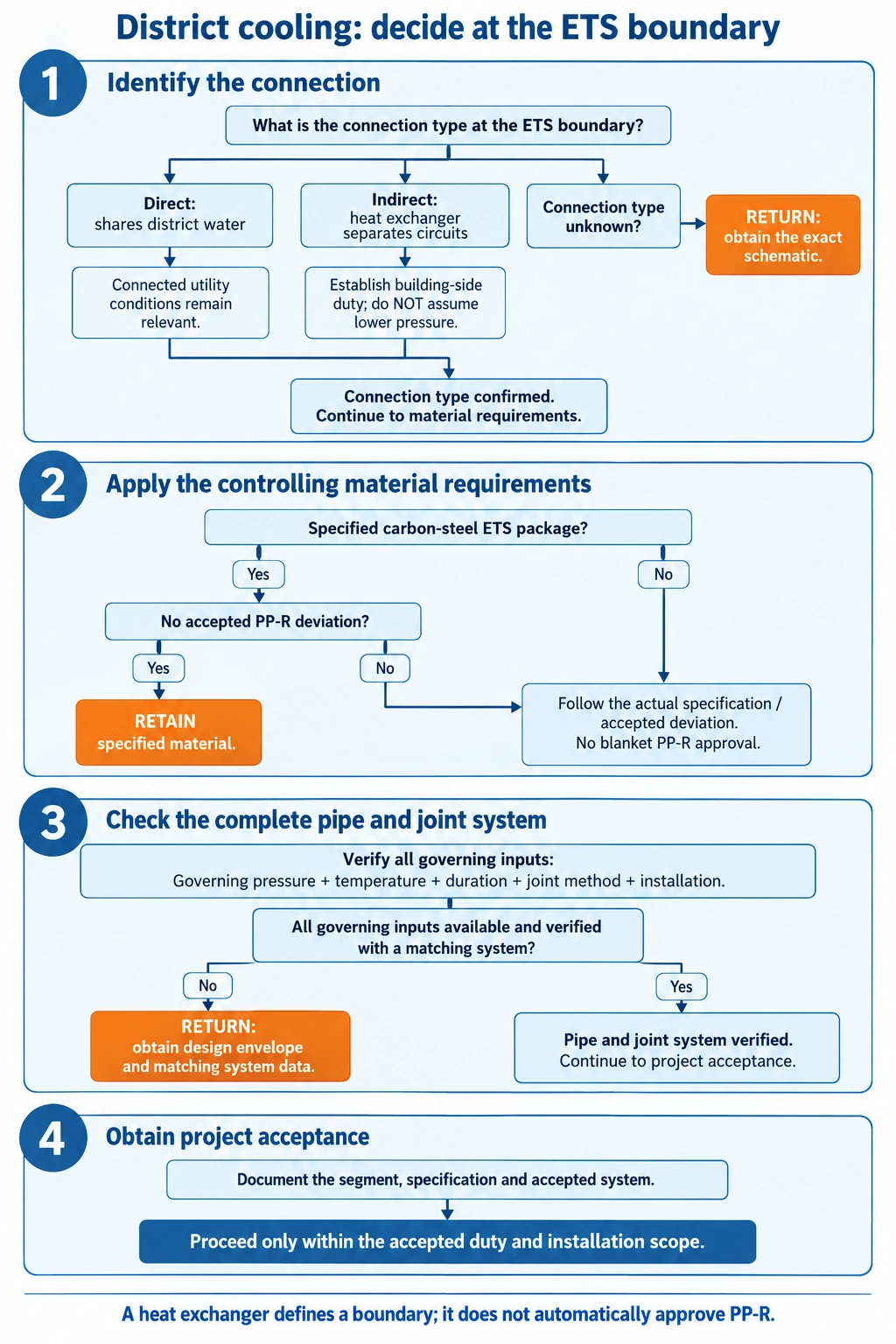
For the last row, the after-input rule is concrete: identify whether the proposed segment shares district water or is separated by a heat exchanger; apply the controlling material requirements for that segment; compare the complete offered pipe/joint system against its established duty; then obtain the required project acceptance. If the circuit is direct, the connected utility conditions remain relevant. If it is indirect, the separate building duty must still be established rather than assumed.
Source and scope
- Identify whether the proposed segment shares district water or is separated by a heat exchanger.
- Apply the controlling material requirements for that segment.
- Compare the complete offered pipe/joint system against its established duty.
- Obtain the required project acceptance.
The chiller-plant primary/secondary-loop guide concerns pump circuits and a decoupler within a chilled-water plant. That hydraulic arrangement is a different question from the district utility/building interface described here. The PP-R chilled-water application guide addresses a particular product-range screening task; its sizes should not be imported into this connection decision.
IFAN ULTRA’s PP-R product series can support a separate enquiry about an actual offered range. District-project references, operator acceptance, pre-insulated availability and project-specific certifications are not verified by this article. Keep those supply questions distinct from the public engineering examples.
Source and scope
Conclusão
PP-R is a candidate to evaluate for a defined segment and a defined complete system. The direct or indirect ETS drawing establishes the water-circuit boundary; the applicable specification establishes which materials or accepted alternatives can be considered.
Evaluate the whole offered package against its own duty and installed environment. A heat exchanger, a product standard and a buried-system catalogue each supply a different part of the decision; none alone approves a generic district-cooling substitution.
Frequently Asked Questions
Can I choose a PP-R PN class from the chilled-water temperature alone?
No; establish the circuit’s full pressure and temperature envelope, then check the complete pipe-and-joint data. This guide selects no generic PN class.
Can a pipe-standard certificate justify replacing specified steel?
No; the proposed alternative also needs project-specific acceptance for that segment. South Energy’s cited ETS package specifies carbon steel.
Can bare PP-R be treated as the buried pre-insulated system shown?
No; the catalogue example includes the carrier, insulation and protective jacket, with installed joint details still to check. It establishes neither IFAN supply nor acceptance for your project.









 English
 Español
 Français
 Português do Brasil