
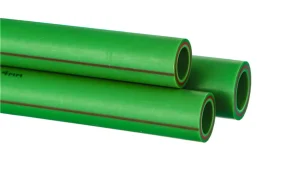
Treat a redundant capped branch and a needed but rarely used outlet differently. Plan removal of a genuine blind end at its connection to the active system; retain a necessary outlet only under the building’s documented water-management programme. If you cannot establish what else the branch supplies, trace it before deciding. A short PP-R stub is not proof of safety.
The decision concerns the branch’s function and water movement. A sound-looking cap or a different pipe material cannot establish that the connected layout is appropriate. This guide helps a building owner or facilities team prepare a disposition for competent review. It gives no cutting, isolation, fusion or disinfection procedure.
Key Takeaways
- A capped redundant spur and an outlet still needed occasionally call for different decisions.
- Define the physical arrangement; the term “dead leg” alone can hide whether an outlet exists.
- A suspected shared feed must be traced before it is treated as redundant.
- UK HSE guidance separates removing dead and blind ends from managing infrequently used outlets.
- A flushing entry needs an accountable programme; it is not evidence that a blind branch has been removed.
- No universal safe stub length or PP-R safety guarantee is established here.
This Microbiology Society talk is explicitly about dead legs and shower heads. It offers neutral background on the branch-use question; it does not approve a PP-R product or prescribe a site-specific control programme.
 Play: Professor Nick Phin: 'Legionnaires' disease – dead legs and shower heads'

Microbiology Society · Open original video on YouTube
An unused outlet and an abandoned blind end are different jobs
Start with what is connected, what is required and what can actually draw water. A removed appliance may leave a branch with no outlet. A guest bathroom may have a working tap that is still needed but rarely used. A pipe visible beside a removed shower may also supply a basin further away. Calling all three “unused” loses the distinction that decides the work.
A real public question about a redundant shower feed describes exactly that uncertainty: the writer asks whether removal is needed while acknowledging that other sinks might join the same pipe. The example uses copper. It is evidence of the layout question, not a technical authority or proof of a PP-R-specific health problem.
| Observed state | What remains to establish | Disposition to develop |
|---|---|---|
| Capped branch serving nothing required | Whole branch is genuinely redundant; active connection is identified | Competent removal plan at the active connection |
| Working outlet still needed occasionally | Purpose, actual use and a workable control arrangement | Managed retention within the building programme |
| Connections or users uncertain | What else the branch supplies | Trace first; hold the removal decision |
These are decision states, not interchangeable descriptions of risk. The table does not rank infection probability. A site assessment must consider the actual system and its users; the visible end of a pipe cannot supply that information.
Why capping the far end leaves the question open
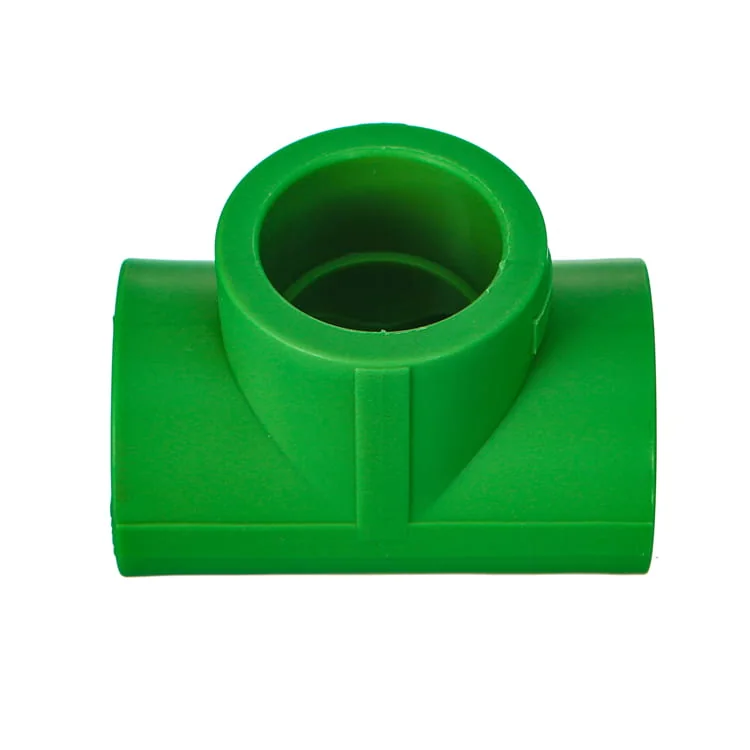
A cap stops discharge at the end. It does not, by itself, remove the connected length of pipe between that cap and the active supply. If the branch has no outlet, ordinary use elsewhere is not a deliberate draw through that branch. A leak-tight termination and a suitable water-system layout therefore answer different questions.
In its hot and cold water systems guidance, the UK Health and Safety Executive advises avoiding stagnation and unnecessary pipe runs, removing dead and blind ends, and managing low-use outlets. Use that distinction to define the proposed scope: identify the active connection and redundant length rather than asking only where a new cap would fit.
The competent contractor must establish the actual work, including what can be isolated, what remains in service and how the modified system will be returned to use. Those are project-specific responsibilities. This article does not tell an unqualified person to open a pressurised system or apply a generic PP-R jointing sequence.
Record the remaining arrangement after the work. “Outlet capped” is not the same completion description as “redundant branch removed at the identified active connection.” Drawings and handover notes should make that difference visible to the next person who surveys the system.
Keep a needed outlet only with a workable management plan
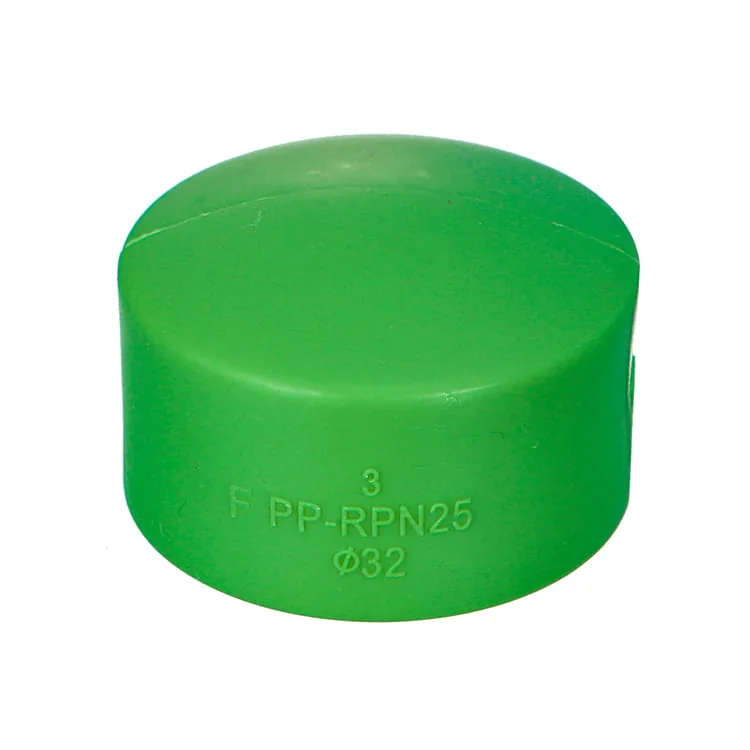
Occasional use is not automatically a reason to remove a genuinely required outlet. It does mean that intended use and management must agree. An outlet retained for a real operational purpose needs an owner and a programme that will actually be followed when normal use is insufficient.
The HSE page specifies regular weekly flushing for infrequently used outlets and says flushing and purging should avoid aerosol release. That is UK guidance for the stated system context. It is not a universal flush duration, an instruction to improvise a purge, or proof that a particular outlet is safe. Local requirements and the competent site risk assessment govern the implemented control arrangements.
Make the retained-outlet record specific: identify the outlet and branch, explain why it is needed, name who carries out and checks the programme, and link to the relevant control scheme and completion records. Include a review trigger, such as a change in use or failure to carry out the prescribed controls. Do not invent a frequency or temperature rule in this register; use the assessed programme applicable to that system.
A capped blind branch has no working outlet through which that programme can simply be performed. Flushing a nearby tap does not establish that the stagnant spur was exchanged. Nor does a single recorded flush settle whether an outlet should remain indefinitely. Retention is an ongoing management decision.
Trace the branch before anyone removes it
Uncertainty changes the immediate action. If the supposedly abandoned line might feed another fixture, do not label it redundant from a photograph or the position of a visible cap. Ask a competent contractor to establish its connections and reconcile the findings with the current drawing and the people using the building.
Record the uncertainty precisely. “Possibly shared with basin” is useful; “probably unused” is not a release to remove it. The missing information matters because the same visible pipe could be a redundant spur, part of an active shared supply, or a branch with a necessary low-use outlet. Each leads to a different disposition.
Once tracing establishes the arrangement, return to the classification. A branch serving another necessary outlet belongs in a continued-service review. A separate spur serving nothing required can enter the removal plan. Keep the identified users and the revised drawing with the decision, so future fixture changes do not recreate the same uncertainty.
Why a short stub is not a safety certificate
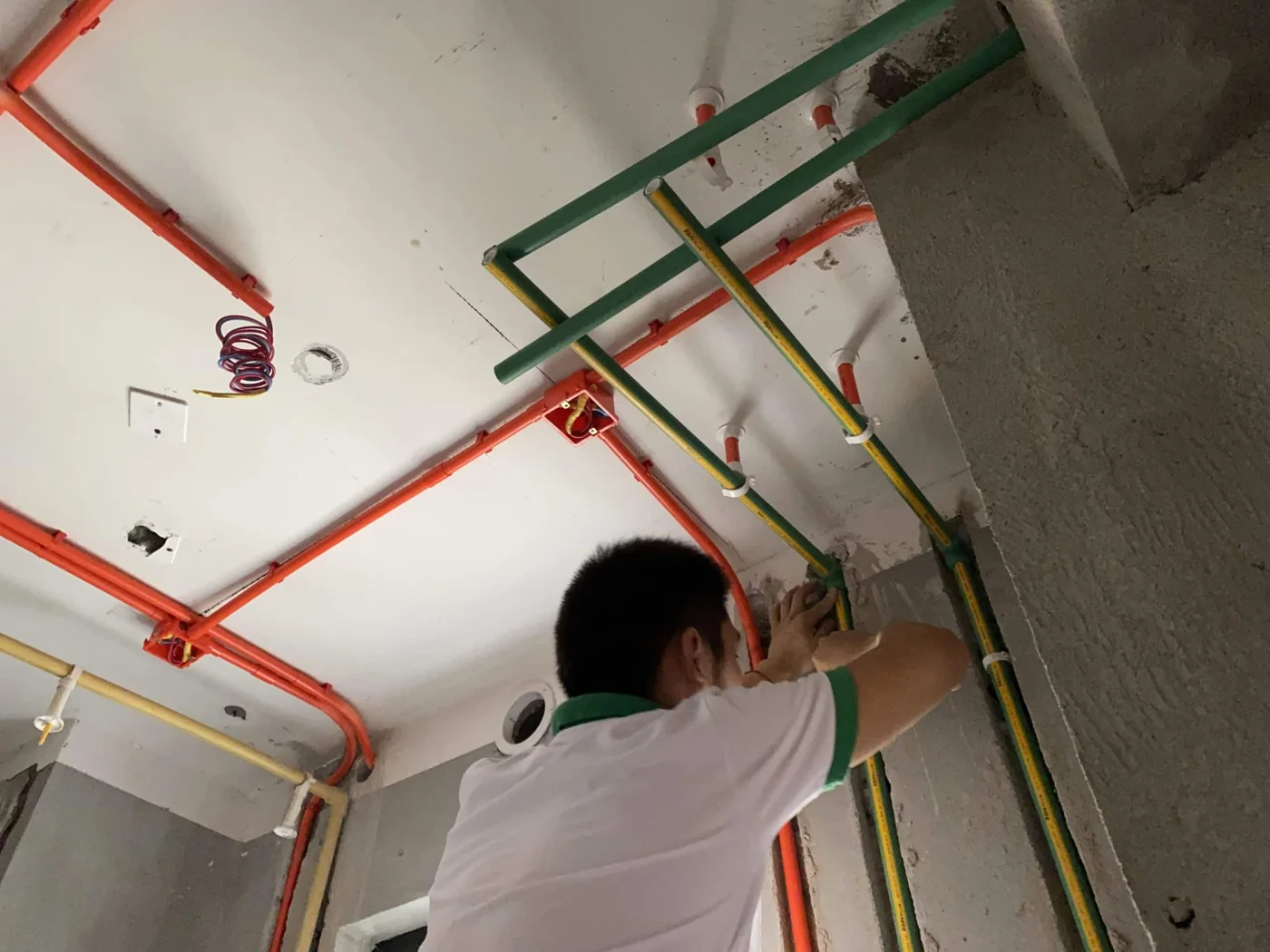
The HSE page cited here does not establish a universal maximum stub length that makes a branch safe. That is a bounded observation about this source, not a claim that no jurisdiction or system specification ever gives a dimension. Check the requirements that actually apply to the building.
Do not borrow a length-to-diameter ratio from a laboratory, hygienic-process or pharmaceutical design and treat it as a building-water health verdict. Such a ratio concerns a particular design context. It cannot replace identifying a redundant feed, understanding outlet use or following the building’s controls.
PP-R also does not answer the branch-use question. Selecting a compatible pipe and fitting system matters when a competent designer specifies replacement work, but the polymer name cannot prove effective turnover in an unused branch. Likewise, a pressure test addresses its stated test task; it does not by itself establish the operating water-management outcome.
Keep those tasks separate from the PP-R installation method statement and material compatibility with disinfectant exposure. Neither a generic jointing method nor a chemical-resistance claim substitutes for a branch disposition.
Turn the survey into a branch action register
Consider three illustrative entries, not records of an actual building. A removed appliance leaves a confirmed capped spur serving no other fixture: assign a competent removal scope at the active connection. A guest outlet remains genuinely required: assign managed retention, a programme owner and its control-record reference. A former shower feed may also serve a basin: assign tracing and keep removal on hold. Different inputs produce different actions without guessing a safe stub length.
For each entry, keep the branch identifier and drawing reference, actual connected uses, reason for retention or removal, evidence of tracing, responsible person, proposed disposition and completion evidence. Where a required input is missing, state the question and who will resolve it. Close the entry only against the agreed work or management evidence, not merely a new cap or a procurement receipt.
If the approved work needs components, use the Review PP-R categories before requesting system compatibility to identify the relevant product family, then submit the actual system identity, size, material, duty, country and approved drawing for compatibility and availability confirmation. No particular retrofit fitting, health certification, stock, MOQ, installation service or delivery date is confirmed here. Product selection follows the accepted scope; it does not decide whether a branch is redundant.
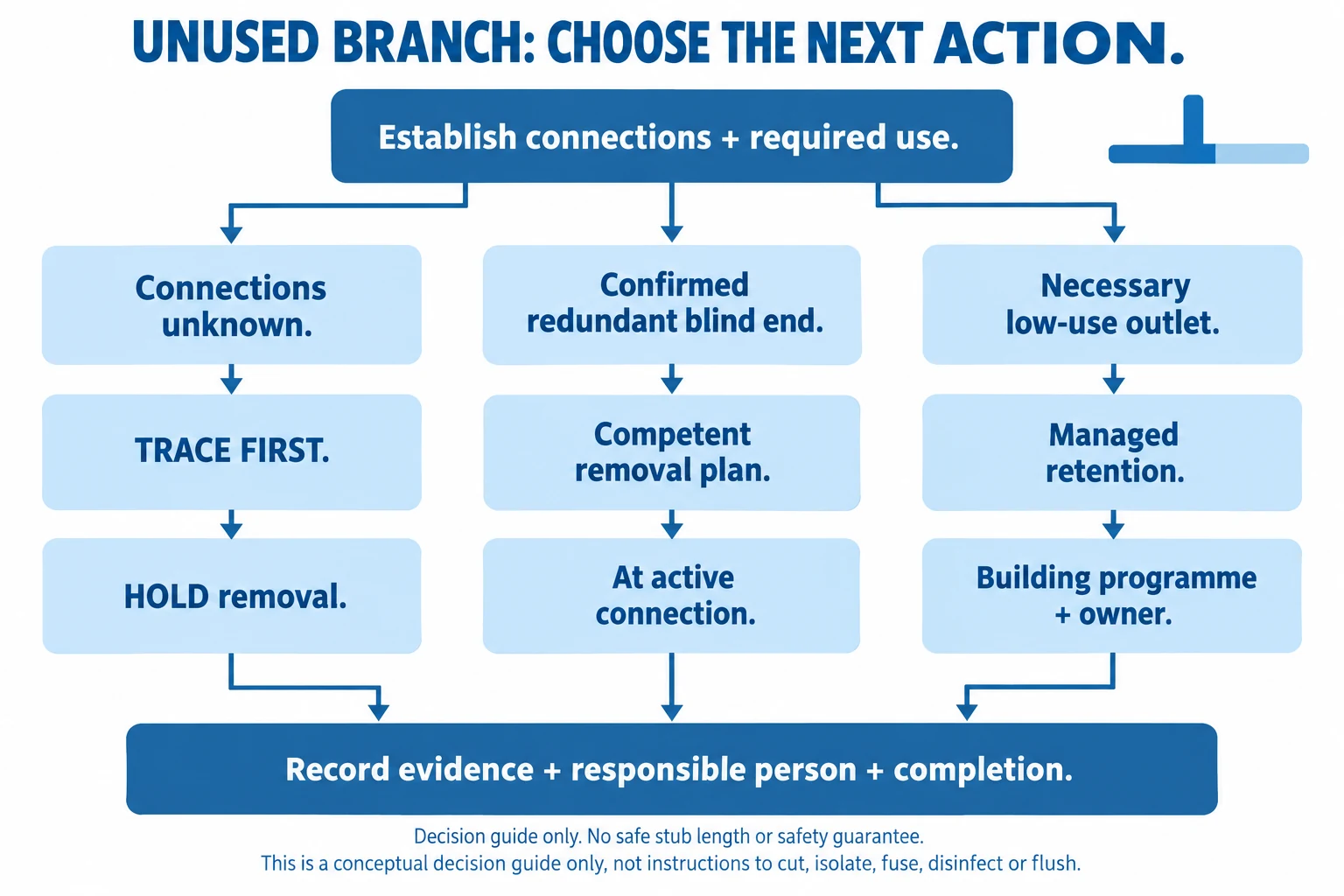
- Establish the actual connections and required use.
- If connections are unknown, trace first and hold removal.
- For a confirmed redundant blind end, develop a competent removal plan at the active connection.
- For a necessary low-use outlet, develop managed retention under the building programme with an owner.
- Record evidence, responsible person and completion; do not infer a safe stub length or safety guarantee.
Conclusion
Resolve the physical state first. A redundant blind branch needs a competent removal plan, a necessary low-use outlet needs accountable management, and an untraced connection needs investigation before either decision. Keep material selection and jointing in their proper supporting role. The finished result is a documented branch disposition, not a promise that a chosen length or one flush makes the system safe.
Frequently Asked Questions
Does replacing copper with PP-R remove a dead-leg problem?
No. A material change does not establish that a redundant branch has been removed or that a retained outlet is properly managed.
Can a necessary infrequently used outlet stay?
Potentially, under the applicable assessed control arrangements. Its purpose, responsible owner and management records must be clear.
Is weekly flushing a universal guarantee?
No. Weekly flushing appears in the cited UK HSE guidance for infrequently used outlets. It supplies neither a universal duration nor a safety guarantee for a particular branch.
What if the hidden branch might feed another tap?
Hold the removal decision and arrange competent tracing. Establishing the connected users determines which disposition is appropriate.









 English
 Español
 Français
 Português do Brasil