

Matching bolt holes do not prove disc clearance. Compare the exact butterfly valve’s clearance requirement with the PPR adapter’s bore profile, then follow both makers’ assembly and full-travel checks. Hold missing geometry, unresolved instructions or binding; do not force the disc or improvise a spacer.
Picture an unpressurized bench assembly whose bolts all enter correctly, but whose valve stops before it reaches fully open. The bolt pattern has answered one question. The rotating disc has exposed another. This is a conceptual example, not an IFAN test or a report from a customer installation.
Key Takeaways
- Check bolting compatibility and internal disc clearance separately.
- Identify the exact valve, adapter and drawing revision before comparing geometry.
- The adapter mouth alone may not describe the region through which the disc moves.
- Use the maker’s preassembly and installation checks; retain the final full-travel result.
- Do not turn another manufacturer’s spacer or modified-adapter arrangement into a universal rule.
- A clearance result does not establish pressure integrity, sealing performance or commissioning acceptance.
Bolt holes line up before the disc is proved to clear
The backing ring provides the bolting interface. The adapter provides the internal opening and a sealing face. Matching the first does not describe everything the valve disc encounters as it rotates. Keep these interfaces separate in the purchase review instead of treating a shared nominal size as a complete compatibility statement.
The Plastics Pipe Institute’s TN-71, Flanges and Flange Adapters for Polypropylene (PP-R & PP-RCT) Piping Systems, 2024 edition, expressly addresses interference between a metal butterfly-valve disc and the smaller bore of a PP flange adapter. Its discussion concerns a physical opening as well as a bolted connection. It is guidance for the PP systems within its stated scope, rather than certification of an offered IFAN pairing.
For general flange terminology, use the existing flange types guide. The task here is narrower: determine whether a particular valve can complete its movement inside the proposed adapter and assembly.

Compare the swept region with the adapter bore
Begin with the valve manufacturer’s clearance drawing or specified minimum connecting-bore requirement. Then identify the adapter’s internal profile in the matching model drawing. The comparison must cover the region the disc actually enters, not just a convenient diameter at the face. Ask the manufacturers to reconcile the drawings if the required envelope cannot be established from the supplied information.
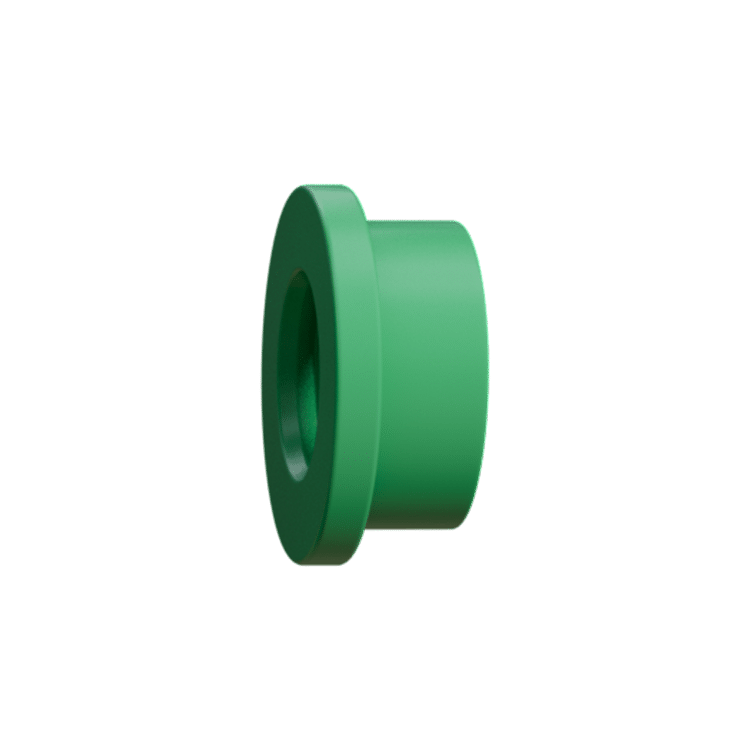
A conceptual counterexample makes this useful. Suppose an adapter has a wide entrance followed by a narrower neck. Seeing room around the disc at the entrance does not prove clearance farther into that neck during rotation. Conversely, a purpose-designed bevel may provide the needed space without a separate spacer. Neither conclusion follows from nominal pipe size or the appearance of the mouth alone.
| Available evidence | Useful result | What remains open? |
|---|---|---|
| Matching drilling and connection designation | Bolting interface identified | Internal clearance and sealing instructions |
| Valve clearance requirement and adapter profile | Documented geometric comparison | Actual positioned assembly and full travel |
| Full travel under applicable assembly instructions | Observed clearance for the recorded assembly | Other specified testing and project acceptance |
Basis: PPI TN-71 sections 3, 5 and 9.3. The distinctions are a selection aid, not a universal clearance dimension or an approval certificate.
If the adapter drawing gives only outside dimensions, the missing input is its internal profile through the swept region. If the valve drawing does not establish the required clearance, that requirement is missing instead. Hold the pairing until the relevant manufacturer supplies or confirms the input; then repeat the comparison against the same model revisions.

Check the proposed pair before committing the pipeline
Aquatherm’s Flanges and Butterfly Valve Installation Guidelines call for a bench dry fit, with the proposed adapter and valve checked for interference. That named-system procedure illustrates why a drawing check and an assembly check belong together. Follow the applicable instructions for the products actually being used.
Keep the full-travel checks visible in the work plan. PPI TN-71 addresses preassembly, a further check after the valve is positioned between the flanges, and full travel after the specified tightening procedure. These stages can reveal a problem that was absent in a loosely held arrangement. A preassembly result cannot stand in for the later positioned result.
If movement binds, stop the acceptance sequence. Determine whether centering or the documented assembly arrangement needs correction under the manufacturer’s instructions. Unresolved interference requires a supported alternative or clarification from the product manufacturers. Do not force the handle, use additional actuator force to overcome contact, or treat tightening as a way to create missing space.
This is a selection and unpressurized assembly discussion. It is not an instruction to loosen a live flange joint. Free travel is also separate from the specified leak testing, pressure suitability and commissioning process.
A spacer is a product decision, not a universal fix
PPI describes both shaped adapter openings and spacer arrangements. That establishes possible design approaches, not a blanket instruction to add a ring. A proposed change must be suitable for the exact valve, adapter and joint, including the sealing arrangement and applicable assembly instructions.
Manufacturer information also changes over time. The returned Aquatherm 2024 installer-manual passage states that its flange adapters can be used directly with ANSI butterfly valves without a spacer, while noting that some valve tolerances are tight. That is a named-system statement; it does not establish that every PP-R adapter works with every butterfly valve. Older advice about modified adapters is not a substitute for the current product’s documentation.
If someone proposes a spacer, machining or another adapter revision, obtain the supported model and joint arrangement from the relevant manufacturers. Do not convert a general drawing into permission to grind a supplied part. PPI notes that changing the adapter opening can affect sealing contact area; solving disc clearance does not eliminate the need to resolve the rest of the joint.
Record the pairing and the result
Keep one pairing record with the valve maker, model and revision; adapter maker, model and revision; pipe size and wall series; valve clearance requirement; and adapter internal profile. Record the applicable gasket or valve-seal arrangement, joining and bolting instructions as separate fields. Missing instructions remain pending rather than being filled with another brand’s values.
Use this sequence for the clearance decision:
- Identify the exact valve, adapter, drawing revisions and applicable instructions; hold missing inputs until the relevant manufacturer supplies or confirms them.
- Check the bolting interface separately from the required internal clearance.
- Compare the valve’s required swept region with the adapter’s internal profile. Hold known interference or unresolved clearance; obtain a supported alternative or clarification before proceeding.
- Follow the manufacturers’ unpressurized preassembly and full-travel checks. If movement binds, stop and resolve the supported assembly or pairing.
- Position and tighten according to the applicable instructions, repeating full travel at each stage. Binding after positioning or tightening also means stop.
- Record clearance only for the exact components and arrangement checked. Keep pressure, sealing and commissioning acceptance separate; reopen the record if a component or arrangement changes.
The result may be clearance observed for this recorded assembly or hold: adapter profile, required clearance or binding unresolved. It is not an unrestricted approval of the installation.
| Recorded finding | Decision | Next step |
|---|---|---|
| Geometry or instruction missing | HOLD | Obtain the missing exact-model input |
| Disc binds during the applicable check | HOLD | Resolve the supported assembly or pairing |
| Full travel observed for the recorded assembly | Record the clearance result | Retain separate pressure, sealing and project acceptance checks |
For a contractor preparing an enquiry, the PPR product-series information provides range context. It does not establish a compatible adapter for your valve. Send the country, service, pipe dimensions, both component identities, drawings, proposed sealing arrangement and quantity when you Ask about the proposed PPR adapter specification. Exact availability, technical acceptance and commercial terms require confirmation.
Conclusion
Keep drilling, internal geometry and full travel as separate checks. If any required input is missing or the disc binds, the pairing remains unresolved. Once clearance is documented for the actual components and arrangement, retain that result alongside the remaining joint and project acceptance requirements.
Frequently asked questions
Does a matching bolt pattern prove disc clearance?
No. It identifies the bolting interface, while the disc moves inside the adapter opening. Check the actual clearance requirement and internal profile.
Must every PPR adapter have an additional spacer?
No universal requirement is established here. Use the exact manufacturers’ current documents; a shaped opening or a named compatible adapter may already accommodate the disc.
Can the installer grind the adapter until the valve opens?
Do not infer that permission from general guidance. Obtain a supported solution from the relevant manufacturers, including its sealing and assembly conditions.
Does passing the travel check complete commissioning?
No. It records movement clearance for the identified assembly. Pressure suitability, sealing tests and the remaining specified acceptance requirements are separate.



 English
 Español
 Français
 Português do Brasil