
I once worked with an architect aiming for LEED Platinum, and we almost lost points because of the piping material. That experience taught me that every component, even hidden pipes, matters in green building.
Piping plays a critical but often overlooked role in green building certifications like LEED, BREEAM, or WELL. It contributes through material transparency documentation, water efficiency from leak-free systems, use of recycled and recyclable materials, responsible sourcing, and even supporting net-zero energy goals through improved thermal performance. Choosing the right piping can earn valuable certification points.
Let’s explore how piping decisions directly impact your project’s green building score.
How Do Material Certifications Like Declare or EPD Contribute to LEED Points?
I’ve seen project teams scramble at the last minute trying to find material documentation. It’s stressful and completely avoidable.
Material certifications like Environmental Product Declarations (EPDs) and Declare labels contribute to LEED points by providing verified data on a product’s life cycle impacts and ingredient transparency. In the LEED v4 and v4.1 rating systems, these documents directly contribute to credits in the “Materials and Resources” category, specifically for Environmental Product Declarations and Sourcing of Raw Materials.
Understanding the Documentation Requirements
Green building certifications require proof. You can’t just claim your product is sustainable; you need third-party verification. This is where Declare and EPD come in.
What is an EPD?
An Environmental Product Declaration is a standardized document that tells you exactly what a product is made of and how it affects the environment throughout its life. Think of it as a nutrition label, but for a building product. It covers:
- Global warming potential
- Ozone depletion potential
- Water usage during manufacturing
- Material composition
For LEED, using products with EPDs can earn points in the Building Product Disclosure and Optimization – Environmental Product Declarations credit. You get points simply for having products with EPDs, and more points for using products that show better environmental performance compared to industry averages.
What is a Declare Label?
The Declare label comes from the International Living Future Institute. It’s simpler than an EPD but focuses on ingredient transparency. A Declare label tells you:
- Where every ingredient comes from
- What it’s made of
- Where the product goes at the end of its life
Declare labels use a simple traffic light system: Red (contains something bad), Yellow (ingredients known but some concerns), or Green (all ingredients declared and safe). For LEED, Declare labels help with the Building Product Disclosure and Optimization – Material Ingredients credit.
How These Documents Earn LEED Points
The table below shows exactly how these certifications contribute to LEED v4:
| LEED Credit Category | What You Need | Points Possible |
|---|---|---|
| EPD Credit | Use at least 20 different permanently installed products from 5 manufacturers with EPDs. | 1 point |
| EPD Optimization | Use at least 10 products from 3 manufacturers that have industry-leading EPDs (showing lower impact). | 1 point |
| Material Ingredients Credit | Use at least 20 different products from 5 manufacturers that have Declare labels or Health Product Declarations. | 1 point |
| Sourcing of Raw Materials | Use products with Declare labels or EPDs that show responsible sourcing (like recycled content). | Up to 2 points |
For a piping manufacturer like IFAN, having EPDs and Declare labels available means we help our clients earn these points without extra work. We provide the documentation upfront, so project teams can focus on design.
What Role Do Water-Efficient and Leak-Free Systems Play in Certification?
Water is becoming our most precious resource. I’ve watched buildings lose certification points because of simple water waste from leaky pipes.
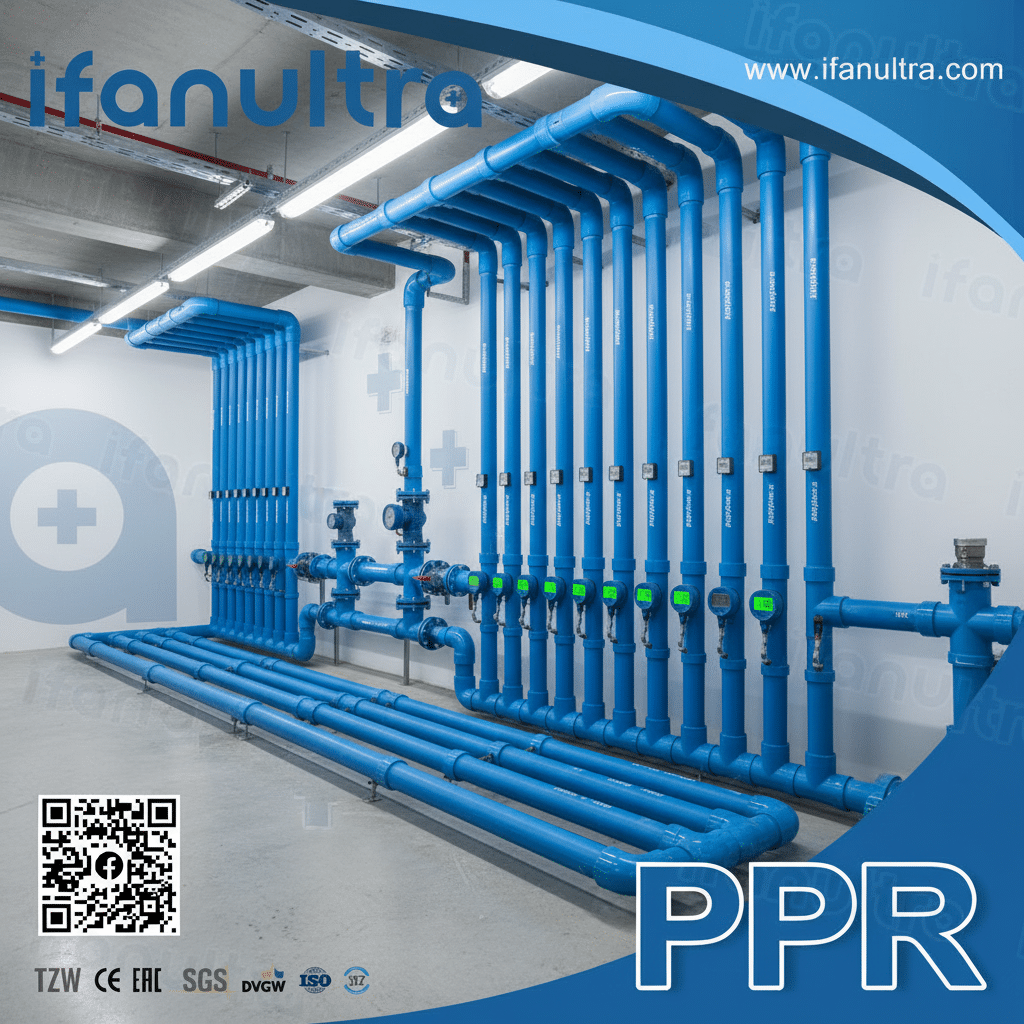
Water-efficient and leak-free systems play a direct role in green certification by reducing overall building water consumption. In LEED, this contributes to the “Indoor Water Use Reduction” and “Outdoor Water Use Reduction” credits. A leak-free system ensures that the water efficiency calculated during design actually happens in the real building. Leaks can easily double a building’s actual water use compared to projections.
The Water Efficiency Credits Explained
Let’s look at how water performance ties directly to certification scores.
Indoor Water Use Reduction (LEED)
This credit rewards projects that use less water than a baseline building. The baseline assumes standard fixtures and no leaks. To earn points, you need:
- High-efficiency fixtures
- AND a distribution system that doesn’t waste water
Here’s what many people miss: You can install the best low-flow faucets in the world, but if your hot water recirculation system leaks or takes forever to deliver hot water, you’re wasting water while users wait. A well-designed PPR piping system with proper insulation delivers hot water faster, reducing the water sent down the drain while waiting for temperature.
The Leak Factor
A study by the American Water Works Association found that typical buildings lose 6-10% of their water to leaks. That’s water you’re paying for but not using. In green building certification, you calculate water use based on design. But if your system leaks, your actual performance falls short.
PPR piping systems help here because:
- Heat-fused joints eliminate leak points completely
- The material doesn’t corrode, so leaks don’t develop over time
- Proper installation means the system performs as designed for 50+ years
Real Impact on Certification Points
The table below shows how much water efficiency matters:
| Building Type | Baseline Water Use | With Efficient Fixtures | With Efficient Fixtures + Leak-Free Pipes | LEED Points Earned |
|---|---|---|---|---|
| Office Building | 100% | 65% (35% reduction) | 60% (40% reduction) | 8-10 points |
| Hotel | 100% | 70% (30% reduction) | 63% (37% reduction) | 7-9 points |
| Residential Tower | 100% | 60% (40% reduction) | 54% (46% reduction) | 9-11 points |
The difference between “efficient fixtures” and “efficient fixtures + leak-free pipes” can mean an extra 1-2 LEED points. In a close certification race, those points matter.
How Does Material Recyclability and Responsible Sourcing Impact Green Ratings?
I’ve had clients ask, “What happens to this pipe in 50 years when we renovate?” That question deserves an honest answer.
Material recyclability and responsible sourcing directly impact green ratings through credits like “Building Life-Cycle Impact Reduction” and “Sourcing of Raw Materials” in LEED. Using piping materials that contain recycled content, can be recycled at end-of-life, and come from responsibly managed sources adds certification points. Additionally, selecting materials that avoid red-list chemicals contributes to healthier building certifications like the Living Building Challenge.
The Circular Economy in Piping
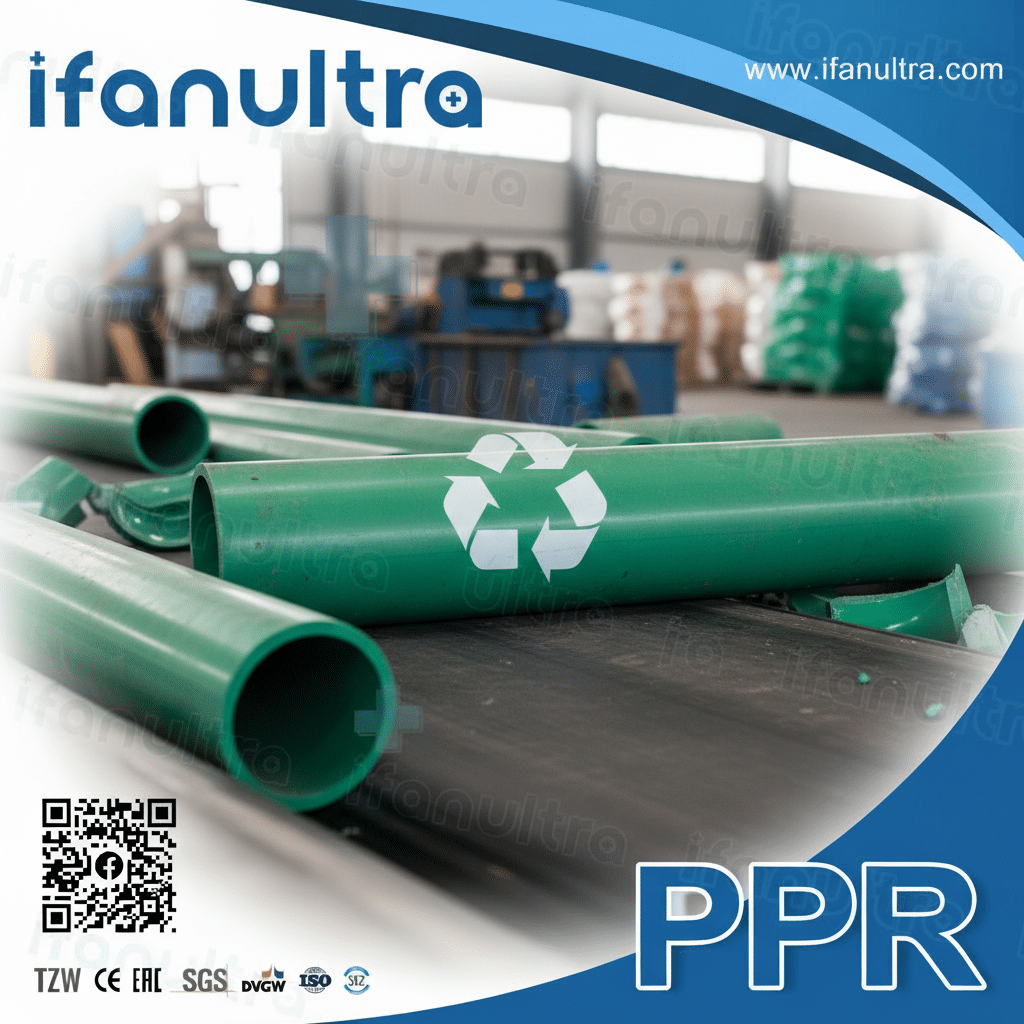
Green building certifications increasingly reward products that fit into a circular economy. This means materials that don’t end up in landfills.
Recycled Content
Many piping materials can incorporate recycled content without sacrificing performance. For plastic pipes like PPR, recycled material must come from clean, post-industrial sources to maintain quality. Using recycled content contributes to LEED’s Sourcing of Raw Materials credit.
The calculation works like this:
- If your piping has 20% recycled content, that percentage counts toward the building’s total recycled material value.
- LEED requires 10-20% recycled content (post-consumer + half of pre-consumer) for one point.
- Higher percentages earn more points.
End-of-Life Recyclability
Green certifications also consider what happens when the building eventually comes down. Materials that can be recycled at end-of-life are valued more highly than those that go to landfill.
PPR pipe offers good recyclability:
- It’s thermoplastic, meaning it can be melted and reformed
- Clean PPR scrap becomes new piping or other plastic products
- No toxic byproducts during recycling
Responsible Sourcing Requirements
The table below shows what responsible sourcing means for different piping materials:
| Matériau | Responsible Sourcing Considerations | Certification Impact |
|---|---|---|
| PPR Plastic | Raw material (polypropylene) sourcing; manufacturing energy use; worker safety | Can earn points with EPD and responsible sourcing documentation |
| Copper | Mining impacts; energy-intensive processing; potential for recycled content | High recycled content potential, but mining concerns |
| PVC | Chlorine production concerns; plasticizer additives; dioxin risks during lifecycle | Faces challenges in green certifications due to toxicity concerns |
For PPR from IFAN, responsible sourcing means:
- Virgin material from certified suppliers with environmental management systems
- Manufacturing with energy-efficient processes
- No heavy metal stabilizers or phthalates
- Full transparency through available EPDs
Avoiding Red-List Chemicals
The Living Building Challenge’s Red List includes chemicals that are harmful to humans and the environment. PPR piping naturally avoids many of these:
- No PVC, so no chlorine or dioxin concerns
- No lead or heavy metal stabilizers
- No phthalate plasticizers
- No halogens
This clean chemistry helps projects pursuing the strictest certification levels.
Can Innovative Piping Systems Contribute to Net-Zero Energy Building Goals?
Net-zero energy sounds like it’s all about solar panels and insulation. But piping plays a bigger role than most people realize.
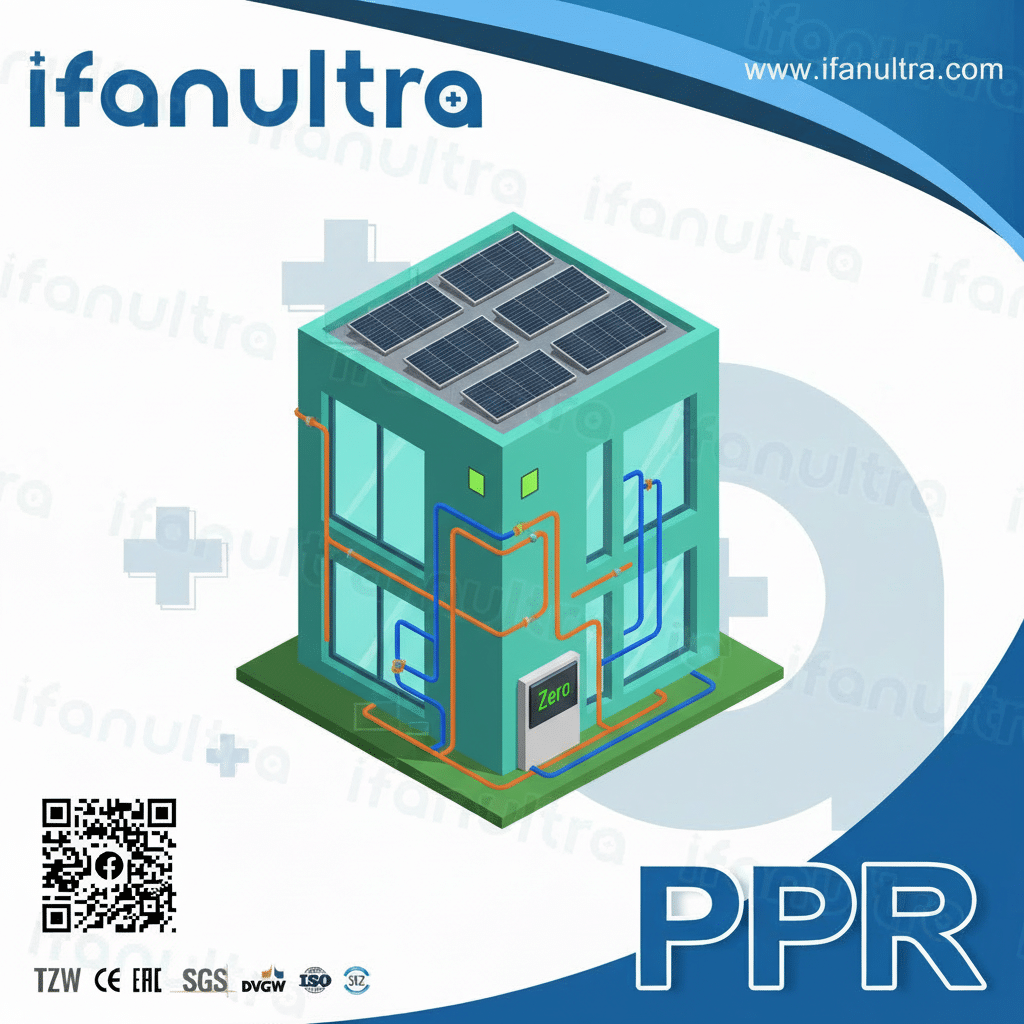
Yes, innovative piping systems can directly contribute to net-zero energy goals through improved thermal performance of distribution systems, enabling ground-source heat pump loops, and reducing embodied carbon compared to traditional materials. Piping that minimizes heat loss in hot water distribution reduces the energy required to maintain water temperature, directly lowering the building’s operational energy use.
Thermal Performance and Energy Savings
In a net-zero energy building, every watt counts. Hot water distribution often represents a surprisingly large energy load.
Heat Loss Matters
Standard copper pipes conduct heat readily. When hot water sits in a copper pipe, it cools quickly, and the heat dissipates into the building structure. In cooling seasons, this adds unwanted heat to the space. In all seasons, it wastes the energy used to heat that water.
PPR pipe has much lower thermal conductivity than metal:
- Copper thermal conductivity: ~400 W/mK
- Steel thermal conductivity: ~50 W/mK
- PPR thermal conductivity: ~0.24 W/mK
This means PPR pipe loses heat about 1600 times slower than copper. For a net-zero building, this difference matters. Less heat loss means:
- Smaller water heater required
- Less energy used to maintain temperature
- Hot water arrives faster (less water wasted waiting)
Insulation Integration
Some innovative piping systems integrate insulation directly. Pre-insulated PPR pipes combine the carrier pipe with factory-applied foam insulation and an outer jacket. This ensures consistent insulation quality and eliminates the thermal bridges that occur with field-applied insulation.
Supporting Renewable Energy Systems
Piping also enables renewable energy systems critical to net-zero buildings:
Ground-Source Heat Pump Loops
Geothermal or ground-source heat pump systems rely on buried piping loops to exchange heat with the ground. These loops must:
- Last 50+ years without corrosion
- Provide excellent heat transfer
- Resist ground chemicals and movement
PPR pipe works well for these applications. Its fusion-welded joints ensure no leaks in buried applications, and the material won’t corrode regardless of soil conditions.
Solar Thermal Systems
Solar hot water systems require piping that can handle high temperatures. Specialized PPR formulations can handle sustained temperatures up to 80°C and peaks up to 95°C, making them suitable for solar thermal applications.
Embodied Carbon Considerations
Net-zero energy isn’t just about operational energy anymore. Green certifications increasingly consider embodied carbon—the carbon emitted during manufacturing, transport, and installation.
The table below compares embodied carbon of different piping materials:
| Pipe Material | Embodied Carbon (kg CO2e per kg) | Lifespan | 50-Year Total Impact |
|---|---|---|---|
| PPR | 1.5 – 2.0 | 50 ans et plus | Lower, as it lasts full building life |
| Copper | 3.0 – 4.0 | 40-50 years | Higher, plus potential replacement |
| PVC | 2.0 – 2.5 | 25-40 years | Medium, but may need replacement |
| Steel | 1.8 – 2.5 | 20-50 years | Variable, corrosion risk |
Choosing PPR for a net-zero project means lower embodied carbon upfront and no need for replacement within the building’s life. This supports both operational and embodied carbon reduction goals.
A Practical Example
Consider a 100-unit apartment building aiming for net-zero energy. Hot water distribution losses might account for 15% of total building energy use. By switching from copper to well-insulated PPR piping, you might reduce those losses by half. That 7.5% overall energy reduction brings the building significantly closer to net-zero, often at lower cost than adding more solar panels.
Conclusion
Piping plays a vital role in green building certifications through material transparency, water efficiency, responsible sourcing, and energy performance. For certified green building projects, choose IFAN’s PPR piping systems with available EPDs, responsible sourcing documentation, and proven performance.









 English
 Español
 Français
 Português do Brasil