

Every supplier’s list of PPR fittings types looks the same until you try to turn it into a purchase order. Then the questions that actually matter surface: which shapes exist at DN110 and which quietly stop at DN40, whether the brass insert is cut to NPT or to BSP taper, and how many of the 95 line items in a catalogue you genuinely need for a first container. A list of names does not answer any of that.
So this guide is built the other way round — from a real published catalogue rather than a generic taxonomy. Every DN range, bolt-hole count and thread designation below was read off the live IFANULTRA product tables on 26 July 2026, and each family is checked against ISO 15874-3, the part of the international standard that actually governs PP fittings. Where the catalogue and the standard disagree, that gap is pointed out rather than smoothed over, because those gaps are exactly where sourcing goes wrong.

Key Takeaways
- ISO 15874-3 recognises exactly four fitting types — socket fusion, electrofusion, mechanical, and fittings with incorporated inserts. Every shape in any catalogue is one of these four.
- The core socket-fusion shapes (coupling, 90° elbow, 45° elbow, tee, end cap) all run 20–125 mm in ten sizes. Nothing in that group goes above 125 mm.
- Electrofusion is the range extender: the IFANULTRA electrofusion coupling is published 20–250 mm, while ISO 15874-3 only tabulates electrofusion socket dimensions up to 160 mm.
- Valves stop early. Ball valves reach 75 mm and stop/globe and check valves stop at 40 mm — well below the 125 mm flow-fitting ceiling.
- ISO 15874-3 cites ISO 228-1 (parallel G) and EN 10226-1 (taper R/Rp) — the BSP family. NPT appears nowhere in its normative references, so an NPT PPR fitting is a market-specific product, not a standard one.
- Split flange rings run to 630 mm and step through 4, 8, 12, 16 and 20 bolt holes — the bolt count changes at 90 mm, 250 mm, 400 mm and 500 mm.
- The real failure mode on a threaded transition is the brass insert rotating inside the plastic body, not the plastic cracking. Once it spins, the fitting is scrap.
How This List Was Built: Criteria and Methodology
Most “types of PPR fittings” articles are assembled by listing whatever shapes the writer can name. That produces a list with no size information, no standard behind it, and no way to tell a mainstream item from a specialty one. The ordering here follows a different rule: families are ranked by how much of a typical PPR order they absorb and how much sourcing risk they carry, and every claim about a size or a thread has to survive two checks before it appears.
The first check is catalogue evidence. A DN range only appears below if it was read from a published dimension table with part numbers in it, not inferred from what a size “should” be. That is why some ranges look asymmetric — the union with a brass nut starts at 32 mm while the PP-R-nut version starts at 20 mm, and no amount of tidying makes those two match. The second check is the standard. Every structural claim about what a fitting type is, or which thread it may carry, is verified against the text of ISO 15874-3, the fittings part of the polypropylene hot-and-cold-water standard.
One consequence is worth stating up front, because it cuts against the grain of most supplier content: there is no standards basis for the common claim that fittings are the weak point of a PPR system. ISO 15874-3 qualifies the fitting material; Part 5 separately qualifies the assembled joint. Injection-moulded fittings are frequently heavier-walled than the pipe they join. When a PPR system fails at a fitting, the cause is almost always the joint — the fusion, the thread, or the bolt torque — not the moulding.
1. The Four Families ISO 15874-3 Actually Recognises
Before the shapes, the categories — because the categories are what determine how a fitting is installed, what tooling a crew needs, and where a range stops. ISO 15874-3 states its scope in one sentence: the standard “is applicable to fittings of the following types: socket fusion fittings, electrofusion fittings, mechanical fittings, fittings with incorporated inserts.” Four types. Every item in every PPR catalogue on earth is one of them, and knowing which one you are looking at tells you more than the shape name does.
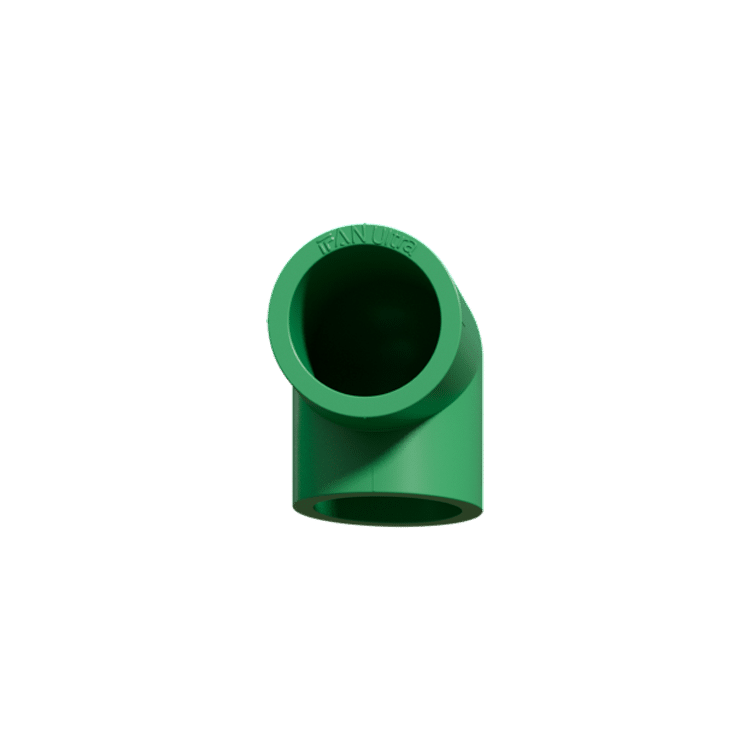
A molded socket elbow. The tapered internal bore is the socket — the feature that puts this fitting in ISO 15874-3’s first family.
Socket fusion is the default and covers the overwhelming majority of any order. A heated tool melts the pipe’s outer surface and the fitting’s inner surface simultaneously; the two are pushed together and the polymer chains interdiffuse into one continuous mass. There is no gasket, no thread and no mechanical seal — which is why a correctly fused PPR joint has no serviceable life separate from the pipe itself.
Electrofusion inverts the heat source: a resistance wire moulded into the fitting body heats the interface when current is applied, so the joint can be made without access for a bulky heating tool. That makes it the answer for repairs, congested plant rooms, and large bores where a socket-fusion iron becomes impractical.
The last two families are where the metal enters. Mechanical fittings clamp onto a seal — a compression ferrule or a union nut — and are demountable by design. Fittings with incorporated inserts are the threaded transitions: a brass or stainless component overmoulded into a polypropylene body so a fused plastic line can terminate in a thread. That fourth family is a small share of the shapes and a large share of the failures, which is why it gets its own section below rather than a line in a table.
| Family | How the joint is made | Demountable? | Where it earns its place |
|---|---|---|---|
| Socket fusion | Heated tool melts both faces; pushed together | No | Everything up to 125 mm — the bulk of any order |
| Electrofusion | Embedded resistance wire heats the interface | No | Repairs, tight spaces, large bore to 250 mm |
| Mécanique | Union nut or compression ferrule onto a seal | Yes | Meters, pumps, anything needing service access |
| Incorporated insert | Brass or stainless overmoulded into the PP body | At the thread only | Every termination at a fixture, valve or metal riser |
2. Flow Fittings: Sockets, Elbows, Tees, Reducers and End Caps
These five shapes are the spine of any PPR order, and they share a single striking property: in the IFANULTRA catalogue they all run exactly the same ten sizes — 20, 25, 32, 40, 50, 63, 75, 90, 110 and 125 mm. The coupling, the 90° elbow, the 45° elbow, the molded socket tee and the end cap terminate at 125 mm and none of them goes further. That symmetry is genuinely useful when you are planning a mix, because it means the flow-fitting portion of a bill of materials can be laid out as one grid with no gaps to check.

A molded socket tee. Equal tees carry one part number per size; reducing tees are indexed by three dimensions, which is where SKU counts multiply.
Sockets and elbows are the simple part. A coupling joins two pipes of the same diameter in a straight run and is the highest-volume single item in almost every order. Elbows come at 90° and 45°, and the choice between them is not cosmetic: a 45° pair through a shallow offset imposes markedly less flow resistance than two 90° turns, which matters on long circulating hot-water loops where pump head is being counted.
Reducing couplings connect two different diameters and, unusually, are indexed by SDR as well as size. The catalogue splits them across three part-number prefixes — 1042, 1043 and 1044 — precisely because the same nominal reduction exists in different wall series. If you are unsure which wall series a project is built in, resolve that before ordering reducers, because Dimensions des tubes PPR and pressure classes are what set it.
Tees are where SKU counts quietly explode, and this is the single most common ordering mistake. An equal tee is one part number per size — ten items covers the range. A reducing tee is indexed by three dimensions (inlet, outlet, branch), so the number of theoretically valid combinations runs into the hundreds.
Buyers who write “assorted tees” on an enquiry and expect a clean quote are usually asking for something no manufacturer stocks in full. The practical approach is to specify reducing tees by the four or five branch combinations your actual drawings use, and treat the rest as made-to-order. End caps close a run, and their real job is temporary: capping a riser so a floor can be pressure-tested before the rest of the building is piped.
| Fitting | Published DN range | Sizes | Part prefix |
|---|---|---|---|
| Coupling (socket) | 20–125 mm | 10 | 1040 |
| Elbow 90° / 45° (molded socket) | 20–125 mm | 10 each | 1080 |
| Tee (molded socket) | 20–125 mm | 10 | 1060 |
| End cap (socket) | 20–125 mm | 10 | 1020 |
| Reducing coupling | to 160→110 mm | by SDR | 1042/1043/1044 |
3. Electrofusion: How the Range Gets Past 125 mm
This is the section that changes how a large-bore project gets specified, and it contains the one number in this article that sits outside the standard. Socket fusion runs out at 125 mm. Above that, a PPR system continues by butt fusion or electrofusion — and the published electrofusion coupling range runs 20 to 250 mm across thirteen sizes: 20, 25, 32, 40, 50, 63, 75, 90, 110, 125, 160, 200 and 250 mm.
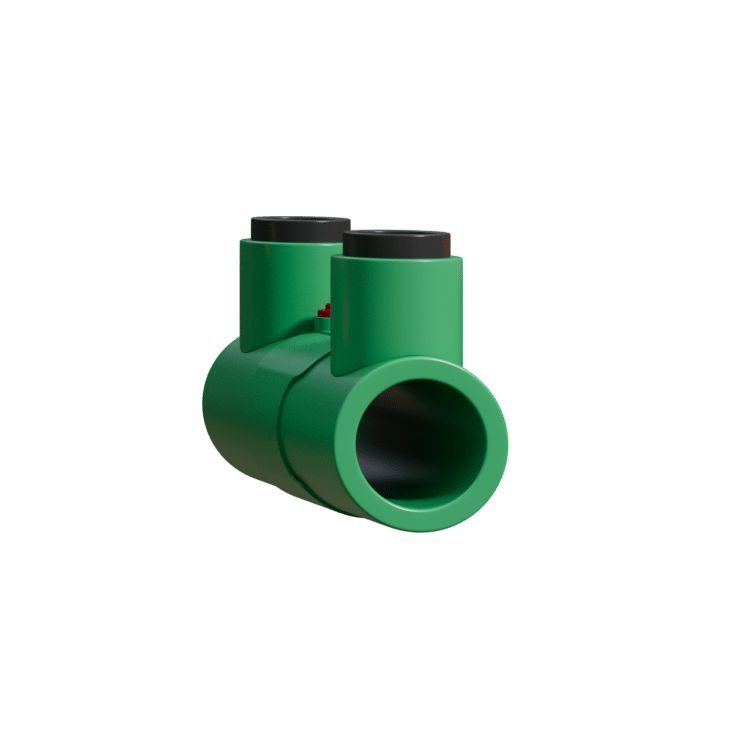
An electrofusion coupling. The two raised terminals on top are where the welding unit clips on — the heat comes from inside the fitting rather than from an external iron.
Compare that against the standard and a gap appears. The foreword to the second edition of ISO 15874-3 records that “the socket dimensions for electrofusion fittings have been extended to 160 mm.” That is the ceiling of the ISO dimensional table. A 200 mm or 250 mm electrofusion coupling is manufacturer-dimensioned, not ISO-dimensioned — the material and performance requirements of the standard still apply, but the socket geometry is the maker’s own.
For a specifier this has a concrete consequence: at 200 mm and above, cross-brand interchangeability stops being a reasonable assumption, and a repair coupling ordered from a second supplier three years later may simply not fit. Buy those two sizes from the same source as the pipe, and keep spares.
The other reason to reach for electrofusion has nothing to do with diameter. A socket-fusion joint needs enough clear space around the pipe to bring in a heating iron and then push two components together axially. In a retrofit — a ceiling void with a live line, a plant room where the pipe is already clipped to a wall — that clearance does not exist.
An electrofusion coupling slides over the prepared ends and is energised in place, which is why it is the standard repair method regardless of size. Stocking a handful of electrofusion couplings in your two highest-volume diameters is cheap insurance for exactly the day a contractor damages a line that cannot be cut back.
4. Threaded Transition Fittings: Where PPR Meets Metal
Every PPR system eventually has to terminate at something that is not PPR — a mixer tap, a water heater, a brass isolating valve, a steel riser. That is the job of the incorporated-insert family, and it is the part of the catalogue where a sourcing error costs the most, because a thread mismatch is not discovered until the fitting is already fused into a wall.
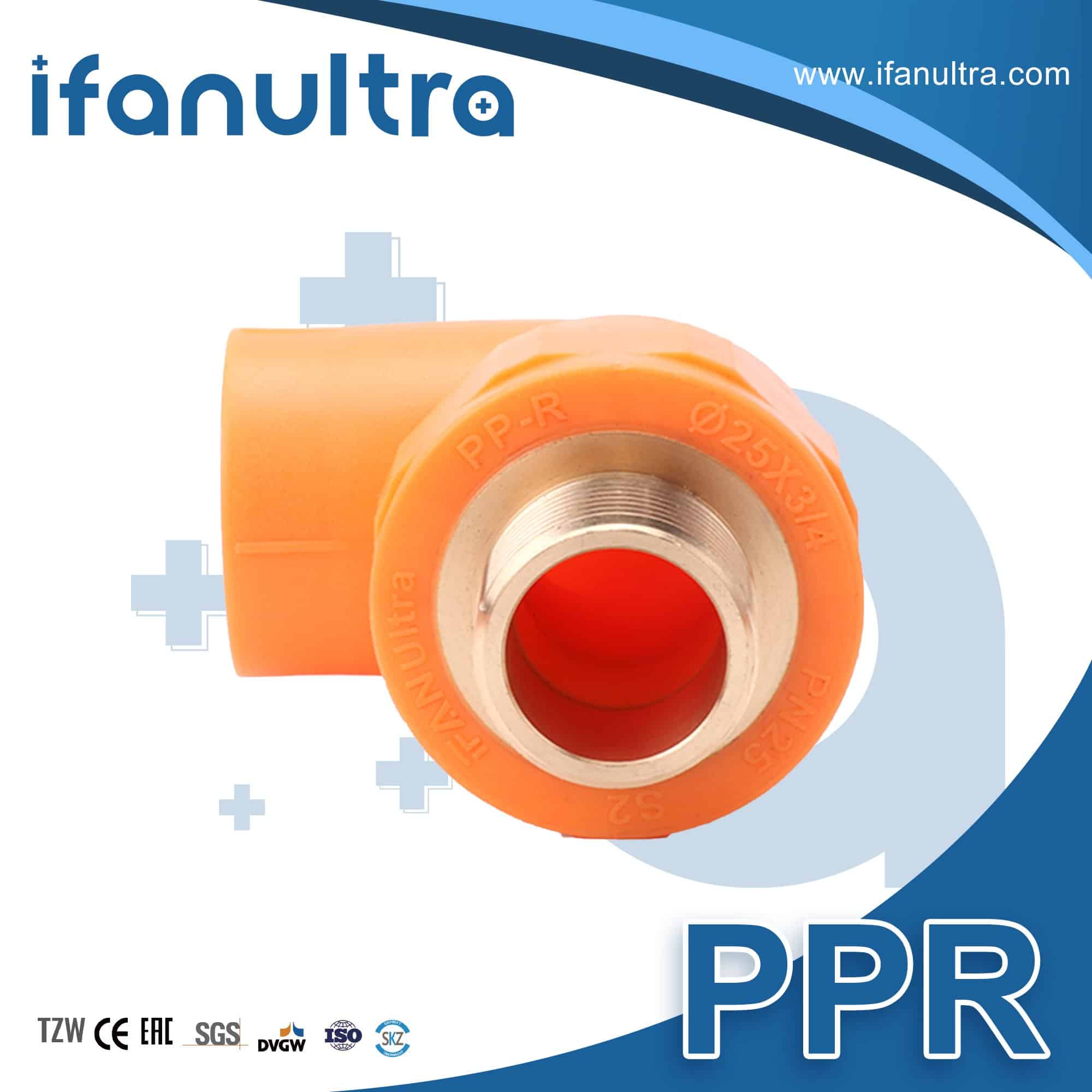
A male threaded transition elbow. The brass is overmoulded into the polypropylene — the bond between the two is the component’s real limit.
Start with what the standard says, because it is narrower than most people assume. ISO 15874-3’s normative reference list names “ISO 228-1, Pipe threads where pressure-tight joints are not made on the threads” and “EN 10226-1, Pipe threads where pressure-tight joints are made on the threads — Part 1: Taper external threads and parallel internal threads.” Both are the BSP family: parallel G, which seals on a washer or O-ring at a face, and taper R/Rp, which seals on the thread flanks themselves.
NPT — the North American standard — appears nowhere in that list. An NPT-threaded PPR fitting is a legitimate product for a specific market, but it is a market-specific product, not a standards-derived one, and the two families are not interchangeable. BSP is cut on a 55° Whitworth form under ISO 228-1 and NPT on a 60° form under ASME B1.20.1: screw one into the other and the flanks never seat, leaving a spiral leak path that a tighter wrench makes worse rather than better.
This is precisely where a real catalogue answers a question a generic list cannot. The transition pieces in the Série mondiale PPR are published with two part-number columns on the same dimension table — one headed “New Part No. (NPT), Zero-lead (potable) brass” and one headed “New Part No. (ISO) Stainless steel” — while other SKUs in the same family are designated with an R thread and described as “DIN 2999.”
In other words the thread standard is set per SKU and per market, not once for the house: NPT for North America, R/Rp for Europe, the Gulf and most of Asia. If you are buying into a market whose plumbing code is BSP, ordering by shape name alone is how you end up with a pallet of correctly-sized, unusable fittings. This is also why the question of which fittings work with PPR pipe has a different answer in each market.
One nomenclature trap deserves flagging, since it appears on the product tables themselves. DIN 2999 is superseded — DIN EN 10226 replaced it, and threads formerly called DIN 2999 are now designated R (taper external) mating Rp (parallel internal), with dimensions to ISO 7/1. A catalogue that still says “DIN 2999” is using legacy naming for a current thread, not offering an obsolete one. Confirm it in writing anyway: “DIN 2999” and “R 1/2” describe the same thread, but only one of them is a designation your inspector will recognise on a certificate.
The material question is worth the same care. ISO 15874-3 requires metallic fitting material to conform to EN 1254-3 for copper alloys or EN 10088-1 for stainless steels — it does not name a specific brass alloy, so any supplier claim that “the standard requires CW617N” is market convention presented as a requirement.
What is worth checking is lead content: the IFANULTRA transition tables specify “zero-lead (potable) brass” for the brass column, with a stainless option on the same SKU, while the industrial check-valve line is listed as ordinary “industrial brass.” For US-destined potable work that distinction is the compliance boundary — the Safe Drinking Water Act’s section 1417 caps lead at a 0.25% weighted average across wetted surfaces, with NSF/ANSI 372 as the conformance route. Requirements vary by jurisdiction and by the role the importer takes on, so confirm the current position for your market before committing a container.
The failure mode that surprises people
There is no published newton-metre torque limit for a threaded PPR transition, and installers looking for one are solving the wrong problem. The documented guidance is turn-based — roughly one to two turns past hand-tight, never bottomed out, with counter-pressure applied to the fitting body. The real failure is not the plastic cracking under hoop stress. It is the brass insert rotating inside the polypropylene, because the overmould bond has been broken by torque applied without counter-pressure. Once the insert spins, no amount of sealant recovers it — the fitting has to be cut out and replaced, and if it has already been fused into a wall, so has the wall.
5. Demountable Fittings: Unions and the Repair Joint
A fused PPR system has one structural drawback: it is monolithic. Nothing comes apart. Every point where a pump, a meter, a filter or a water heater has to be removable needs a mechanical fitting designed for it, and the union is that fitting — a three-part assembly of body, tail and nut that lets a component be unbolted and reinstalled without cutting pipe.
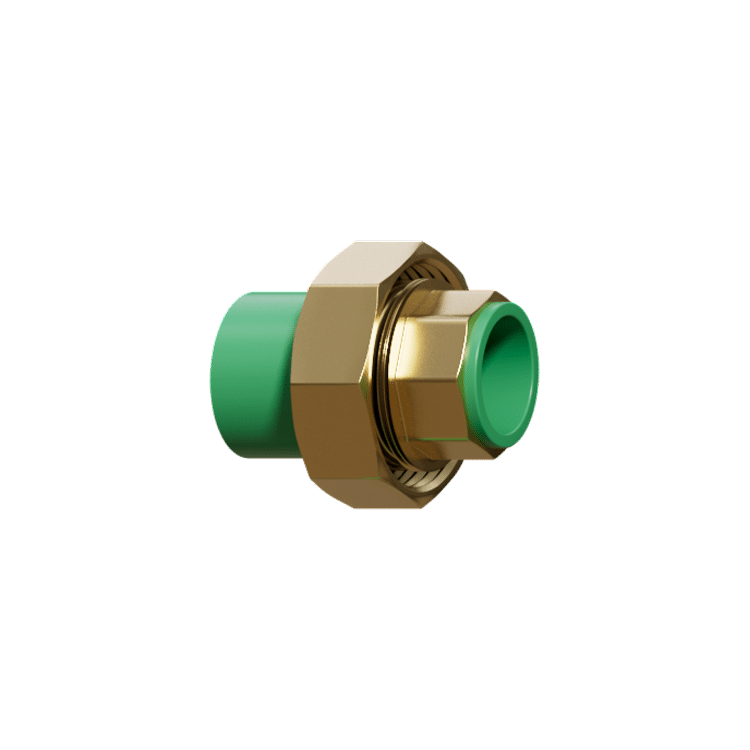
A union with a brass nut. The nut material determines how many service cycles the joint survives.
The catalogue offers this in two versions, and the difference is not trivial. The union with a PP-R nut runs 20–75 mm; the union with a brass nut runs 32–75 mm and does not go below 32 mm at all. The choice is a service-life judgement rather than a pressure one.
A brass nut tolerates repeated tightening cycles and the occasional wrench from an impatient technician; a polypropylene nut is lighter, fully corrosion-immune and cheaper, but it is the part that will eventually round off if a joint is broken and remade every year. For a plant room where filters get swapped on a schedule, specify brass. For a domestic riser where the union exists so the meter can be changed once a decade, the PP-R nut is the more sensible purchase.
Where unions are genuinely worth arguing for is at the design stage, and it is the cheapest argument in plumbing. Adding a union either side of every serviceable component costs a few dollars per position on a first fit. Omitting it means that in five years someone will cut a live line to remove a pump and then need to fuse in a repair coupling in a wet, cramped position — the exact conditions under which a fusion joint is most likely to be made badly. If you are advising a customer on a stock range rather than just filling their order, this is the item to push.
6. Flange Adapters and Split Flange Rings: The Large-Bore Exit
At the point where a PPR line meets a pump, a butterfly valve or a metal header, the connection becomes a bolted flange. This is a two-part arrangement that catches people out on a first order: the flange adapter is a fused PPR component with a flat stub face, and the flange ring is a separate loose backing ring that provides the bolt holes. They are ordered separately, and the ring is not optional.
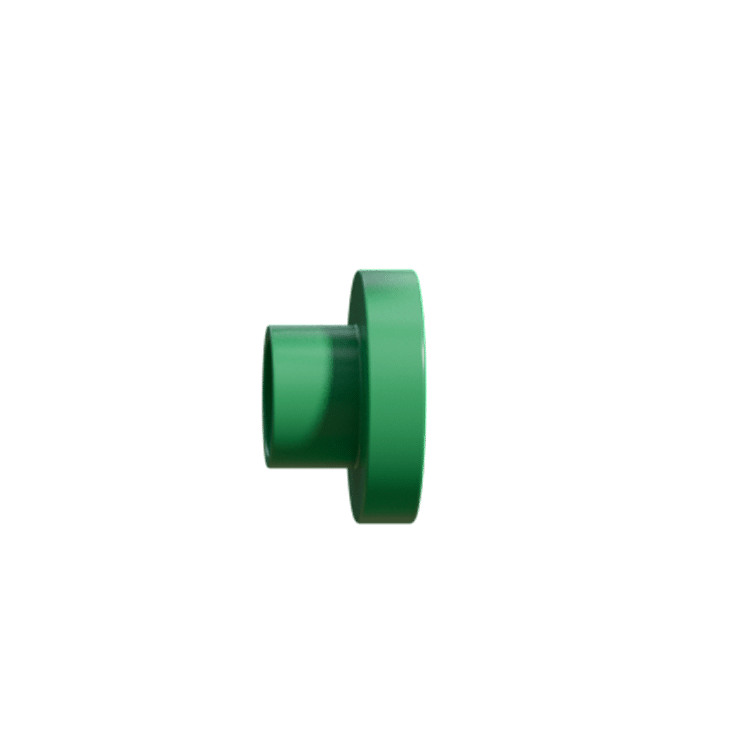
A socket-fused flange adapter. The PPR component provides the sealing face; a separate loose ring provides the bolts.
The two ranges are deliberately mismatched, and that mismatch is informative. The socket-fused flange adapter is published 32–125 mm in eight sizes. The split flange ring runs 32–630 mm across seventeen sizes — 32, 40, 50, 63, 75, 90, 110, 125, 160, 200, 250, 315, 355, 400, 450, 500 and 630 mm.
Rings exist far beyond where any socket-fused adapter does because at large bore the adapter itself becomes a butt-fusion component; the ring is what carries the bolt pattern in both cases. The bolt-hole count steps predictably with size: 4 holes from 32 to 75 mm, 8 holes from 90 to 200 mm, 12 holes from 250 to 355 mm, 16 holes at 400 and 450 mm, and 20 holes at 500 and 630 mm.
Two practical warnings apply to every flanged PPR joint. The first is that torque figures for plastic flanges are manufacturer-published rather than standard-derived, so they must come from the supplier of the specific fitting and not from a general table.
The second is more important and more often skipped: a plastic flange must be re-torqued after the joint has been sitting under load, because the polypropylene stub face creep-relaxes under the bolt clamp. Aquatherm’s published flange guidance puts that window at 24 to 48 hours of normal operating conditions before the bolt torques are checked and re-tightened. The Plastics Pipe Institute’s TN-38 calls the equivalent step on polyethylene flanges a mandatory re-torque after a 4-to-24-hour creep-relaxation period.
The window differs by material and manufacturer; the requirement does not. Tighten in a star pattern in stages, use washers on both sides, and put the re-torque on the commissioning checklist as a named task. A flange that was tight on the day of assembly and weeping a week later has not failed — it was simply never re-torqued.
7. Valves Inside a PPR System
Valves are technically fittings and are usually listed alongside them, but they behave differently in a range in one material respect: they stop early. In the IFANULTRA catalogue the PPR ball valve is published 20–75 mm, while the screw-down stop/globe valve and the inclined check valve both run only 20–40 mm. Against a flow-fitting range that reaches 125 mm and an electrofusion range that reaches 250 mm, that is a hard and early ceiling.
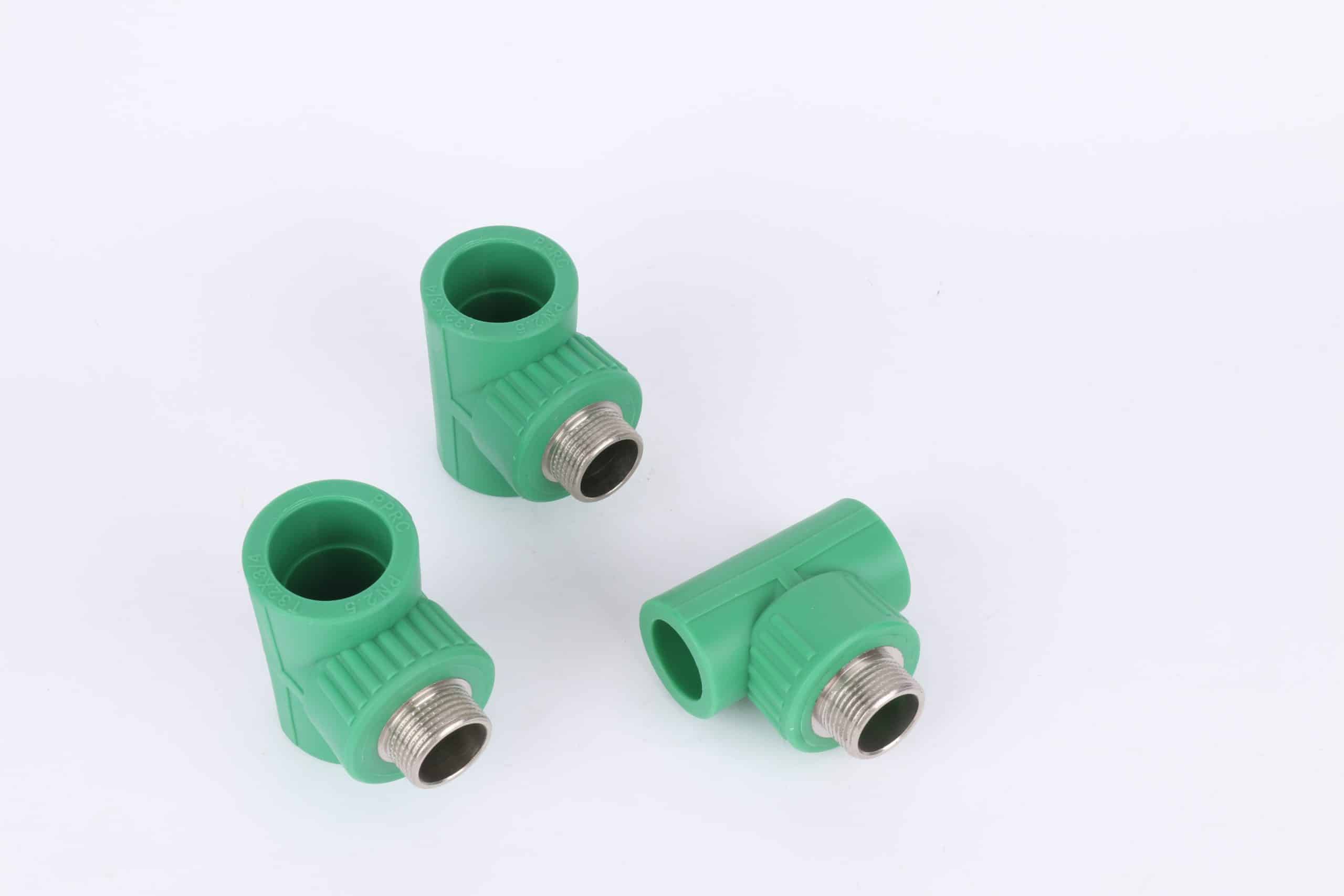
A threaded tee taking a branch off a riser — the usual way a valve enters a PPR system once the plastic valve range runs out.
The design consequence follows directly. Above 75 mm, isolation is not achieved with a plastic valve — it is achieved by flanging out to a metal valve, which is why the flange adapter and split flange ring ranges matter so much on any project with a real riser. A specifier who assumes a 110 mm PPR ball valve exists somewhere in the range will discover the gap at the worst possible moment, which is after the pipe has been ordered. Plan the isolation strategy at 90 mm and above around flanges from the start.
Valve type selection follows ordinary hydraulic logic, with one PPR-specific note. A ball valve is the correct choice for isolation — full open or full shut, minimal pressure drop, and it will sit untouched for years without seizing.
A screw-down stop or globe valve is the one to reach for when flow needs to be throttled rather than switched, since a partially-open ball valve wears its seat unevenly and eventually leaks past. Check valves prevent reverse flow at pump outlets and on the cold feed to a heater. It is also worth noting that ball valves for thermoplastic hot-and-cold-water systems now have their own dedicated international standard — ISO 18984 was published as a first edition in July 2025, distinct from the older industrial thermoplastic valve standards, which makes it a reasonable thing to ask a supplier about on new tenders.
8. Specialty Transitions: PEX, Copper and the Short-Range Items
The tail of a PPR catalogue is a set of items that solve one problem each, and they share a pattern worth understanding: they are all short-range. The PPR-to-PEX adapter, in both crimp and expansion versions, exists only at 20, 25 and 32 mm. The 90° stub-out from PP-R to copper exists only at 20, 25 and 32 mm. Neither goes further, and the reason is that these components exist to solve a last-metre problem — a PPR distribution system meeting a PEX manifold on an underfloor heating circuit, or terminating at a copper tail for a fixture in a retrofit. Nobody transitions a 110 mm main to PEX.
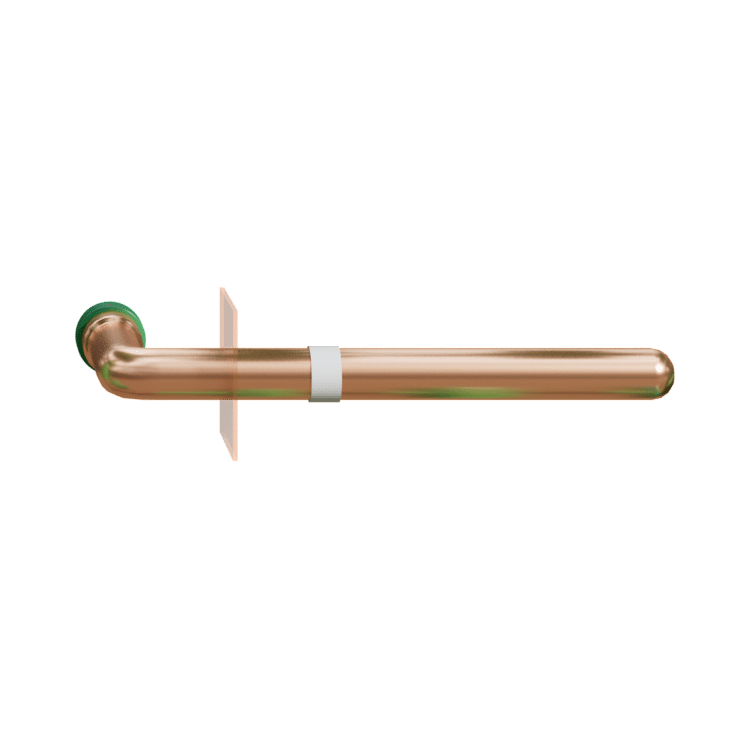
For a distributor deciding what to stock, that pattern is the useful signal rather than the individual part numbers. Specialty transitions are low-volume, application-specific, and highly market-dependent: a Gulf market building with PPR risers and copper fixture tails needs the copper stub-outs and will never touch the PEX adapters, while a European underfloor-heating installer wants the reverse. Ordering both families “to be safe” on a first container is how slow-moving stock is created. Ask which fixture standard the destination market actually terminates in, order that family, and leave the other to a follow-up shipment.
A related question comes up often enough to answer here: whether fibre-composite pipe needs fibre-composite fittings. It does not, and the reason is structural rather than commercial. The glass-fibre layer that reduces thermal expansion is produced by multi-layer extrusion, a process that applies to pipe; fittings are injection moulded and are plain PP-R or PP-RCT throughout. A fitting also has negligible axial length, so there is no expansion to restrain across it.
Critically, the two surfaces that actually fuse — the pipe’s outer wall and the fitting’s inner socket — are plain polypropylene on both sides regardless, which is exactly why faser pipe fuses normally to a standard fitting. Any supplier offering “fibre-reinforced fittings” at a premium is selling a category that does not exist.
9. Specifying a Stock Range: What We Check Before Quoting a Fitting Order
Turning the families above into an actual order is a different exercise from understanding them, and it comes down to six questions. What we check on a fitting enquiry before it is quoted is set out below, in the order these points actually cause problems. Getting them answered in writing before a proforma invoice is issued prevents almost every fitting problem that shows up later on site.
What we check before a proforma is issued
- Thread standard, written per SKU. Not “BSP or NPT” as a blanket answer for the order — the designation is set per line item, and a catalogue can legitimately carry both. Get it written against each threaded part number.
- SDR and PN class, matched across pipe and fittings. A fitting socket is dimensioned to a pipe outside diameter, so it will physically accept a pipe of the right OD in the wrong wall series — and the resulting joint is not rated for what the drawing assumes.
- Reducing-tee combinations, listed explicitly. Name the four or five inlet/outlet/branch combinations your drawings actually use. “Assorted” is not a specification anyone can quote against.
- Brass specification where water is potable. Named on the document as zero-lead, not assumed from a product photograph. The same catalogue can carry an industrial-brass line for non-potable duty.
- Anything above 160 mm, flagged. That portion is manufacturer-dimensioned rather than ISO-dimensioned, so it should come from a single source together with spares.
- Electrofusion and union counts, deliberately set. These are the two items buyers systematically under-order, because neither appears on a drawing — they exist to make future repairs and future servicing possible.
How many of the 95 line items you actually need
The IFANULTRA product sitemap carried 95 live product pages on 26 July 2026 — 4 of them pipe, 91 fittings, valves and accessories. That is the number a first-time buyer is handed, and it is the wrong number to order against. Work a real project through the families above and the list collapses by roughly two thirds. Take a distributor stocking a mid-rise residential job: 20 mm and 25 mm branch work, 32 mm and 50 mm risers, one 90 mm plant-room main.
| Objet | Sizes ordered | Lines |
|---|---|---|
| Coupling, 90° elbow, equal tee | 20, 25, 32, 50, 90 mm | 15 |
| Coude à 45 | 25, 50 mm | 2 |
| Reducing tee | 3 named combinations | 3 |
| Reducing coupling | 50→32, 32→25, 25→20 mm | 3 |
| End cap | 20, 25 mm | 2 |
| Threaded transition, male + female | 20, 25 mm | 4 |
| Ball valve | 20, 25, 32, 50 mm | 4 |
| Flange adapter + split flange ring | 90 mm | 2 |
| Union, PP-R nut | 32, 50 mm | 2 |
| Electrofusion coupling (repair stock) | 32, 50 mm | 2 |
| Total | — | 39 |
Thirty-nine lines out of 95, and the 39 are not evenly spread. The first three rows — 15 lines of coupling, elbow and tee — will be most of the shipped volume. Everything below them is there to make the system terminate, isolate, reduce and be repairable, which is why cutting those rows to save on line count is the classic first-container mistake.
The 56 lines left out are worth naming, so a buyer knows what was deliberately skipped rather than accidentally missed: the flow-fitting sizes this project never uses (40, 63, 75, 110, 125 mm), the split flange range above 90 mm out to 630 mm, stop and check valves, PEX adapters and copper stub-outs, the brass-nut union line, and electrofusion from 63 mm up. None of those are optional in general — they are optional for this project. Change it to a hotel retrofit terminating in copper and the stub-outs move into the ordered set immediately.
The rule underneath the arithmetic: order across the shapes you need at the sizes on your drawings, not across the sizes a catalogue offers. Note too that the 90 mm main isolates through the flange pair rather than a ball valve, because no 90 mm plastic ball valve exists in the range.
Building a first container mix?
This is useful mainly if you are a distributor or stocking contractor putting together a wholesale range rather than buying a handful of parts — and yes, that’s us: IFANULTRA is the brand whose catalogue the DN ranges above were read from. The Global Series carries the full published spread, including the electrofusion sizes above 160 mm and both NPT and R-thread transition columns. It will not suit you if you need a single-project parts list or a fitting family outside PPR.
10. Which Range Fits Which Buyer
A catalogue split into two series is not a good/better arrangement, and reading it that way leads to over-buying. The two ranges answer different commercial questions, and the honest guidance depends on what the buyer is doing.
A broad range earns its keep when the buyer cannot predict what will be asked for — a distributor serving many contractors, a market where projects arrive without notice, anyone who needs the large-bore and specialty items to be available rather than quoted. The cost is inventory: a wide range means slower-moving lines and more capital sitting on shelves. A narrower range is the better instrument when the application is known and repetitive — residential fit-out in one or two diameters, a contractor buying for their own work rather than for resale, a first shipment into a market that is still being tested.
The mistake to avoid is ordering the wide range on a first container “to see what sells,” which reliably converts working capital into 630 mm flange rings nobody asks for.
| Best served by a broad range | Better served by a narrow range |
|---|---|
| Distributors supplying many contractors | Contractors buying for their own projects |
| Projects with risers above 90 mm | Residential work in 20–50 mm |
| Markets needing both NPT and R threads | A single-code market |
| Buyers who must quote large-bore fast | A first trial container into a new market |
Comparing a lean range against a full one
Aimed at importers and procurement teams sizing a first wholesale order rather than specifiers pricing one job — and to be transparent, that’s us again. The Quality Series is the narrower range described above; the published fitting families and DN spreads for both are on the series pages, so the comparison can be made from the tables rather than from a sales conversation. If your project needs the 200–250 mm electrofusion sizes, this is the wrong one of the two.
Conclusion
PPR fittings reduce to four families in ISO 15874-3 and about a dozen working shapes, but the useful information is never the name — it is where each family’s DN range stops, which thread standard the insert is cut to, and which failure mode the family carries. Socket fusion to 125 mm, electrofusion to 250 mm with the standard’s dimensional table ending at 160 mm, valves stopping at 75 mm, flange rings running to 630 mm, and threads set per SKU rather than per catalogue: those five facts shape a stock list more than any list of shapes can.
If you are assembling a range rather than buying a single part, work through the six specification questions above before a proforma is issued. Distributors sizing a first order will find the published DN tables on the Série mondiale PPR pages more useful than any summary.
Frequently Asked Questions
How many types of PPR fittings are there?
ISO 15874-3 recognises four: socket fusion, electrofusion, mechanical, and fittings with incorporated inserts. Within those four sit roughly a dozen working shapes — couplings, elbows, tees, reducers, end caps, unions, flange adapters, valves and threaded transitions.
What is the largest PPR socket fusion fitting size?
125 mm is the practical ceiling for socket-fusion flow fittings. Above it, systems continue by butt fusion or electrofusion; published electrofusion couplings reach 250 mm, though ISO 15874-3 tabulates electrofusion socket dimensions only up to 160 mm.
Can I mix PPR fittings from different brands?
Below 160 mm the socket geometry is set by ISO 15874-3, so mixing is dimensionally possible but still inadvisable because material grades and fusion behaviour differ. Above 160 mm sockets are manufacturer-dimensioned, and mixing brands should be treated as unsupported.
Do PPR fittings use BSP or NPT threads?
ISO 15874-3 cites only the BSP family — ISO 228-1 for parallel G and EN 10226-1 for taper R/Rp. NPT versions are made for North American markets but are not standards-derived. Confirm the designation per part number before ordering.
Why do PPR flanges need re-tightening?
The polypropylene stub face creep-relaxes under bolt clamp load, so a joint tight at assembly loses preload over the following days. Re-torque in a star pattern typically within 24 to 48 hours, using the fitting manufacturer’s published figures.
Do fibre-composite PPR pipes need special fittings?
No. The fibre layer is created by multi-layer extrusion and applies to pipe only; fittings are injection moulded in plain PP-R or PP-RCT. The surfaces that fuse are plain polypropylene on both sides, so faser pipe joins standard fittings normally.
What torque should I use on a threaded PPR fitting?
No newton-metre limit is published. Guidance is turn-based: one to two turns past hand-tight, never bottomed out, with counter-pressure on the fitting body. Over-torque spins the brass insert inside the plastic, which scraps the fitting.









 English
 Español
 Français
 Português do Brasil