
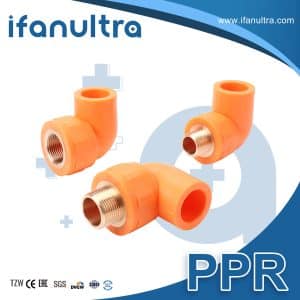
The types of pipe fittings all exist to do one of five jobs: change direction, branch a line, change size, join or extend a run, or close it off. Once you can name which job a fitting does, choosing the right one stops being guesswork — an elbow turns a corner, a tee splits a flow, a reducer steps down a diameter, a coupling joins two lengths, and a cap ends the line. Everything else is a variation on those five.
This guide walks every common fitting family, how each one connects, the materials they come in, and how to pick the right part for a job. It is written for the water and plumbing side rather than heavy industrial steel, so the examples lean toward PPR, PVC, CPVC and brass systems. For the wider material picture, the PPR pipe guide covers pressure classes and installation; here we stay on the fittings.
Key Takeaways
- Every fitting does one of five jobs: change direction, branch, change size, join/extend, or terminate.
- Elbows turn 45° or 90°; tees branch at 90°; wyes branch at 45° for smoother flow on drainage.
- Reducers come in two shapes: concentric (centered, for vertical lines) and eccentric (offset, to keep horizontal lines from trapping air or liquid).
- A union lets you disconnect a joint later; a coupling is permanent. Choose the union anywhere a pump, meter or valve may need removal.
- How a fitting connects matters as much as its shape: PPR is heat-fused at ~260°C, PVC is solvent-cemented, brass is threaded, and copper is soldered.
- Transition fittings — threaded and flange adapters — bridge plastic pipe to metal valves, pumps and meters, and are where most systems leak if made poorly.
- In a PPR system the fittings fuse into one homogeneous part with the pipe, so there is no glued or gasketed joint to age over the pipe’s 50-year design life.
What a Pipe Fitting Is and the Five Jobs They Do
A pipe fitting is any component that connects two or more sections of pipe, or connects pipe to another device. Straight pipe only carries water in a straight line; the fittings are what let a system turn, split, shrink, join and stop. Reading a fitting by its job is faster than memorizing hundreds of part names, because the job tells you the shape.
- Change direction: elbows, bends, returns.
- Branch a line: tees, wyes, crosses.
- Change size: reducers, bushings, swages.
- Join or extend: couplings, unions, nipples.
- Terminate or connect a device: caps, plugs, and the adapters that bridge to valves and meters.
Pipe Fittings by Function: The Quick Map
Before the detail, here is the whole category on one page. Match the job to the fitting family, then read the section below for the variations.
| Job | Fittings | Typical use |
|---|---|---|
| Change direction | Elbow (45°/90°), bend, return | Turning a corner around a wall or riser |
| Branch a line | Tee, reducing tee, wye, cross | Feeding a fixture off a main |
| Change size | Reducer (concentric/eccentric), bushing | Stepping a DN50 main down to a DN25 branch |
| Join or extend | Coupling, union, nipple | Joining two lengths; a removable joint |
| Terminate / connect device | Cap, plug, threaded & flange adapter | Closing a line; bridging to a metal valve |
Elbows and Bends: Changing Direction
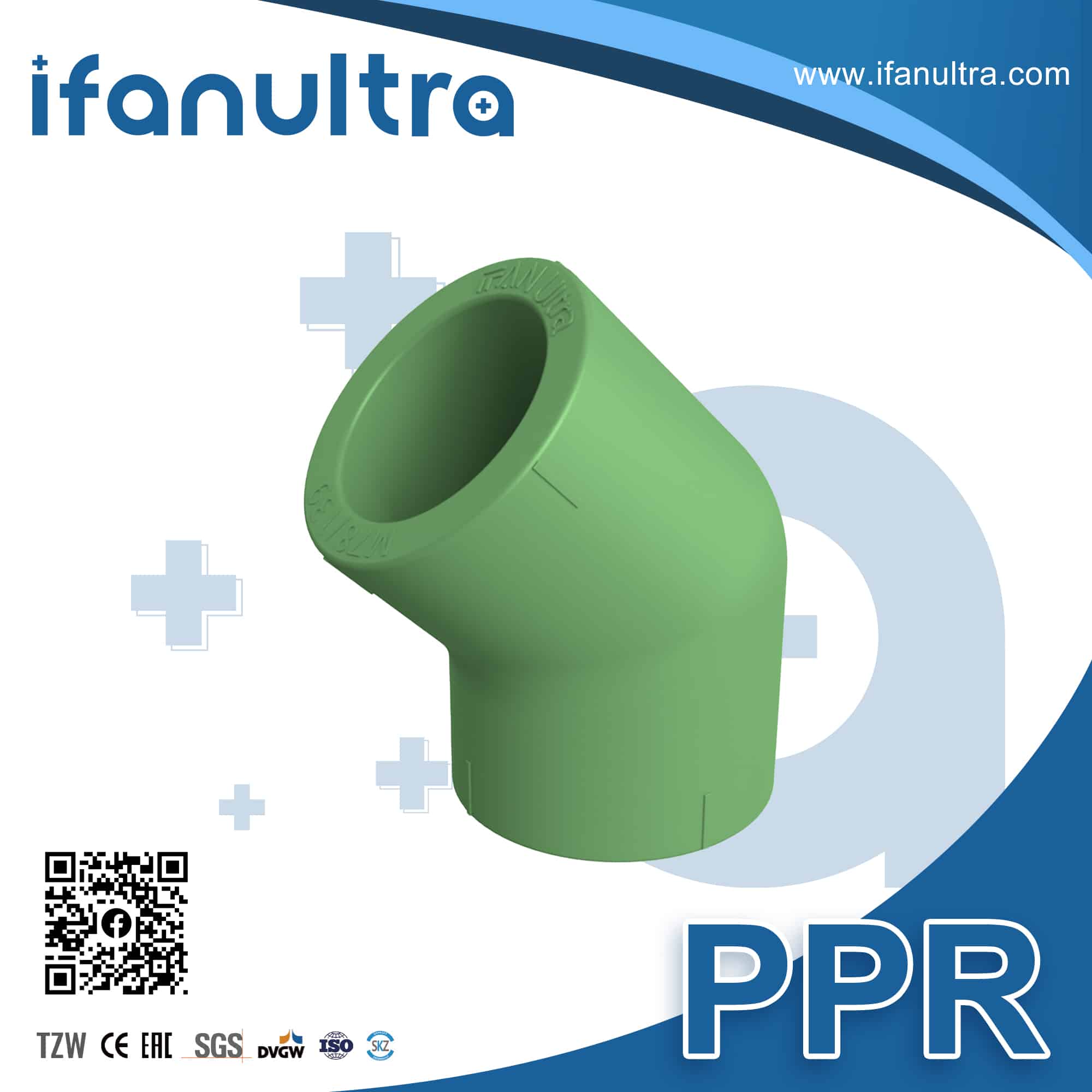
The elbow is the most-used fitting in any building. It turns the line, and the two everyday angles are 90° and 45°. Two 45° elbows in series make a gentler offset than a single 90°, which lowers turbulence and pressure loss — a detail that matters on long pumped runs.
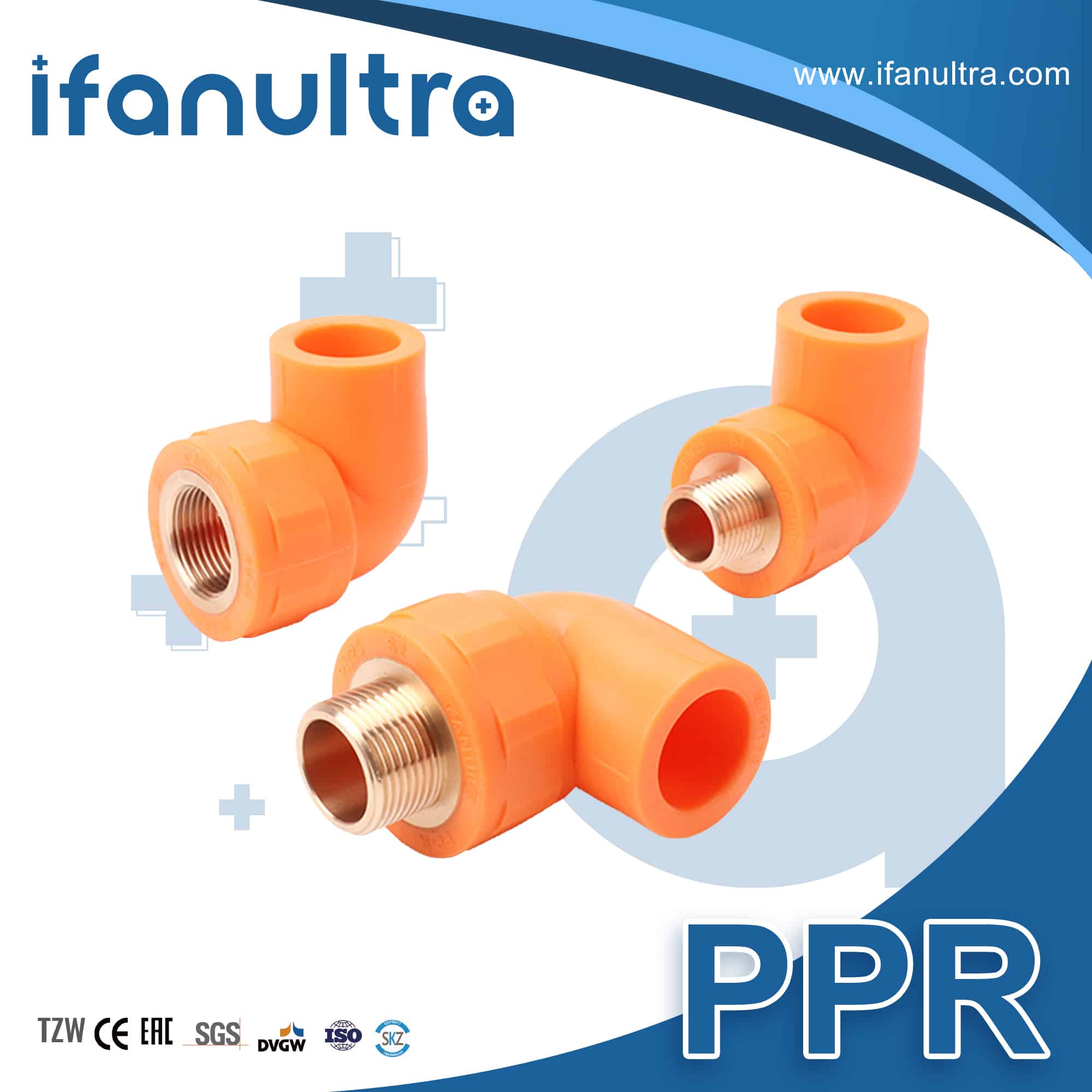
- 90° and 45° elbows: the standard corner turns. A 135° elbow (a 45° turn the other way) covers the odd angle.
- Long-radius vs short-radius: a long-radius elbow sweeps wider and flows more smoothly; a short-radius fits a tight space but adds turbulence.
- Threaded (street) elbow: one male, one female end, so it screws directly into another fitting without a nipple — common at metal transitions.
On a large-diameter PPR line, a segmented (fabricated) elbow is butt-fused from mitred sections because a moulded elbow that big is impractical. Undersizing the elbow radius on a hot line is a quiet mistake: the tighter the turn, the more the thermal-expansion stress concentrates at the joint.
Tees, Wyes and Crosses: Branching a Line
A tee takes one line and splits it into two at 90°. When all three openings are the same size it is an equal tee; when the branch is smaller it is a reducing tee, which saves you fitting a separate reducer. On pressurized water this is the everyday branch fitting.
- Equal and reducing tees: feed a branch off a main; the reducing tee steps the branch down in one part.
- Threaded-branch tees: a female or male thread on the branch takes a metal valve or a fixture connection directly.
- Wye (Y) fittings: branch at 45° instead of 90°, giving smoother flow — standard on drainage where solids must not snag.
- Cross: four openings from one fitting, used in fire lines and grids where two runs intersect.
2025-2-26.jpg)
Reducers and Bushings: Changing Size
A reducer connects two different pipe diameters. The choice that trips people up is concentric vs eccentric, and it is not cosmetic.
- Concentric reducer: the two openings share a centreline, so it is symmetrical. Use it on vertical lines.
- Eccentric reducer: the openings are offset so one side stays flat. On a horizontal line this keeps the top (or bottom) level, which stops air pockets on a pump suction or stops liquid pooling on a drain.
- Bushing: a compact insert that reduces a female opening down a size or two without a full reducer — cheaper but with a sharper flow step.
Fitting a concentric reducer on a horizontal pump suction is a classic cause of cavitation, because the air pocket it creates starves the pump. The eccentric version, installed flat-side up, is the fix.
Couplings, Unions and Nipples: Joining and Extending
These three join straight runs, and the difference between a coupling and a union is the single most useful thing to know here. A coupling is a permanent joiner — once fused or cemented, it stays. A union is a three-part joiner with a nut that unscrews, so you can break the joint later without cutting the pipe.
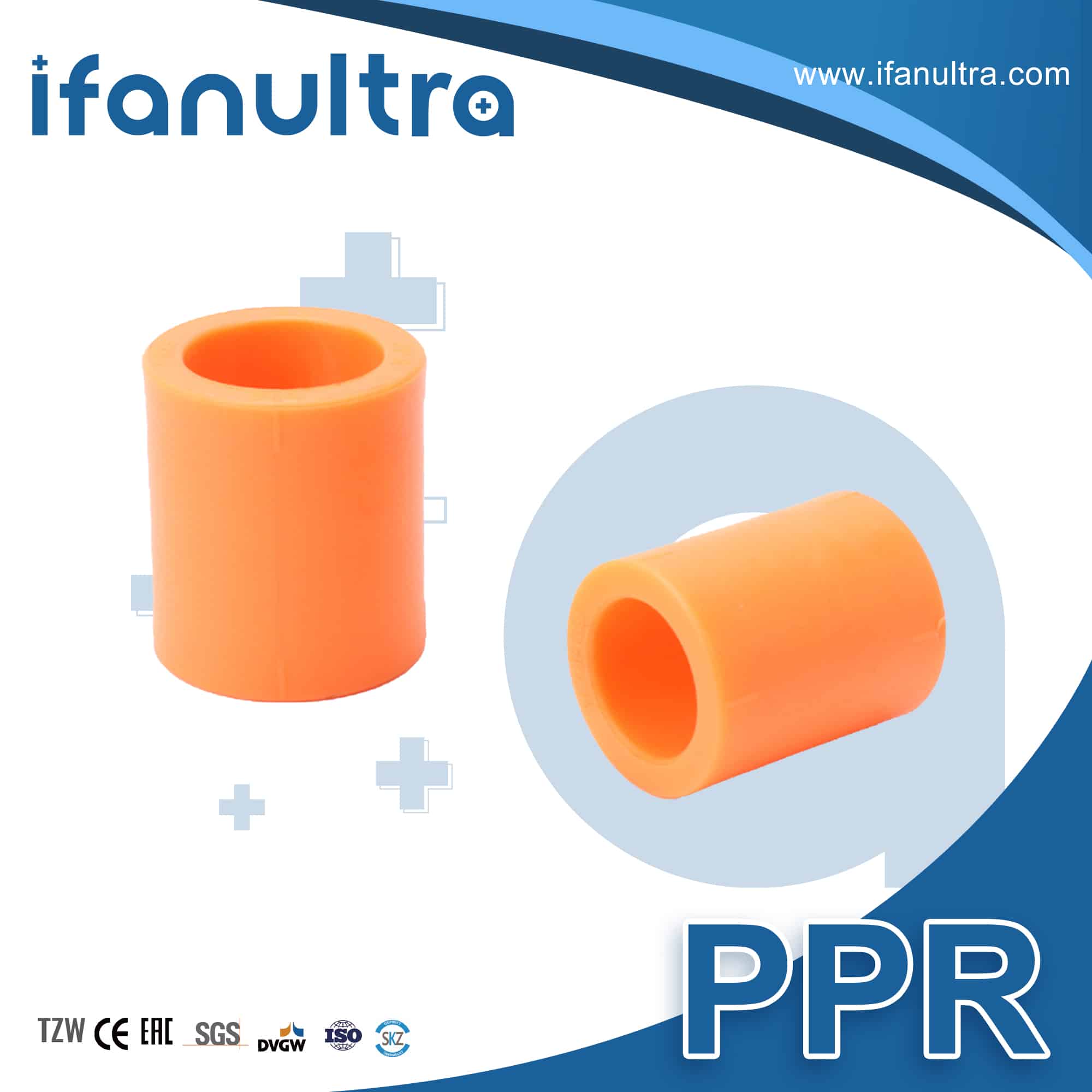
- Coupling: joins two lengths permanently; a reducing coupling joins two sizes.
- Union: a removable joint. Fit one on both sides of any pump, meter or valve you may service, or you will be cutting pipe to remove it.
- Nipple: a short length threaded on both ends, used to extend or space two female fittings.
On plastic systems the strongest union design uses a brass insert for the threaded seat rather than a thread cut into the plastic, because the metal seat survives repeated tightening. Skipping unions to save a few cents per joint is a decision the maintenance crew pays for later.

Caps and Plugs: Closing a Line
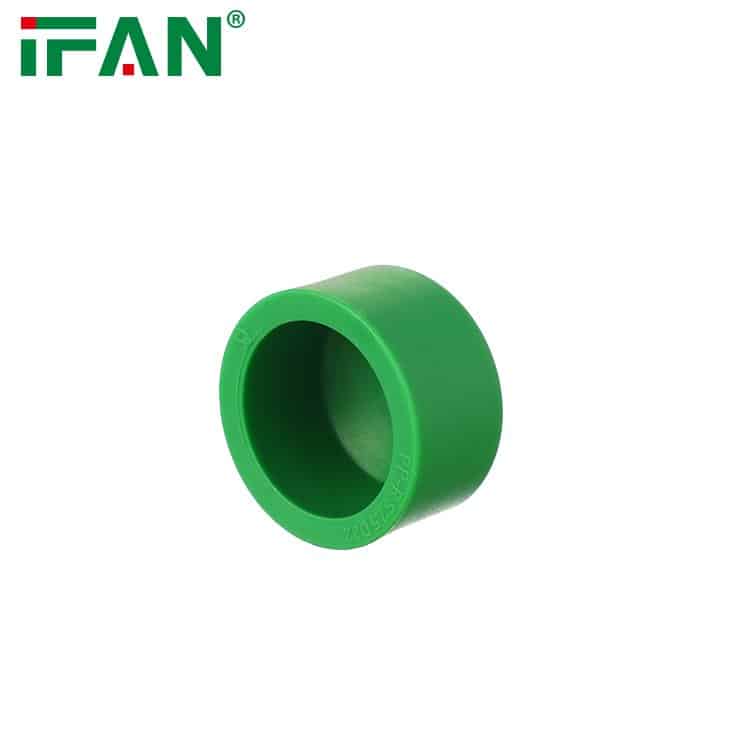
Both close off a pipe; the difference is which side they seal. A cap fits over the outside of a pipe end. A plug screws or fuses into the inside of a female fitting. You use a cap to end a run and a plug to close a spare branch on a tee or manifold, and both are what you fit to pressure-test a section before the walls close.
Adapters and Transition Fittings: Connecting Different Systems
Almost no system is one material end to end. Adapters are the fittings that bridge plastic pipe to threaded metal, to a flanged valve, or to a different pipe standard — and they are where most real-world leaks start, because they join two materials that behave differently.
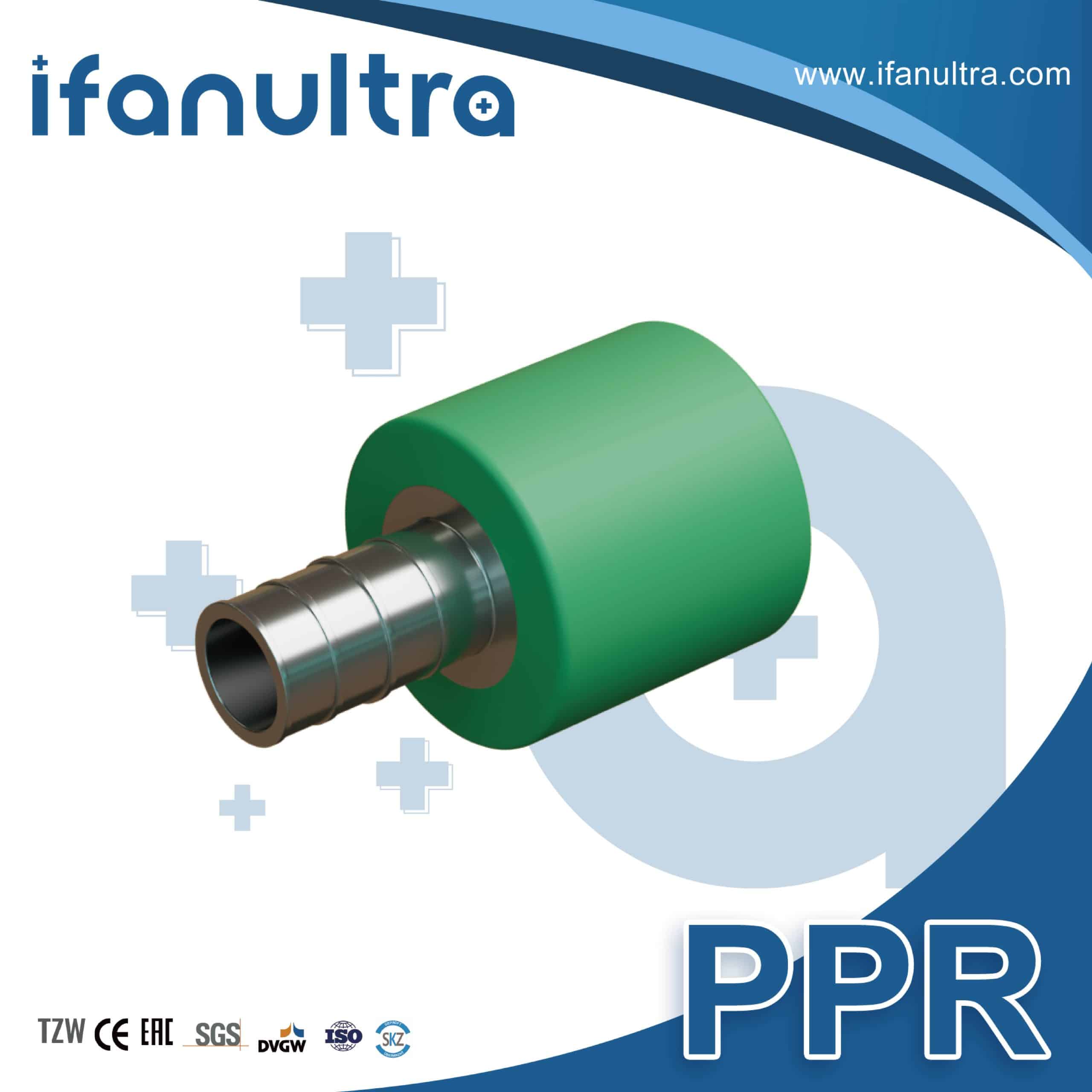
- Threaded (male/female) adapters: put a metal thread on a plastic run so it can screw into a valve, meter or tap. The durable versions mould a brass insert into the plastic body.
- Flange adapters: for larger diameters, a fused stub plus a loose backing ring lets a plastic line bolt to a flanged pump or valve. The full range of flange faces and standards is covered in the flange types guide.
- Cross-material adapters: PPR-to-PEX or PPR-to-metal transition fittings let one system meet another where a retrofit or a fixture demands it.
The insider rule at any metal-to-plastic junction: over-tightening a plastic thread cracks it, and PTFE tape plus hand-tight-plus-a-turn is usually enough. A brass-insert adapter tolerates the torque a bare plastic thread will not.
How Fittings Connect: The Joining Methods
A fitting’s shape tells you what it does; its connection type tells you how it goes on and how it fails. The same elbow exists as a fusion fitting, a solvent-weld fitting, a threaded fitting and a push-fit fitting — and they are not interchangeable.
| Connection | How it joins | Common on |
|---|---|---|
| Socket heat fusion | Pipe and fitting melted at ~260°C into one part | PPR |
| Solvent cement | Chemically welded with primer and glue | PVC, CPVC |
| Fileté | Male/female screw threads with tape or dope | Brass, steel, transitions |
| Soldered / brazed | Filler metal melted into the joint | Copper |
| Compression / push-fit | Mechanical ring or grab-ring seal, no heat | PEX, retrofit joints |
| Flanged | Bolted faces with a gasket, removable | Large diameters, valves, pumps |
The fused joint is the reason PPR systems are quiet performers: there is no glue line to fail and no gasket to age. The step-by-step is in the PPR installation guide.
Fitting Materials Compared
The same fitting family exists in several materials, and the material sets the temperature limit, the joining method and the price. For pressurized hot-and-cold water, the practical shortlist is PPR, CPVC, PEX, brass and copper.
| Matériau | Max temp | Joins by | Best for |
|---|---|---|---|
| PPR | ~70°C cont / 95°C peak | Heat fusion | Hot & cold pressure plumbing |
| CPVC | ~93°C | Solvent cement | Hot water without fusion tools |
| PEX | ~95°C | Crimp / push-fit | Flexible retrofit runs |
| Brass | Haut | Fileté | Valves, transitions, manifolds |
| Copper | Very high | Soldered | High-heat and code-mandated lines |
Fittings in a PPR System
In a PPR network the fittings are not bolted or glued onto the pipe — they are fused into it, so a socket, elbow or tee becomes one continuous piece of polypropylene with the pipe. That is what removes the weak point most plumbing systems carry at every joint. IFANULTRA runs the full fitting range — sockets, elbows, tees, reducers, unions, caps and brass-insert transition fittings — in virgin Nordic PP-R across the PPR product series, so a distributor can stock a complete system rather than half of one.
Isolation still needs valves, and in a PPR line the ball and stop valves fuse in the same way rather than bolting on; the full set of valve options is covered in the types of valves guide. The one place metal is unavoidable is at meters, pumps and mixers, which is exactly what the brass-insert threaded and flange adapters are for.
Standards That Govern Fittings
Fittings are made to standards so that a fitting from one compliant maker mates with compliant pipe from another. For PPR pipe and fittings the baseline is ISO 15874, mirrored as DIN 8077/8078; for industrial steel fittings the reference set is ASME B16.9 (butt-weld), B16.11 (forged threaded and socket-weld) and B16.5 (flanges). The exact standard your project requires may vary by market and application, so confirm the specified standard with the project engineer or the relevant authority before ordering.
How to Choose the Right Fitting
Work the decision in this order and the part number falls out at the end:
- Job first: is this changing direction, branching, reducing, joining, or terminating?
- Then material and connection: match the fitting to the pipe system — a PPR line takes fusion fittings, not solvent-weld ones.
- Then size and rating: the DN and PN class of the fitting must match the pipe; a PN20 line needs PN20 fittings.
- Then serviceability: add a union wherever a device may be removed, and an eccentric reducer wherever a horizontal line must stay air-free.
A short example: branching a DN25 hot-water feed off a DN40 PPR riser to a mixer means a reducing tee (DN40 × DN40 × DN25), a short length of DN25 pipe, a brass-insert female threaded adapter at the mixer, and a union just before it so the mixer can be swapped without cutting the wall open. Five parts, each chosen by its job.
What We Check on Every Fitting Batch
Fittings fail more often than pipe because they carry the threads, the brass inserts and the moulded detail, so IFANULTRA runs each batch through a fixed set of checks before it ships.
- Resin check: virgin Nordic PP-R, so a fused fitting reaches the same 50-year rating as the pipe.
- Socket dimension gauge: the fusion socket measured to ISO 15874 tolerance so it grips the pipe correctly.
- Brass-insert bond: threaded and union inserts pull-tested so the metal cannot spin or pull out of the plastic body.
- Thread and pressure check: thread gauge on transition parts, sample fittings held under pressure to confirm the batch rating.
- Marking match: the size, class and certificate on the fitting match the batch paperwork.
Conclusion
Pipe fittings look like hundreds of separate parts, but they collapse into five jobs and a handful of connection types. Name the job, match the material and connection to the pipe, size it to the DN and PN, and add a union where service is likely — that sequence picks the right fitting almost every time.
If you are specifying or stocking a system, decide the pipe material first, because it fixes which fittings you can use. From there, the range on this site — and the linked flange, valve and installation guides — covers the parts and the process end to end.
Related Guides
Frequently Asked Questions
What are the main types of pipe fittings?
The main types group by job: elbows and bends change direction, tees and wyes branch a line, reducers change size, couplings and unions join runs, and caps and plugs close them off. Adapters bridge to other systems.
What is the difference between a coupling and a union?
A coupling joins two pipes permanently once fused or cemented. A union has a nut that unscrews, so the joint can be taken apart later without cutting the pipe. Use a union anywhere a device may be removed.
When do you use an eccentric reducer instead of a concentric one?
Use an eccentric reducer on horizontal lines to keep one side flat, which prevents air pockets on a pump suction or liquid pooling on a drain. Concentric reducers suit vertical lines where symmetry is fine.
How do PPR fittings connect to the pipe?
PPR fittings connect by socket heat fusion at about 260°C. The pipe end and fitting socket are heated and pushed together, fusing into one homogeneous part with no glue, gasket or thread at the joint.
How do you connect plastic pipe to a metal valve?
Use a transition adapter — a threaded adapter with a moulded brass insert for smaller sizes, or a flange adapter with a backing ring for larger lines. The brass insert lets the joint take thread torque without cracking.
Written by the IFANULTRA team — a PPR pipe and fittings brand of IFAN Group, drawing on 30+ years of manufacturing experience, German automated production lines, and ISO 9001, SKZ and NSF certified PPR product lines.









 English
 Español
 Français
 Português do Brasil