

A quotation lands on your desk naming one of the PPR pipe brands you keep seeing on “top 10” lists, and you have never seen that name printed on a length of pipe. You run a distribution yard, moving a container of PP-R a quarter, and the price sits under your current line. What you need to know is who made the pipe, and whether the certificate belongs to that plant.
Here is the test, and it works on any name from any list. A real brand is one where the marking on the pipe, the batch release record and the certificate entry on the issuer’s public register all resolve to one legal entity and one production site. A relabelled brand breaks that chain, usually at the register.
This page sorts the five kinds of brand you will be offered and names the four documents to demand before a 30 % deposit leaves your account.
Key Takeaways
- ISO 15874-2 requires marking on the pipe at least once per metre with a production period (and a site code for multi-plant makers), but accepts a trade mark or code instead of the manufacturer’s name, so a compliant print line can still hide who made the pipe.
- Under ISO/TS 15874-7 only the batch release test (BRT) gates a batch; ask for the BRT record, not the type-test certificate.
- The certificate is the register entry, not the PDF: DVGW, SKZ, WRAS, NSF, Kiwa and IAF CertSearch publish searchable lists, and Kiwa warns that counterfeit Kiwa certificates are sold in China.
- An SKZ certificate runs five years and follows an inspection of the specific plant; a distributor’s brand can sit under one only through a contract naming the manufacturer.
- IFANULTRA is a group-launched brand (kind 2); ask for our certificate numbers and check them at the issuer, as you would for anyone.
- Stock kinds 1 to 3 with the producing entity written into the PO, treat kind 4 as unbranded pipe, and walk away from kind 5 on the first register miss.
The brand this page submits to its own test, kind 2, introduces itself in the video below; watch it the way you would read any brand’s catalogue, then ask for the producing entity, the site and the certificate numbers.

The Criteria: Three Checks That Sort Any PPR Pipe Brand Without a Laboratory
You don’t need a pressure rig to sort brands, just a sample length, the supplier’s paperwork and a browser. The three checks below are the criteria every card is judged by, and each maps to a document a genuine maker already holds.
Check 1: the print line on the pipe
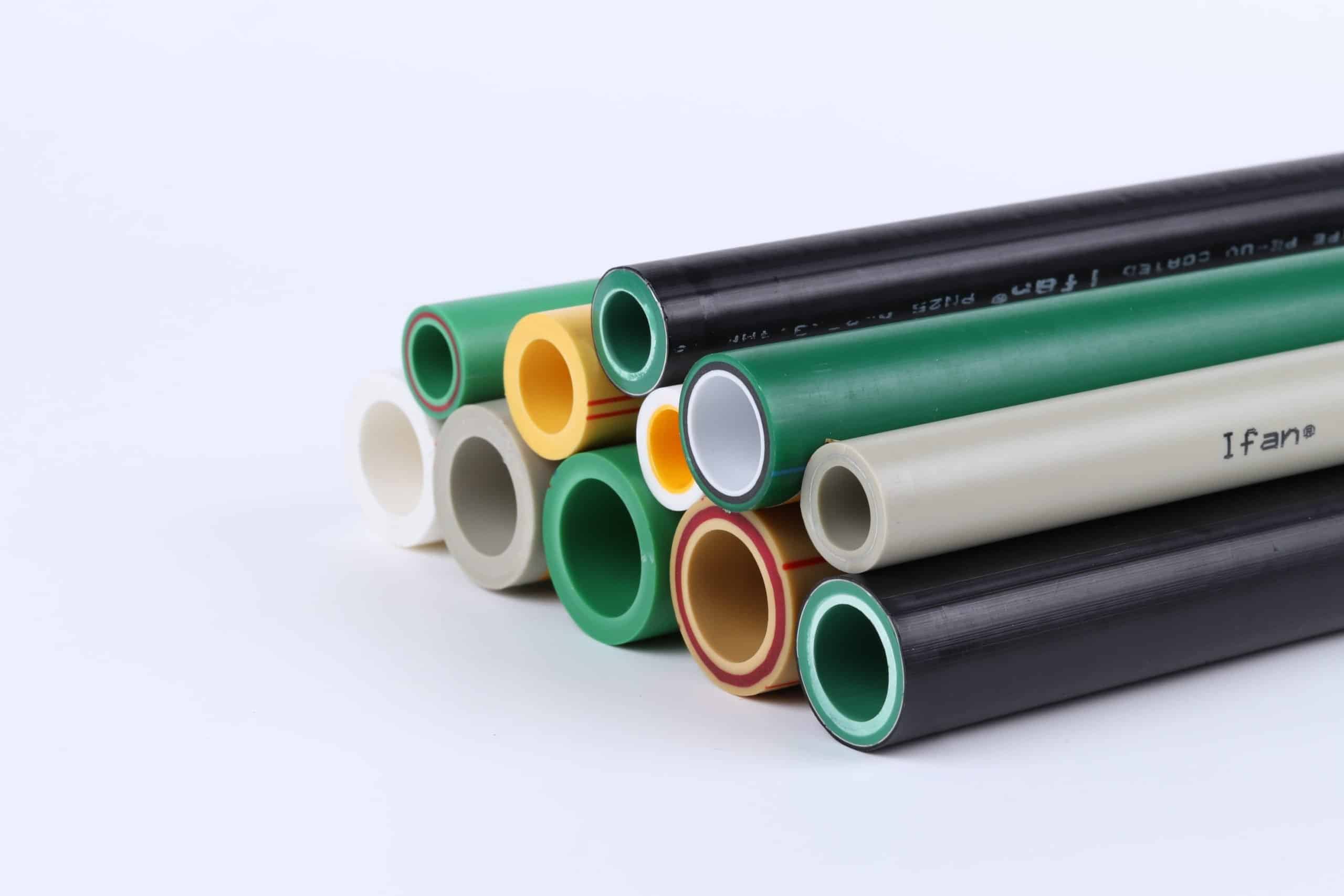
ISO 15874-2:2013, still the current edition as of 2026, requires 8 marking fields on the pipe at least once every 1 m. The field-by-field reading is in our incoming inspection guide, so this page uses only the two fields that decide brand identity.
The manufacturer field reads “name and/or trade mark”, and the standard accepts a code, so a print line carrying nothing but a brand you have never heard of is fully compliant while telling you nothing about the factory. Next comes the traceability block: a production period in year and month, plus a site code when the maker runs more than one plant. Treat that block as a phone test. A brand that made the pipe can decode its own period and site code in one call; a brand that bought the pipe has to ask someone else.
Check 2: the batch record, not the type test
Suppliers send a type-test report because it looks like proof. Under ISO/TS 15874-7:2018, though, only the batch release test (BRT) “has to be satisfactorily completed before the batch can be released”; the other three test types are laid out in the same inspection guide.
For brand verification the BRT matters because of who holds it. The record is written by or on behalf of the manufacturer, per production period, so the entity that can hand it over is the entity that extruded the pipe. A factory brand or a group brand produces it on request. A relabel-seller usually cannot, because the record sits at a factory it does not want to name, and a house brand can produce it only if its contract names that factory. Asking for the BRT tied to the period code on your sample is the quickest way to learn which of those three you are talking to.
Check 3: the register, not the PDF
Every certifier that matters in PP-R publishes a searchable list, and the list is the certificate. DVGW CERT keeps directories of the water products it has certified and tells readers to check a certificate missing from the list with its staff before relying on it. SKZ states that its certificate is valid for 5 years and lists the currently valid marks.
WRAS runs an approvals directory. NSF’s listings for drinking-water components can be searched by manufacturer, trade name and facility location, which resolves a trade name to a plant. Kiwa’s certificate finder takes a company name or a certificate number.
For the ISO 9001 certificate every supplier attaches, IAF CertSearch confirms 3 things: the certificate is valid, the certification body is accredited, and the accreditation body is a mutual-recognition signatory. IAF ceased operations on 1 January 2026 and passed its role to Global Accreditation Cooperation, but the database stayed online. One more lookup closes the loop on ownership.
The WIPO Global Brand Database searches trademark records from participating national offices and the Madrid System by name or number, free of charge, and the registrant it returns is the legal owner of the brand. When that owner is a trading company and the certificate names a factory, you have just learned what kind of brand you are looking at.
The Five Kinds of PPR Pipe Brand, Side by Side
Run the three checks on any quotation and the brand falls into one of 5 kinds. This is a paperwork ranking, not a quality ranking: a group-launched brand can hold tighter wall tolerances than a 50-year-old factory name. The kinds measure how many of the three checks resolve to one legal entity and one production site, and how much you must write into the purchase order to close the gap. The cards below explain each row and hand you the verdict.
| Kind of brand | What the print line shows | Who the certificate names | Verdict for a distributor |
|---|---|---|---|
| 1. Manufacturer-owned brand | Factory name or its registered mark, period code, site code | The same factory, at the inspected plant | Stock it; verify the register before the first order |
| 2. Group-launched brand | Newer brand mark, period code, site code | The group’s producing entity, which may not match the brand name | Stock it; write the producing entity into the PO |
| 3. Distributor house brand under OEM | Distributor’s mark, period code from the maker | Distributor as holder, manufacturer named in the contract | Stock with conditions; the factory must be named in writing |
| 4. Trader relabel | A label, or a mark whose period code nobody can decode | Some other factory, or no one | Treat as unbranded pipe; price and inspect it that way |
| 5. Counterfeit of an established brand | A real brand’s mark, copied | Not in any register, or the number belongs to someone else | Walk away on the first register miss |
Source: ISO 15874-2:2013 Table 12; SKZ Specification A 01 (December 2020) clauses 2.2, 3.2, 6.3 to 6.5; verdicts: this page, 12 September 2026.
1. The Manufacturer-Owned Brand: One Name on the Pipe, the Certificate and the Register
Verdict: stock it. Pipe, certificate and register all name the factory at one inspected plant; you verify once.
On the pipe, the second Table 12 field is the factory’s name or its registered mark, repeated at least once every 1 m. The traceability block carries the year-and-month period and, for a maker with several plants, a site code the factory can decode on the phone. On paper, the product certificate names the same company. SKZ’s conditions for its mark, Specification A 01, make the link explicit.
The mark is awarded only after factory production control at the specific manufacturer’s plant passes an initial inspection. The factory must then keep batch records naming the manufacturer and the production plant, per machine and tool, for at least 5 years. On the register, the entry resolves the trade name to a facility; NSF’s public listing goes as far as letting you filter by facility location.
What goes wrong with kind 1 is rarely the pipe. It is assuming the name is enough, so nobody checks the period code against the BRT record and last year’s production ships against this year’s certificate. The trade-off for the cleanest paperwork is commercial: a factory-owned brand sells through its own appointed channel, so territory exclusivity is a negotiation and the price carries the brand.
| Ventajas | Consideraciones |
|---|---|
| All three checks resolve to one entity and one plant | Territory exclusivity is negotiated, not given |
| BRT record available for your production period | Certificate date must still be matched to the period code |
2. The Group-Launched Brand: Made In-House, Sold Under a Newer Name

Verdict: stock it, with the producing legal entity written into the PO. Disclosure: IFANULTRA is this kind, and yes, that’s us.
A manufacturing group with decades of output launches a new brand for export, produced on its own lines. IFANULTRA is exactly this: a PP-R brand launched by IFAN Group for the global market, drawing on the group’s 30+ years of manufacturing, extruded on German automated lines from virgin Nordic PP-R rather than recycled filler. The pipe is made in-house, but the paperwork has a seam to know about before you trust any group brand, ours included.
A trademark owner returned by the WIPO database and the legal entity on a product certificate can be two different company names inside one group. Under SKZ’s rules the trademark and production date on the pipe may even be printed in code, with the key deposited at SKZ. None of that is a red flag, just a reason to ask three questions.
What to ask a group brand, ours included
Ask which legal entity extrudes the pipe and at which site. Then get the certificate numbers so you can check them on the issuer’s register yourself, and a sample length so the period code can be reconciled to a batch release record. Our own outbound protocol runs that last step in reverse: printed markings are reconciled to certificate numbers, and the resin is verified by source and grade, before a container is released.
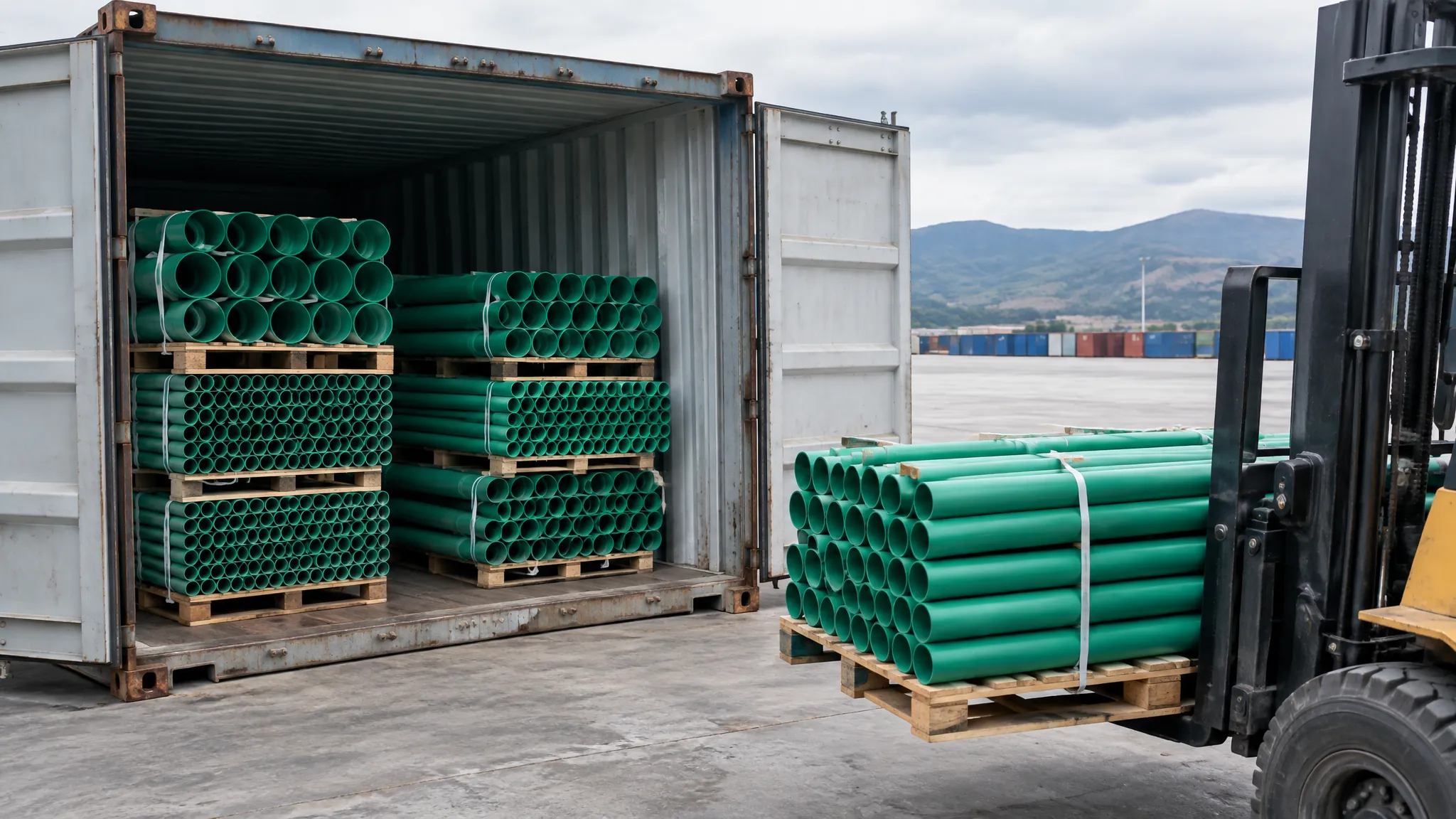
The range you would be checking runs DN20 to DN160 in PN10 (SDR11), PN16 (SDR7.4), PN20 (SDR6) and PN25 (SDR5), across the PPR Global Series and PPR Quality Series. The minimum order is one full container, production takes 15 to 25 days before ocean transit, and payment is a 30 % deposit with 70 % before shipment.
Not ideal for: a buyer who needs a name with 50 years on the shelf, or one ordering below a container, where LCL cost erodes the reason to import.
| Ventajas | Consideraciones |
|---|---|
| Pipe and batch record come from the same group plant | Brand name and certificate holder can differ; name the entity in the PO |
| Exclusivity is easier to negotiate on a newer brand | Certificate numbers must be requested and checked, not assumed |
3. The Distributor House Brand Made Under OEM: Legitimate, if the Paper Names the Factory

Verdict: stock with conditions. Legitimate when the certificate contract names the factory; otherwise treat as kind 4.
A distributor or an importer builds a house brand and has a factory extrude it. The certifiers allow this, and they say how. SKZ’s Specification A 01 provides that when the same product is made for a distributor holding an SKZ inspection contract agreed with the manufacturer, a conformity test is run on the product produced for that distributor.
Read what that requires: the manufacturer is a party to the contract, so the factory is on paper, and the tested pipe is the distributor’s run, not a generic sample. The factory production control records behind that certificate still name the manufacturer and the production plant and are kept for 5 years.
A house brand that can produce those pages is a private label. One that changes its answer about where the pipe comes from is a relabel in a nicer carton. Setting one up properly, including what the factory needs from you, is covered in our guide to private-label and OEM PP-R.
What goes wrong here is continuity. A house brand can switch factories between containers without the mark on the pipe changing, and the only place the switch shows is the period code and site code, which now decode to a plant the certificate never inspected. So ask for the factory name on every order confirmation, and reconcile the first pallet’s period code to the batch record before the 70 % balance is paid.
| Ventajas | Consideraciones |
|---|---|
| Certifier rules allow it with the factory named in the contract | Factory can change between containers without the mark changing |
| Conformity test is on the distributor’s own run | Ask for the factory name on every order confirmation |
4. The Trader Relabel: A Sticker Where the Marking Should Be

Verdict: treat it as unbranded pipe. Price it and inspect it that way; a label never stands in for the marking.
A trading company buys PP-R from whichever factory is cheapest this quarter and sells it under its own name, sometimes with a printed mark it asked the factory to run, sometimes with an adhesive label on the pipe or only on the carton.
The standard is on your side here. Marking under ISO 15874-2 is printed or formed directly on the pipe at least once every 1 m. A label is not marking, and a printed mark with a period code the seller cannot decode is a mark the seller did not commission. Ask for the batch release record for that period code and the conversation ends, because the BRT sits at a factory the trader will not introduce you to.
The standard defines the batch tightly enough to make this bite: Table 11 caps the pipe’s melt flow rate at 30 % away from the compound of the same batch, which is only checkable if someone knows which batch the pipe came from.
The first organic result in the UAE for this very query is a supplier directory that lists each PPR brand name under a trading company. Distributing a factory brand is honest business, so that proves no relabelling. It does show that a directory answers “who sells it” and never “who makes it”, which is the question you are paying for.
Kind 4 pipe can be sound pipe with no paperwork, which is why the incoming inspection plan for it has to be written as if no brand existed.
| Ventajas | Consideraciones |
|---|---|
| Often the lowest quotation on the table | No batch release record reachable for the pipe you receive |
| Usable where your own incoming inspection replaces the paperwork | Factory can change every container; label carries no traceability |
5. The Counterfeit: A Real Brand’s Name on Someone Else’s Pipe

Verdict: walk away on the first register miss. The register is the only test a good forgery cannot pass.
The last kind copies an established brand’s mark onto pipe the brand never made, and it travels with certificates that look right because they were copied too. Kiwa warns in writing that organisations in China sell counterfeit Kiwa certificates and points buyers to its certificate finder and its Beijing office. DVGW CERT’s answer to a certificate missing from its list is to ask its staff before relying on it.
An SKZ certificate carries a 5-year validity, so a PDF whose dates run longer, or whose issue date predates the plant it names, has already failed. The ISO 9001 certificate in every quotation pack can be checked on IAF CertSearch for 3 things at once: the certificate is valid, the issuing body is accredited, and the accreditation body is a mutual-recognition signatory.
None of these lookups takes longer than a call to chase a late container. Do them before the 30 % deposit, because after it a customs officer tests the same paperwork instead of you; that outcome is described in our piece on a PPR certificate held at customs. Even if counterfeit pipe holds pressure, you have bought a claim you cannot repeat to your own customers.
| Ventajas | Consideraciones |
|---|---|
| None that survive a register lookup | Certificate absent from the issuer’s list, or the number belongs to another company |
| Exposes a seller you can now cross off for every product | Liability sits with you at customs and with your own customers |
Which Kind to Stock: The Shortlist Checklist Before the Deposit
Three distributors read the same quotation and should reach three different decisions, because the cost of being wrong differs for each.
Three distributors, three decisions
The yard stocking one container a quarter for retail plumbers can live with kind 3 and even kind 4. Every joint is made by someone who will call if the pipe fuses badly, and incoming inspection replaces the missing paperwork, provided the pipe is bought as unbranded stock and never resold under a claim it cannot carry.
The project supplier bidding a tender cannot: a consultant will look the certificate up and reject the submittal if the holder’s name does not match the marking, so kinds 1 and 2 with the producing entity written into the submittal are the only safe answers. The importer building a house brand is choosing to become kind 3, and the decision that matters is whether the factory agrees to be named in the certificate contract. A factory that refuses is offering to make you a kind 4 with your own logo on it.
The four documents, and the PO line
In every case the deposit waits for 4 documents. First, a photograph of the print line on a sample length showing all 8 Table 12 fields, with the period code and site code decoded by the seller in writing. Second, the batch release record for that period code, not a type-test report. Third, the certificate number plus your own screenshot of the register entry, taken from the issuer’s site and not from the seller’s PDF.
Fourth, the trademark owner from a WIPO or national IP office search, so the entity behind the brand sits on file next to the entity on the certificate. Then write the purchase-order line the way our own protocol reads it back: brand, producing legal entity, production site, certificate number, and “markings to be reconciled to certificate numbers before release”.
On a 15 to 25 day production window the four documents cost you an afternoon; at customs they cost you the container. The full pre-order routine is in our factory vetting checklist.
Conclusión
Stock the brand whose print line, batch record and register entry name one company at one plant, and write that company into the purchase order even when the brand is ours. Skip that line and three things break in order: the period code stops matching any batch record, the certificate stops matching the marking, and the first consultant or customs officer who runs the lookup you skipped hands the problem back with the container attached.
The answer flips only for a buyer who inspects every pallet as unbranded pipe and resells it without a brand claim.
Before you reply to the next quotation, pull up the register for whichever certificate it attaches and compare the holder’s name with the mark on the sample. If the two agree, you have a shortlist.
Frequently Asked Questions
Which PPR brand is best?
The one whose marking, batch release record and certificate register entry all name the same company at the same plant. A brand that passes that test can be a factory name or a newer group brand; a brand that fails it is a relabel or a fake, however well known the name.
Does a “top 10 PPR pipe brands” list prove the brand manufactures its pipe?
No. The lists that rank for this query are written by manufacturers and traders and none of them checks who extrudes the pipe. Take any name from a list, find its certificate on the issuer’s register, and compare the holder’s name to the mark printed on a sample length.
What must be printed on a PPR pipe under ISO 15874-2?
ISO 15874-2:2013 Table 12 requires eight marking items at least once per metre. For brand identity the two that matter are the manufacturer field, which may be a trade mark or a code rather than a name, and the traceability block with the production year, month and site code.
Can a distributor’s own PPR brand hold a real certificate?
Yes, under rules like SKZ Specification A 01, which requires a certificate contract agreed with the manufacturer and a conformity test on the pipe produced for that distributor. If the distributor cannot name the factory in writing, the brand is a relabel, not a private label.
How long is an SKZ certificate for PPR pipe valid?
Five years, extendable for a further five while the product keeps meeting the current specification, according to SKZ Specification A 01 clause 2.4. A certificate PDF showing a longer validity has already failed the check.
What if the certificate is not in the issuer’s online register?
Treat it as unverified and ask the issuer directly, which is what DVGW CERT tells readers to do for a certificate missing from its list. Do not pay a deposit against a PDF the issuer cannot confirm.


 English
 Español
 Français
 Português do Brasil