
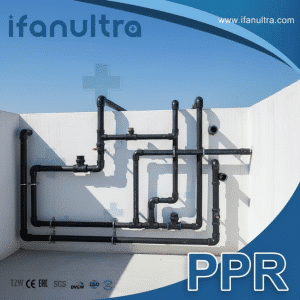
I recall a project where standard PPR pipes installed on a rooftop became brittle and cracked within just two years. This costly mistake taught us the critical importance of specifying the right material for sunlight exposure.
Properly formulated UV-resistant PPR can last 20 years or more in direct sunlight. This extended lifespan is achieved by adding special carbon black or UV-stabilizing additives during manufacturing, which absorb and block the sun’s damaging radiation, significantly slowing down the material’s degradation compared to standard, unprotected PPR pipes.
While the material is durable, its actual outdoor service life is not a single number. Several key factors determine how long it will truly last. Let’s examine what you can realistically expect and how to ensure maximum longevity.
What is the Typical Guaranteed Service Life for UV-Resistant PPR Outdoors?
Clients often ask for a simple warranty number, but the answer involves understanding material grades. Not all “UV-resistant” PPR is created equal.
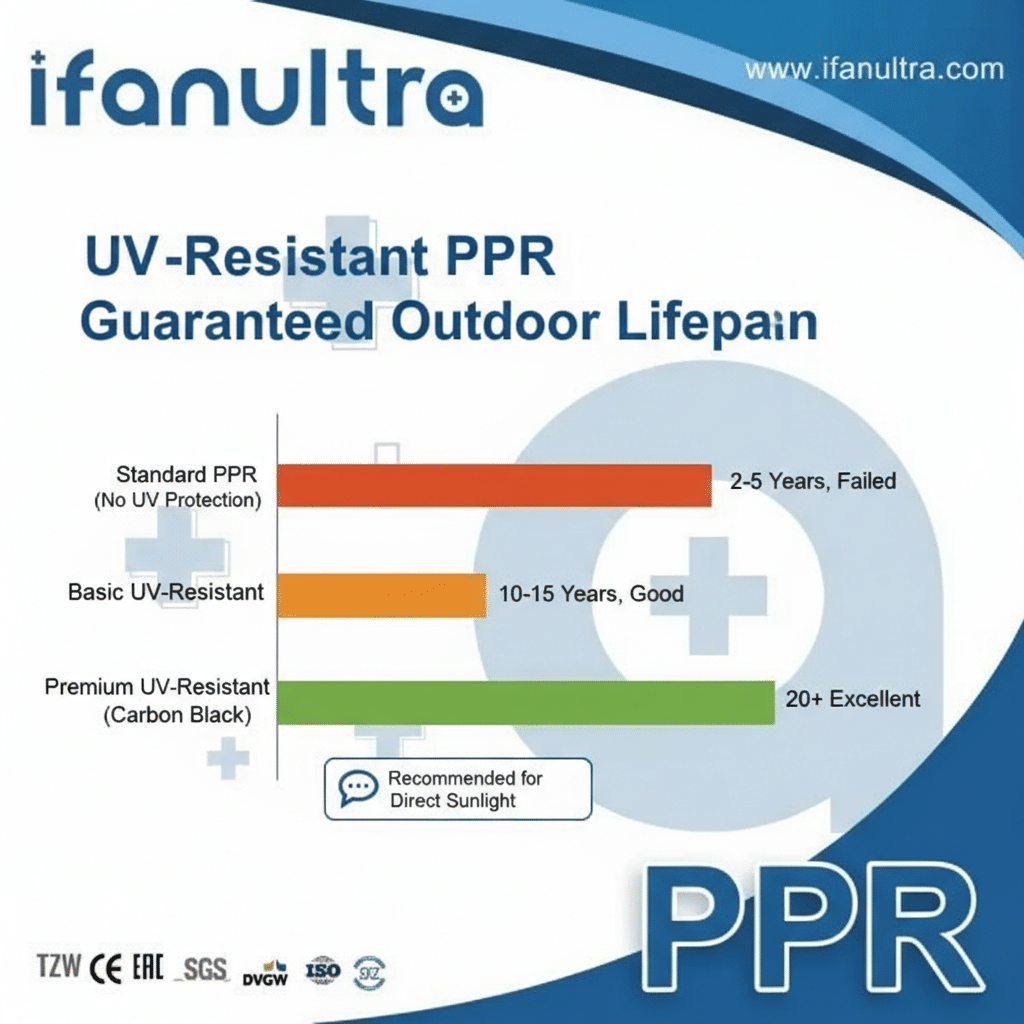
Manufacturers typically guarantee UV-resistant PPR for 10 to 20 years of outdoor service life. This guarantee assumes standard climatic conditions and proper installation. High-quality grades with optimal stabilizer content often come with a 20+ year performance expectation, while basic formulations may be rated for only 10-15 years.
Decoding Manufacturer Guarantees
A “guaranteed service life” is a manufacturer’s prediction based on material formulation and laboratory testing. It is not an absolute promise but a reliable indicator of expected performance. You must read the fine print, as these guarantees often depend on correct use.
First, the guarantee applies only to pipes specifically labeled as “UV-resistant,” “outdoor grade,” or “with UV stabilization.” Standard white or green PPR pipes have little to no protection and will degrade rapidly outdoors—sometimes in as little as 2-5 years. The protective additives, usually carbon black (which turns the pipe black) or specific light-blocking compounds, are essential.
Key Factors in the Guarantee
The length of the guarantee depends on two main things:
- The Quality and Quantity of UV Stabilizers: More and better stabilizers mean longer protection. Premium pipes use high-load, evenly dispersed stabilizers.
- The Definition of “Failure”: The guarantee usually means the pipe will maintain its pressure-bearing capacity and not suffer catastrophic failure. Some surface fading or minor brittleness on the very outer layer may occur but won’t affect function.
Comparing Pipe Lifespan Expectations
This table shows what you can generally expect from different materials in direct sunlight:
| Pipe Material | Key Protector | Typical Guaranteed Outdoor Lifespan | Notes |
|---|---|---|---|
| Standard PPR (White/Green) | None | Not Recommended | Degrades quickly (2-5 years). Becomes very brittle. |
| Basic UV-Resistant PPR | Low-level Stabilizers | 10 – 15 years | Suitable for mild climates with moderate sun exposure. |
| Premium UV-Resistant PPR | High-load Carbon Black/Stabilizers | 20+ years | For harsh, sunny climates and long-term projects. |
| PVC with UV Inhibitors | Similar Stabilizers | 15 – 25 years | Can become brittle in temperature swings. |
| Copper | Natural Metal | Indefinite | Does not degrade from UV but can corrode from atmosphere. |
For critical outdoor applications, always insist on the manufacturer’s technical data sheet that states the UV-resistance performance and expected service life. Reputable suppliers like IFAN provide this documentation.
How Do Accelerated Weathering Tests Predict Long-Term Performance in Sunlight?
You cannot wait 20 years to test a pipe. So, we rely on science to simulate decades of sun damage in just months.
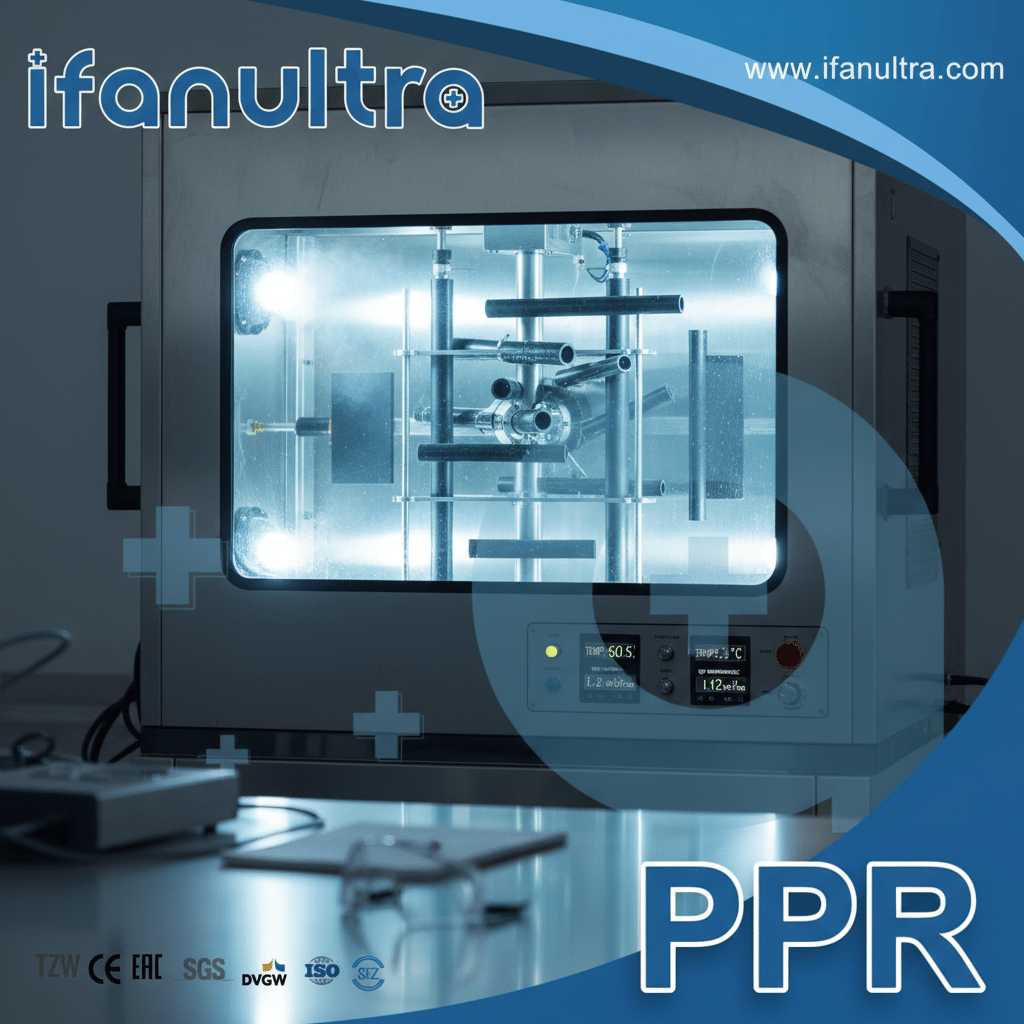
Accelerated weathering tests use powerful xenon-arc or QUV lamps to simulate sunlight, heat, and rain in a controlled chamber. By exposing pipes to intense, continuous UV light at elevated temperatures, these tests can replicate about 10-20 years of natural outdoor exposure in just 1,000 to 2,500 hours. Scientists then measure changes in the pipe’s strength and elongation to predict its real-world lifespan.
The Science Behind the Simulation
These tests are not random; they follow strict international standards (like ISO 4892 or ASTM G154). The goal is to create the most damaging parts of sunlight—the ultraviolet rays—much faster than nature does.
Here is how the process works:
- Light Exposure: The test places pipe samples under special lamps that emit a full spectrum of light, with intense UV levels. The UV radiation breaks down the polymer chains in the plastic.
- Heat Acceleration: The chamber raises the temperature. Heat speeds up all chemical reactions, including the degradation caused by UV light. This combination of high UV and high temperature is the key to acceleration.
- Moisture Cycles: To mimic rain and dew, the tests often include spray or condensation cycles. Moisture can cause additional stress and wash away some surface stabilizers.
From Test Data to Real-World Prediction
After hundreds or thousands of hours in the chamber, technicians remove the samples. They do not just look at them; they perform precise mechanical tests.
The most important test is the tensile strength and elongation-at-break test. They stretch the aged pipe material until it breaks and measure:
- How much force it takes (tensile strength): Has it lost strength?
- How far it can stretch before breaking (elongation): Has it become brittle?
PPR is a tough material because it can stretch. As UV damage occurs, it loses this ability to stretch and becomes brittle. Engineers compare the data from the weathered samples to the data from new pipes. They use established scientific models to calculate how many years of real-world sun exposure would cause the same amount of damage.
Understanding the Limits of Testing
These tests are excellent predictors, but they are not perfect. They provide a very good comparative baseline.
- They are great for comparing grades: Test A shows Pipe X lasts 1,500 simulated hours before losing 50% strength, while Pipe Y lasts only 800 hours. Clearly, Pipe X is more UV-resistant.
- They have limitations: Real-world weather has variables a chamber cannot perfectly mimic, like pollution, acid rain, or extreme, unexpected temperature swings. Therefore, the predicted lifespan is a well-informed estimate, not an exact expiration date.
When selecting pipes, ask if the supplier has accelerated weathering test reports. This data separates proven products from unverified claims.
What Climate Factors Most Significantly Affect the Actual Lifespan?
The guaranteed lifespan is for “standard” conditions. In the real world, local weather drastically changes the timeline.
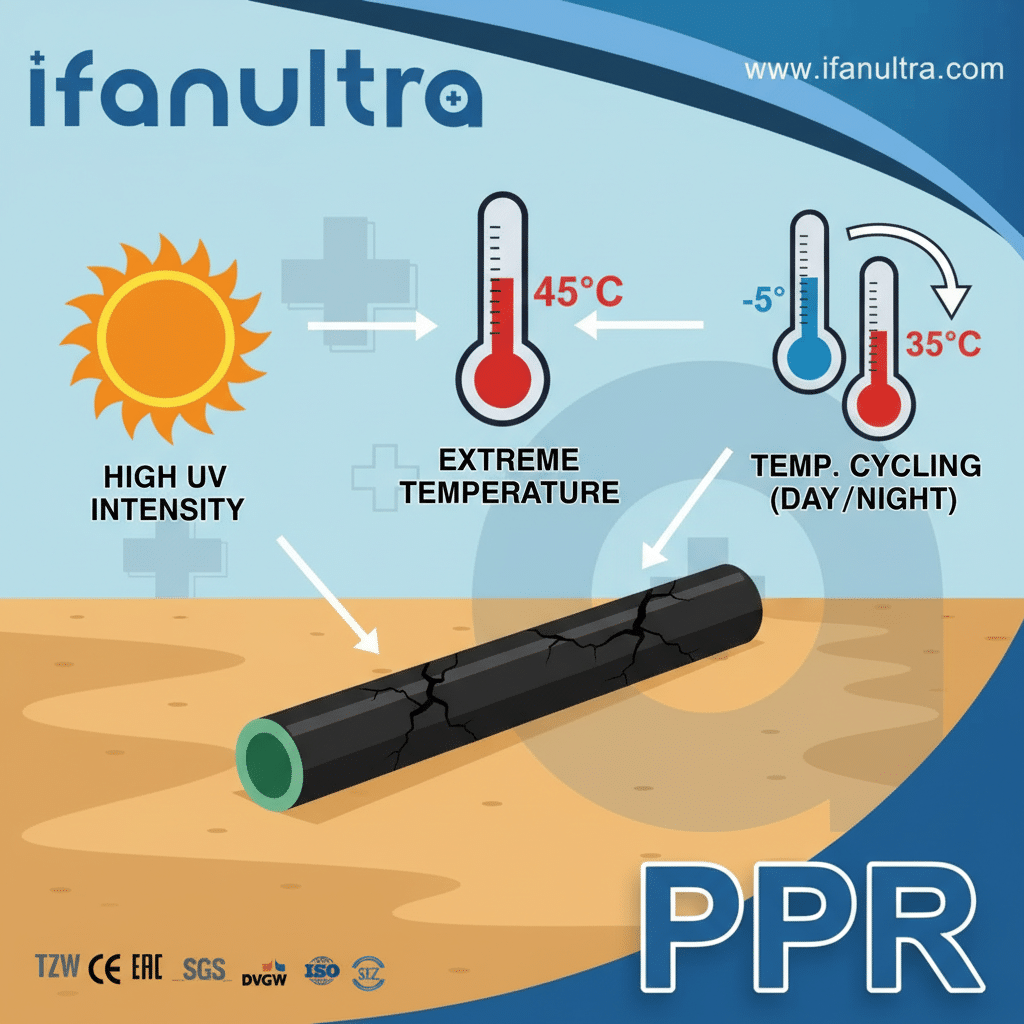
**Three climate factors most significantly affect the actual lifespan of UV-resistant PPR: 1) *Solar UV Index Intensity*, 2) *Ambient Temperature*, and 3) *Temperature Cycling* (daily and seasonal swings). High altitude, tropical sun, and desert climates with large day-night temperature variations will shorten the service life compared to milder, cloudy, or temperate regions.**
Factor 1: UV Intensity and Duration
This is the most obvious factor. The amount of destructive UV radiation that hits the pipe is not constant worldwide.
- High UV Regions: Areas near the equator, high-altitude locations, and places with very clear air (like deserts) receive much more intense UV radiation. Here, the degradation process happens faster.
- Low UV Regions: Cloudy, temperate, or high-latitude regions have less intense UV exposure, so the pipes will last longer than the “standard” prediction.
Practical Tip: For projects in high UV zones, specify the highest grade of UV-resistant PPR (with carbon black) and consider protective sleeving or shading for the pipes.
Factor 2: Constant High Ambient Temperature
Heat accelerates chemical reactions. A pipe constantly exposed to 40°C (104°F) will degrade faster than one at 25°C (77°F), even if the UV light is the same. The heat weakens the material and makes it more susceptible to UV damage.
Practical Tip: For pipes on hot rooftops or against sun-heated walls, ensure adequate ventilation around them to allow heat to dissipate.
Factor 3: Temperature Cycling (Swings)
This is a critical but often overlooked factor. When a pipe heats up during the day and cools down at night, it expands and contracts. This constant movement creates mechanical stress. When combined with UV-induced brittleness, it can lead to micro-cracks developing faster. Desert climates are especially harsh due to huge daily temperature swings.
Practical Tip: Ensure the pipe is installed with proper expansion loops and clips that allow for movement, reducing stress.
Regional Lifespan Expectation Guide
The table below provides a rough adjustment to the “standard” 20-year expectation based on climate:
| Climate Type | Key Characteristics | Impact on UV-Resistant PPR | Adjusted Lifespan Expectation* |
|---|---|---|---|
| Temperate / Cloudy | Mild temps, moderate UV, low swings. | Minimal acceleration of degradation. | 25+ years |
| Mediterranean | Strong seasonal sun, warm summers. | Moderate acceleration. | 18-22 years |
| Tropical | Intense, year-round UV, high humidity & heat. | High acceleration from constant UV and heat. | 12-18 years |
| Arid / Desert | Extreme UV, very high daytime heat, large daily swings. | Very high acceleration from all three factors. | 10-15 years |
| High-Altitude | Extreme UV intensity due to thin atmosphere. | Extreme UV acceleration. | 8-12 years |
*Assuming a premium UV-resistant PPR with a 20-year standard rating. Always consult a local engineer.
How Does Its Lifespan Compare to Metal Pipes in the Same Outdoor Conditions?
The choice often comes down to plastic vs. metal. Each has very different aging processes outdoors.
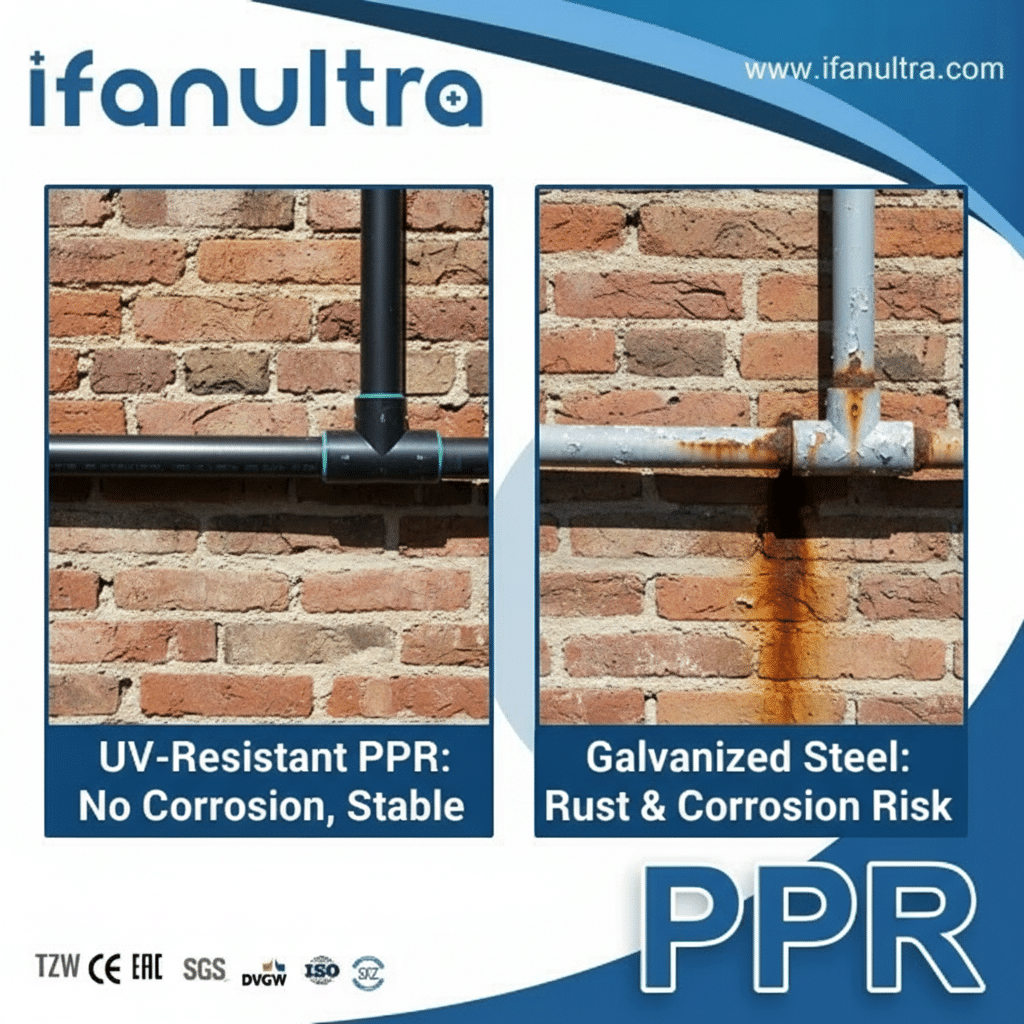
In outdoor conditions, UV-resistant PPR and metal pipes fail for different reasons. PPR’s lifespan is limited by UV degradation and temperature, while metal pipes are limited by external corrosion and insulation needs. In non-corrosive, mild climates, metals can last longer. In corrosive, salty, or acidic environments, properly specified UV-resistant PPR will often outlast unprotected metal pipes.
The Battle of Different Failure Modes
You cannot compare them directly without context because they “wear out” in different ways.
UV-Resistant PPR:
- Failure Mode: Gradual surface embrittlement from UV exposure. The inner wall remains largely unaffected.
- Weakness: Sunlight and extreme heat.
- Strength: Immunity to most forms of corrosion, low thermal conductivity (needs no insulation against condensation).
Metal Pipes (Steel, Copper):
- Failure Mode: Corrosion (rust, patina, pitting) from moisture, salt, and atmospheric chemicals.
- Weakness: Water, oxygen, salt spray, acid rain.
- Strength: Unlimited resistance to UV radiation itself.
Detailed Comparison in Various Environments
Let’s see how they match up in specific outdoor scenarios:
1. On a Coastal Rooftop (Salt Air, Sun):
- Galvanized Steel: Will rust quickly due to salt. Poor choice.
- Copper: Will corrode and develop a patina; salt can cause pitting.
- UV-Resistant PPR: Will not corrode from salt air. Only concern is UV and heat. PPR is often the better choice here.
2. For an Outdoor Cold Water Line (Inland, Temperate):
- Steel (with paint/insulation): Requires constant maintenance of its protective coating.
- Copper: Performs well but is expensive and can be stolen. Needs insulation to prevent condensation.
- UV-Resistant PPR: A simple, cost-effective solution with no corrosion or condensation issues.
3. For Solar Thermal or Hot Outdoor Lines:
- Metals: Handle high temperatures well but expand significantly and need complex support.
- PPR: Has a maximum continuous operating temperature (~70°C). For high-temp outdoor applications, specialized PPR-HT or metal may be required.
Cost and Maintenance Over Time
The long-term view is crucial. Consider this comparison over 20 years:
| Aspect | Premium UV-Resistant PPR | Galvanized Steel | Copper |
|---|---|---|---|
| Initial Material Cost | Low | Medium | Very High |
| Installation Cost | Low (lightweight, easy to weld) | Medium (heavy, needs threading/welding) | High (skilled labor for soldering) |
| Immunity to UV | Good (with stabilizers) | Excellent | Excellent |
| Immunity to Corrosion | Excellent | Poor (requires maintenance) | Good (but can corrode) |
| Maintenance Needed | Virtually None | High (re-painting, leak repairs) | Low-Medium (watch for corrosion) |
| Total 20-Year Cost | Lowest | Highest | Very High |
Conclusion
UV-resistant PPR offers a reliable, cost-effective solution for outdoor plumbing, with a typical lifespan of 20+ years in most climates. For a guaranteed, long-lasting performance, choose IFAN’s premium UV-resistant PPR pipes for your next outdoor project.









 English
 Español
 Français
 Português do Brasil